Æsir
Thor
Þórr
The thunder god, strongest of the Æsir: son of Odin and Earth, husband of Sif, and with his hammer Mjöllnir the gods' defender against the giants, until he dies killing the World Serpent.
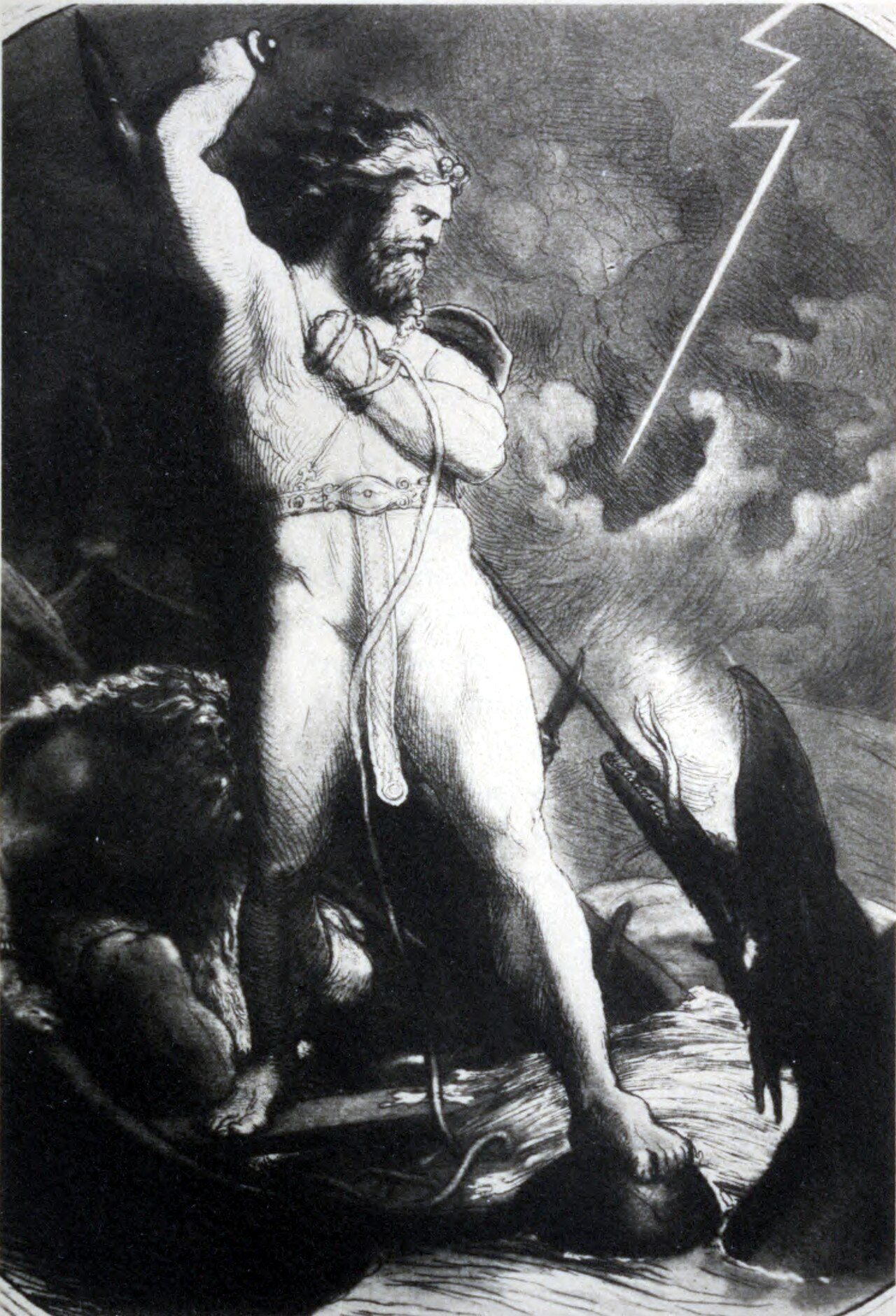
Thor is the god of thunder and the strongest of the Æsir. Snorri calls him "strongest of all the gods and men" Gylfaginning 21, and almost every story about him is about that strength: what he can lift, drink, eat and break, and the giants he kills. Bellows's translation also calls him Hlorrithi, Vingthor and Veur; Brodeur's calls him Ása-Thor and Öku-Thor, "Driving-Thor", after his chariot.
Family
Thor is the son of Odin. In Hárbarðsljóð he introduces himself as "Othin's son, Meili's brother, and Magni's father" Hárbarðsljóð 9. His mother is the Earth, Jörð: Snorri says Odin begot "the first son, which is Ása-Thor" on her Gylfaginning 9, and the poems call Thor "the son of Jorth" Þrymskviða 1, "the son of Hlothyn" and "the son of Fjorgyn" Völuspá 55 Völuspá 56.
His wife is Sif Lokasenna, prose 1, whose hair of gold the dwarfs made after Loki cut off her own Skáldskaparmál 35, and her son Ullr is Thor's stepson Gylfaginning 31. Snorri's list of Thor's kennings names his children: "Father of Magni and Módi and Thrúdr" Skáldskaparmál 4. Magni's mother was the giantess Járnsaxa Skáldskaparmál 17. His servants are the farmer's children Þjálfi and Röskva, whom he took in payment after one of them broke a goat's leg bone Gylfaginning 44.
Hammer, goats and hall
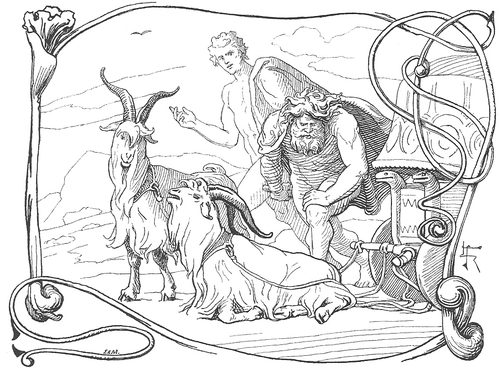
Thor's hall is Bilskirnir, with five hundred and forty rooms, "the greatest house that men know of" Gylfaginning 21. Two goats, Tanngnjóstr and Tanngrisnir, pull his chariot; he can kill and eat them and raise them again with his hammer Gylfaginning 44. He has three treasures: the hammer Mjöllnir, the girdle of might Megingjörð that doubles his strength, and iron gloves for gripping the hammer's shaft Gylfaginning 21.
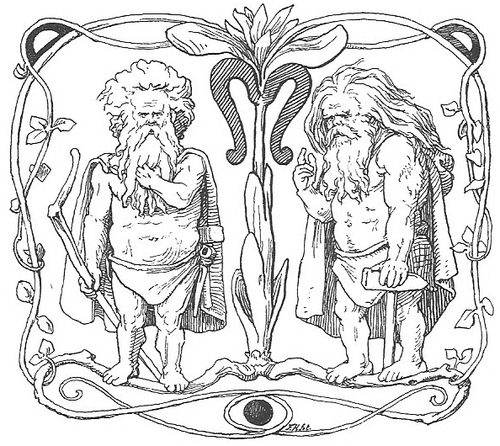
The hammer was forged by dwarfs for a wager with Loki. It never misses, always returns to his hand, and can shrink to fit inside his shirt; its only flaw is a short handle Skáldskaparmál 35. The gods judged it the best of all their treasures, "the greatest defence against the Rime-Giants" Skáldskaparmál 35.
Against the giants
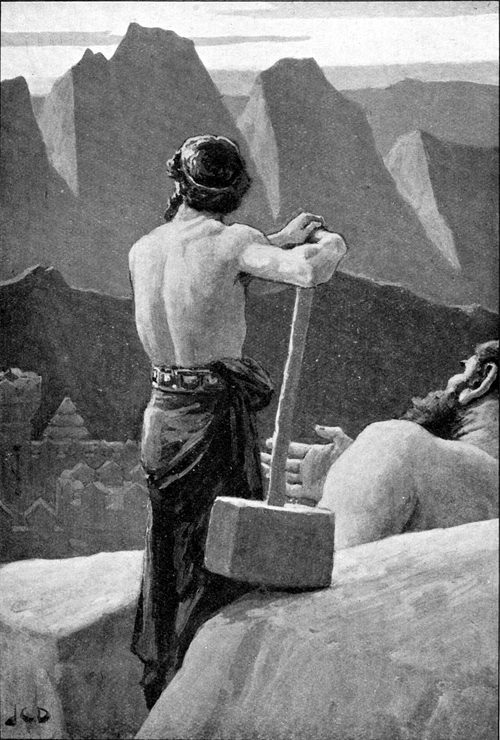
Thor's work is killing giants. When the giant who built Ásgarð's wall was about to win the sun, the moon and Freyja as his wages, the gods called on Thor, who "paid the wright's wage" with one blow Gylfaginning 42; Völuspá adds that "seldom he sits when he such things hears" Völuspá 26. He faced Hrungnir, the strongest giant, in a duel. Hrungnir's whetstone shattered against the hammer, and a fragment lodged in Thor's head for good Skáldskaparmál 17. He waded a flooding river to reach Geirröðr, and killed him with a glowing iron bar thrown back through a pillar Skáldskaparmál 18.
The best-known poem about him is a comedy. In Þrymskviða the giant Þrymr steals the hammer and demands Freyja as his bride. Thor is dressed in a bridal veil and sent instead.
Thor alone ate an ox, and eight salmon,All the dainties as well that were set for the women;And drank Sif's mate three tuns of mead.Þrymskviða 24
When the hammer is laid in the "bride's" lap to bless the marriage, Thor's heart laughs, and he kills the whole wedding party Þrymskviða 31.
The World Serpent
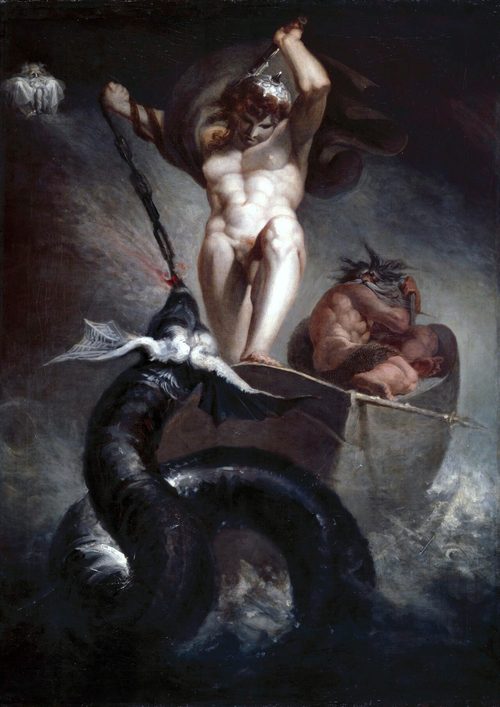
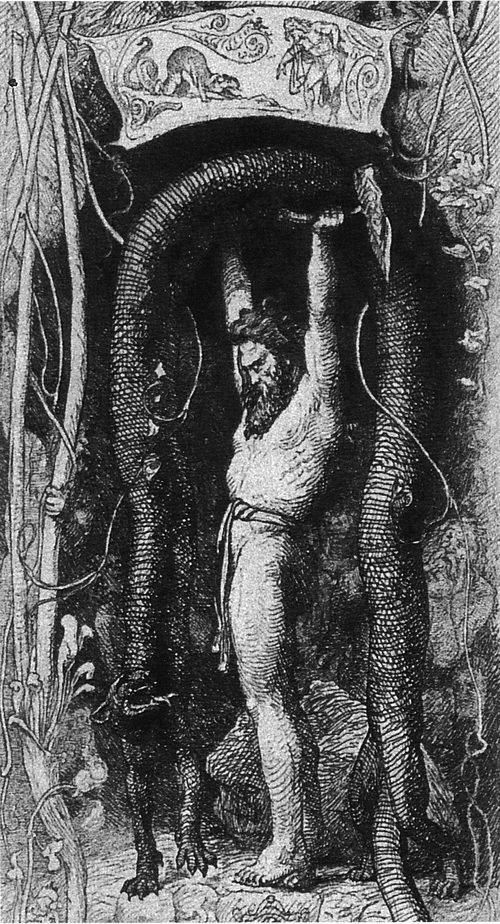
Thor's great enemy is Jörmungandr, the serpent coiled around the world. At Útgarða-Loki's hall he fails to lift a grey cat off the floor; afterwards he learns that the cat was the serpent, and that the giants were terrified when he raised one of its feet Gylfaginning 47. Later, fishing with the giant Hymir with an ox-head for bait, he hauls the serpent to the gunwale Hymiskviða 24. The sources disagree about the outcome. Hymiskviða says he struck its head with the hammer Hymiskviða 24; Snorri says Hymir cut the line, and though some claim Thor struck off its head, "the Midgard Serpent yet lives" Gylfaginning 48.
A god with limits
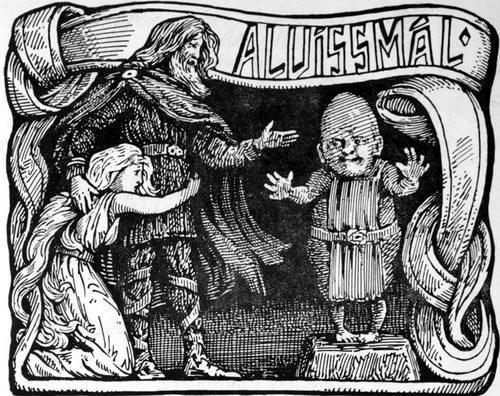
The poems are not always respectful. At Útgarða-Loki's court Thor is beaten by illusions: he cannot drain a horn whose end lies in the sea, and an old woman, Old Age herself, forces him to one knee Gylfaginning 46 Gylfaginning 47. Loki taunts him with hiding "in the thumb of a glove" Lokasenna 60. In Hárbarðsljóð Odin, as a ferryman, refuses to row him across and sneers that Thor gets the thralls while Odin gets the nobles Hárbarðsljóð 24. In Alvíssmál it is Thor who wins by cunning, keeping a dwarf who wants his daughter answering questions all night until "the day has caught thee, dwarf!" Alvíssmál 35.
Ragnarök
At Ragnarök Thor meets the serpent for the last time. He kills it, walks nine paces and falls dead from its venom Völuspá 56 Gylfaginning 51. His sons Móði and Magni survive and inherit Mjöllnir Vafþrúðnismál 51.
Outside the Eddas
Thor was among the most widely worshipped gods of the Viking Age. Adam of Bremen describes his image at the centre of the temple at Uppsala, between Odin and Freyr. Snorri's Prologue, by contrast, turns him into Trór, a grandson of King Priam of Troy who fought giants and a dragon and married a prophetess called Sif Prose Edda, Prologue.
In the sources
Quoted from the hosted translations; each line is checked against the text when the site is built. Select a reference to read it in context.
Thor is the foremost of them, he that is called Thor of the Æsir, or Öku-Thor; he is strongest of all the gods and men.
He has also three things of great price: one is the hammer Mjöllnir, which the Rime-Giants and the Hill-Giants know, when it is raised on high
Wild was Vingthor when he awoke, And when his mighty hammer he missed
The venomous serpent swiftly up To the boat did Thor, the bold one, pull
the hammer Mjöllnir struck Hrungnir in the middle of the head, and smashed his skull into small crumbs
Nine paces fares the son of Fjorgyn, And, slain by the serpent, fearless he sinks.
The noble who fall in the fight hath Othin, And Thor hath the race of the thralls.
Where the sources disagree or fall silent
- Thor's descent: Gylfaginning makes him Odin's eldest son by the Earth (Gylfaginning 9), but the Prologue makes him Trór, grandson of King Priam of Troy and a distant ancestor of Odin (Prose Edda, Prologue).
- Whether Thor killed the Midgard Serpent on the fishing trip: Hymiskvída says he struck its head (Hymiskviða 24); Snorri reports that some say so but believes it still lives in the sea (Gylfaginning 48).
- Who threw Thjazi's eyes into the sky: Thor claims it in Hárbarðsljóð (Hárbarðsljóð 19); Snorri says Odin did it to atone to Skaði (Skáldskaparmál 1).
- His mother is named Jörð by Snorri and in Þrymskviða (Þrymskviða 1), Hlóðyn and Fjörgyn in Völuspá (Völuspá 55-56). These are usually taken as names of the same earth-goddess, but the poems do not say so.
In modern culture
Not from the medieval sources.
Thursday is 'Thor's day' (Old English Thunresdæg), and many Scandinavian place-names and personal names begin with Thor-. Small hammer pendants were worn in the Viking Age and are worn again today, including in modern heathen religion. Marvel's Thor first appeared in Journey into Mystery #83 (1962) and later in films from 2011: there he is blond, Loki is his adopted brother and the hammer can be lifted only by the worthy, none of which comes from the Eddas.