
Poetic Edda · poems of the gods
Hymiskviða
The Lay of Hymir
Bellows's introduction
The Hymiskvitha is found complete in both manuscripts; in Regius it follows the Harbarthsljoth, while in the Arnamagnæan Codex it comes after the Grimnismol. Snorri does not quote it, although he tells the main story involved.
The poem is a distinctly inferior piece of work, obviously based on various narrative fragments, awkwardly pieced together. Some critics, Jessen and Edzardi for instance, have maintained that the compiler had before him three distinct poems, which he simply put together; others, like Finnur Jonsson and Mogk, think that the author made a new poem of his own on the basis of earlier poems, now lost. It seems probable that he took a lot of odds and ends of material concerning Thor, whether in prose or in verse, and worked them together in a perfunctory way, without much caring how well they fitted. His chief aim was probably to impress the credulous imaginations of hearers greedy for wonders.
The poem is almost certainly one of the latest of those dealing with the gods, though Finnur Jonsson, in order to support his theory of a Norwegian origin, has to date it relatively early. If, as seems probable, it was produced in Iceland, the chances are that it was composed in the first half of the eleventh century. Jessen, rather recklessly, goes so far as to put it two hundred years later. In any case, it belongs to a period of literary decadence,—the great days of Eddic poetry would never have permitted the nine hundred headed person found in Hymir's home—and to one in which the usual forms of diction in mythological poetry had yielded somewhat to the verbal subtleties of skaldic verse.
While the skaldic poetry properly falls outside the limits of this book, it is necessary here to say a word about it. There is preserved, in the sagas and elsewhere, a very considerable body of lyric poetry, the authorship of each poem being nearly always definitely stated, whether correctly or otherwise. This type of poetry is marked by an extraordinary complexity of diction, with a peculiarly difficult vocabulary of its own. It was to explain some of the "kennings" which composed this special vocabulary that Snorri wrote one of the sections of the Prose Edda. As an illustration, in a single stanza of one poem in the Egilssaga, a sword is called "the halo of the helm," "the wound-hoe," "the blood-snake" (possibly; no one is sure what the compound word means) and "the ice of the girdle," while men appear in the same stanza as "Othin's ash-trees," and battle is spoken of as "the iron game." One of the eight lines has defied translation completely.
Skaldic diction made relatively few inroads into the earlier Eddic poems, but in the Hymiskvitha these circumlocutions are fairly numerous. This sets the poem somewhat apart from the rest of the mythological collection. Only the vigor of the two main stories—Thor's expedition after Hymir's kettle and the fishing trip in which he caught Mithgarthsorm—saves it from complete mediocrity.
Of old the godsmade feast together,And drink they soughtere sated they were;Twigs they shook,and blood they tried:Rich fare in Ægir'shall they found.
Note
Twigs: Vigfusson comments at some length on "the rite practised in the heathen age of inquiring into the future by dipping bunches of chips or twigs into the blood (of sacrifices) and shaking them." But the two operations may have been separate, the twigs being simply "divining-rods" marked with runes. In either case, the gods were seeking information by magic as to where they could find plenty to drink. Ægir: a giant who is also the god of the sea; little is known of him outside of what is told here and in the introductory prose to the Lokasenna, though Snorri has a brief account of him, giving his home as Hlesey (Läsö, cf. Harbarthsljoth, 37). Grimnismol, 45, has a reference to this same feast.
Cited on Ægir, Thor fishes for the World Serpent
The mountain-dwellersat merry as boyhood,But soon like a blindedman he seemed;The son of Ygggazed in his eyes:"For the gods a feastshalt thou forthwith get."
Note
Mountain-dweller: the giant (Ægir). Line 2: the principal word in the original has defied interpretation, and any translation of the line must be largely guesswork. Ygg: Othin; his son is Thor. Some editors assume a gap after this stanza.
Cited on Ægir
The word-wielder toilfor the giant worked,And so revengeon the gods he sought;He bade Sif's matethe kettle bring:"Therein for ye allmuch ale shall I brew."
Note
Word-wielder: Thor. The giant: Ægir. Sif: Thor's wife; cf. Harbarthsljoth, 48. The kettle: Ægir's kettle is possibly the sea itself.
The far-famed onescould find it not,And the holy godscould get it nowhere;Till in truthful wisedid Tyr speak forth,And helpful counselto Hlorrithi gave.
Note
Tyr: the god of battle; his two great achievements were thrusting his hand into the mouth of the wolf Fenrir so that the gods might bind him, whereby he lost his hand (cf. Voluspo, 39, note), and his fight with the hound Garm in the last battle, in which they kill each other. Hlorrithi: Thor.
"There dwells to the eastof ElivagarHymir the wiseat the end of heaven;A kettle my fatherfierce doth own,A mighty vessela mile in depth."
Note
Elivagar ("Stormy Waves"): possibly the Milky Way; cf. Vafthruthnismol, 31, note. Hymir: this giant figures only in this episode. It is not clear why Tyr, who is elsewhere spoken of as a son of Othin, should here call Hymir his father. Finnur Jonsson, in an attempt to get round this difficulty, deliberately changed the word "father" to "grandfather," but this does not help greatly.
Cited on Élivágar, Hymir, Jötunheimr, Týr, Thor fishes for the World Serpent
Thor spake:“May we win, dost thou think,this whirler of water?”Tyr spake:“Aye, friend, we can,if cunning we are.”
Note
Neither manuscript has any superscriptions, but most editors have supplied them as above. From this point through stanza 11 the editors have varied considerably in grouping the lines into stanzas. The manuscripts indicate the third lines of stanzas 7, 8, 9, and 10 as beginning stanzas, but this makes more complications than the present arrangement. It is possible that, as Sijmons suggests, two lines have been lost after stanza 6.
Forward that daywith speed they fared,From Asgarth came theyto Egil's home;The goats with hornsbedecked he guarded;Then they sped to the hallwhere Hymir dwelt.
Note
Egil: possibly, though by no means certainly, the father of Thor's servant, Thjalfi, for, according to Snorri, Thor's first stop on this journey was at the house of a peasant whose children, Thjalfi and Roskva, he took into his service; cf. stanza 38, note. The Arnamagnæan Codex has "Ægir" instead of "Egil," but, aside from the fact that Thor had just left Ægir's house, the sea-god can hardly have been spoken of as a goat-herd.
Cited on Asgard, Thor fishes for the World Serpent
The youth found his grandam,that greatly he loathed,And full nine hundredheads she had;But the other fairwith gold came forth,And the bright-browed onebrought beer to her son.
Note
The youth: Tyr, whose extraordinary grandmother is Hymir's mother. We know nothing further of her, or of the other, who is Hymir's wife and Tyr's mother. It may be guessed, however, that she belonged rather to the race of the gods than to that of the giants.
Cited on Hymir, Týr, Thor fishes for the World Serpent
"Kinsman of giants,beneath the kettleWill I set ye both,ye heroes bold;For many a timemy dear-loved mateTo guests is wrathfuland grim of mind."
Late to his homethe misshapen Hymir,The giant harsh,from his hunting came;The icicles rattledas in he came,For the fellow's chin-forestfrozen was.
Cited on Hymir, Thor fishes for the World Serpent
"Hail to thee, Hymir!good thoughts mayst thou have;Here has thy sonto thine hall now come;(For him have we waited,his way was long;)And with him faresthe foeman of Hroth,The friend of mankind,and Veur they call him.
Note
Two or three editors give this stanza a superscription ("The concubine spake," "The daughter spake"). Line 3 is commonly regarded as spurious. The foeman of Hroth: of course this means Thor, but nothing is known of any enemy of his by this name. Several editors have sought to make a single word meaning "the famous enemy" out of the phrase. Concerning Thor as the friend of man, particularly of the peasant class, cf. introduction to Harbarthsljoth. Veur: another name, of uncertain meaning, for Thor.
"See where underthe gable they sit!Behind the beamdo they hide themselves."The beam at the glanceof the giant broke,And the mighty pillarin pieces fell.
Cited on Hymir, Thor fishes for the World Serpent
Eight fell from the ledge,and one alone,The hard-hammered kettle,of all was whole;Forth came they then,and his foes he sought,The giant old,and held with his eyes.
Note
Eight: the giant's glance, besides breaking the beam, knocks down all the kettles with such violence that all but the one under which Thor and Tyr are hiding are broken.
Much sorrow his heartforetold when he sawThe giantess' foemancome forth on the floor;Then of the steersdid they bring in three;Their flesh to boildid the giant bid.
Note
Hymir's wrath does not permit him to ignore the duties of a host to his guests, always strongly insisted on.
Cited on Thor fishes for the World Serpent
By a head was eachthe shorter hewed,And the beasts to the firestraight they bore;The husband of Sif,ere to sleep he went,Alone two oxenof Hymir's ate.
Note
Thor's appetite figures elsewhere; cf. Thrymskvitha, 24.
Cited on Hymir
To the comrade hoaryof Hrungnir thenDid Hlorrithi's mealfull mighty seem;"Next time at evewe three must eatThe food we haves the hunting's spoil."
Note
The comrade of Hrungnir: Hymir, presumably simply because both are giants; cf. Harbarthsljoth, 14 and note.
...............Fain to row on the seawas Veur, he said,If the giant boldwould give him bait.
Note
The manuscripts indicate no lacuna, and many editors unite stanza 17 with lines 1 and 2 of 18. Sijmons and Gering assume a gap after these two lines, but it seems more probable that the missing passage, if any, belonged before them, supplying the connection with the previous stanza.
Cited on Thor fishes for the World Serpent
Hymir spake:"Go to the herd,if thou hast it in mind,Thou slayer of giants,thy bait to seek;For there thou soonmayst find, methinks,Bait from the oxeneasy to get."
Note
The manuscripts have no superscription. Many editors combine lines 3 and 4 with lines 1 and 2 of stanza 19. In Snorri's extended paraphrase of the story, Hymir declines to go fishing with Thor on the ground that the latter is too small a person to be worth bothering about. "You would freeze," he says, "if you stayed out in mid-ocean as long as I generally do." Bait (line 4): the word literally means "chaff," hence any small bits; Hymir means that Thor should collect dung for bait.
Swift to the woodthe hero went,Till before him an oxall black he found;From the beast the slayerof giants brokeThe fortress highof his double horns.
Note
Many editors combine lines 3 and 4 with stanza 20. Fortress, etc.: the ox's head; cf. introductory note concerning the diction of this poem. Several editors assume a lacuna after stanza 19, but this seems unnecessary.
Hymir spake:"Thy works, methinks,are worse by far,Thou steerer of ships,than when still thou sittest."................................
Note
The manuscripts have no superscription. Steerer of ships: probably merely a reference to Thor's intention to go fishing. The lacuna after stanza 20 is assumed by most editors.
The lord of the goatsbade the ape-begottenFarther to steerthe steed of the rollers;But the giant saidthat his will, forsooth,Longer to rowwas little enough.
Note
Lord of the goats: Thor, because of his goat-drawn chariot. Ape-begotten: Hymir; the word "api," rare until relatively late times in its literal sense, is fairly common with the meaning of "fool." Giants were generally assumed to be stupid. Steed of the rollers: a ship, because boats were pulled up on shore by means of rollers.
Cited on Thor fishes for the World Serpent
Two whales on his hookdid the mighty HymirSoon pull upon a single cast;In the stern the kinsmanof Othin sat,And Veur with cunninghis cast prepared.
Cited on Hymir, Thor fishes for the World Serpent
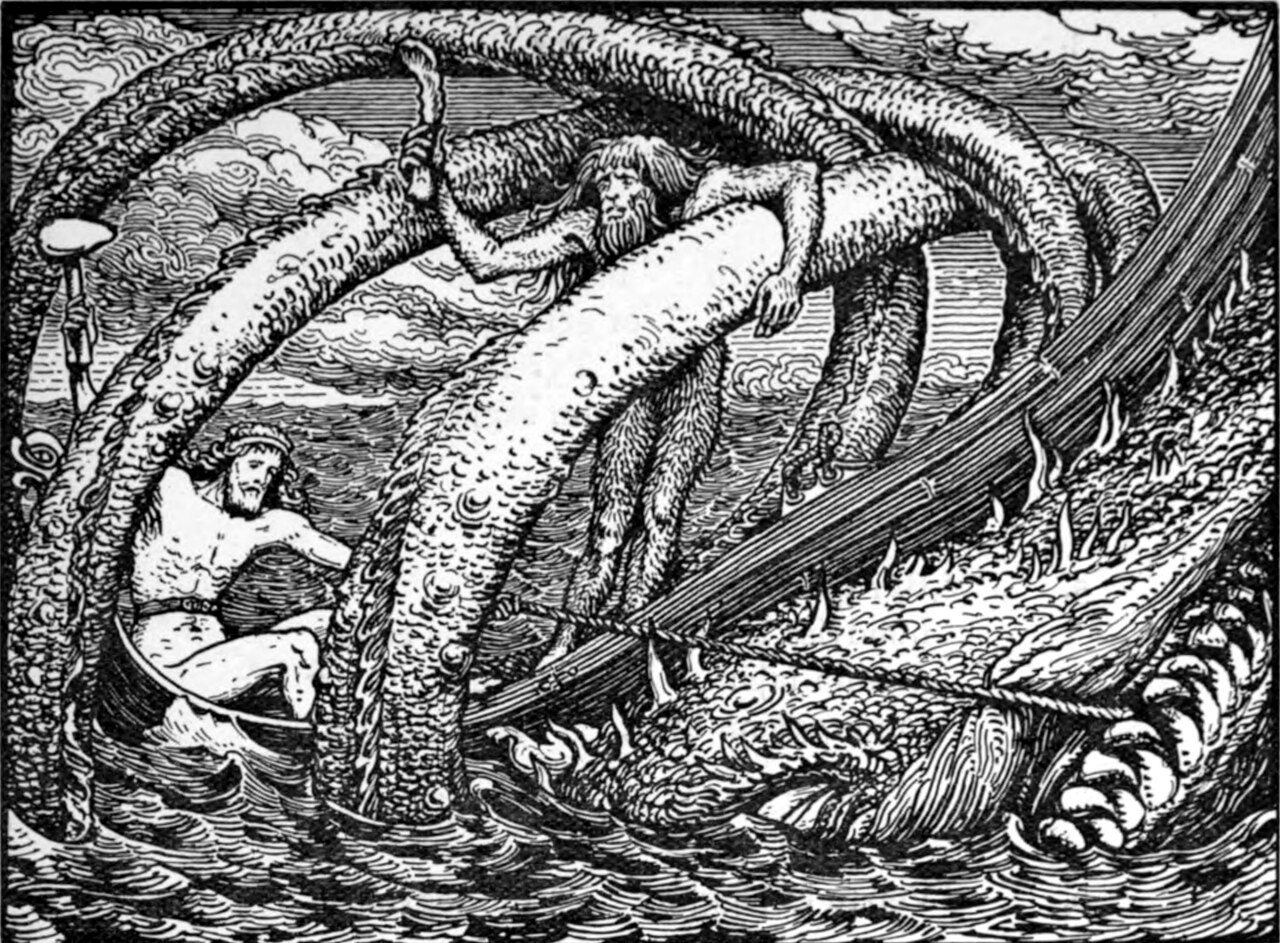
The warder of men,the worm's destroyer,Fixed on his hookthe head of the ox;There gaped at the baitthe foe of the gods,The girdler of allthe earth beneath.
Note
Warder of men: Thor; cf. stanza 11. Worm's destroyer: likewise Thor, who in the last battle slays, and is slain by, Mithgarthsorm; cf. Voluspo, 56. The foe of the gods: Mithgarthsorm, who lies in the sea, and surrounds the whole earth.
Cited on Hymir, Jörmungandr, Thor fishes for the World Serpent
The venomous serpentswiftly upTo the boat did Thor,the bold one, pull;With his hammer the loathlyhill of the hairOf the brother of Fenrirhe smote from above.
Note
Hill of the hair: head,—a thoroughly characteristic skaldic phrase. Brother of Fenrir: Mithgarthsorm was, like the wolf Fenrir and the goddess Hel, born to Loki and the giantess Angrbotha (cf. Voluspo, 39 and note), and I have translated this line accordingly; but the word used in the text has been guessed as meaning almost anything from "comrade" to "enemy."
Cited on Thor, Thor fishes for the World Serpent
The monsters roared,and the rocks resounded,And all the earthso old was shaken;................Then sank the fishin the sea forthwith.
Note
No gap is indicated in the manuscripts, but that a line or more has been lost is highly probable. In Snorri's version, Thor pulls so hard on the line that he drives both his feet through the flooring of the boat, and stands on bottom. When he pulls the serpent up, Hymir cuts the line with his bait-knife, which explains the serpent's escape. Thor, in a rage, knocks Hymir overboard with his hammer, and then wades ashore. The lines of stanzas 25 and 26 have been variously grouped.
Cited on Thor fishes for the World Serpent
................Joyless as backthey rowed was the giant;Speechless did Hymirsit at the oars,With the rudder he soughta second wind.
Note
No gap is indicated in the manuscripts, but line 2 begins with a small letter. A second wind: another direction, i. e., he put about for the shore.
Cited on Thor fishes for the World Serpent
Hymir spake:"The half of our toilwilt thou have with me,And now make fastour goat of the flood;Or home wilt thou bearthe whales to the house,Across the gorgeof the wooded glen?"
Note
No superscription in the manuscripts. In its place Bugge supplies a line—"These words spake Hymir, the giant wise." The manuscripts reverse the order of the lines 2 and 3, and in both of them line 4 stands after stanza 28. Goat of the flood: boat.
Hlorrithi stoodand the stem he gripped,And the sea-horse with waterawash he lifted;Oars and bailerand all he boreWith the surf-swine hometo the giant's house.
Note
Sea-horse: boat. Surf-swine: the whales.
His might the giantagain would match,For stubborn he was,with the strength of Thor;None truly strong,though stoutly he rowed,Would he call save onewho could break the cup.
Note
Snorri says nothing of this episode of Hymir's cup. The glass which cannot be broken appears in the folklore of various races.
Cited on Thor fishes for the World Serpent
Hlorrithi then,when the cup he held,Struck with the glassthe pillars of stone;As he sat the postsin pieces he shattered,Yet the glass to Hymirwhole they brought.
But the loved one fairof the giant foundA counsel true,and told her thought:Smite the skull of Hymir,heavy with food,For harder it isthan ever was glass."
Note
The loved one: Hymir's wife and Tyr's mother; cf. stanza 8 and note. The idea that a giant's skull is harder than stone or anything else is characteristic of the later Norse folk-stories, and in one of the so-called "mythical sagas" we find a giant actually named Hard-Skull.
Cited on Hymir
The goats' mighty rulerthen rose on his knee,And with all the strengthof a god he struck;Whole was the fellow'shelmet-stem,But shattered the wine-cuprounded was.
Note
Helmet-stem: head.
Hymir spake:"Fair is the treasurethat from me is gone,Since now the cupon my knees lies shattered;"So spake the giant:"No more can I sayIn days to be,'Thou art brewed, mine ale.'
Note
The manuscripts have no superscription. Line 4 in the manuscripts is somewhat obscure, and Bugge, followed by some editors, suggests a reading which may be rendered (beginning with the second half of line 3): "No more can I speak / Ever again as I spoke of old."
Cited on Thor fishes for the World Serpent
"Enough shall it beif out ye can bringForth from our housethe kettle here."Tyr then twiceto move it tried,But before him the kettletwice stood fast.
Cited on Týr
The father of Mothithe rim seized firm,And before it stoodon the floor below;Up on his headSif's husband raised it,And about his heelsthe handles clattered.
Note
The father of Mothi and Sif's husband: Thor.
Not long had they fared,ere backwards lookedThe son of Othin,once more to see;From their caves in the eastbeheld he comingWith Hymir the throngof the many-headed.
Note
The many-headed: The giants, although rarely designated as a race in this way, sometimes had two or more heads; cf. stanza 8, Skirnismol, 31 and Vafthruthnismol, 33. Hymir's mother is, however, the only many-headed giant actually to appear in the action of the poems, and it is safe to assume that the tradition as a whole belongs to the period of Norse folk-tales of the märchen order.
Cited on Hymir, Thor fishes for the World Serpent
He stood and castfrom his back the kettle,And Mjollnir, the loverof murder, he wielded;................So all the whalesof the waste he slew.
Note
No gap is indicated in the manuscripts. Some editors put the missing line as 2, some as 3, and some, leaving the present three lines together, add a fourth, and metrically incorrect, one from late paper manuscripts: "Who with Hymir followed after." Whales of waste: giants.
Cited on Mjölnir
Not long had they faredere one there layOf Hlorrithi's goatshalf-dead on the ground;In his leg the pole-horsethere was lame;The deed the evilLoki had done.
Note
According to Snorri, when Thor set out with Loki (not Tyr) for the giants' land, he stopped first at a peasant's house (cf. stanza 7 and note). There he proceeded to cook his own goats for supper. The peasant's son, Thjalfi, eager to get at the marrow, split one of the leg-bones with his knife. The next morning, when Thor was ready to proceed with his journey, he called the goats to life again, but one of them proved irretrievably lame. His wrath led the peasant to give him both his children as servants (cf. stanza 39). Snorri does not indicate that Loki was in any way to blame.
Cited on Tanngrisnir and Tanngnjóstr, Þjálfi and Röskva, Thor's journey to Útgarða-Loki, Thor fishes for the World Serpent
But ye all have heard,—for of them who haveThe tales of the gods,who better can tell?—What prize he wonfrom the wilderness-dweller,Who both his childrengave him to boot.
Note
This deliberate introduction of the story-teller is exceedingly rare in the older poetry.
The mighty one cameto the council of gods,And the kettle he hadthat Hymir's was;So gladly their alethe gods could drinkIn Ægir's hallat the autumn-time.
Note
The translation of the last two lines is mostly guesswork, as the word rendered "gods" is uncertain, and the one rendered "at the autumn-time" is quite obscure.
Cited on Ægir, Thor fishes for the World Serpent