god or goddess
Jörð
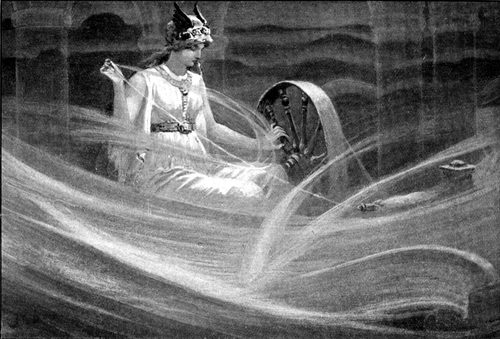
The Earth personified as a goddess: Odin's bride and the mother of Thor, so that Thor is called the 'son of Earth'. Snorri gives her two incompatible parentages.
Jörð is the earth, thought of as a goddess. She matters in the myths as Thor's mother, and the poets use that relationship constantly: Thor is "the son of Jorth" Þrymskviða 1, "the son of Earth" Lokasenna 58, and in Skáldskaparmál simply "Jörd's Son" Skáldskaparmál 17. Snorri lists her among the goddesses: "Jörd, the mother of Thor, and Rindr, Váli's mother, are reckoned among the Ásynjur" Gylfaginning 36.
Odin's bride
Thor's father is Odin. Snorri's kennings for the earth include "Mother of Thor" and "Odin's Bride" Skáldskaparmál 24, and his kennings for Frigg call Frigg her "Co-Wife" Skáldskaparmál 19. A verse by the poet Hallfreðr, quoted by Snorri, calls the land of Norway the "Wife of Thridi", one of Odin's names, and Snorri explains that "in poesy the earth is called the Wife of Odin" Skáldskaparmál 2. Scholars read such verses as flattery with a mythic edge: a ruler who won Norway was pictured as taking Odin's bride.
Two parentages
Snorri gives her two incompatible origins. In Gylfaginning 9 Odin begets Thor on the Earth, who "was his daughter and his wife" Gylfaginning 9. One chapter later she is the daughter of Night, a giant's daughter, by her second husband Annarr, and so a half-sister of Day Gylfaginning 10. Skáldskaparmál follows the second version: "Daughter of Ónarr ... Daughter of Night, Sister of Audr and of Day" Skáldskaparmál 24. The same kennings also call the earth "Flesh of Ymir" Skáldskaparmál 24, mixing the goddess with the land made from Ymir's body.
Other names
Völuspá names Thor's mother twice, with different names: he is "the son of Hlothyn" Völuspá 55 and "the son of Fjorgyn" Völuspá 56. In Hárbarðsljóð the ferryman sends Thor to the land where "Fjorgyn her son Thor" will find him Hárbarðsljóð 56. Hlóðyn also appears as a plain poetic word for the earth Skáldskaparmál 56. Most scholars take both as names of Jörð. Fjörgyn has been compared with the Lithuanian thunder god Perkūnas and with Gothic fairguni, "mountain", but the connections are debated.
Jörð has no story of her own. She is the ground Thor stands on and fights for.
In the sources
Quoted from the hosted translations; each line is checked against the text when the site is built. Select a reference to read it in context.
The Earth was his daughter and his wife; on her he begot the first son, which is Ása-Thor
Afterward she was wedded to him that was called Annarr; Jörd was their daughter.
He shook his beard, his hair was bristling, As the son of Jorth about him sought.
Nine paces fares the son of Fjorgyn
by calling her Flesh of Ymir, and Mother of Thor, Daughter of Ónarr, Odin's Bride, Co-Wife of Frigg and Rindr and Gunnlöd
Where the sources disagree or fall silent
- Her parentage: Gylfaginning 9 calls the Earth Odin's daughter as well as his wife; Gylfaginning 10 and Skáldskaparmál 24 make her the daughter of Night and Annarr (Ónarr).
- Whether Hlóðyn (Völuspá 55) and Fjörgyn (voluspa 56, harbardsljod 56) are other names of Jörð or separate goddesses. Snorri also names a male Fjörgynn as Frigg's father (Skáldskaparmál 19).