
Poetic Edda · poems of the gods
Þrymskviða
The Lay of Thrym
Bellows's introduction
The Thrymskvitha is found only in the Codex Regius, where it follows the Lokasenna. Snorri does not quote from it, nor, rather oddly, does the story occur in the Prose Edda.
Artistically the Thrymskvitha is one of the best, as it is, next to the Voluspo, the most famous, of the entire collection. It has, indeed, been called "the finest ballad in the world," and not without some reason. Its swift, vigorous action, the sharpness of its characterization and the humor of the central situation combine to make it one of the most vivid short narrative poems ever composed. Of course we know nothing specific of its author, but there can be no question that he was a poet of extraordinary ability. The poem assumed its present form, most critics agree, somewhere about 900, and thus it is one of the oldest in the collection. It has been suggested, on the basis of stylistic similarity, that its author may also have composed the Skirnismol, and possibly Baldrs Draumar. There is also some resemblance between the Thrymskvitha and the Lokasenna (note, in this connection, Bugge's suggestion that the Skirnismol and the Lokasenna may have been by the same man), and it is not impossible that all four poems have a single authorship.
The Thrymskvitha has been preserved in excellent condition, without any serious gaps or interpolations. In striking contrast to many of the poems, it contains no prose narrative links, the story being told in narrative verse—a rare phenomenon in the poems of the Edda.
Wild was Vingthorwhen he awoke,And when his mightyhammer he missed;He shook his beard,his hair was bristling,As the son of Jorthabout him sought.
Note
Vingthor ("Thor the Hurler"): another name for Thor, equivalent to Vingnir (Vafthruthnismol, 51). Concerning Thor and his hammer, Mjollnir, cf. Hymiskvitha, Lokasenna, and Harbarthsljoth, passim. Jorth: Earth, Thor's mother, Othin being his father.
Cited on Jörð, Thor, Thrym steals Thor's hammer
Hear now the speechthat first he spake:"Harken, Loki,and heed my words,Nowhere on earthis it known to man,Nor in heaven above:our hammer is stolen."
Note
Loki: cf. Lokasenna, passim.
Cited on Thrym steals Thor's hammer
To the dwelling fairof Freyja went they,Hear now the speechthat first he spake:"Wilt thou, Freyja,thy feather-dress lend me,That so my hammerI may seek?"
Note
Freyja: Njorth's daughter, and sister of Freyr; cf. Lokasenna, introductory prose and note, also Skirnismol, introductory prose. Freyja's house was Sessrymnir ("Rich in Seats") built in Folkvang ("Field of the Folk"); cf. Grimnismol, 14. Feather-dress: this flying equipment of Freyja's is also used in the story of Thjazi, wherein Loki again borrows the "hawk's dress" of Freyja, this time to rescue Ithun; cf. Harbarthsljoth, 19 and note.
Cited on Freyja, Thrym steals Thor's hammer
Freyja spake:"Thine should it bethough of silver bright,And I would give itthough 'twere of gold."Then Loki flew,and the feather-dress whirred,Till he left behind himthe home of the gods,And reached at lastthe realm of the giants.
Note
The manuscript and most editions have lines 1-2 in inverse order. Several editors assume a lacuna before line 1, making a stanza out of the two conjectural lines (Bugge actually supplies them) and lines 1-2 of stanza 4. Thus they either make a separate stanza out of lines 3-5 or unite them in a six-line stanza with 5. The manuscript punctuation and capitalization—not wholly trustworthy guides—indicate the stanza divisions as in this translation.
Cited on Loki
Thrym sat on a mound,the giants' master,Leashes of goldhe laid for his dogs,And stroked and smoothedthe manes of his steeds.
Note
Thrym: a frost-giant. Gering declares that this story of the theft of Thor's hammer symbolizes the fact that thunderstorms rarely occur in winter.
Cited on Þrymr, Thrym steals Thor's hammer
Thrym spake:"How fare the gods,how fare the elves?Why comst thou aloneto the giants' land?"Loki spake:"Ill fare the gods,ill fare the elves!Hast thou hiddenHlorrithi's hammer?"
Note
Line 1: cf. Voluspo, 48, 1. The manuscript does not indicate Loki as the speaker of lines 3-4. Hlorrithi: Thor.
Cited on Elves
Thrym spake:"I have hiddenHlorrithi's hammer,Eight miles downdeep in the earth;And back againshall no man bring itIf Freyja I win notto be my wife."
Note
No superscription in the manuscript. Vigfusson made up and inserted lines like "Then spake Loki the son of Laufey" whenever he thought they would be useful.
Cited on Freyja, Mjölnir, Þrymr, Thrym steals Thor's hammer
Then Loki flew,and the feather-dress whirred,Till he left behind himthe home of the giants,And reached at lastthe realm of the gods.There in the courtyardThor he met:Hear now the speechthat first he spake:
Cited on Thrym steals Thor's hammer
"Hast thou found tidingsas well as trouble?Thy news in the airshalt thou utter now;Oft doth the sitterhis story forget,And lies he speakswho lays himself down."
Note
The manuscript marks line 2, instead of line 1, as the beginning of a stanza, which has caused editors some confusion in grouping the lines of stanzas 8 and 9.
Loki spake:"Trouble I have,and tidings as well:Thrym, king of the giants,keeps thy hammer,And back againshall no man bring itIf Freyja he wins notto be his wife."
Note
No superscription in the manuscript.
Freyja the fairthen went they to find;Hear now the speechthat first he spake:"Bind on, Freyja,the bridal veil,For we two must hasteto the giants' home."
Wrathful was Freyja,and fiercely she snorted,And the dwelling greatof the gods was shaken,And burst was the mightyBrisings' necklace:"Most lustful indeedshould I look to allIf I journeyed with theeto the giants' home."
Note
Many editors have rejected either line 2 or line 3. Vigfusson inserts one of his own lines before line 4. Brisings' necklace: a marvelous necklace fashioned by the dwarfs, here called Brisings (i.e., "Twiners"); cf. Lokasenna, 20 and note.
Cited on Brísingamen, Freyja, Þrymr, Thrym steals Thor's hammer
Then were the godstogether met,And the goddesses cameand council held,And the far-famed onesa plan would find,How they might Hlorrithi'shammer win.
Note
Lines 1-3 are identical with Baldrs Draumar, 1, 1-3.
Then Heimdall spake,whitest of the gods,Like the Wanes he knewthe future well:"Bind we on Thorthe bridal veil,Let him bear the mightyBrisings' necklace;
Note
Heimdall: the phrase "whitest of the gods" suggests that Heimdall was the god of light as well as being the watchman. His wisdom was probably connected with his sleepless watching over all the worlds; cf. Lokasenna, 47 and note. On the Wanes cf. Voluspo, 21 and note. They are not elsewhere spoken of as peculiarly gifted with knowledge of future events.
Cited on Brísingamen, Heimdall, The Vanir, Thrym steals Thor's hammer
"Keys around himlet there rattle,And down to his kneeshang woman's dress;With gems full broadupon his breast,And a pretty capto crown his head."
Then Thor the mightyhis answer made:"Me would the godsunmanly callIf I let bindthe bridal veil."
Note
Possibly a line has been lost from this stanza.
Cited on Thrym steals Thor's hammer
Then Loki spake,the son of Laufey:"Be silent, Thor,and speak not thus;Else will the giantsin Asgarth dwellIf thy hammer is brought nothome to thee."
Note
Laufey: Loki's mother, cf. Lokasenna, 52 and note.
Cited on Asgard, Laufey, Loki, The nine worlds, Thrym steals Thor's hammer
Then bound they on Thorthe bridal veil,And next the mightyBrisings' necklace.
Note
The manuscript abbreviates all six lines, giving only the initial letters of the words. The stanza division is thus arbitrary; some editors have made one stanza of the six lines, others have combined the last two lines of stanza 19 with stanza 20. It is possible that a couple of lines have been lost.
Cited on Brísingamen, Thrym steals Thor's hammer
Keys around himlet they rattle,And down to his kneeshung woman's dress;With gems full broadupon his breast,And a pretty capto crown his head.
Note
The manuscript abbreviates all six lines, giving only the initial letters of the words. The stanza division is thus arbitrary; some editors have made one stanza of the six lines, others have combined the last two lines of stanza 19 with stanza 20. It is possible that a couple of lines have been lost.
Then Loki spake,the son of Laufey:"As thy maid-servant thitherI go with thee;We two shall hasteto the giants' home."
Cited on Loki
Then home the goatsto the hall were driven,They wrenched at the halters,swift were they to run;The mountains burst,earth burned with fire,And Othin's sonsought Jotunheim.
Note
Goats: Thor's wagon was always drawn by goats; cf. Hymiskvitha, 38 and note. Jotunheim: the world of the giants.
Cited on Jötunheimr, Tanngrisnir and Tanngnjóstr, Thrym steals Thor's hammer
Then loud spake Thrym,the giants' leader:"Bestir ye, giants,put straw on the benches;Now Freyja they bringto be my bride,The daughter of Njorthout of Noatun.
Note
Njorth: cf. Voluspo, 21, and Grimnismol, 11 and 16. Noatun ("Ships'-Haven"): Njorth's home, where his wife, Skathi, found it impossible to stay; cf. Grimnismol, 11 and note.
Cited on Nóatún, Thrym steals Thor's hammer
"Gold-horned cattlego to my stables,Jet-black oxen,the giant's joy;Many my gems,and many my jewels,Freyja alonedid I lack, methinks."
Cited on Jötunheimr, Þrymr
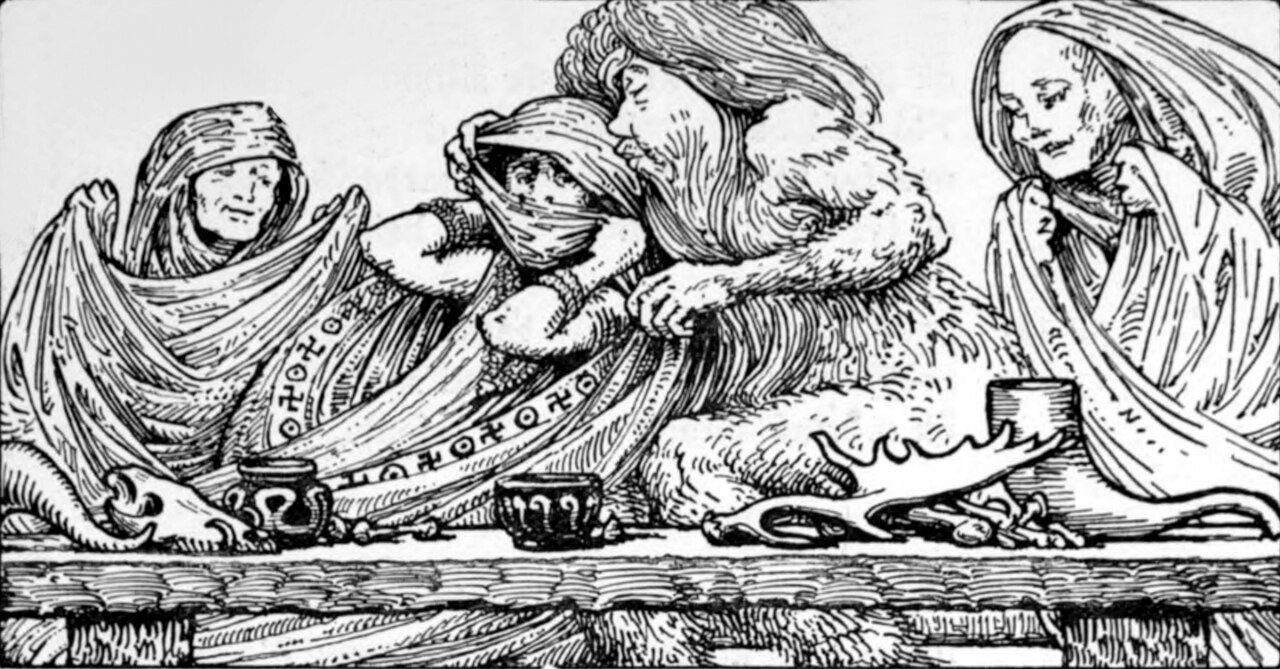
Early it wasto evening come,And forth was bornethe beer for the giants;Thor alone ate an ox,and eight salmon,All the dainties as wellthat were set for the women;And drank Sif's matethree tuns of mead.
Note
Grundtvig thinks this is all that is left of two stanzas describing Thor's supper. Some editors reject line 4. In line 3 the manuscript has "he," the reference being, of course, to Thor, on whose appetite cf. Hymiskvitha, 15. Sif: Thor's wife; cf. Lokasenna, note to the introductory prose and stanza 53.
Cited on Sif, Thor, Þrymr, Thrym steals Thor's hammer
Then loud spake Thrym,the giants' leader:"Who ever saw bridemore keenly bite?I ne'er saw bridewith a broader bite,Nor a maiden who drankmore mead than this!"
Cited on Thrym steals Thor's hammer
Hard by there satthe serving-maid wise,So well she answeredthe giant's words:"From food has Freyjaeight nights fasted,So hot was her longingfor Jotunheim."
Cited on Þrymr, Thrym steals Thor's hammer
Thrym looked 'neath the veil,for he longed to kiss,But back he leapedthe length of the hall:"Why are so fearfulthe eyes of Freyja?Fire, methinks,from her eyes burns forth."
Note
For clearness I have inserted Thrym's name in place of the pronoun of the original. Fire: the noun is lacking in the manuscript; most editors have inserted it, however, following a late paper manuscript.
Cited on Thrym steals Thor's hammer
Hard by there satthe serving-maid wise,So well she answeredthe giant's words:"No sleep has Freyjafor eight nights found,So hot was her longingfor Jotunheim."
Note
In the manuscript the whole stanza is abbreviated to initial letters, except for "sleep," "Freyja," and "found."
Cited on Þrymr, Thrym steals Thor's hammer
Soon came the giant'sluckless sister,Who feared not to askthe bridal fee:"From thy hands the ringsof red gold take,If thou wouldst winmy willing love,(My willing loveand welcome glad.)"
Note
Luckless: so the manuscript, but many editors have altered the word "arma" to "aldna," meaning "old," to correspond with line 1 of stanza 32. Line 5 may well be spurious.
Cited on Þrymr, Thrym steals Thor's hammer
Then loud spake Thrym,the giants' leader:"Bring in the hammerto hallow the bride;On the maiden's kneeslet Mjollnir lie,That us both the handof Vor may bless."
Note
Hallow: just what this means is not clear, but there are references to other kinds of consecration, though not of a bride, with the "sign of the hammer." According to Vigfusson, "the hammer was the holy sign with the heathens, answering to the cross of the Christians." In Snorri's story of Thor's resuscitation of his cooked goat (cf. Hymiskvitha, 38, note) the god "hallows" the goat with his hammer. One of the oldest runic signs, supposed to have magic power, was named Thor's-hammer. Vor: the goddess of vows, particularly between men and women; Snorri lists a number of little-known goddesses similar to Vor, all of them apparently little more than names for Frigg.
Cited on Mjölnir, Þrymr, Vár, Thrym steals Thor's hammer
The heart in the breastof Hlorrithi laughedWhen the hard-souled onehis hammer beheld;First Thrym, the kingof the giants, he killed,Then all the folkof the giants he felled.
Cited on Thor, Þrymr, Thrym steals Thor's hammer
The giant's sisterold he slew,She who had beggedthe bridal fee;A stroke she gotin the shilling's stead,And for many ringsthe might of the hammer.
Cited on Thrym steals Thor's hammer
And so his hammergot Othin's son.
Note
Some editors reject this line, which, from a dramatic standpoint, is certainly a pity. In the manuscript it begins with a capital letter, like the opening of a new stanza.
Cited on Thrym steals Thor's hammer