A myth retold · about 5 minutes
Thor in the hall of Geirröðr
To save his own life Loki promises to bring Thor, unarmed, to the giant Geirröðr. A friendly giantess lends Thor a belt, gloves and staff; he survives a flooding river, a rising chair and a red-hot iron bar, and kills Geirröðr and his daughters.
After the Hrungnir story, Ægir asks Bragi whether Thor did any greater deeds among the trolls. Bragi says this one is worth telling at length Skáldskaparmál 18. It is unusual because Thor goes into the giants' world without Mjölnir, his belt of strength (Megingjörð) or his iron gloves, and the fault is Loki's.
Loki in the chest
Loki was flying for fun in Frigg's falcon-shape and, out of curiosity, flew into the courtyard of the giant Geirröðr. He landed on the great hall and peered in through a window. Geirröðr saw him and ordered the bird caught. The wall was so high that the man sent up it could barely climb it, and Loki enjoyed watching him struggle, waiting until the last moment to fly. When the man was almost on him he spread his wings and kicked off, but his feet were stuck fast Skáldskaparmál 18.
He was brought to Geirröðr, who looked at his eyes and suspected a man inside the bird. Loki would not speak. Geirröðr shut him in a chest and starved him for three months. When he was let out and told to talk, Loki said who he was, and to save his life he swore that he would bring Thor to Geirröðr's house without his hammer or his belt of strength Skáldskaparmál 18.
The giantess on the road
Snorri does not say how Loki talked Thor into it; the poem he quotes later says only that Loki, "ever ... a liar", told him green roads led to Geirröðr's house. On the way they stayed the night with the giantess Gríðr, the mother of the silent god Víðarr. She told Thor the truth about Geirröðr: a cunning giant and hard to deal with. She lent Thor a belt of strength and iron gloves of her own, and her staff, called Gríðarvölr Skáldskaparmál 18.
The river Vimur
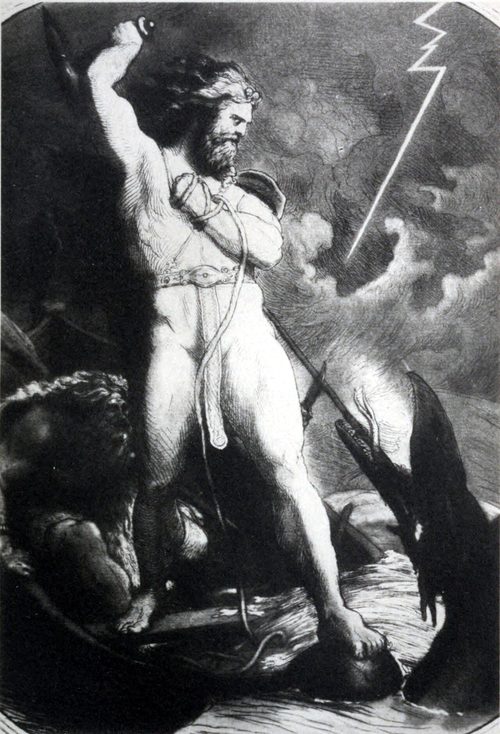
They came to Vimur, the greatest of all rivers. Thor buckled on the belt and braced himself against the current with the staff, while Loki held on to the belt behind him. In midstream the river rose until it broke over Thor's shoulders, and he spoke to it:
Wax thou not now, Vimur,For I fain would wade theeInto the Giants' garth:Know thou, if thou waxest,Then waxeth God-strength in meAs high up as the heaven.Skáldskaparmál 18
Then he saw why the water was rising. Geirröðr's daughter Gjálp stood astride the river upstream, one foot on each side of a gorge, and she was causing the flood. Thor picked a big stone out of the river and threw it at her, saying "At its source should a river be stemmed", and he did not miss. At that moment he was swept to the bank, grabbed a rowan bush and pulled himself out. That, says Snorri, is why people say the rowan is Thor's rescue Skáldskaparmál 18.
The rising chair
At Geirröðr's they were shown not into the hall but into a goat-shed, where there was a single chair. Thor sat on it. The chair began to rise under him towards the roof. He pushed Gríðr's staff against the rafters and shoved himself down against the chair. There was a great crack and a scream: under the chair had been Geirröðr's two daughters, Gjálp and Greip, and he had broken both their backs Skáldskaparmál 18.
The iron bar
Then Geirröðr called Thor into the hall to play games. Great fires burned down the whole length of it. As Thor came opposite him, Geirröðr picked up a red-hot lump of iron with tongs and threw it at him. Thor caught it in the iron gloves and held it up. Geirröðr jumped behind an iron pillar.
Thor lifted up the bar and threw it, and it passed through the pillar and through Geirrödr and through the wall, and so on out, even into the earth.Skáldskaparmál 18
There Snorri's prose ends.
Where the story comes from
Snorri's prose (around 1220) follows and summarises Þórsdrápa, a poem by the Icelandic skald Eilífr Goðrúnarson from the late 10th century, which he then quotes in full Skáldskaparmál 18. The poem is famously difficult, packed with kennings, but some differences from the prose are clear:
- Who goes with Thor. In Snorri, Loki travels with him and holds on to his belt in the river. In Þórsdrápa, Loki only lures Thor into going ("Ever was Loptr a liar"); it is "warlike Thjálfi" who goes further on the road with Thor, and in the river it is Þjálfi who hangs on Thor's shield-strap.
- The river. The poem has both Thor and Þjálfi wading with staffs, and the giantesses "held the stream stubborn against them". It does not mention the rowan bush or the stone thrown at Gjálp.
- The daughters. In the poem Thor is pressed up against the rafters on the chair and crushes both women's backs and breast-bones against the roof-beam, as in Snorri.
- The killing. The poem agrees that Thor caught the molten bar and drove it through Geirröðr at the pillar, but adds that he went on to kill many more giants of the household "with the fragment of Grídr's Rod".
Snorri also knows the story's skeleton from elsewhere: he lists "Visitor and Chest-Trapping of Geirrödr" among the kennings for Loki Skáldskaparmál 16, and Úlfr Uggason calls Thor "Vimur's ford's Wide-Grappler", a name Snorri explains by this very river Skáldskaparmál 4. Note that the falcon-shape is Frigg's here; in the stories of Iðunn and Þrymr, Loki borrows Freyja's.
The giant has a namesake in the Poetic Edda: King Geirröðr of Grímnismál, who tortures Odin between two fires (see Odin as Grímnir between the fires). That Geirröðr is a human king; the two stories have nothing in common but the name and a fiery hall.
Reading it today
The episode with Gjálp in the river is one of the coarsest in Norse myth: many readers take her "causing the spate" to mean she was urinating or menstruating into it, and Thor's saying about stemming a river at its source supports that reading, though Snorri does not spell it out. The rowan saying and the chair and the bar suggest a story that had collected explanations and household proverbs over time. Scholars also note that Thor, deprived of his hammer, wins by borrowed gear from a friendly giantess, a reminder that the giants are not a single hostile race in these myths.
Key passages
he swore to Geirrödr with oaths that he would get Thor to come into Geirrödr's dwelling in such a fashion that he should have neither hammer nor Girdle of Might with him
Wax thou not now, Vimur, / For I fain would wade thee / Into the Giants' garth
Then Thor saw Gjálp, daughter of Geirrödr, standing in certain ravines, one leg in each, spanning the river, and she was causing the spate.
Thor lifted up the bar and threw it, and it passed through the pillar and through Geirrödr and through the wall, and so on out, even into the earth.
Till Thjálfi came uplifted / On his lord Thor's wide shield-strap
Visitor and Chest-Trapping of Geirrödr