A myth retold · about 6 minutes
Baldr's dreams and death
Baldr dreams of his own death; Odin rides to Hel to question a dead seeress; and, in Snorri's telling, Loki puts a sprig of mistletoe into blind Höðr's hand. The gods lose their brightest member and the slide toward Ragnarök begins.
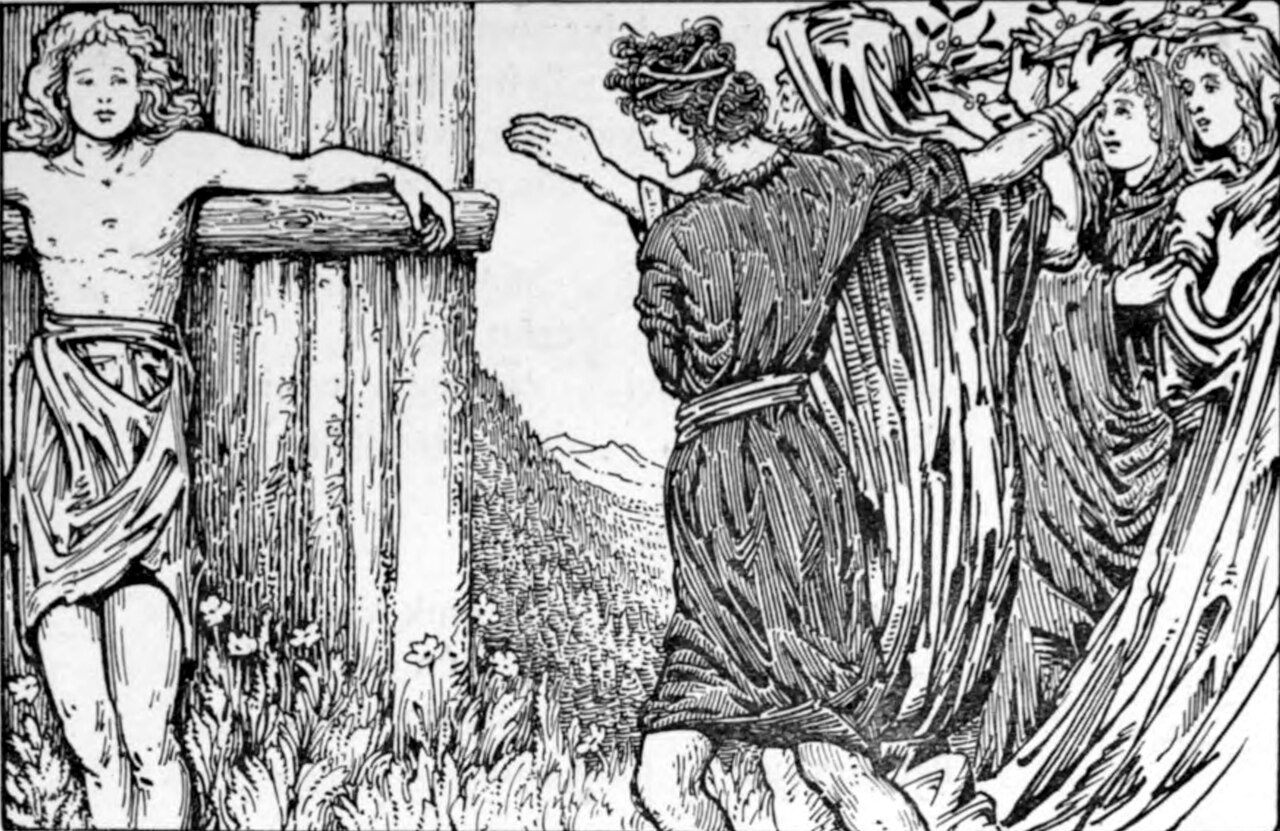
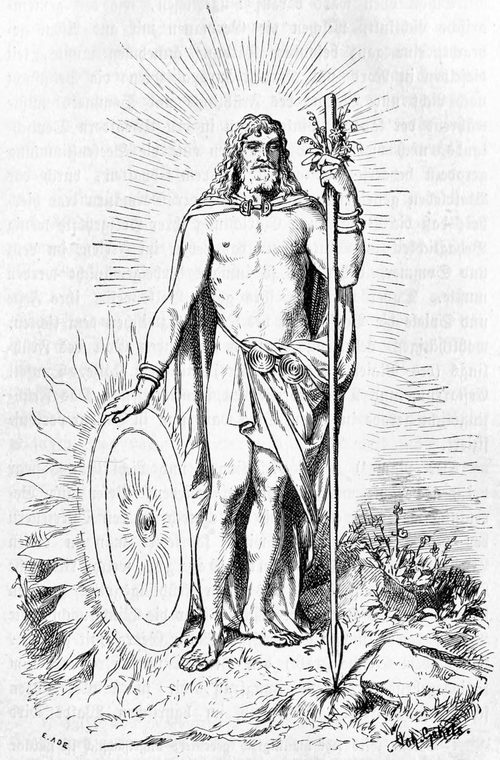
Baldr is the one god of whom the sources say nothing but good. Snorri calls him the best of the gods, so fair that light shines from him, the wisest and most gracious of the Æsir, living in Breiðablik where nothing unclean may be Gylfaginning 22. His death is the turning point of the whole mythology: after it, the gods are on the road to Ragnarök.
Three kinds of source tell the story, and they are not equally full. Two short Eddic poems, Baldrs draumar and Völuspá, give the dreams, the weapon, the killer and the avenger in a few stanzas each. Snorri Sturluson's Gylfaginning, written in the 1220s, supplies everything else: Frigg's oaths, the game at the assembly, Loki's disguise, the funeral. The retelling below follows the poems where they speak and Snorri where they are silent, and says which is which.
The dreams and Odin's ride
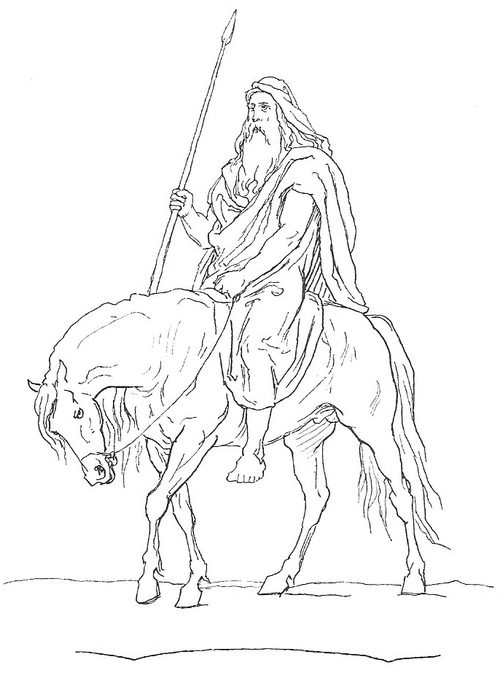
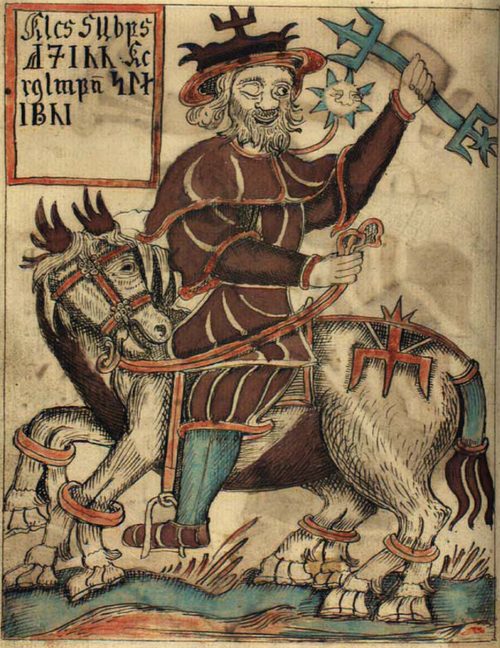
The gods and goddesses meet in council because Baldr has had "baleful dreams" Baldrs draumar 1. The poem never says what he dreamed. Odin does not wait for the council to decide. He saddles Sleipnir and rides down to Niflhel, the realm of the dead. On the way a dog comes up from below, blood on its breast, and howls at him Baldrs draumar 2-3; the poem gives it no name, though many readers connect it with Garmr. Odin rides on until he reaches the high house of Hel.
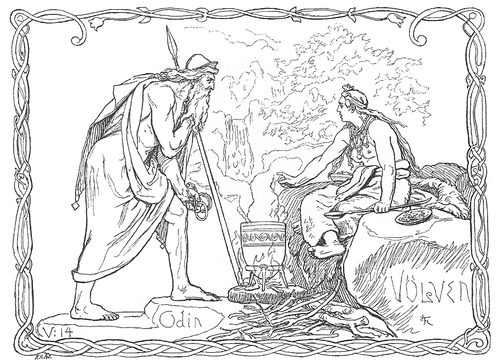
East of the door lies the grave of a wise-woman, a völva. Odin chants spells over it until she rises, unwilling: she has been snowed on, rained on and drenched with dew, and long dead Baldrs draumar 4-5. Odin gives a false name, Vegtam son of Valtam, and asks for whom the benches in Hel's hall are spread with rings and gold Baldrs draumar 6.
"Here for Baldr the mead is brewed,The shining drink, and a shield lies o'er it;But their hope is gone from the mighty gods.Baldrs draumar 7
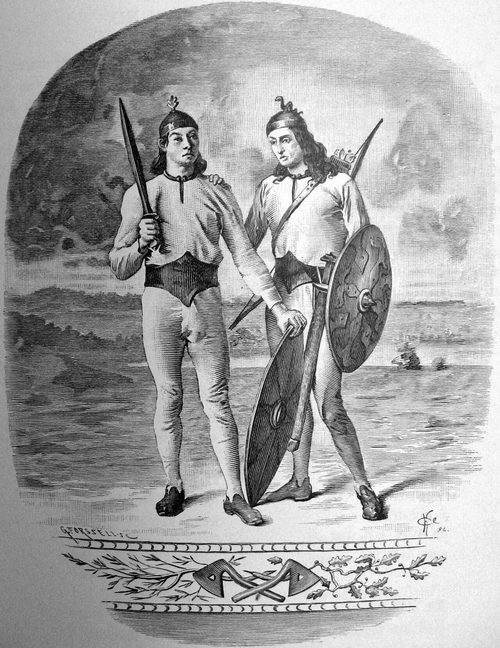
Odin presses her three more times. Who will kill Baldr? "Hoth thither bears the far-famed branch" Baldrs draumar 9: Baldr's own brother, Höðr. Who will avenge him? Rindr will bear Váli in the west, and at one night old he will fight, neither washing his hands nor combing his hair until Baldr's slayer is on the pyre Baldrs draumar 11. Then Odin asks a riddle about weeping maidens, and the riddle gives him away. "Odin thou art," she says; he answers that she is no wise-woman but "of giants three the mother" Baldrs draumar 12-13. She sends him home with a final prophecy: no one will wake her again until Loki breaks loose and the destroyers come Baldrs draumar 14.
Frigg's oaths and the mistletoe
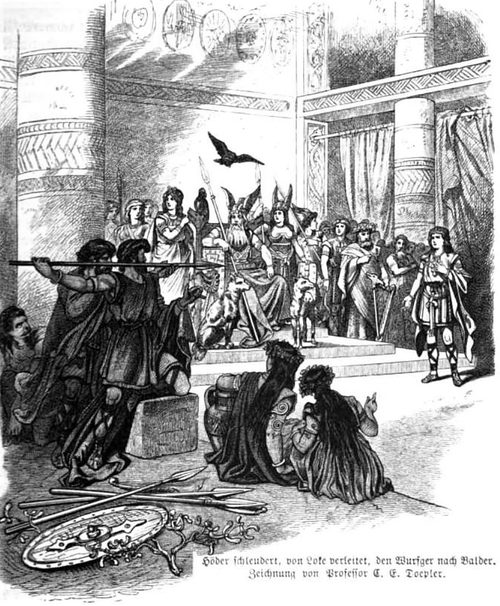
Here the poem stops and Snorri begins. In his version Baldr tells his dreams to the Æsir, and they decide to ask safety for him from every danger. Frigg takes oaths from fire and water, iron and every metal, stones, earth, trees, sicknesses, beasts, birds, poison and serpents that they will not harm him Gylfaginning 49. Once that is done the gods make a sport of it: Baldr stands up at the assembly and the others shoot at him, hew at him and throw stones, and nothing hurts him.
Loki dislikes it. He takes the shape of a woman and visits Frigg at Fensalir, asking innocently what the gods are doing. Frigg explains that weapons and trees cannot hurt Baldr because she has their oaths. Has everything sworn? Not quite, she says:
There grows a tree-sprout alone westward of Valhall: it is called Mistletoe; I thought it too young to ask the oath of.Gylfaginning 49
Loki pulls up the mistletoe and goes to the assembly. Höðr is standing outside the ring because he is blind. Loki asks him why he is not shooting at Baldr; Höðr answers that he cannot see where Baldr is, and has no weapon. Loki offers to guide his aim, and gives him the sprig. Höðr throws; the shaft passes through Baldr, and he falls dead. Snorri calls it "the greatest mischance that has ever befallen among gods and men" Gylfaginning 49.
The gods are struck dumb. They all know who is to blame, but they cannot take vengeance, because the assembly place is a sanctuary. When they try to speak they can only weep, and Odin takes it hardest, because he understands best what the loss means Gylfaginning 49.
Vengeance
Snorri's narrative turns from here to the ride to Hel (see Hermóðr's ride to Hel) and then to Loki's punishment (see The binding of Loki). The poems are more interested in Höðr. Völuspá sees the avenger born "ere long", fighting at one night old, unwashed and uncombed until "he bore to the bale-blaze Baldr's foe" Völuspá 33-34. Hyndluljóð says Váli was swift to slay "his brother's slayer" Hyndluljóð 30. The foe meant is Höðr, not Loki. Snorri knows this too, but only in his list of poetic names, where Váli is "Foe and Slayer of Hödr" Skáldskaparmál 12. In Gylfaginning itself he never tells Höðr's death.
Meanwhile, Völuspá adds, Frigg weeps in Fensalir "for Valhall's need" Völuspá 34.
The funeral
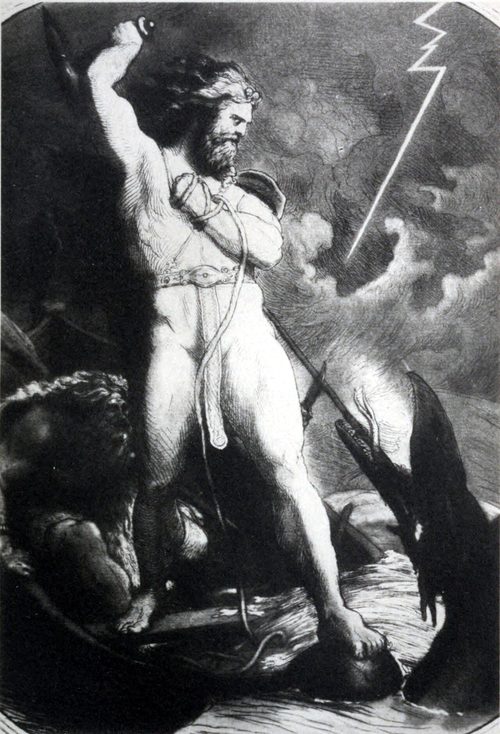
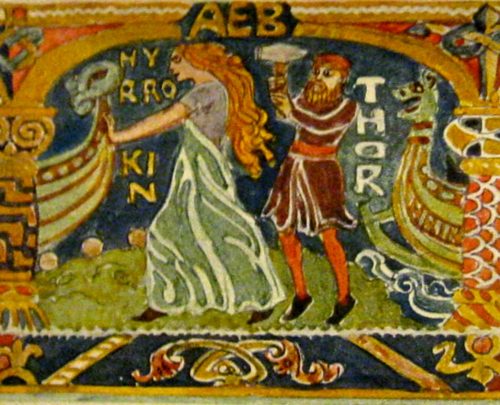
Snorri alone describes the funeral. The gods carry Baldr's body to the sea to burn it on his ship Hringhorni, the greatest of all ships, but cannot launch it. They send to Jötunheimr for the giantess Hyrrokkin, who arrives riding a wolf with vipers for reins. Four berserks cannot hold her mount until they have knocked it down. She shoves the ship out at the first push, so hard that fire flies from the rollers and the earth shakes. Thor grabs his hammer to kill her, and the gods have to beg for her life Gylfaginning 49.
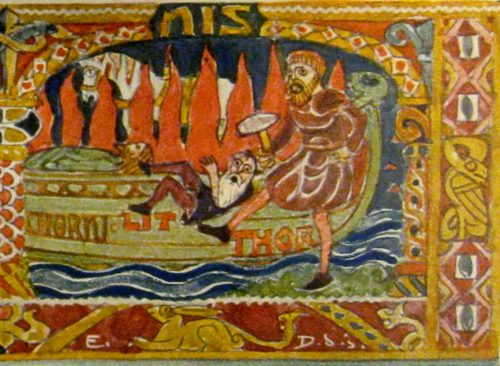
When Baldr's body is carried aboard, his wife Nanna dies of grief and is laid on the pyre beside him. Thor hallows the pyre with Mjöllnir; a dwarf named Litr runs in front of his feet, and Thor kicks him into the fire. Odin comes with Frigg, the valkyries and his ravens; Freyr drives his boar, Heimdallr rides Gulltoppr, Freyja drives her cats, and frost-giants and hill-giants come too. Odin lays the ring Draupnir on the pyre, and Baldr's horse is led to the flames in all its harness Gylfaginning 49.
Where the story comes from
Baldrs draumar (14 stanzas, in the manuscript AM 748 I 4to rather than the Codex Regius) tells only Odin's ride and the seeress's answers. Völuspá gives four stanzas: the mistletoe "full grown in strength", Höðr's throw, the infant avenger, Frigg's tears Völuspá 32-34. Neither poem mentions Loki in connection with the killing, though Baldrs draumar ends with him bound Baldrs draumar 14. The poetic evidence for Loki's guilt is Lokasenna, where he tells Frigg, "Mine is the blame that Baldr no more Thou seest ride home to the hall" Lokasenna 28.
Snorri's Gylfaginning 49 is much the fullest account and the only one with Frigg's oaths, the game at the assembly, Loki in disguise, the "too young" mistletoe, Hyrrokkin, Litr and Nanna's death. Snorri had older material. He names the tenth-century poet Úlfr Uggason, whose Húsdrápa told "the story of Baldr" Skáldskaparmál 5, and quotes its lines on Freyr riding his boar to Baldr's pyre Skáldskaparmál 7. Even so, much of the detail is attested only by him, two centuries after the conversion.
The versions differ in small but telling ways. Völuspá's mistletoe is full grown; Snorri's is too young to swear. In Snorri the gods beg for Hyrrokkin's life, yet a skaldic verse he quotes lists her among the giantesses Thor killed Skáldskaparmál 4. Outside the Eddas, Saxo Grammaticus's Latin history tells a very different, unmythical story in which Høtherus and Balderus are rivals for a woman.
Reading it today
A common reading sees Baldr as a figure of innocence whose death shows that even the gods cannot escape fate: Odin learns exactly what will happen and still cannot stop it. Some scholars have compared the story with dying-god myths elsewhere, or with Christian ideas of an innocent sufferer who returns, since Völuspá has Baldr come back after Ragnarök Völuspá 62. How much Christian influence lies behind Snorri's version is still debated. The question no source answers is what Odin whispered into his dead son's ear on the pyre. In Vafþrúðnismál it is the riddle no giant can solve Vafþrúðnismál 54-55.
Key passages
Once were the gods together met, And the goddesses came and council held
Hoth thither bears the far-famed branch, He shall the bane of Baldr become
I saw for Baldr, the bleeding god, The son of Othin, his destiny set
From the branch which seemed so slender and fair Came a harmful shaft that Hoth should hurl
There grows a tree-sprout alone westward of Valhall: it is called Mistletoe; I thought it too young to ask the oath of.
Mine is the blame that Baldr no more Thou seest ride home to the hall.