A myth retold · about 6 minutes
Ragnarök: the doom of the gods
The end of the Norse world as told in Völuspá, Vafþrúðnismál and Snorri's Gylfaginning: winter and war, the wolf and the serpent loose, the gods killed one by one, and Surtr's fire over the earth.
Ragnarök means "the fate (or doom) of the powers", that is, of the gods. Snorri also uses the form ragnarøkkr, "twilight of the gods", which Brodeur translates as "the Weird of the Gods". It is the end the whole mythology looks toward: Odin rides to Hel to ask about it, the gods bind Fenrir and Loki to put it off, and Loki taunts them with it at Ægir's feast. The retelling below follows the order of Völuspá, the oldest full account, and brings in Vafþrúðnismál and Snorri's Gylfaginning where they add to it or contradict it.
The signs
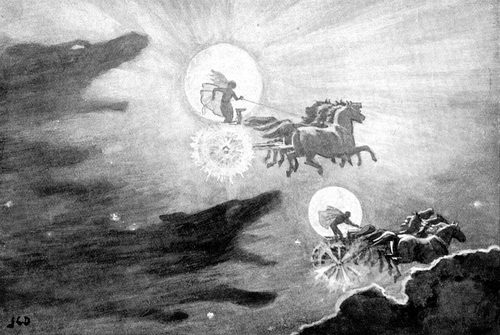
Völuspá's seeress sees an old giantess in the east, in Ironwood, giving birth to the brood of Fenrir. One of them, "in monster's guise", is to steal the sun; he gorges on the flesh of the dead and reddens the gods' home with blood, and the sunshine grows dark and summers turn to storm Völuspá 40-41. Snorri names the wolves who chase sun and moon as Sköll and Hati (see Sköll and Hati) and says that at the end they will catch them Gylfaginning 12 Gylfaginning 51.
Among humans, kinship breaks down:
Brothers shall fight and fell each other,And sisters' sons shall kinship stain;Hard is it on earth, with mighty whoredom;Axe-time, sword-time, shields are sundered,Wind-time, wolf-time, ere the world falls;Nor ever shall men each other spare.Völuspá 45
Vafþrúðnismál speaks of "the mighty winter" that comes to men Vafþrúðnismál 44. Snorri builds a timetable out of these hints. First come three winters of war over the whole world, then the Awful Winter (Fimbulvetr): three winters in a row with snow from every side, savage frost and wind, a powerless sun and no summer in between Gylfaginning 51.
Then three cocks crow. The red cock Fjalar crows over the giants' watchman Eggþér, who sits on a mound playing his harp. Gollinkambi wakes the heroes in Odin's hall, and a rust-red bird crows beneath the earth at the gates of Hel Völuspá 42-43.
The breaking of bonds
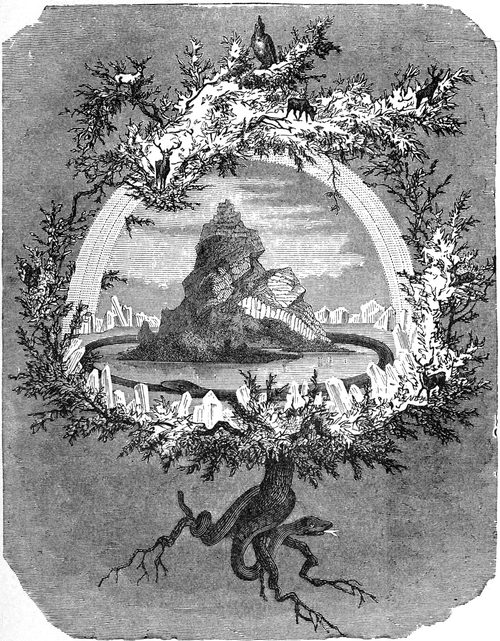
The seeress's refrain sounds for the first time: "Now Garm howls loud before Gnipahellir, / The fetters will burst, and the wolf run free" Völuspá 44. Heimdallr blows the Gjallarhorn; Odin turns to the head of Mímir for counsel; Yggdrasil shakes and its old limbs shiver, and "the giant is loose" Völuspá 46-47. The gods hold council, all Jötunheimr groans, and the dwarves moan at their stone doors Völuspá 48.
The enemies come from every side. Hrymr comes from the east with his shield raised; the world serpent Jörmungandr writhes in giant-rage and churns the waves; an eagle screams and tears at corpses; the ship Naglfar breaks loose Völuspá 50. A ship sails from the north with the people of Hel, and Loki stands at the helm Völuspá 51. From the south comes Surtr:
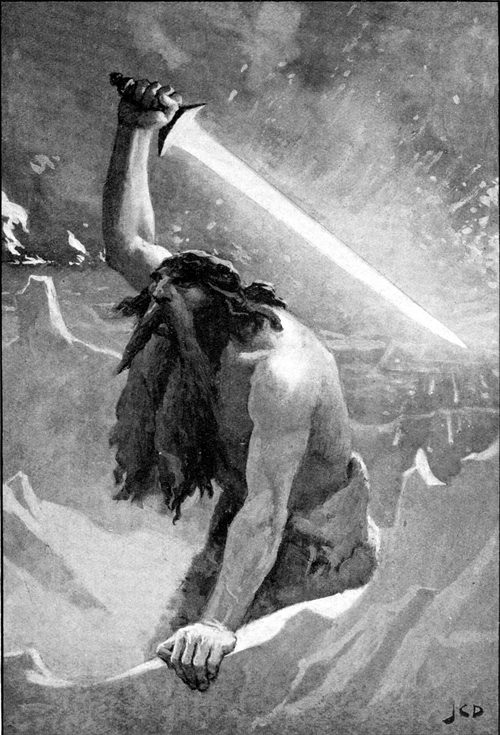
Surt fares from the south with the scourge of branches,The sun of the battle-gods shone from his sword;The crags are sundered, the giant-women sink,The dead throng Hel-way, and heaven is cloven.Völuspá 52
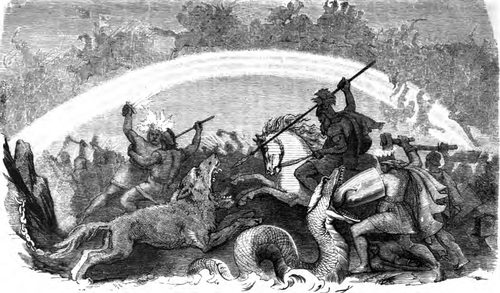
Snorri adds details. Fenrir advances with his lower jaw on the earth and his upper jaw against the sky, fire blazing from his eyes and nostrils; the serpent sprays venom over the air and sea; heaven splits open and the sons of Muspell ride out with Surtr in front, and Bifröst breaks under them Gylfaginning 51. All the armies meet on the plain Vígríðr, a hundred leagues each way Gylfaginning 51. Vafþrúðnismál gives it the same name and size Vafþrúðnismál 18.
The gods fall
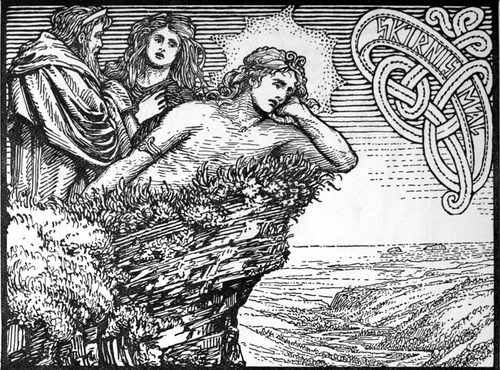
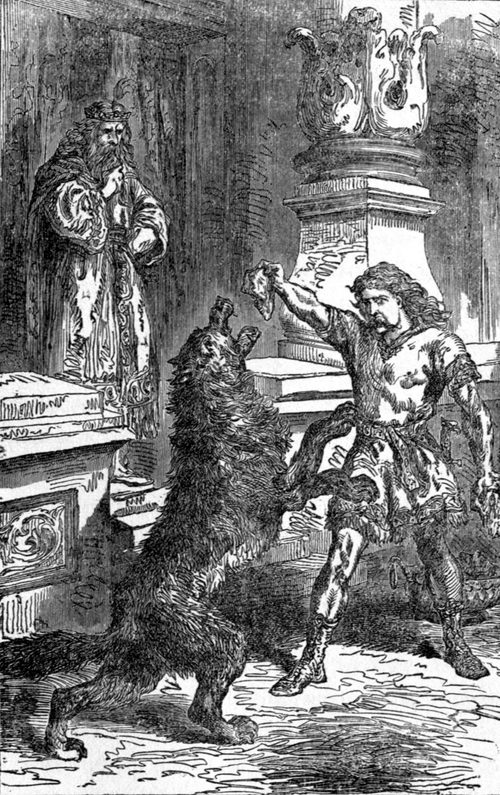
Völuspá tells the battle as a series of duels. Frigg, here called Hlín, suffers "yet another hurt" when Odin goes out to fight the wolf. Freyr, "Beli's fair slayer", goes against Surtr Völuspá 53. Snorri explains why Freyr loses: he has no sword, because he gave it to Skírnir to win Gerðr Gylfaginning 51 (see Freyr's sword). Loki had already taunted him with it at Ægir's feast Lokasenna 42.
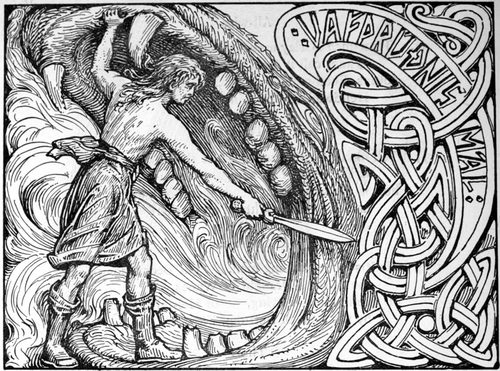
The wolf swallows Odin. His son Víðarr avenges him at once:
Then comes Sigfather's mighty son,Vithar, to fight with the foaming wolf;In the giant's son does he thrust his swordFull to the heart: his father is avenged.Völuspá 54
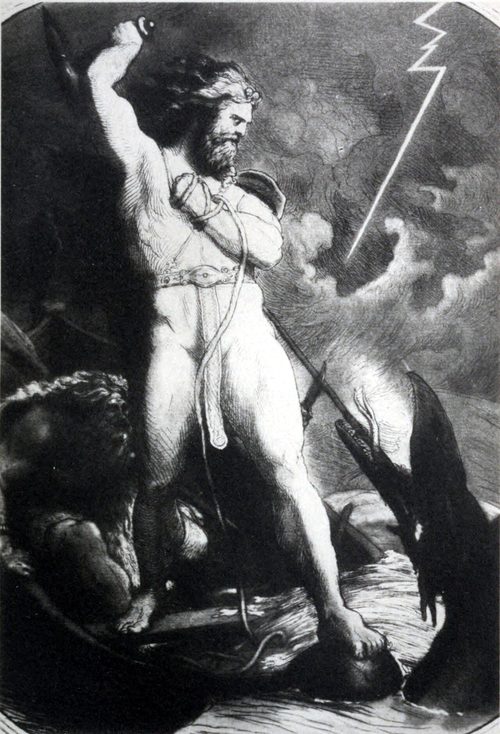
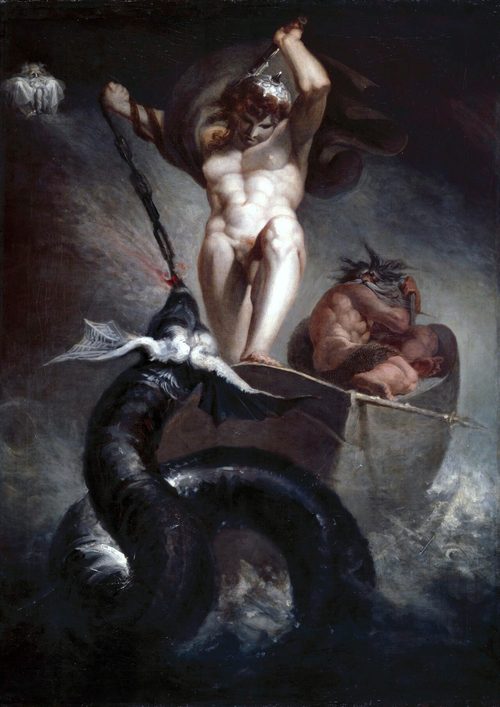
Thor, "the son of Hlothyn", goes against the serpent. He kills it in his rage, walks nine paces, and falls dead, "fearless" Völuspá 55-56. Snorri says the serpent's venom killed him Gylfaginning 51.
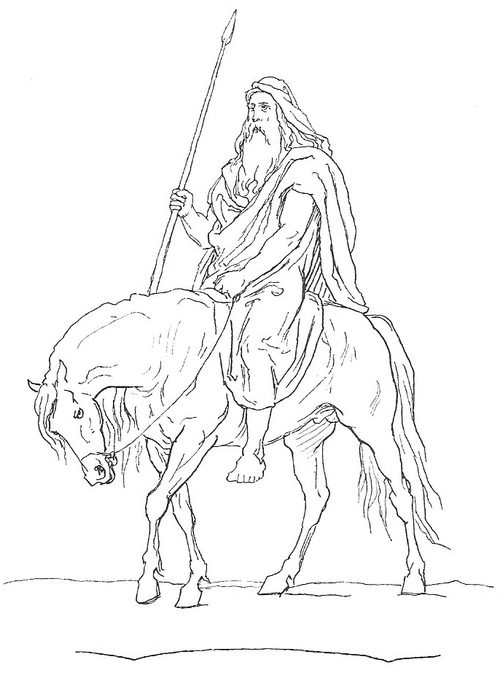
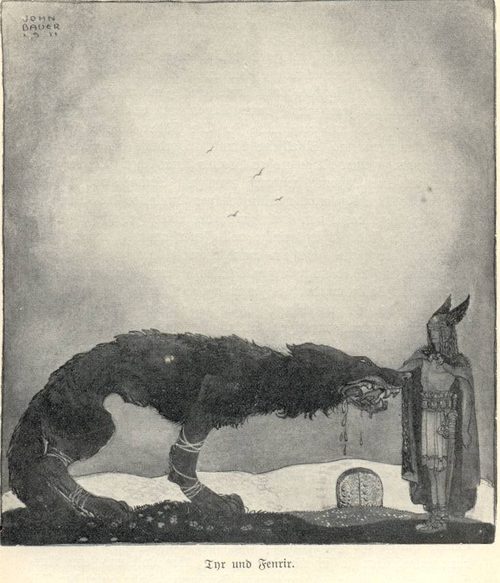
Snorri adds two more pairings that are not in Völuspá. The hound Garmr breaks loose and fights Týr, and they kill each other; Loki and Heimdallr kill each other Gylfaginning 51. The einherjar march out behind Odin, who rides first in a gold helmet with his spear Gungnir Gylfaginning 51.
Fire
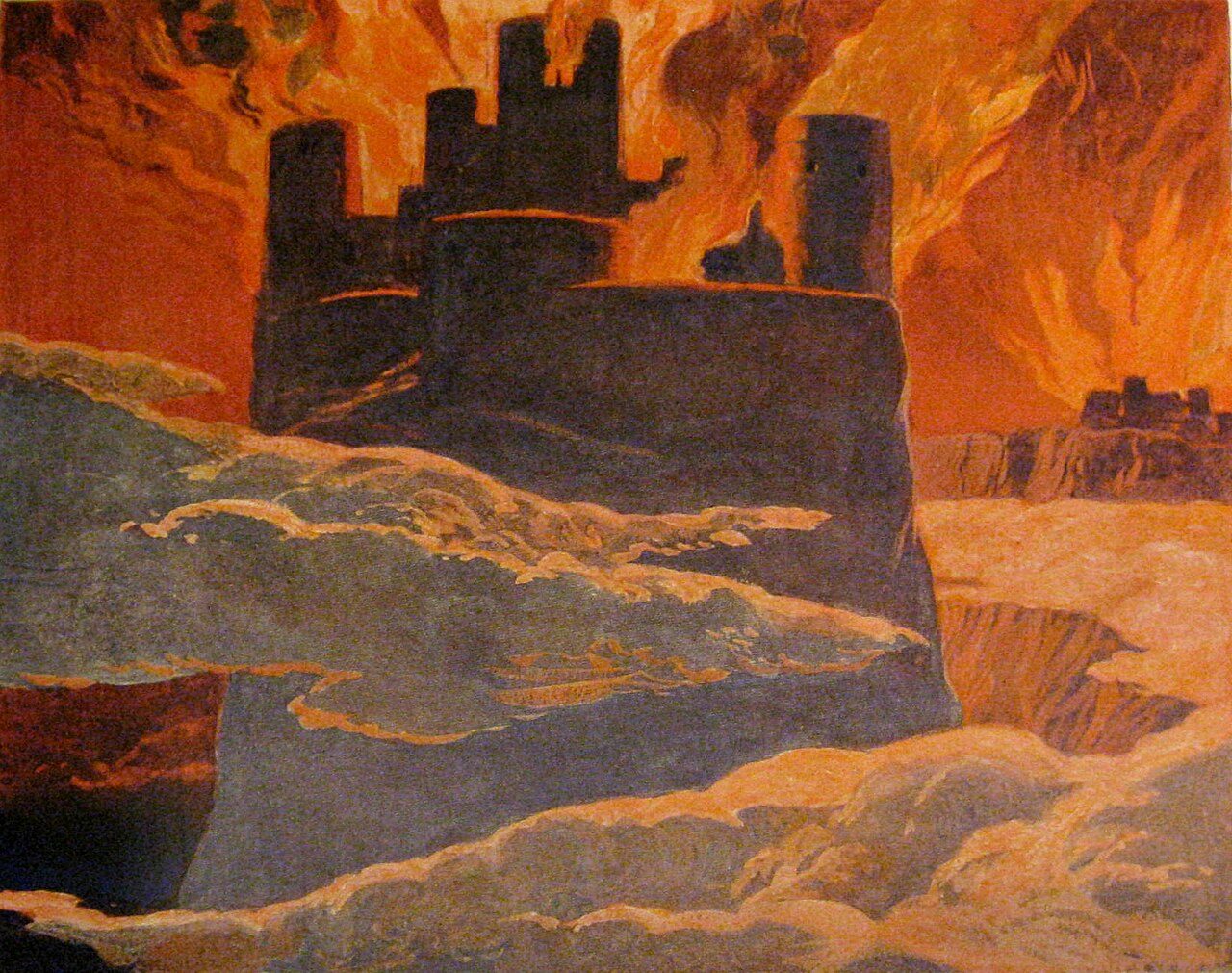
Surtr throws fire over the earth and burns the whole world Gylfaginning 51. Völuspá's version is the most famous picture of the end:
The sun turns black, earth sinks in the sea,The hot stars down from heaven are whirled;Fierce grows the steam and the life-feeding flame,Till fire leaps high about heaven itself.Völuspá 57
For many sources this is not the final word. The seeress goes on to see the earth rise again, green, from the sea (see The world reborn).
Where the story comes from
Völuspá (stanzas 40–58 in Bellows's numbering), probably composed around the year 1000, is the backbone. Vafþrúðnismál handles Ragnarök in question-and-answer form: the battlefield Vafþrúðnismál 18, the great winter Vafþrúðnismál 44, Odin's death and Víðarr's revenge Vafþrúðnismál 53, and who survives. Snorri's Gylfaginning 51 (c. 1220s) weaves both poems together, quotes Völuspá at length, and adds a good deal of his own.
The sources disagree on several points:
- How Víðarr kills the wolf. Völuspá: he drives a sword into its heart Völuspá 54. Vafþrúðnismál: he tears its jaws apart Vafþrúðnismál 53. Snorri combines them: Víðarr sets one foot, in a shoe made from the scraps of leather people have cut from their shoes through all time, on the wolf's lower jaw and tears the upper jaw away Gylfaginning 51.
- Who steers which ship, and from where. In Bellows's Völuspá, Hrymr comes from the east and Naglfar is loose, while a ship from the north carries Hel's people with Loki at the helm Völuspá 50-51. Snorri's prose makes Hrymr the steersman of Naglfar Gylfaginning 51, but the Völuspá text he quotes reads "From the east sails the keel; come now Múspell's folk … and Loki steereth" Gylfaginning 51. The manuscripts of the poem differ.
- Týr and Garmr, Heimdallr and Loki. These duels are only in Snorri. In Völuspá, Garmr only howls Völuspá 44.
- Where the battle is fought. Vafþrúðnismál and Snorri call it the plain Vígríðr. In Fáfnismál, the dying dragon calls it an isle, Óskópnir, where Bifröst breaks and the horses swim Fáfnismál 14-15.
- The Fimbulwinter. Vafþrúðnismál mentions "the mighty winter" Vafþrúðnismál 44; Völuspá has dark sunshine and storms Völuspá 41; the three-plus-three winters are Snorri's.
One Völuspá line is hard to interpret. After "the giant is loose", Bellows translates "the kinsman of Surt shall slay him soon" Völuspá 47. Who is slain, and by whom, is unclear, and editors read the line in different ways.
Reading it today
Scholars have long debated how much Christian ideas of the Last Judgement shaped these accounts, especially Völuspá, composed at the time of Iceland's conversion. Some see a native myth with Christian colouring; others see a poem shaped in dialogue with Christianity. Comparisons have also been drawn with Iranian and other Indo-European end-of-the-world myths, but these remain debated. Pictures of the battle survive in stone. The Gosforth Cross in Cumbria and the Thorwald's Cross fragment on the Isle of Man are often read as showing Víðarr and the wolf, and Odin with Fenrir, respectively. Modern culture took up the name chiefly through Wagner's Götterdämmerung (1876), a translation of "twilight of the gods", and more recently through films and games that borrow the name, often with little of the medieval story.
Key passages
Axe-time, sword-time, shields are sundered, Wind-time, wolf-time, ere the world falls
Loud blows Heimdall, the horn is aloft
When Othin fares to fight with the wolf, And Beli's fair slayer seeks out Surt
The wolf shall fell the father of men, And this shall Vithar avenge; The terrible jaws shall he tear apart
he shall do battle with Týr, and each become the other's slayer
The sun turns black, earth sinks in the sea, The hot stars down from heaven are whirled