A myth retold · about 6 minutes
Thor's journey to Útgarða-Loki
Thor travels east with Loki, Þjálfi and Röskva, sleeps in a giant's glove, and loses every contest in the hall of Útgarða-Loki: to fire, to thought, to the sea, to the World Serpent and to old age. Only at parting does he learn he was tricked.
This is the longest single story in Snorri's Gylfaginning, and the funniest. Gangleri, the king who is questioning the gods, asks whether Thor has ever met anything stronger than himself. His hosts squirm. Thor is the mightiest, they say, and everyone is bound to believe it; but the third of them, Third, finally tells the tale Gylfaginning 44.
The goats and the farmer's children
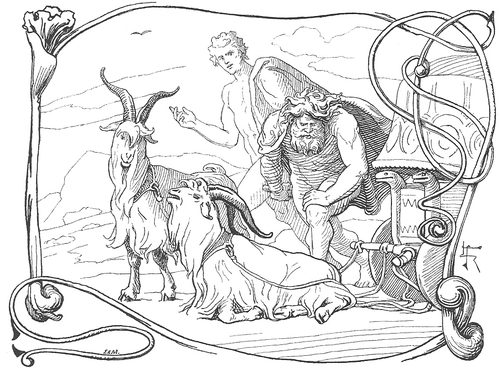
Thor set out in his chariot drawn by his two goats (Tanngrisnir and Tanngnjóstr), with Loki beside him. They stopped for the night at a farmer's house. Thor slaughtered both goats, skinned them and put them in the pot, and invited the farmer's family to eat with him. He spread the goat-skins away from the fire and told everyone to throw the bones onto them. The farmer's son, Þjálfi, split one thigh-bone with his knife to get at the marrow Gylfaginning 44.
Before dawn Thor got up, raised Mjölnir and blessed the skins. The goats stood up alive, but one was lame in a hind leg. Thor knew at once that a bone had been broken. He let his brows sink over his eyes and gripped the hammer until his knuckles went white; the family screamed for mercy and offered everything they owned. His anger cooled, and he took as compensation the two children, Þjálfi and his sister Röskva, who have served him ever since Gylfaginning 44.
The glove and the giant
Leaving the goats behind, Thor went east towards Jötunheimr, crossed the deep sea, and walked with his three companions into a great forest. Þjálfi, the fastest runner of all men, carried Thor's bag, though there was little food in it. At dark they found an enormous hall with a doorway as wide as the whole end wall, and slept there. At midnight the ground shook. They moved into a side room off to the right; Thor sat in its doorway gripping his hammer while the others cowered behind him, listening to a great roaring Gylfaginning 45.
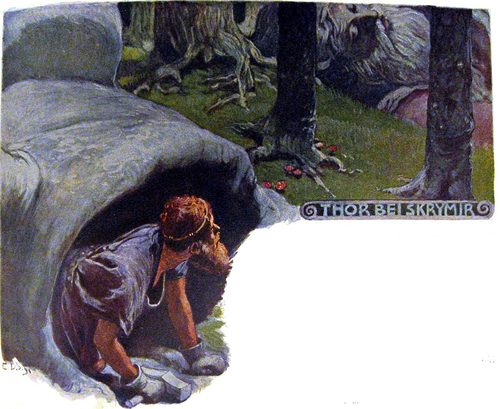
At dawn Thor went out and found a huge man asleep in the wood, snoring. Thor put on his belt of strength (Megingjörð), but the man woke, and for the first time, it is said, Thor did not dare strike. The giant said his name was Skrýmir and that he did not need to ask Thor's. Then he asked whether Thor had dragged off his glove. He picked it up: the "hall" was the glove, and the side room was its thumb Gylfaginning 45.
Skrýmir offered to travel with them and pool their food. He tied everything in one bag and strode ahead all day. That night under an oak he lay down and told them to help themselves to supper. Thor could not loosen a single knot. In a rage he hit the sleeping giant on the head with Mjölnir:
Skrýmir awoke, and asked whether a leaf had fallen upon his head; or whether they had eaten and were ready for bed?Gylfaginning 45
At midnight Thor struck again, and felt the hammer sink deep into the crown of his head; Skrýmir woke and asked if an acorn had fallen on him. Before dawn Thor struck a third time, on the temple, with all his strength. Skrýmir sat up and stroked his cheek: there must be birds in the tree, he said, dropping twigs. Then he gave them advice. They would see bigger men than him at the castle of Útgarðr, where they should not boast; better still, turn back. He shouldered the food bag and went off north. Snorri notes that the Æsir did not wish him a good journey Gylfaginning 45.
Games in the giant's hall
At noon they reached a castle so high they had to bend their heads back to see the top. Thor could not open the gate, so they squeezed between the bars. In the hall sat Útgarða-Loki, who looked at them in his own time, smiled scornfully, and asked if "this toddler" was really Thor. No one stayed there, he said, who was not master of some skill Gylfaginning 46.
Loki offered to out-eat anyone. A trough of meat was set down, Loki at one end and a man called Logi at the other. They met in the middle; Loki had eaten the meat off the bones, but Logi had eaten meat, bones and trough. Þjálfi offered to race. Útgarða-Loki matched him against a boy called Hugi, who won three heats, each by a wider margin than the last Gylfaginning 46.
Then it was Thor's turn. He offered to drink. He was given a drinking horn that good drinkers, he was told, empty in one draught and poor ones in three. Three huge draughts lowered it only a little. Next, a game for young lads: lift the host's cat. Thor got his hands under its belly and heaved, but the cat only arched its back, and at full stretch Thor managed to lift one paw off the floor. Furious, he challenged anyone to wrestle. Útgarða-Loki called in his old nurse, Elli. The harder Thor gripped, the firmer she stood, and soon he went down on one knee Gylfaginning 46. Then it was night, and the visitors were given a place to sleep and treated well.
The truth at the gate
In the morning Útgarða-Loki fed them and walked them out. Outside, he told Thor the truth: he had used illusions. He was Skrýmir. He had tied the food bag with iron. Each hammer-blow would have killed him, so he had slipped a hill in the way; Thor would see three deep, square valleys in it near the castle. Logi was wildfire, which burns trough and bones as fast as meat. Hugi was Útgarða-Loki's own thought, and no one runs as fast as thought Gylfaginning 47. Then:
the other end of the horn was out in the sea, but thou didst not perceive it. But now, when thou comest to the sea, thou shalt be able to mark what a diminishing thou hast drunk in the sea: this is henceforth called "ebb-tides."Gylfaginning 47
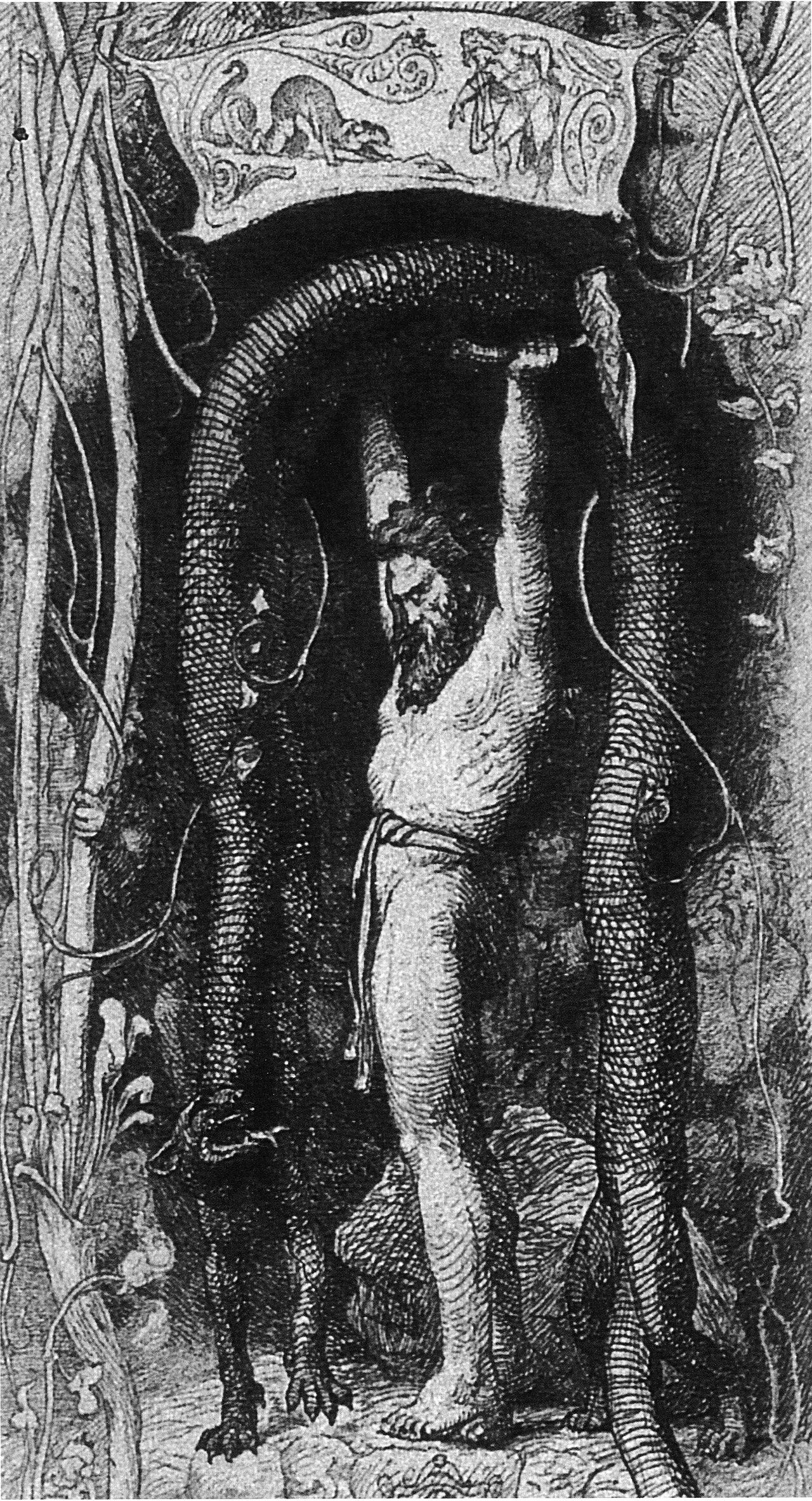
The cat was the Midgard Serpent, which circles the whole earth, and everyone had been terrified to see Thor lift it so close to the sky. Elli was old age, who brings down everyone in the end; it was a marvel that Thor fell only to one knee. They had better never come back, said Útgarða-Loki Gylfaginning 47.
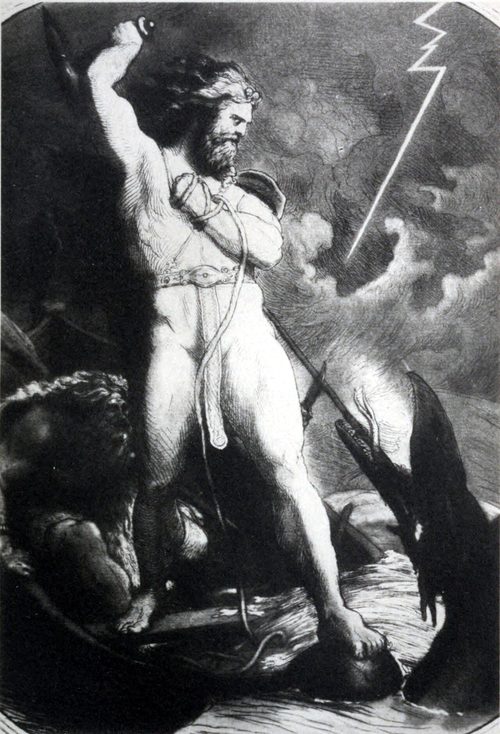
Thor raised his hammer. Útgarða-Loki was gone. He turned to smash the castle, and there was only a wide, empty plain. He went home to Þrúðvangar, already resolved to meet the Serpent again, which is the story of Thor fishes for the World Serpent Gylfaginning 47.
Where the story comes from
Snorri's Gylfaginning (around 1220) is the only full account, and the name Útgarða-Loki appears nowhere else in the Eddas. But the poets knew parts of it. In Lokasenna Loki taunts Thor that he hid "in the thumb of a glove" and could not untie "the straps of Skrymir's wallet" Lokasenna 60 Lokasenna 62. In Hárbarðsljóð Hárbarðr makes the same joke about Thor cowering in a glove, but there Thor is afraid to sneeze or fart "lest Fjalar should hear" Hárbarðsljóð 26: a different name for the glove's owner.
The opening episode also has a variant. In Hymiskvíða one of Thor's goats is lamed on the way home from Hymir's hall, "the deed the evil Loki had done", and the poet says that Thor took the farmer's two children in payment Hymiskviða 38-39. Snorri blames Þjálfi's marrow-hunting instead Gylfaginning 44. Hárbarðsljóð also shows Þjálfi as Thor's companion on another eastern adventure Hárbarðsljóð 39.
Reading it today
The story is built as a set of riddles with answers: fire, thought, sea, the Serpent and old age are things no one can beat, and Thor's "defeats" turn out to be near-victories. The explanation of the tides is the clearest example of a story told to account for something in nature. Scholars have long debated how much of it Snorri invented or reshaped; the glove references in two Eddic poems show that at least the encounter with the giant was old. Some readers also see Christian or learned influence in the allegorical figures of Thought and Old Age.
The tale is a staple of modern retellings of Norse myth for children.
Key passages
Thjálfi, the husbandman's son, was holding a thigh-bone of the goat, and split it with his knife and broke it for the marrow.
Skrýmir awoke, and asked whether a leaf had fallen upon his head
the cat bent into an arch just as Thor stretched up his hands
That cat was not as it appeared to thee: it was the Midgard Serpent
In the thumb of a glove didst thou hide, thou great one, / And there forgot thou wast Thor.
For cowardly fear in a glove wast thou fain to crawl, / And there forgot thou wast Thor