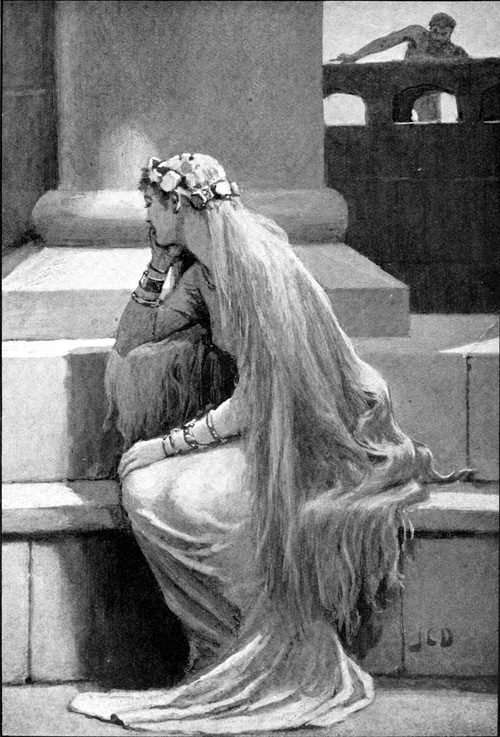
A myth retold · about 5 minutes
Thrym steals Thor's hammer
Thor wakes to find Mjölnir gone. The giant Þrymr will return it only for Freyja as his bride, so Thor goes to the wedding himself, in a veil, with Loki as his bridesmaid.
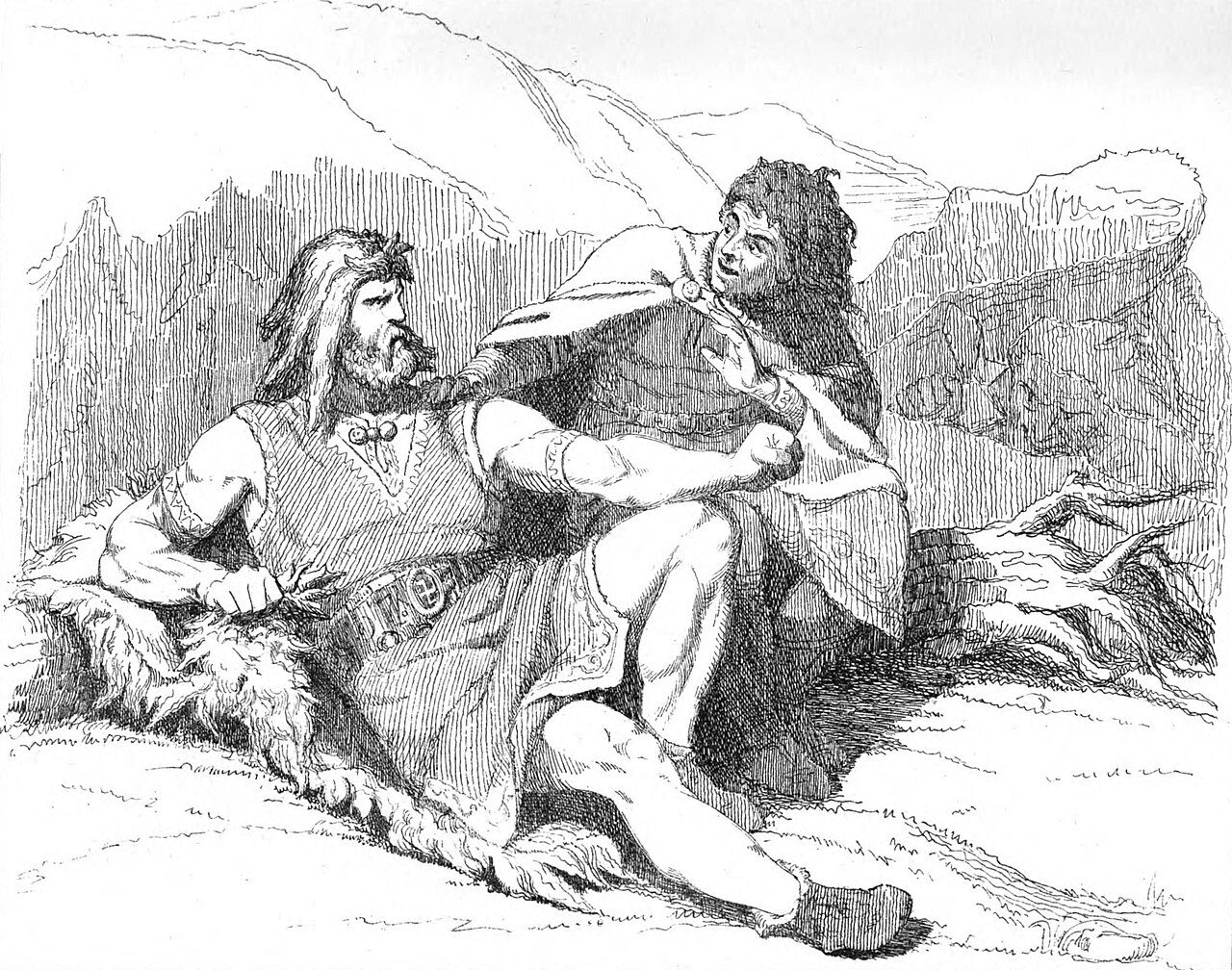
Þrymskviða is the most purely comic poem in the Poetic Edda, and one of the most tightly built. It has no prose frame and no variant: Snorri never retells it, and no other source tells the story. Everything here comes from its thirty-odd stanzas.
The hammer is gone
Thor woke up furious. His hammer was missing. He shook his beard, his hair bristled, and the son of Jörð groped around for it Þrymskviða 1. The first person he told was Loki: nobody on earth or in heaven knew it yet, but "our hammer is stolen" Þrymskviða 2.
They went to Freyja and asked to borrow her feather-shape so Loki could search. She would lend it, she said, even if it were silver or gold Þrymskviða 3-4. Loki flew, the feathers whirring, out of the land of the gods and into the land of the giants.
There sat Þrymr, lord of the giants, on a mound, plaiting gold leashes for his dogs and smoothing his horses' manes. "How fare the gods, how fare the elves?" he asked. "Ill fare the gods, ill fare the elves," said Loki: "Hast thou hidden Hlorrithi's hammer?" Þrymskviða 5-6 Þrymr admitted it at once:
"I have hidden Hlorrithi's hammer,Eight miles down deep in the earth;And back again shall no man bring itIf Freyja I win not to be my wife."Þrymskviða 7
Loki flew back. Thor met him in the courtyard and would not let him land before he spoke: a man sitting down forgets his story, and a man lying down tells lies Þrymskviða 8-9. Loki gave the news.
Freyja says no
Thor and Loki went to Freyja and told her to put on a bridal veil: the two of them must hurry to Jötunheimr. Her answer shook the hall of the gods:
Wrathful was Freyja, and fiercely she snorted,And the dwelling great of the gods was shaken,And burst was the mighty Brisings' necklace:"Most lustful indeed should I look to allIf I journeyed with thee to the giants' home."Þrymskviða 12
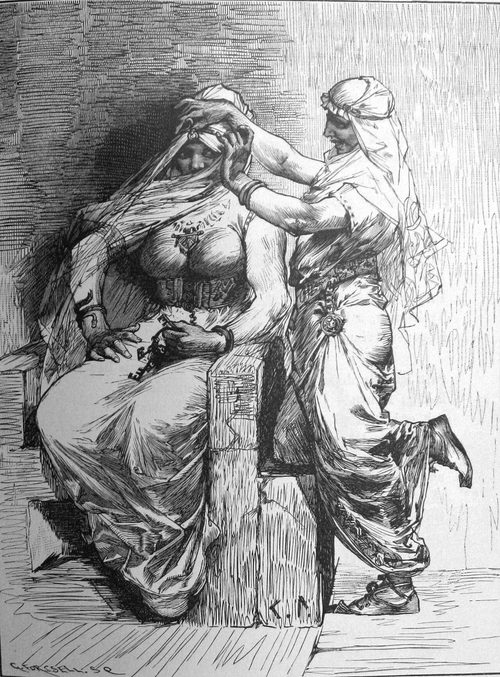
The gods and goddesses met in council. Heimdallr, whitest of the gods, who could see the future like the Vanir, had the answer: dress Thor as the bride. Put the bridal veil and the necklace Brísingamen on him, hang keys at his belt, let a woman's dress fall to his knees, put broad gems on his breast and a pretty cap on his head Þrymskviða 14-15.
Thor objected that the gods would call him unmanly Þrymskviða 16. Loki told him to be quiet: without the hammer, the giants would soon be living in Asgard Þrymskviða 17. So they dressed him, stanza by stanza, exactly as Heimdallr had said, and Loki offered to go along as his maid Þrymskviða 18-20. The goats were brought in; mountains burst and the earth burned as Odin's son drove to Jötunheimr Þrymskviða 21.
The bride at the feast
Þrymr was delighted. Spread straw on the benches, he told the giants: they were bringing him Freyja, daughter of Njörðr of Nóatún. He had gold-horned cows and jet-black oxen and treasure enough; Freyja was all he lacked Þrymskviða 22-23.
At the evening feast the bride ate a whole ox, eight salmon and all the delicacies set out for the women, and drank three casks of mead Þrymskviða 24. Þrymr had never seen a bride bite so broadly or drink so deep Þrymskviða 25. The clever maid had an answer: Freyja had not eaten for eight nights, so eager was she to come to Jötunheimr Þrymskviða 26.
Þrymr bent to kiss her under the veil, and leapt back the length of the hall:
Thrym looked 'neath the veil, for he longed to kiss,But back he leaped the length of the hall:"Why are so fearful the eyes of Freyja?Fire, methinks, from her eyes burns forth."Þrymskviða 27
The maid answered again: Freyja had not slept for eight nights, she had longed so hard for Jötunheimr Þrymskviða 28. Then the giant's sister came in and asked the bride for red-gold rings as the price of her friendship Þrymskviða 29.
The hammer in the bride's lap
Þrymr called for the hammer to bless the bride. Lay Mjölnir in the maiden's lap, he said, and let them be wed by the hand of Vár Þrymskviða 30. Snorri describes Vár as the goddess who hears the oaths and agreements of men and women Gylfaginning 35.
The heart in the breast of Hlorrithi laughedWhen the hard-souled one his hammer beheld;First Thrym, the king of the giants, he killed,Then all the folk of the giants he felled.Þrymskviða 31
He killed the old sister too: instead of shillings she got a blow, and the hammer's weight in place of rings Þrymskviða 32. "And so his hammer got Othin's son" Þrymskviða 33.
Where the story comes from
The poem survives only in the Codex Regius (around 1270). It is not mentioned in Snorri's Edda, though Snorri knew the hammer's importance well: he calls it the gods' best defence against the frost-giants Skáldskaparmál 35 and explains that Thor needs his iron gloves to wield it Gylfaginning 21. The poem's own names follow common usage elsewhere: Thor is "Vingthor" and "Hlorrithi", "son of Jorth" and "Othin's son"; Freyja is Njörðr's daughter from Nóatún, as in Snorri Gylfaginning 24.
Its date is one of the most argued questions in Eddic scholarship. Some scholars place it among the oldest poems, from the pagan period; others argue it is a late, knowing parody composed in Christian Iceland, perhaps in the 13th century, pointing to its polished, ballad-like repetitions and its comic treatment of the gods. There is no firm evidence either way.
Reading it today
Readers have taken the poem as pure farce, as satire on the gods, or as a story about the hammer's role in weddings: the use of Mjölnir to "hallow" the bride suggests a custom of blessing marriages with a hammer, and small hammer-shaped amulets are common Viking-Age finds, though nothing ties them to weddings directly. The cross-dressing is the heart of the joke: Thor, the most masculine of the gods, fears exactly the mockery the poem gives him, and Loki, whom Odin elsewhere taunts for having lived as a milkmaid and borne children Lokasenna 23, plays the maid with ease.
It is one of the most often retold Norse myths today, a favourite of children's collections of the stories.
Key passages
Wild was Vingthor when he awoke, / And when his mighty hammer he missed
I have hidden Hlorrithi's hammer, / Eight miles down deep in the earth; / And back again shall no man bring it / If Freyja I win not to be my wife.
Wrathful was Freyja, and fiercely she snorted, / And the dwelling great of the gods was shaken
Else will the giants in Asgarth dwell / If thy hammer is brought not home to thee.
Why are so fearful the eyes of Freyja? / Fire, methinks, from her eyes burns forth.
The heart in the breast of Hlorrithi laughed / When the hard-souled one his hammer beheld