A myth retold · about 6 minutes
Thor fishes for the World Serpent
Sent to fetch a giant's brewing kettle, Thor goes fishing with the giant Hymir, baits his hook with an ox-head and hauls the Midgard Serpent up to the gunwale. The poem Hymiskvíða and Snorri tell it differently, and disagree on how it ended.
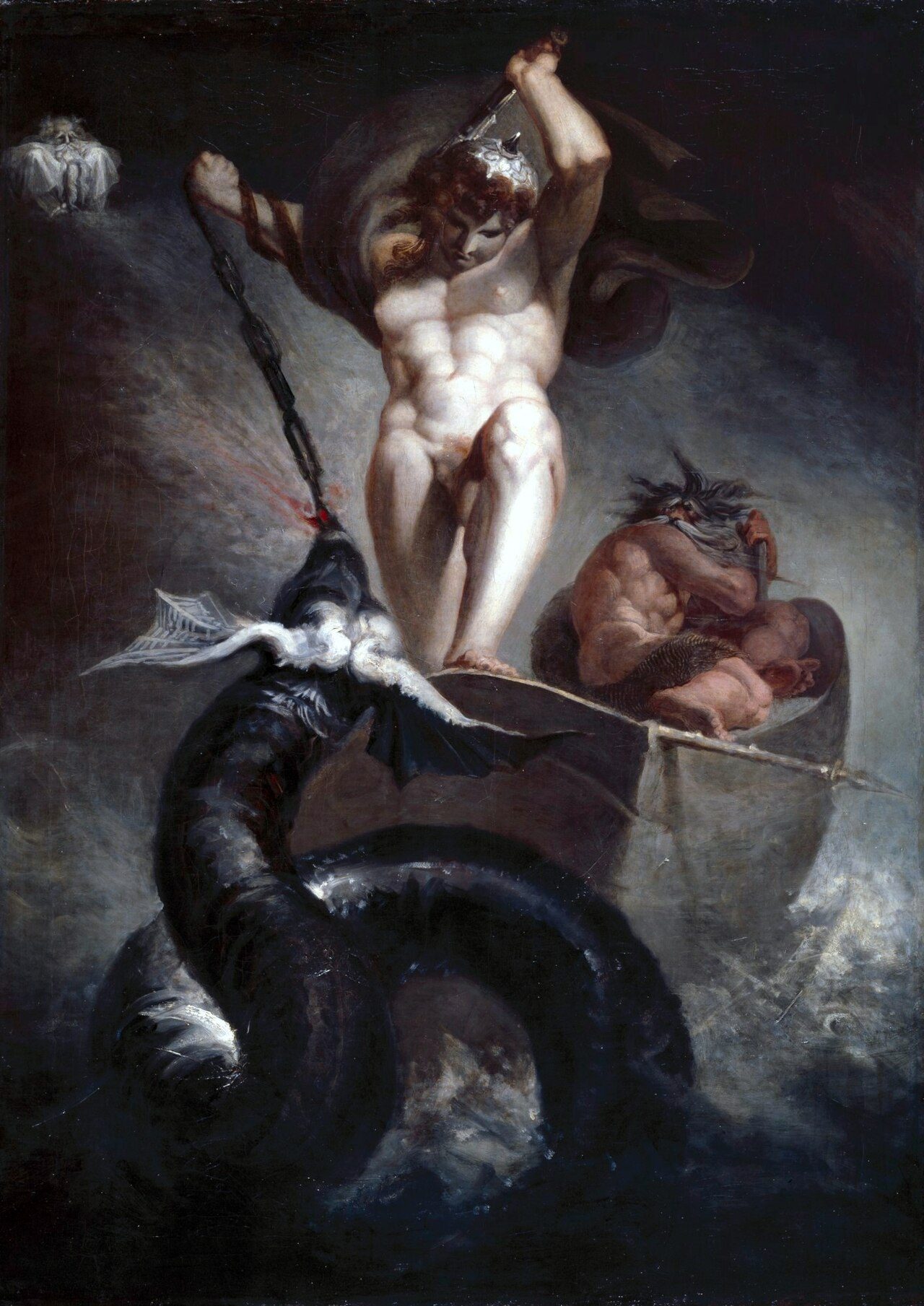
Thor's fishing trip is one of the oldest-attested Norse myths: it was carved on stones and sung by skalds long before it was written down. Two full versions survive, and they differ. This retelling follows the Eddic poem Hymiskvíða; Snorri's version is set out after it.
A kettle for Ægir
The gods were feasting, and they wanted ale. Thor stared the sea-giant Ægir in the eye and told him to make them a feast. Ægir, resentful, set him a task: bring a kettle big enough to brew for them all Hymiskviða 1-3. No god knew where to find one until Týr spoke up:
"There dwells to the east of ElivagarHymir the wise at the end of heaven;A kettle my father fierce doth own,A mighty vessel a mile in depth."Hymiskviða 5
In this poem, then, Týr is the son of the giant Hymir. The two gods set out from Asgard for the far side of the rivers of Élivágar, left Thor's goats with a man named Egil, and went on to Hymir's hall Hymiskviða 7. There Týr met his grandmother, whom he loathed: she had nine hundred heads. His mother, bright with gold, brought them beer and hid them under the kettles, warning that her husband was often hostile to guests Hymiskviða 8-9.
Supper at Hymir's
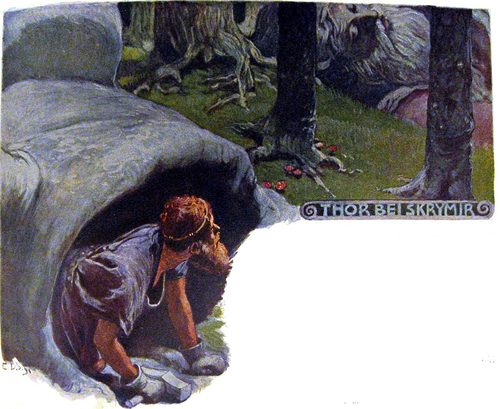
Hymir came home late from hunting, icicles rattling in his frozen beard. His wife told him his son had come, and with him Thor ("Veur", in the poem) Hymiskviða 10-11. At the giant's glance the beam they hid behind split, a pillar broke, and eight kettles fell from the ledge; only one, hard-hammered, stayed whole Hymiskviða 12-13. Hymir was not pleased to see the giants' enemy on his floor, but three oxen were killed and boiled, and before bed Thor ate two of them by himself. Hymir said that tomorrow evening they would have to live on what they caught Hymiskviða 14-16.
Thor said he would gladly row out to fish, if the giant would give him bait. Go to the herd, said Hymir, and find your own. Thor went into the wood, found an all-black ox and broke off its head Hymiskviða 17-19.
The bait and the Serpent
Out at sea Thor told Hymir to row farther; the giant had no wish to Hymiskviða 21. Hymir pulled up two whales at one cast. Thor, in the stern, prepared his line with care and fixed the ox-head on his hook Hymiskviða 22-23. Then:
There gaped at the bait the foe of the gods,The girdler of all the earth beneath.Hymiskviða 23
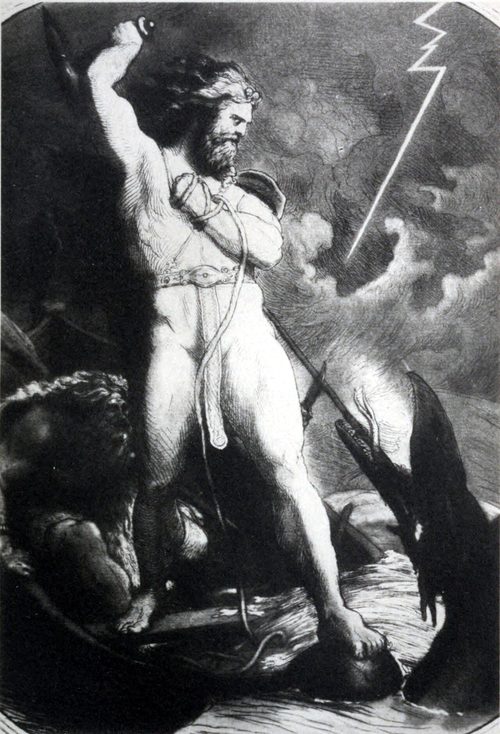
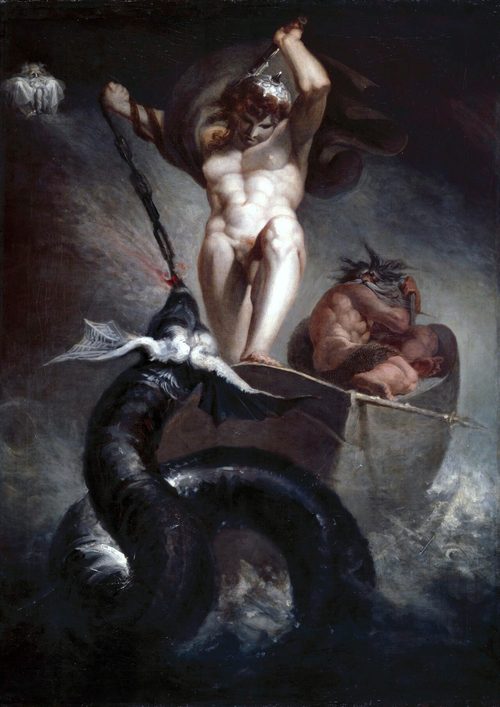
Thor hauled the venomous serpent up to the boat and struck the top of its head with his hammer Hymiskviða 24. Monsters roared, the rocks echoed, the whole old earth shook, and the fish sank back into the sea Hymiskviða 25. A gap in the manuscript hides exactly what happened between the blow and the sinking.
Hymir rowed back in gloomy silence. Then he challenged Thor: would he carry the whales up to the house, or make the boat fast? Thor picked up the whole boat, full of water, with oars and bailer, and carried it and the whales up through the wooded gorge to the giant's house Hymiskviða 26-28.
The cup and the kettle
Hymir was still not satisfied. A man was not truly strong, he said, unless he could break his cup. Thor threw it at the stone pillars; the pillars shattered, the cup was brought back whole. Then Týr's mother whispered advice: strike it on Hymir's own skull, which is harder than any glass. Thor rose to his knee and struck with all his strength; the giant's head was fine, the cup broke Hymiskviða 29-32. Hymir mourned his treasure and said they could take the kettle if they could carry it out. Týr tried twice and could not move it. Thor seized the rim, lifted it onto his head, and walked off with its handles clattering round his heels Hymiskviða 33-35.
Looking back, he saw Hymir coming after them from the east with a host of many-headed giants. Thor set down the kettle and killed them all with Mjölnir Hymiskviða 36-37. On the way, one of his goats went lame, "the deed the evil Loki had done", and the poet reminds his hearers how Thor took two children from a farmer in payment Hymiskviða 38-39. Thor brought the kettle to the gods, and every autumn after they drank ale in Ægir's hall Hymiskviða 40.
Snorri's version
In Gylfaginning the trip is Thor's revenge for his humiliation by Útgarða-Loki, where he had lifted the Serpent disguised as a cat (see Thor's journey to Útgarða-Loki). There is no kettle and no Týr. Thor goes alone, without his chariot, disguised as a young lad, and spends the night with Hymir. When Hymir says the boy will freeze out at sea, Thor nearly hits him, but saves his strength. He takes the head of the biggest ox, named Himinbrjótr ("Heaven-breaker") Gylfaginning 48.
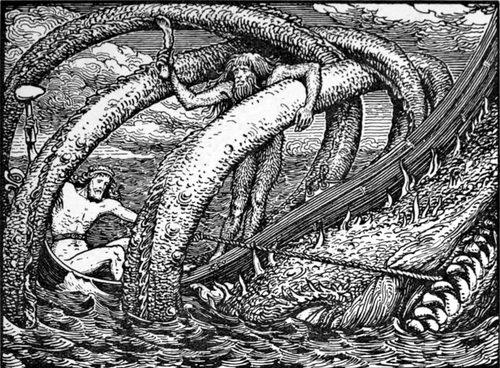
Thor rows past the fishing banks and out to where Hymir says the Midgard Serpent makes it dangerous. The Serpent takes the bait and lunges so hard that Thor's fists smash against the gunwale. Thor summons his divine strength and pushes so hard that his feet go through the bottom of the boat and he stands on the sea floor, and hauls the Serpent up:
bow Thor flashed fiery glances at the Serpent, and the Serpent in turn stared up toward him from below and blew venom.Gylfaginning 48
Hymir goes pale and yellow with fear. Just as Thor raises the hammer, the giant cuts the line, and the Serpent sinks. Thor throws the hammer after it. "Men say" it struck the Serpent's head off on the sea bed, says Snorri's narrator, "but I think it were true to tell thee that the Midgard Serpent yet lives". Thor punches Hymir overboard and wades ashore Gylfaginning 48.
Where the story comes from
Hymiskvíða is in the Codex Regius (around 1270); many scholars consider it a fairly late poem, full of elaborate kennings. Snorri's Gylfaginning dates from around 1220. The main differences:
- Purpose and company. Poem: a kettle for Ægir's feast, with Týr. Snorri: revenge on the Serpent, alone.
- Týr's father. Poem: Hymir Hymiskviða 5. Snorri elsewhere calls Týr the son of Odin Skáldskaparmál 9.
- The climax. Poem: Thor strikes the Serpent's head and it sinks Hymiskviða 24-25. Snorri: Hymir cuts the line before the blow; Thor's feet go through the boat.
- The ending. Poem: Thor carries the boat home and beats Hymir in further trials. Snorri: Thor knocks Hymir overboard.
Snorri also quotes much older skaldic verses Skáldskaparmál 4. Bragi Boddason (9th century) describes the Serpent staring up at Thor; Eysteinn Valdason has Thor's fists pulled past the gunwale; Úlfr Uggason (about 985), describing carvings in a hall in Iceland, says Thor punched Hymir's temple ("a hurt full deadly") and struck the Serpent's head off. So some old tradition did kill the Serpent here, and Snorri chose the version in which it survives for Ragnarök, where Thor and the Serpent kill each other Völuspá 56.
Reading it today
The scene was clearly popular in the Viking Age: carved stones from Sweden, Denmark and England show a figure in a boat with a hook and line, sometimes with his foot through the hull, which matches Snorri's detail. Scholars often contrast the two endings: an older tradition in which Thor kills the Serpent, and a later one shaped by the idea that the Serpent must survive to fight at Ragnarök. Hymiskvíða's comic giant-family scenes, the many-headed grandmother and the cup broken on Hymir's skull, have led some readers to see the poem as partly a playful, learned reworking of older material.
Key passages
There dwells to the east of Elivagar / Hymir the wise at the end of heaven; / A kettle my father fierce doth own, / A mighty vessel a mile in depth.
There gaped at the bait the foe of the gods, / The girdler of all the earth beneath.
With his hammer the loathly hill of the hair / Of the brother of Fenrir he smote from above.
braced his feet so strongly that he plunged through the ship with both feet, and dashed his feet against the bottom
the giant fumbled for his fish-knife and hacked off Thor's line at the gunwale, and the Serpent sank down into the sea
Vimur's ford's Wide-Grappler / 'Gainst the waves smote featly / The glittering Serpent's head off.