
Poetic Edda · poems of the gods
Vafþrúðnismál
The Lay of Vafthrudnir
Bellows's introduction
The Vafthruthnismol follows the Hovamol in the Codex Regius. From stanza 20 on it is also included in the Arnamagnæan Codex, the first part evidently having appeared on a leaf now lost. Snorri quotes eight stanzas of it in the Prose Edda, and in his prose text closely paraphrases many others.
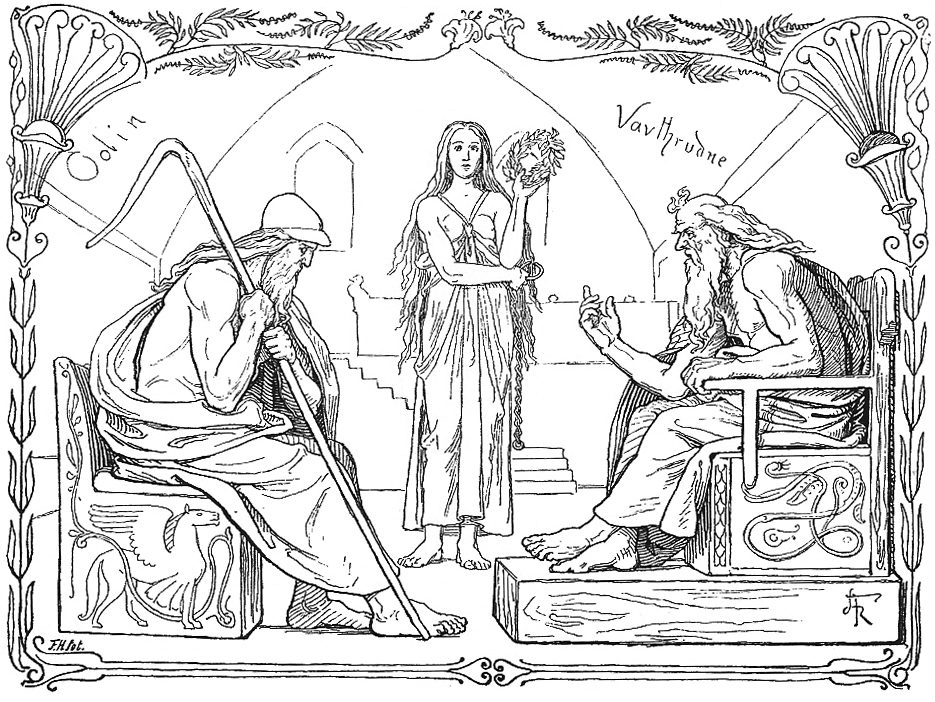
The poem is wholly in dialogue form except for a single narrative stanza (stanza 5). After a brief introductory discussion between Othin and his wife, Frigg, concerning the reputed wisdom of the giant Vafthruthnir, Othin, always in quest of wisdom, seeks out the giant, calling himself Gagnrath. The giant immediately insists that they shall demonstrate which is the wiser of the two, and propounds four questions (stanzas 11, 13, 15, and 17), each of which Othin answers. It is then the god's turn to ask, and he begins with a series of twelve numbered questions regarding the origins and past history of life. These Vafthruthnir answers, and Othin asks five more questions, this time referring to what is to follow the destruction of the gods, the last one asking the name of his own slayer. Again Vafthruthnir answers, and Othin finally propounds the unanswerable question: "What spake Othin himself in the ears of his son, ere in the bale-fire he burned?" Vafthruthnir, recognizing his questioner as Othin himself, admits his inferiority in wisdom, and so the contest ends.
The whole poem is essentially encyclopædic in character, and thus was particularly useful to Snorri in his preparation of the Prose Edda. The encyclopædic poem with a slight narrative outline seems to have been exceedingly popular; the Grimnismol and the much later Alvissmol represent different phases of the same type. The Vafthruthnismol and Grimnismol together, indeed, constitute a fairly complete dictionary of Norse mythology. There has been much discussion as to the probable date of the Vafthruthnismol, but it appears to belong to about the same period as the Voluspo: in other words, the middle of the tenth century. While there may be a few interpolated passages in the poem as we now have it, it is clearly a united whole, and evidently in relatively good condition.
Othin spake:"Counsel me, Frigg,for I long to fare,And Vafthruthnir fain would find;In wisdom oldwith the giant wiseMyself would I seek to match."
Note
The phrases "Othin spake," "Frigg spake," etc. appear in abbreviated form in both manuscripts. Frigg: Othin's wife; cf. Voluspo, 34 and note. Vafthruthnir ("the Mighty in Riddles"): nothing is known of this giant beyond what is told in this poem.
Frigg spake:"Heerfather hereat home would I keep,Where the gods together dwell;Amid all the giantsan equal in mightTo Vafthruthnir know I none."
Note
Heerfather ("Father of the Host"): Othin.
Cited on Frigg, Vafþrúðnir, Odin's contest of wisdom with Vafþrúðnir
Othin spake:"Much have I fared,much have I found,Much have I got from the gods;And fain would I knowhow Vafthruthnir nowLives in his lofty hall."
Frigg spake:"Safe mayst thou go,safe come again,And safe be the way thou wendest!Father of men,let thy mind be keenWhen speech with the giant thou seekest."
The wisdom thenof the giant wiseForth did he fare to try;He found the hallof the father of Im,And in forthwith went Ygg.
Note
This single narrative stanza is presumably a later interpolation. Im: the name appears to be corrupt, but we know nothing of any son of Vafthruthnir. Ygg ("the Terrible"): Othin.
Othin spake:"Vafthruthnir, hail!to thy hall am I come,For thyself I fain would see;And first would I askif wise thou art,Or, giant, all wisdom hast won."
Vafthruthnir spake:"Who is the manthat speaks to me,Here in my lofty hall?Forth from our dwellingthou never shalt fare,Unless wiser than I thou art."
Othin spake:"Gagnrath they call me,and thirsty I comeFrom a journey hard to thy hall;Welcome I look for,for long have I fared,And gentle greeting, giant."
Note
Gagnrath ("the Gain-Counsellor"): Othin on his travels always assumes a name other than his own.
Cited on Odin, Odin's contest of wisdom with Vafþrúðnir
Vafthruthnir spake:"Why standest thou thereon the floor whilst thou speakest?A seat shalt thou have in my hall;Then soon shall we knowwhose knowledge is more,The guest's or the sage's gray."
Othin spake:"If a poor man reachesthe home of the rich,Let him wisely speak or be still;For to him who speakswith the hard of heartWill chattering ever work ill."
Note
This stanza sounds very much like many of those in the first part of the Hovamol, and may have been introduced here from some such source.
Vafthruthnir spake:"Speak forth now, Gagnrath,if there from the floorThou wouldst thy wisdom make known:What name has the steedthat each morn anewThe day for mankind doth draw?"
Othin spake:"Skinfaxi is he,the steed who for menThe glittering day doth draw;The best of horsesto heroes he seems,And brightly his mane doth burn."
Note
Skinfaxi: "Shining-Mane."
Cited on Dagr, Skinfaxi and Hrímfaxi, Sun, Moon, Night and Day
Vafthruthnir spake:"Speak forth now, Gagnrath,if there from the floorThou wouldst thy wisdom make known:What name has the steedthat from East anewBrings night for the noble gods?"
Note
Here, and in general throughout the poem, the two-line introductory formulæ are abbreviated in the manuscripts.
Cited on Skinfaxi and Hrímfaxi
Othin spake:"Hrimfaxi name theythe steed that anewBrings night for the noble gods;Each morning foamfrom his bit there falls,And thence come the dews in the dales."
Note
Hrimfaxi: "Frosty-Mane."
Cited on Nótt, Skinfaxi and Hrímfaxi, Sun, Moon, Night and Day
Vafthruthnir spake:"Speak forth now, Gagnrath,if there from the floorThou wouldst thy wisdom make known:What name has the riverthat 'twixt the realmsOf the gods and the giants goes?"
Othin spake:"Ifing is the riverthat 'twixt the realmsOf the gods and the giants goes;For all time everopen it flows,No ice on the river there is."
Note
Ifing: there is no other reference to this river, which never freezes, so that the giants cannot cross it.
Cited on Jötunheimr
Vafthruthnir spake:"Speak forth now, Gagnrath,if there from the floorThou wouldst thy wisdom make known:What name has the fieldwhere in fight shall meetSurt and the gracious gods?"
Note
Surt: the ruler of the fire-world (Muspellsheim), who comes to attack the gods in the last battle; cf. Voluspo, 52.
Cited on Vígríðr
Othin spake:"Vigrith is the fieldwhere in fight shall meetSurt and the gracious gods;A hundred mileseach way does it measure.And so are its boundaries set."
Note
Vigrith: "the Field of Battle." Snorri quotes this stanza. A hundred miles: a general phrase for a vast distance.
Cited on Ragnarök, Surtr, Vígríðr, Ragnarök: the doom of the gods, Sigurðr slays Fáfnir
Vafthruthnir spake:"Wise art thou, guest!To my bench shalt thou go,In our seats let us speak together;Here in the hallour heads, O guest,Shall we wager our wisdom upon."
Note
With this stanza Vafthruthnir, sufficiently impressed with his guest's wisdom to invite him to share his own seat, resigns the questioning to Othin.
Cited on Vafþrúðnir, Odin's contest of wisdom with Vafþrúðnir
Othin spake:"First answer me well,if thy wisdom avails,And thou knowest it, Vafthruthnir, now:In earliest timewhence came the earth,Or the sky, thou giant sage?"
Note
The fragmentary version of this poem in the Arnamagnæan Codex begins in the middle of the first line of this stanza.
Vafthruthnir spake:"Out of Ymir's fleshwas fashioned the earth,And the mountains were made of his bones;The sky from the frost-coldgiant's skull,And the ocean out of his blood."
Note
Ymir: the giant out of whose body the gods made the world; cf. Voluspo, 3 and note.
Cited on Midgard, Vafþrúðnir, Ymir, The making of the world, Odin's contest of wisdom with Vafþrúðnir
Othin spake:"Next answer me well,if thy wisdom avails,And thou knowest it, Vafthruthnir, now:Whence came the moon,o'er the world of menThat fares, and the flaming sun?"
Note
In this and in Othin's following questions, both manuscripts replace the words "next," "third," "fourth," etc., by Roman numerals.
Vafthruthnir spake:"Mundilferi is hewho begat the moon,And fathered the flaming sun;The round of heaveneach day they run,To tell the time for men."
Note
Mundilferi ("the Turner"?): known only as the father of Mani (the Moon) and Sol (the Sun). Note that, curiously enough, Mani is the boy and Sol the girl. According to Snorri, Sol drove the horses of the sun, and Mani those of the moon, for the gods, indignant that they should have been given such imposing names, took them from their father to perform these tasks. Cf. Grimnismol, 37.
Cited on Máni, Mundilfari, Sól, Sun, Moon, Night and Day
Othin spake:"Third answer me well,if wise thou art called,If thou knowest it, Vafthruthnir, now:Whence came the day,o'er mankind that fares,Or night with the narrowing moon?"
Vafthruthnir spake:"The father of dayis Delling called,And the night was begotten by Nor;Full moon and oldby the gods were fashioned,To tell the time for men."
Note
Delling ("the Dayspring"? Probably another form of the name, Dogling, meaning "Son of the Dew" is more correct): the husband of Not (Night); their son was Dag (Day); cf. Hovamol, 161. Nor: Snorri calls the father of Night Norvi or Narfi, and puts him among the giants. Lines 3-4: cf. Voluspo, 6.
Cited on Dagr, Máni, Nörfi, Nótt, Sun, Moon, Night and Day
Othin spake:"Fourth answer me well,if wise thou art called,If thou knowest it, Vafthruthnir, now:Whence did winter come,or the summer warm,First with the gracious gods?"
Vafthruthnir spake:"Vindsval he waswho was winter's father,And Svosuth summer begat;"..............................
Note
Neither the Regius nor the Arnamagnæan Codex indicates a lacuna. Most editors have filled out the stanza with two lines from late paper manuscripts: "And both of these shall ever be, / Till the gods to destruction go." Bugge ingeniously paraphrases Snorri's prose: "Vindsval's father was Vosuth called, / And rough is all his race." Vindsval: "the Wind-Cold," also called Vindljoni, "the Wind-Man." Svosuth: "the Gentle."
Othin spake:"Fifth answer me well,if wise thou art called,If thou knowest it, Vafthruthnir, now:What giant firstwas fashioned of old,And the eldest of Ymir's kin?"
Note
Ymir's kin: the giants.
Cited on Þrúðgelmir, Odin's contest of wisdom with Vafþrúðnir
Vafthruthnir spake:"Winters unmeasuredere earth was madeWas the birth of Bergelmir;Thruthgelmir's sonwas the giant strong,And Aurgelmir's grandson of old."
Note
Bergelmir: when the gods slew Ymir in order to make the world out of his body, so much blood flowed from him that all the frost-giants were drowned except Bergelmir and his wife, who escaped in a boat; cf. stanza 35. Of Thruthgelmir ("the Mightily Burning") we know nothing, but Aurgelmir was the frost-giants' name for Ymir himself. Thus Ymir was the first of the giants, and so Othin's question is answered.
Cited on Bergelmir, Þrúðgelmir, The making of the world
Othin spake:"Sixth answer me well,if wise thou art called,If thou knowest it, Vafthruthnir, now:Whence did Aurgelmir comewith the giants' kin,Long since, thou giant sage?"
Vafthruthnir spake:"Down from Elivagardid venom drop,And waxed till a giant it was;And thence aroseour giants' race,And thus so fierce are we found."
Note
Snorri quotes this stanza, and the last two lines are taken from his version, as both of the manuscripts omit them. Elivagar ("Stormy Waves"): Mogk suggests that this river may have been the Milky Way. At any rate, the venom carried in its waters froze into ice-banks over Ginnunga-gap (the "yawning gap" referred to in Voluspo, 3), and then dripped down to make the giant Ymir.
Cited on Élivágar, The giants (jötnar), Vafþrúðnir, Ymir, The making of the world
Othin spake:"Seventh answer me well,if wise thou art called,If thou knowest it, Vafthruthnir, now:How begat he children,the giant grim,Who never a giantess knew?"
Vafthruthnir spake:"They say 'neath the armsof the giant of iceGrew man-child and maid together;And foot with footdid the wise one fashionA son that six heads bore."
Note
Snorri gives, without materially elaborating on it, the same account of how Ymir's son and daughter were born under his left arm, and how his feet together created a son. That this offspring should have had six heads is nothing out of the ordinary, for various giants had more than the normal number, and Hymir's mother is credited with a little matter of nine hundred heads; cf. Hymiskvitha, 8. Of the career of Ymir's six-headed son we know nothing; he may have been the Thruthgelmir of stanza 29.
Cited on Þrúðgelmir, Ymir, The making of the world
Othin spake:"Eighth answer me well,if wise thou art called,If thou knowest it, Vafthruthnir, now:What farthest backdost thou bear in mind?For wide is thy wisdom, giant!"
Vafthruthnir spake:"Winters unmeasuredere earth was madeWas the birth of Bergelmir;This first knew I well,when the giant wiseIn a boat of old was borne."
Note
Snorri quotes this stanza. Bergelmir: on him and his boat cf. stanza 29 and note.
Cited on Bergelmir, Vafþrúðnir, The making of the world, Odin's contest of wisdom with Vafþrúðnir
Othin spake:"Ninth answer me well,if wise thou art called,If thou knowest it, Vafthruthnir, now:Whence comes the windthat fares o'er the wavesYet never itself is seen?"
Cited on Hræsvelgr, Odin's contest of wisdom with Vafþrúðnir
Vafthruthnir spake:"In an eagle's guiseat the end of heavenHræsvelg sits, they say;And from his wingsdoes the wind come forthTo move o'er the world of men."
Note
Snorri quotes this stanza. Hræsvelg ("the Corpse-Eater"): on this giant in eagle's form cf. Voluspo, 50, and Skirnismol, 27.
Cited on Hræsvelgr, Veðrfölnir and the eagle
Othin spake:"Tenth answer me now,if thou knowest allThe fate that is fixed for the gods:Whence came up Njorthto the kin of the gods,—(Rich in templesand shrines he rules,—)Though of gods he was never begot?"
Note
With this stanza the question-formula changes, and Othin's questions from this point on concern more or less directly the great final struggle. Line 4 is presumably spurious. Njorth: on Njorth and the Wanes, who gave him as a hostage to the gods at the end of their war, cf. Voluspo, 21 and note.
Vafthruthnir spake:"In the home of the Wanesdid the wise ones create him,And gave him as pledge to the gods;At the fall of the worldshall he fare once moreHome to the Wanes so wise."
Cited on The nine worlds, Njörðr, Vanaheimr, The Vanir, The war of the Æsir and the Vanir, The world reborn
Othin spake:"Eleventh answer me well,...................What men......in......homeEach day to fight go forth?"
Note
In both manuscripts, apparently through the carelessness of some older copyist, stanzas 40 and 41 are run together: "Eleventh answer me well, what men in the home mightily battle each day? They fell each other, and fare from the fight all healed full soon to sit." Luckily Snorri quotes stanza 41 in full, and the translation is from his version. Stanza 40 should probably run something like this: "Eleventh answer me well, if thou knowest all / The fate that is fixed for the gods: / What men are they who in Othin's home / Each day to fight go forth?"
Cited on Einherjar, Odin's contest of wisdom with Vafþrúðnir
Vafthruthnir spake:"The heroes allin Othin's hallEach day to fight go forth;They fell each other,and fare from the fightAll healed full soon to sit."
Note
The heroes: those brought to Valhall by the Valkyries. After the day's fighting they are healed of their wounds and all feast together.
Cited on Einherjar
Othin spake:"Twelfth answer me nowhow all thou knowestOf the fate that is fixed for the gods;Of the runes of the godsand the giants' raceThe truth indeed dost thou tell,(And wide is thy wisdom, giant!)"
Vafthruthnir spake:"Of the runes of the godsand the giants' raceThe truth indeed can I tell,(For to every world have I won;)To nine worlds came I,to Niflhel beneath,The home where dead men dwell."
Note
Nine worlds: cf. Voluspo, 2. Niflhel: "Dark-Hell."
Cited on Hel (the realm), Niflheimr, The nine worlds, Vafþrúðnir
Othin spake:"Much have I fared,much have I found,Much have I got of the gods:What shall live of mankindwhen at last there comesThe mighty winter to men?"
Note
The mighty winter: Before the final destruction three winters follow one another with no intervening summers.
Cited on Líf and Lífþrasir, Ragnarök, Ragnarök: the doom of the gods, Odin's contest of wisdom with Vafþrúðnir
Vafthruthnir spake:"In Hoddmimir's woodshall hide themselvesLif and Lifthrasir then;The morning dewsfor meat shall they have,Such food shall men then find."
Note
Snorri quotes this stanza. Hoddmimir's wood: probably this is the ash-tree Yggdrasil, which is sometimes referred to as "Mimir's Tree," because Mimir waters it from his well; cf. Voluspo, 27 and note, and Svipdagsmol, 30 and note. Hoddmimir is presumably another name for Mimir. Lif ("Life") and Lifthrasir ("Sturdy of Life"?): nothing further is known of this pair, from whom the new race of men is to spring.
Cited on Ask and Embla, Líf and Lífþrasir, Mímir, Ragnarök, Ask and Embla: the first humans, The world reborn
Othin spake:"Much have I fared,much have I found,Much have I got of the gods:Whence comes the sunto the smooth sky back,When Fenrir has snatched it forth?"
Note
Fenrir: there appears to be a confusion between the wolf Fenrir (cf. Voluspo, 39 and note) and his son, the wolf Skoll, who steals the sun (cf. Voluspo, 40 and note).
Cited on Fenrir, Ragnarök, Sköll and Hati, Sun, Moon, Night and Day, The world reborn, Odin's contest of wisdom with Vafþrúðnir
Vafthruthnir spake:"A daughter brightAlfrothul bearsEre Fenrir snatches her forth;Her mother's pathsshall the maiden treadWhen the gods to death have gone."
Note
Snorri quotes this stanza. Alfrothul ("the Elf-Beam"): the sun.
Cited on Ragnarök, Sól, Sun, Moon, Night and Day, The world reborn
Othin spake:"Much have I fared,much have I found,Much have I got of the gods:What maidens are they,so wise of mind.That forth o'er the sea shall fare?"
Vafthruthnir spake:"O'er Mogthrasir's hillshall the maidens pass,And three are their throngs that come;They all shall protectthe dwellers on earth,Though they come of the giants' kin."
Note
Mogthrasir ("Desiring Sons"): not mentioned elsewhere in the Eddic poems, or by Snorri. The maidens: apparently Norns, like the "giant-maids" in Voluspo, 8. These Norns, however, are kindly to men.
Cited on The world reborn
Othin spake:"Much have I fared,much have I found,Much have I got of the gods:Who then shall rulethe realm of the gods,When the fires of Surt have sunk?"
Note
Surt: cf. Voluspo, 52 and note.
Vafthruthnir spake:"In the gods' home Vitharand Vali shall dwell,When the fires of Surt have sunk;Mothi and Magnishall Mjollnir haveWhen Vingnir falls in fight."
Note
Vithar: a son of Othin, who slays the wolf Fenrir; cf. Voluspo, 54 and note. Vali: the son whom Othin begot to avenge Baldr's death; cf. Voluspo, 33 and note. Mothi ("Wrath") and Magni ("Might"): the sons of the god Thor, who after his death inherit his famous hammer, Mjollnir. Concerning this hammer cf. especially Thrymskvitha, passim. Vingnir ("the Hurler"): Thor. Concerning his death cf. Voluspo, 56. This stanza is quoted by Snorri.
Cited on Magni, Mjölnir, Móði, Ragnarök, Surtr, Thor and 4 more
Othin spake:"Much have I fared,much have I found,Much have I got of the gods:What shall bring the doomof death to Othin,When the gods to destruction go?"
Vafthruthnir spake:"The wolf shall fellthe father of men,And this shall Vithar avenge;The terrible jawsshall he tear apart,And so the wolf shall he slay."
Note
The wolf: Fenrir; cf. Voluspo, 53 and 54.
Cited on Fenrir, Odin, Ragnarök, Vafþrúðnir, Víðarr, The binding of Fenrir and 2 more
Othin spake:"Much have I fared,much have I found,Much have I got from the gods:What spake Othin himselfin the ears of his son,Ere in the bale-fire he burned?"
Note
His son: Baldr. Bugge changes lines 3-4 to run: "What did Othin speak in the ear of Baldr, / When to the bale-fire they bore him?" For Baldr's death cf. Voluspo, 32 and note. The question is, of course, unanswerable save by Othin himself, and so the giant at last recognizes his guest.
Cited on Baldr, Odin, Vafþrúðnir, Baldr's dreams and death, Odin's contest of wisdom with Vafþrúðnir
Vafthruthnir spake:"No man can tellwhat in olden timeThou spak'st in the ears of thy son;With fated mouththe fall of the godsAnd mine olden tales have I told;With Othin in knowledgenow have I striven,And ever the wiser thou art."
Note
Fated: in stanza 19 Vafthruthnir was rash enough to wager his head against his guest's on the outcome of the contest of wisdom, so he knows that his defeat means his death.
Cited on The giants (jötnar), Vafþrúðnir, Odin's contest of wisdom with Vafþrúðnir