
Poetic Edda · poems of the gods
Hyndluljóð
The Poem of Hyndla
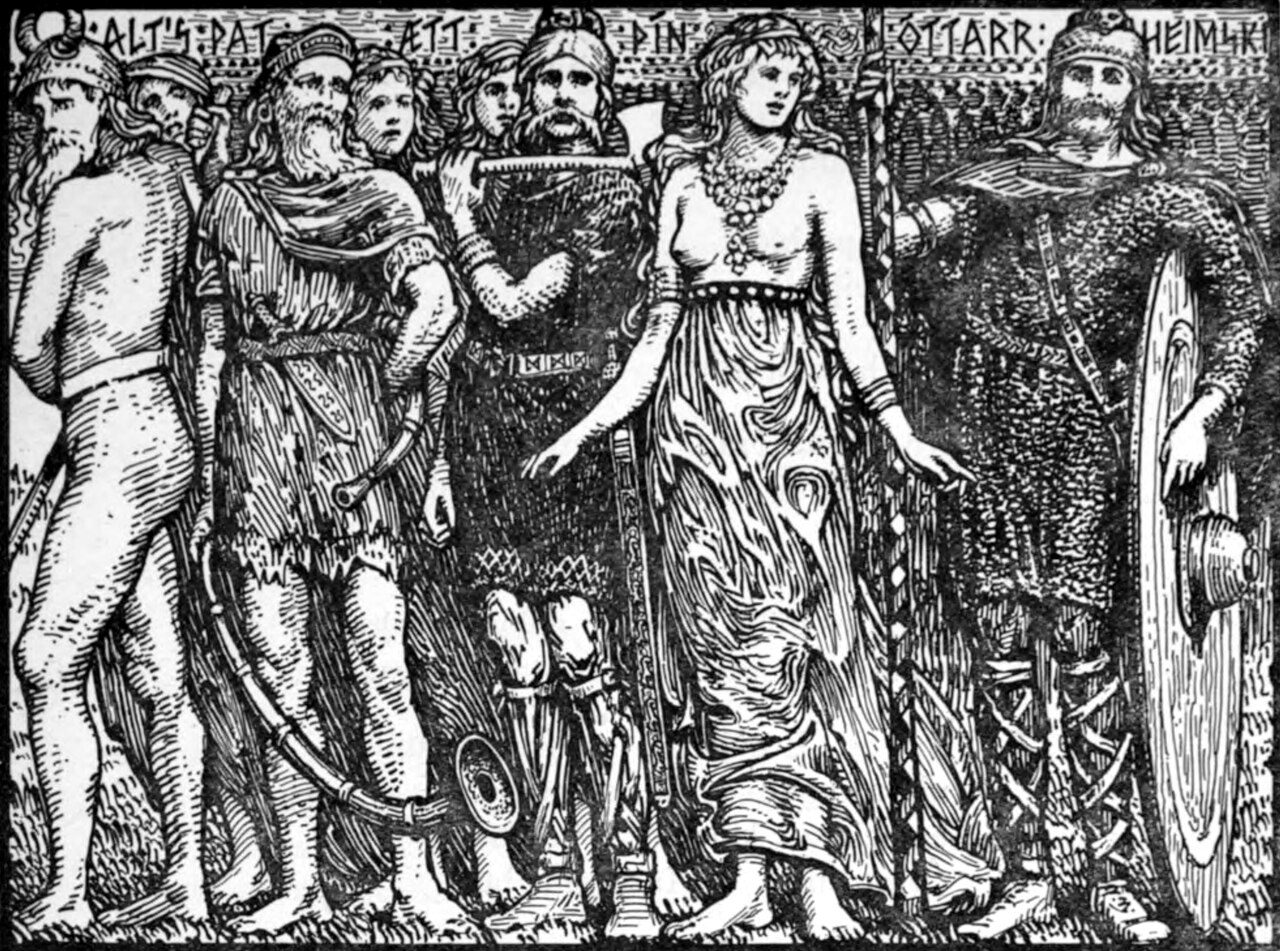
Bellows's introduction
The Hyndluljoth is found in neither of the great manuscripts of the Poetic Edda, but is included in the so-called Flateyjarbok (Book of the Flat Island), an enormous compilation made somewhere about 1400. The lateness of this manuscript would of itself be enough to cast a doubt upon the condition in which the poem has been preserved, and there can be no question that what we have of it is in very poor shape. It is, in fact, two separate poems, or parts of them, clumsily put together. The longer one, the Poem of Hyndla proper, is chiefly a collection of names, not strictly mythological but belonging to the semi-historical hero-sagas of Norse tradition. The wise-woman, Hyndla, being asked by Freyja to trace the ancestry of her favorite, Ottar, for the purpose of deciding a wager, gives a complex genealogy including many of the heroes who appear in the popular sagas handed down from days long before the Icelandic settlements. The poet was learned, but without enthusiasm; it is not likely that he composed the Hyndluljoth much before the twelfth century, though the material of which it is compounded must have been very much older. Although the genealogies are essentially continental, the poem seems rather like a product of the archæological period of Iceland.
Inserted bodily in the Hyndluljoth proper is a fragment of fifty-one lines, taken from a poem of which, by a curious chance, we know the name. Snorri quotes one stanza of it, calling it "the short Voluspo." The fragment preserved gives, of course, no indication of the length of the original poem, but it shows that it was a late and very inferior imitation of the great Voluspo. Like the Hyndluljoth proper, it apparently comes from the twelfth century; but there is nothing whatever to indicate that the two poems were the work of the same man, or were ever connected in any way until some blundering copyist mixed them up. Certainly the connection did not exist in the middle of the thirteenth century, when Snorri quoted "the short Voluspo."
Neither poem is of any great value, either as mythology or as poetry. The author of "the short Voluspo" seems, indeed, to have been more or less confused as to his facts; and both poets were too late to feel anything of the enthusiasm of the earlier school. The names of Hyndla's heroes, of course, suggest an unlimited number of stories, but as most of these have no direct relation to the poems of the Edda, I have limited the notes to a mere record of who the persons mentioned were, and the saga-groups in which they appeared.
Freyja spake:"Maiden, awake!wake thee, my friend,My sister Hyndla,in thy hollow cave!Already comes darkness,and ride must weTo Valhall to seekthe sacred hall.
Note
Freyja: The names of the speakers do not appear in the manuscripts. On Freyja cf. Voluspo, 21 and note; Skirnismol, introductory prose and note; Lokasenna, introductory prose and note. As stanzas 9-10 show, Ottar has made a wager of his entire inheritance with Angantyr regarding the relative loftiness of their ancestry, and by rich offerings (Hyndla hints at less commendable methods) has induced Freyja to assist him in establishing his genealogy. Freyja, having turned Ottar for purposes of disguise into a boar, calls on the giantess Hyndla ("She-Dog") to aid her. Hyndla does not appear elsewhere in the poems.
"The favor of Heerfatherseek we to find,To his followers goldhe gladly gives;To Hermoth gave hehelm and mail-coat,And to Sigmund he gavea sword as gift.
Note
Heerfather: Othin; cf. Voluspo, 30. Hermoth: mentioned in the Prose Edda as a son of Othin who is sent to Hel to ask for the return of the slain Baldr. Sigmund: according to the Volsungasaga Sigmund was the son of Volsung, and hence Othin's great-great-grandson (note that Wagner eliminates all the intervening generations by the simple expedient of using Volsung's name as one of Othin's many appellations). Sigmund alone was able to draw from the tree the sword which a mysterious stranger (Othin, of course) had thrust into it (compare the first act of Wagner's Die Walküre).
"Triumph to some,and treasure to others,To many wisdomand skill in words,Fair winds to the sailor,to the singer his art,And a manly heartto many a hero.
Note
Sijmons suggests that this stanza may be an interpolation.
"Thor shall I honor,and this shall I ask,That his favor truemayst thou ever find;..............................Though little the bridesof the giants he loves.
Note
No lacuna after line 2 is indicated in the manuscript. Editors have attempted various experiments in rearranging this and the following stanza.
"From the stall now oneof thy wolves lead forth,And along with my boarshalt thou let him run;For slow my boar goeson the road of the gods,And I would not wearymy worthy steed."
Note
Some editors, following Simrock, assign this whole stanza to Hyndla; others assign to her lines 3-4. Giving the entire stanza to Freyja makes better sense than any other arrangement, but is dependent on changing the manuscript's "thy" in line 3 to "my," as suggested by Bugge. The boar on which Freyja rides ("my worthy steed") is, of course, Ottar.
Cited on Hildisvíni, Hyndla
Hyndla spake:"Falsely thou askest me,Freyja, to go,For so in the glanceof thine eyes I see;On the way of the slainthy lover goes with thee,Ottar the young,the son of Instein."
Note
Hyndla detects Ottar, and accuses Freyja of having her lover with her. Unless Ottar is identical with Oth (cf. Voluspo, 25 and note), which seems most unlikely, there is no other reference to this love affair. The way of the slain: the road to Valhall.
Cited on Freyja, Hildisvíni, Hyndla
Freyja spake:"Wild dreams, methinks,are thine when thou sayestMy lover is with meon the way of the slain;There shines the boarwith bristles of gold,Hildisvini,he who was madeBy Dain and Nabbi,the cunning dwarfs.
Note
Various experiments have been made in condensing the stanza into four lines, or in combining it with stanza 8. Hildisvini ("Battle-Swine"): perhaps Freyja refers to the boar with golden bristles given, according to Snorri, to her brother Freyr by the dwarfs. Dain: a dwarf; cf. Voluspo, 11. Nabbi: a dwarf nowhere else mentioned.
Cited on Dwarves, Freyja, Hildisvíni
"Now let us downfrom our saddles leap,And talk of the raceof the heroes twain;The men who were bornof the gods above,..............................
Note
The first line is obviously corrupt in the manuscript, and has been variously emended. The general assumption is that in the interval between stanzas 7 and 8 Freyja and Hyndla have arrived at Valhall. No lacuna is indicated in the manuscript.
"A wager have madein the foreign metalOttar the youngand Angantyr;We must guard, for the heroyoung to have,His father's wealth,the fruits of his race.
Note
Foreign metal: gold. The word valr, meaning "foreign," and akin to "Welsh," is interesting in this connection, and some editors interpret it frankly as "Celtic," i.e., Irish.
Cited on Hildisvíni, Hyndla
"For me a shrineof stones he made,—And now to glassthe rock has grown;—Oft with the bloodof beasts was it red;In the goddesses everdid Ottar trust.
Note
To glass: i.e., the constant fires on the altar have fused the stone into glass. Glass beads, etc., were of very early use, though the use of glass for windows probably did not begin in Iceland much before 1200.
Cited on Freyja
"Tell to me nowthe ancient names,And the races of allthat were born of old:Who are of the Skjoldungs,who of the Skilfings,Who of the Othlings,who of the Ylfings,Who are the free-born,who are the high-born,The noblest of menthat in Mithgarth dwell?"
Note
Possibly two stanzas, or perhaps one with interpolations. The manuscript omits the first half of line 4, here filled out from stanza 16, line 2. Skjoldungs: the descendants of Skjold, a mythical king who was Othin's son and the ancestor of the Danish kings; cf. Snorri's Edda, Skaldskaparmal, 43. Skilfings: mentioned by Snorri as descendants of King Skelfir, a mythical ruler in "the East." In Grimnismol, 54, the name Skilfing appears as one of Othin's many appellations. Othlings: Snorri derives this race from Authi, the son of Halfdan the Old (cf. stanza 14). Ylfings: some editors have changed this to "Ynglings," as in stanza 16, referring to the descendants of Yng or Yngvi, another son of Halfdan, but the reference may be to the same mythical family to which Helgi Hundingsbane belonged (cf. Helgakvitha Hundingsbana I, 5).
Hyndla spake:"Thou art, Ottar,the son of Instein,And Instein the sonof Alf the Old,Alf of Ulf,Ulf of Sæfari,And Sæfari's fatherwas Svan the Red.
Note
Instein: mentioned in the Halfssaga as one of the warriors of King Half of Horthaland (the so-called Halfsrekkar). The others mentioned in this stanza appear in one of the later mythical accounts of the settlement of Norway.
"Thy mother, brightwith bracelets fair,Hight, methinks,the priestess Hledis;Frothi her father,and Friaut her mother;—Her race of the mightiestmen must seem.
"Of old the noblestof all was Ali,Before him Halfdan,foremost of Skjoldungs;Famed were the battlesthe hero fought,To the corners of heavenhis deeds were carried.
Note
Stanzas 14-16 are clearly interpolated, as Friaut (stanza 13, line 3) is the daughter of Hildigun (stanza 17, line 1). Halfdan the Old, a mythical king of Denmark, called by Snorri "the most famous of all kings," of whom it was foretold that "for three hundred years there should be no woman and no man in his line who was not of great repute." After the slaying of Sigtrygg he married Almveig (or Alvig), daughter of King Eymund of Holmgarth (i.e., Russia), who bore him eighteen sons, nine at one birth. These nine were all slain, but the other nine were traditionally the ancestors of the most famous families in Northern hero lore.
"Strengthened by Eymund,the strongest of men,Sigtrygg he slewwith the ice-cold sword;His bride was Almveig,the best of women,And eighteen boysdid Almveig bear him.
"Hence come the Skjoldungs,hence the Skilfings,Hence the Othlings,hence the Ynglings,Hence come the free-born,hence the high-born,The noblest of menthat in Mithgarth dwell:And all are thy kinsmen,Ottar, thou fool!
Note
Compare stanza 11. All or part of this stanza may be interpolated.
Cited on Hyndla
"Hildigun thenher mother hight,The daughter of Svavaand Sækonung;And all are thy kinsmen,Ottar, thou fool!It is much to know,—wilt thou hear yet more?
Note
Hildigun (or Hildiguth): with this the poem returns to Ottar's direct ancestry, Hildigun being Friaut's mother. Line 4: cf. the refrain-line in the Voluspo (stanzas 27, 29, etc.).
"The mate of Dagwas a mother of heroes,Thora, who bore himthe bravest of fighters,Frathmar and Gyrthand the Frekis twain,Am and Jofurmar,Alf the Old;It is much to know,—wilt thou hear yet more?
Note
Another interpolation, as Ketil (stanza 19, line 1) is the husband of Hildigun (stanza 17). Dag: one of Halfdan's sons, and ancestor of the Döglings. Line 5 may be a late addition.
"Her husband was Ketil,the heir of Klypp,He was of thy motherthe mother's-father;Before the daysof Kari was Frothi,And born of Hildwas Hoalf then.
Note
Ketil: the semi-mythical Ketil Hortha-Kari, from whom various Icelandic families traced their descent. Hoalf: probably King Half of Horthaland, hero of the Halfssaga, and son of Hjorleif and Hild (cf. stanza 12, note).
"Next was Nanna,daughter of Nokkvi,Thy father's kinsmanher son became;Old is the line,and longer still,And all are thy kinsmen,Ottar, thou fool!
Note
Nanna: the manuscript has "Manna." Of Nanna and her father, Nokkvi, we know nothing, but apparently Nanna's son married a sister of Instein, Ottar's father.
Cited on Nanna
"Isolf and Osolf,the sons of Olmoth,Whose wife was Skurhild,the daughter of Skekkil,Count them amongthe heroes mighty,And all are thy kinsmen,Ottar, thou fool!
Note
Olmoth: one of the sons of Ketil Hortha-Kari. Line 4: here, and generally hereafter when it appears in the poem, this refrain-line is abbreviated in the manuscript to the word "all."
"Gunnar the Bulwark,Grim the Hardy,Thorir the Iron-shield,Ulf the Gaper,Brodd and Hörvirboth did I know;In the household they wereof Hrolf the Old.
Note
An isolated stanza, which some editors place after stanza 24, others combining lines 1-2 with the fragmentary stanza 23. In the manuscript lines 3-4 stand after stanza 24, where they fail to connect clearly with anything. Hrolf the Old: probably King Hrolf Gautreksson of Gautland, in the saga relating to whom (Fornaldar sögur III, 57 ff.) appear the names of Thorir the Iron-shield and Grim Thorkelsson.
"Hervarth, Hjorvarth,Hrani, Angantyr,Bui and Brami,Barri and Reifnir,Tind and Tyrfing,the Haddings twain,—And all are thy kinsmen,Ottar, thou fool!
Note
Stanzas 23 and 24 name the twelve Berserkers, the sons of Arngrim and Eyfura, the story of whom is told in the Hervararsaga and the Orvar-Oddssaga. Saxo Grammaticus tells of the battle between them and Hjalmar and Orvar-Odd. Line 1 does not appear in the manuscript, but is added from the list of names given in the sagas. The Berserkers were wild warriors, distinguished above all by the fits of frenzy to which they were subject in battle; during these fits they howled like wild beasts, foamed at the mouth, and gnawed the iron rims of their shields. At such times they were proof against steel or fire, but when the fever abated they were weak. The etymology of the word berserk is disputed; probably, however, it means "bear-shirt."
"Eastward in Bolmwere born of oldThe sons of Arngrimand Eyfura;With berserk-tumultand baleful deedLike fire o'er landand sea they fared,—And all are thy kinsmen,Ottar, thou fool!
Note
The manuscript omits the first half of line 1, here supplied from the Orvar-Oddssaga. Bolm: probably the island of Bolmsö, in the Swedish province of Smaland. In the manuscript and in most editions stanza 24 is followed by lines 3-4 of stanza 22. Some editors reject line 5 as spurious.
"The sons of Jormunrekall of yoreTo the gods in deathwere as offerings given;He was kinsman of Sigurth,—hear well what I say,—The foe of hosts,and Fafnir's slayer.
Note
In the manuscript line 1 stands after line 4 of stanza 29. Probably a stanza enumerating Jormunrek's sons has been lost. Many editors combine lines 3-4 of stanza 22 and lines 2-4 of stanza 25 into one stanza. Jormunrek: the historical Ermanarich, king of the Goths, who died about 376. According to Norse tradition, in which Jormunrek played a large part, he slew his own sons (cf. Guthrunarhvot and Hamthesmol). In the saga Jormunrek married Sigurth's daughter, Svanhild. Stanzas 25-27 connect Ottar's descent with the whole Volsung-Sigurth-Jormunrek-Gjuki genealogy. The story of Sigurth is the basis for most of the heroic poems of the Edda, of the famous Volsungasaga, and, in Germany, of the Nibelungenlied. On his battle with the dragon Fafnir cf. Fafnismol.
Cited on Jörmunrekkr
"From Volsung's seedwas the hero sprung,And Hjordis was bornof Hrauthung's race,And Eylimifrom the Othlings came,—And all are thy kinsmen,Ottar, thou fool!
Note
Volsung: Sigurth's grandfather and Othin's great-grandson. Hjordis: daughter of King Eylimi, wife of Sigmund and mother of Sigurth. Othlings: cf. stanza 11.
"Gunnar and Hogni,the heirs of Gjuki,And Guthrun as well,who their sister was;But Gotthorm was notof Gjuki's race,Although the brotherof both he was:And all are thy kinsmen,Ottar, thou fool!
Note
Gunnar, Hogni, and Guthrun: the three children of the Burgundian king Gjuki and his wife Grimhild (Kriemhild); Guthrun was Sigurth's wife. Gotthorm, the third brother, who Sigurth at Brynhild's behest, was Grimhild's son, and thus a step-son of Gjuki. These four play an important part in the heroic cycle of Eddic poems. Cf. Gripisspo, introductory note.
"Of Hvethna's sonswas Haki the best,And Hjorvarth the fatherof Hvethna was;..............................
Note
In the manuscript and in many editions these two lines stand between stanzas 33 and 34. The change here made follows Bugge. The manuscript indicates no gap between stanzas 27 and 29. Hvethna: wife of king Halfdan of Denmark.
"Harald Battle-toothof Auth was born,Hrörek the Ring-giverher husband was;Auth the Deep-mindedwas Ivar's daughter,But Rathbarth the fatherof Randver was:And all are thy kinsmen,Ottar, thou fool!"***
Note
The manuscript and many editions include line 1 of stanza 25 after line 4 of stanza 29. The story of Harald Battle-tooth is told in detail by Saxo Grammaticus. Harald's father was Hrörek, king of Denmark; his mother was Auth, daughter of Ivar, king of Sweden. After Ivar had treacherously destroyed Hrörek, Auth fled with Harald to Russia, where she married King Rathbarth. Harald's warlike career in Norway, and his death on the Bravalla-field at the hands of his nephew, Sigurth Ring, son of Randver and grandson of Rathbarth and Auth, were favorite saga themes.
Eleven in numberthe gods were known,When Baldr o'er the hillof death was bowed;And this to avengewas Vali swift,When his brother's slayersoon he slew.
Note
At this point begins the fragmentary and interpolated "short Voluspo" identified by Snorri. The manuscript gives no indication of the break in the poem's continuity. Eleven: there are various references to the "twelve" gods (including Baldr); Snorri (Gylfaginning, 20-33) lists the following twelve in addition to Othin: Thor, Baldr, Njorth, Freyr, Tyr, Bragi, Heimdall, Hoth, Vithar, Vali, Ull and Forseti; he adds Loki as of doubtful divinity. Baldr and Vali: cf. Voluspo, 32-33.
Cited on Baldr, Váli, Baldr's dreams and death
The father of Baldrwas the heir of Bur,..............................
Note
The fragmentary stanzas 31-34 have been regrouped in various ways, and with many conjectures as to omissions, none of which are indicated in the manuscript. The order here is as in the manuscript, except that lines 1-2 of stanza 28 have been transposed from after line 2 of stanza 33. Bur's heir: Othin, cf. Voluspo, 4.
Cited on Borr
Freyr's wife was Gerth,the daughter of Gymir,Of the giants' brood,and Aurbotha bore her;To these as wellwas Thjazi kin,The dark-loving giant;his daughter was Skathi.
Note
Freyr, Gerth, Gymir: cf. Skirnismol. Aurbotha: a giantess, mother of Gerth. Thjazi and Skathi: cf. Lokasenna, 49, and Harbarthsljoth, 19.
Cited on Freyr, Gerðr, Gymir, Þjazi, Freyr and Gerðr
Much have I told thee,and further will tell;There is much that I know;—wilt thou hear yet more?
Note
Cf. Voluspo, 44 and 27.
Heith and Hrossthjof,the children of Hrimnir...............................
Note
Heith ("Witch") and Hrossthjof ("Horse-thief"): the only other reference to the giant Hrimnir (Skirnismol, 28) makes no mention of his children.
The sybils arosefrom Vitholf's race,From Vilmeithall the seers are,And the workers of charmsare Svarthofthi's children,And from Ymir sprangthe giants all.
Note
This stanza is quoted by Snorri (Gylfaginning, 5). Of Vitholf ("Forest Wolf"), Vilmeith ("Wish-Tree") and Svarthofthi ("Black Head") nothing further is known. Ymir: cf. Voluspo, 3.
Much have I told thee,and further will tell;There is much that I know;—wilt thou hear yet more?
One there was bornin the bygone days,Of the race of the gods,and great was his might;Nine giant women,at the world's edge,Once bore the manso mighty in arms.
Note
According to Snorri (Gylfaginning, 27) Heimdall was the son of Othin and of nine sisters. As Heimdall was the watchman of the gods, this has given rise to much "solar myth" discussion. The names of his nine giantess mothers are frequently said to denote attributes of the sea.
Cited on Gjálp and Greip, Heimdall
Gjolp there bore him,Greip there bore him,Eistla bore him,and Eyrgjafa,Ulfrun bore him,and Angeyja,Imth and Atla,and Jarnsaxa.
Note
The names of Heimdall's mothers may be rendered "Yelper," "Griper," "Foamer," "Sand-Strewer," "She-Wolf," "Sorrow-Whelmer," "Dusk," "Fury," and "Iron-Sword."
Cited on Gjálp and Greip
Strong was he madewith the strength of earth,With the ice-cold sea,and the blood of swine.
Note
It has been suggested that these lines were interpolated from Guthrunarkvitha II, 22. Some editors add the refrain of stanza 36. Swine's blood: to Heimdall's strength drawn from earth and sea was added that derived from sacrifice.
One there was born,the best of all,And strong was he madewith the strength of earth;The proudest is calledthe kinsman of menOf the rulers allthroughout the world.
Note
In the manuscript this stanza stands after stanza 44. Regarding Heimdall's kinship to the three great classes of men, cf. Rigsthula, introductory note, wherein the apparent confusion of his attributes with those of Othin is discussed.
Much have I told thee,and further will tell;There is much that I know;—wilt thou hear yet more?
The wolf did Lokiwith Angrbotha win,And Sleipnir bore heto Svathilfari;The worst of marvelsseemed the oneThat sprang from the brotherof Byleist then.
Note
Probably a lacuna before this stanza. Regarding the wolf Fenrir, born of Loki and the giantess Angrbotha, cf. Voluspo, 39 and note. Sleipnir: Othin's eight-legged horse, born of the stallion Svathilfari and of Loki in the guise of a mare (cf. Grimnismol, 44). The worst: doubtless referring to Mithgarthsorm, another child of Loki. The brother of Byleist: Loki; cf. Voluspo, 51.
Cited on Angrboða, Fenrir, Loki, Sleipnir, Svaðilfari, The binding of Fenrir and 1 more
A heart ate Loki,—in the embers it lay,And half-cooked found hethe woman's heart;—With child from the womanLopt soon was,And thence among mencame the monsters all.
Note
Nothing further is known of the myth here referred to, wherein Loki (Lopt) eats the cooked heart of a woman and thus himself gives birth to a monster. The reference is not likely to be to the serpent, as, according to Snorri (Gylfaginning, 34), the wolf, the serpent, and Hel were all the children of Loki and Angrbotha.
Cited on Loki
The sea, storm-driven,seeks heaven itself,O'er the earth it flows,the air grows sterile;Then follow the snowsand the furious winds,For the gods are doomed,and the end is death.
Note
Probably an omission, perhaps of considerable length, before this stanza. For the description of the destruction of the world, cf. Voluspo, 57.
Then comes another,a greater than all.Though never I darehis name to speak;Few are they now thatfarther can seeThan the moment when Othinshall meet the wolf.***
Note
Cf. Voluspo, 65, where the possible reference to Christianity is noted. With this stanza the fragmentary "short Voluspo" ends, and the dialogue between Freyja and Hyndla continues.
Cited on Hyndla, The world reborn
Freyja spake:"To my boar now bringthe memory-beer,So that all thy words,that well thou hast spoken,The third morn hencehe may hold in mind,When their races Ottarand Angantyr tell."
Note
Freyja now admits the identity of her boar as Ottar, who with the help of the "memory-beer" is to recall the entire genealogy he has just heard, and thus win his wager with Angantyr.
Cited on Hildisvíni
Hyndla spake:"Hence shalt thou fare,for fain would I sleep,From me thou gettestfew favors good;My noble one, outin the night thou leapestAs Heithrun goesthe goats among.
Note
Heithrun: the she-goat that stands by Valhall (cf. Grimnismol, 25), the name being here used simply of the she-goats in general, in caustic comment on Freyja's morals. Of these Loki entertained a similar view; cf. Lokasenna, 30.
"To Oth didst thou run,who loved thee ever,And many underthy apron have crawled;My noble one, outin the night thou leapest,As Heithrun goesthe goats among."
Note
Oth: cf. stanza 6 and note, and Voluspo, 25 and note. Lines 3-4, abbreviated in the manuscript, are very likely repeated here by mistake.
Freyja spake:"Around the giantessflames shall I raise,So that forth unburnedthou mayst not fare."
Note
The manuscript repeats once again lines 3-4 of stanza 47 as the last two lines of this stanza. It seems probable that two lines have been lost, to the effect that Freyja will burn the giantess alive "If swiftly now thou dost not seek, / And hither bring the memory-beer."
Cited on Hyndla
Hyndla spake:"Flames I see burning,the earth is on fire,And each for his lifethe price must lose;Bring then to Ottarthe draught of beer,Of venom fullfor an evil fate."