giant
Hrungnir
The strongest of the giants, with a head, heart and shield of stone. He races Odin into Ásgard, gets drunk there, and dies when Thor's hammer shatters his whetstone and his skull.
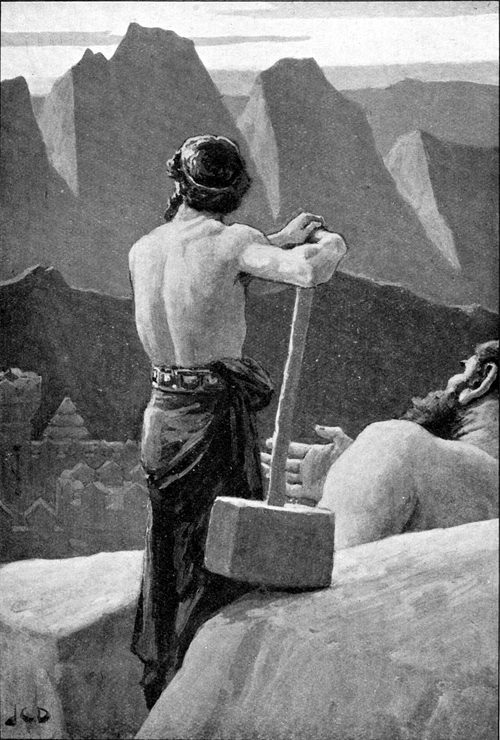
Hrungnir is the giant Thor fights in single combat, and in Snorri's telling the strongest of all giants Skáldskaparmál 17. The full story is told in Skáldskaparmál (see Thor's duel with Hrungnir). The poems only allude to it. Thor boasts in Hárbarðsljóð that he felled the giant "whose head of stone was made" Hárbarðsljóð 15, and "Hrungnir's slayer" became a name for Thor Lokasenna 61 Lokasenna 63.
The horse race and the challenge
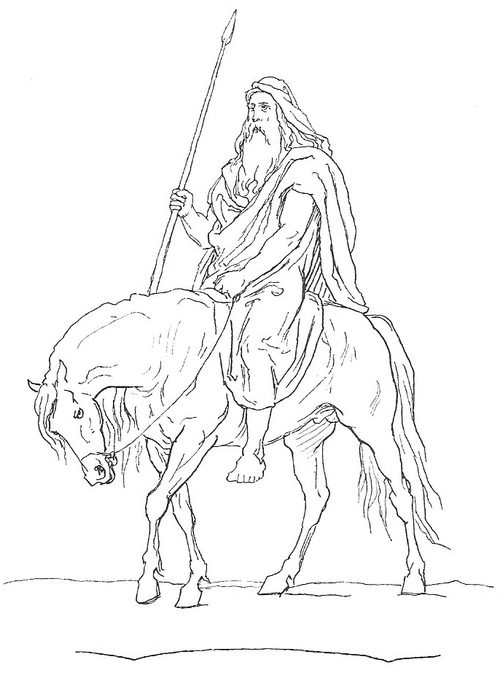
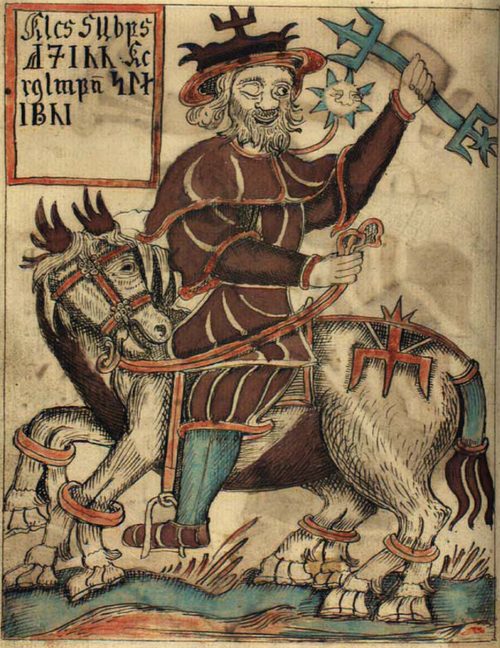
Odin rides Sleipnir into Jötunheim. Hrungnir praises the horse and boasts that his own Gold-Mane is better, and the two race all the way into Ásgard. There the gods offer the giant a drink. Drunk from Thor's own cups, Hrungnir boasts that he will carry Valhall to Jötunheim, kill the gods, and take Freyja and Sif home with him. When Thor arrives, Hrungnir claims Odin's safe-conduct and challenges Thor to fight at Grjótúnagarðr on the border. Snorri says no one had ever challenged Thor to single combat before Skáldskaparmál 17.
The duel
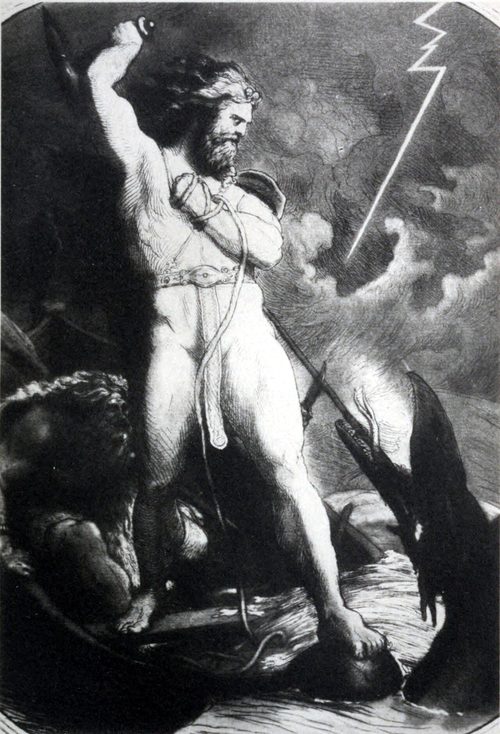
The giants build a clay giant, Mökkurkálfi, to stand beside their champion. Hrungnir has a three-cornered heart of stone, a stone head and a stone shield, and a whetstone for a weapon. Þjálfi runs ahead and warns him that Thor will come from below. Hrungnir stands on his shield, and Thor comes at him amid lightning and thunder. Hammer and whetstone meet in mid-air. The whetstone shatters, and its broken pieces are the origin of all flint. One piece sinks into Thor's head, and Mjölnir crushes Hrungnir's skull Skáldskaparmál 17.
then he saw Thor in God-like anger, who came forward furiously and swung the hammer and cast it at Hrungnir from afar off.Skáldskaparmál 17
Hrungnir's dead leg pins Thor to the ground until his three-night-old son Magni lifts it off, and Thor gives Magni the giant's horse. The seeress Gróa nearly charms the stone out of Thor's head, but loses her spell when Thor's news about her husband delights her. The stone is still there, which is why no one should throw a whetstone across the floor Skáldskaparmál 17.
Snorri's main source was Haustlöng, a 9th- or 10th-century poem by Þjóðólfr of Hvinir describing a painted shield. He quotes its Hrungnir stanzas after the story Skáldskaparmál 17.
In the sources
Quoted from the hosted translations; each line is checked against the text when the site is built. Select a reference to read it in context.
Hrungnir had the heart which is notorious, of hard stone and spiked with three corners
But the hammer Mjöllnir struck Hrungnir in the middle of the head, and smashed his skull into small crumbs
Fain art thou to tell how with Hrungnir I fought, The haughty giant, whose head of stone was made
The slayer of Hrungnir shall send thee to hell
Where the sources disagree or fall silent
- A kenning in Bragi's verse calls the shield the 'Sole-Blade of Thrúdr's thief' (Skáldskaparmál 48), which suggests a lost story in which Hrungnir carried off Thor's daughter Þrúðr.
- Hymiskviða calls Hymir 'the comrade hoary of Hrungnir' (Hymiskviða 16), but no story of their friendship survives.