A myth retold · about 6 minutes
The binding of Loki
After Baldr's death Loki hides as a salmon in a waterfall. The gods catch him in a net, bind him on three stones with his own son's entrails, and hang a serpent over his face. Sigyn catches the venom in a bowl until Ragnarök.
Loki spends most of the mythology getting the gods into trouble and then getting them out again. After the death of Baldr there is no getting out. Snorri introduces this story as the answer to a simple question: was Loki ever punished for causing Baldr's death and then keeping him in Hel? "This thing was repaid him in such wise that he shall remember it long" Gylfaginning 50. The narrative below follows Snorri's Gylfaginning, the only full account, and notes where the shorter poetic sources disagree.
The house with four doors
When the gods are as angry with him as might be expected, Loki runs off and hides on a mountain. There he builds a house with four doors, so that he can see out in every direction. In the daytime he often turns into a salmon and hides in the waterfall called Fránangr-Falls, and he wonders what trick the gods might invent to catch him there Gylfaginning 50.
Sitting by his fire one day, he takes linen thread and knots it into meshes, "as a net is made since": in Snorri's telling, Loki invents the fishing net. While he is working he sees the gods close by. Odin has spotted him from his high seat Hliðskjálf. Loki jumps up, throws the net into the fire and leaps into the river Gylfaginning 50.
The first god into the empty house is the wisest of them, Kvasir. In the white ash on the hearth he can still see the pattern of the burnt net, and he works out that it must be a device for catching fish. The gods copy it and make a net of their own Gylfaginning 50.
The salmon in the net
The gods take the net to the waterfall. Thor holds one end and all the other gods hold the other. On the first sweep Loki lies down between two stones, and the net passes over him; the gods can only feel that something alive has touched it. They weight the net so heavily that nothing can get under it and try again. This time Loki swims ahead of it, and when he sees he is close to the sea he jumps over the net-rope and swims back up into the falls Gylfaginning 50.
Now the gods know where he is. They split into two groups, one on each bank, while Thor wades down the middle of the river, and they drive the net toward the sea. Loki has two choices: swim out to sea, which means death, or jump the net again. He jumps. Thor grabs him in mid-air; the salmon slips through his hand until his grip stops at the tail. "For this reason," Snorri adds, "the salmon has a tapering back" Gylfaginning 50.
Three stones and a serpent
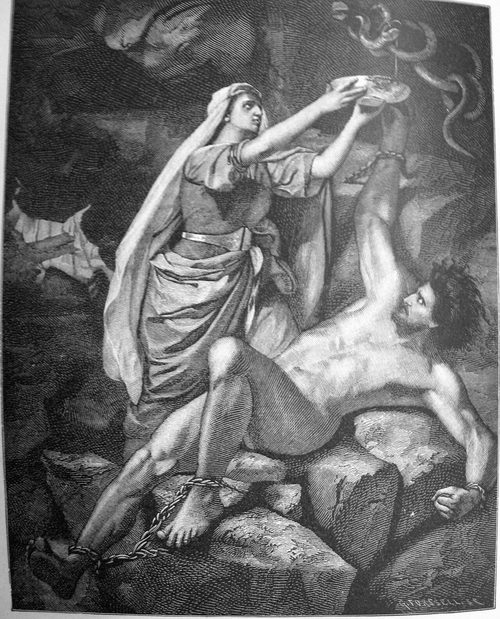
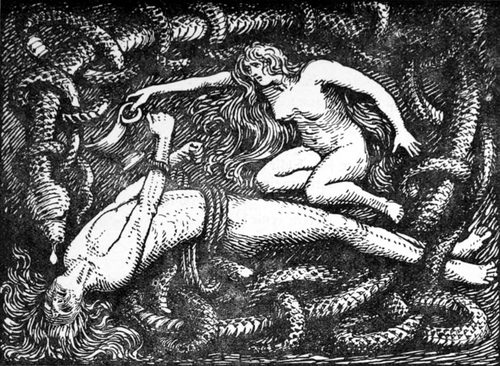
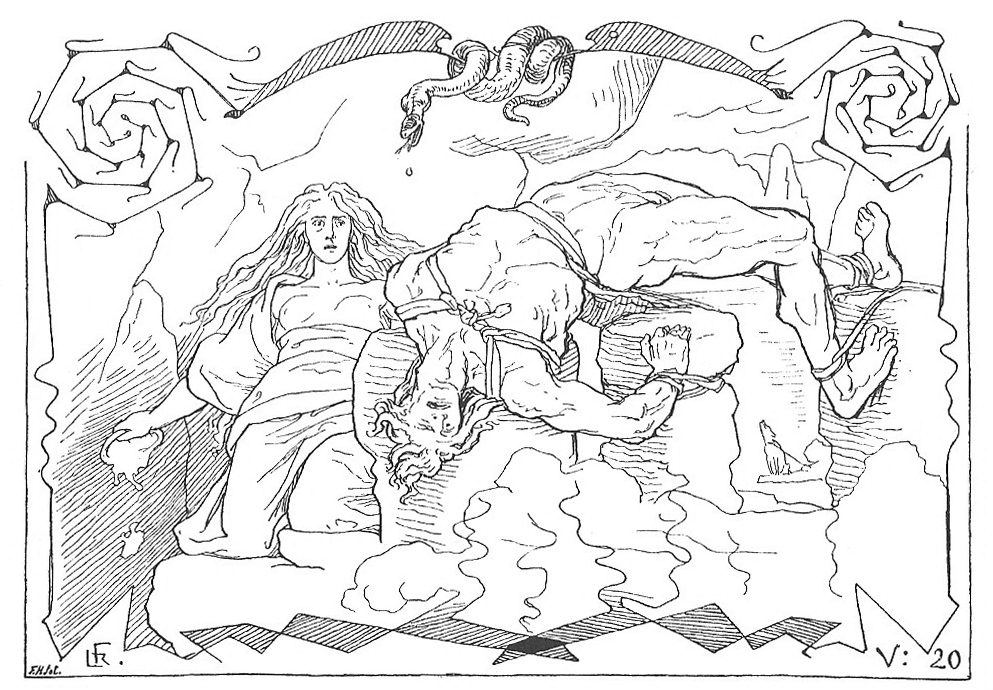
Loki is taken "truceless" into a cave. The gods set three flat stones on edge and drill a hole through each. Then they bring Loki's sons. Here Snorri's text is confused. It first names them as Vili and Nari or Narfi, then says the gods turned Váli into a wolf, and that he tore his brother Narfi apart Gylfaginning 50. With Narfi's entrails the gods tie Loki across the three stones, one under his shoulders, one under his loins and one under the backs of his knees, and the bonds turn to iron.
Then Skadi took a venomous serpent and fastened it up over him, so that the venom should drip from the serpent into his face. But Sigyn, his wife, stands near him and holds a basin under the venom-dropsGylfaginning 50
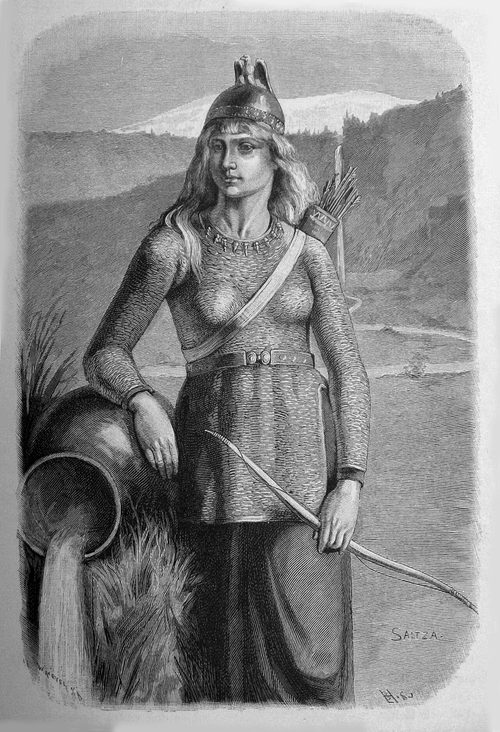
Skaði, whose father Loki helped to kill, hangs the serpent. Loki's wife Sigyn holds a bowl under the venom; when it is full she has to go and empty it, and while she is gone the poison falls on Loki's face. He writhes so violently that the whole earth shakes, and "ye call that 'earthquakes.'" There he lies "till the Weird of the Gods" Gylfaginning 50.
Until the end
The bonds are not permanent, and every source that mentions them knows it. In Baldrs draumar the dead seeress tells Odin that no one will wake her again "till Loki wanders loose from his bonds" and the destroyers come Baldrs draumar 14. In Völuspá she sees him bound in the woods with Sigyn beside him, unhappy Völuspá 35. When Ragnarök comes, the "brother of Byleist" goes to war with the giants and Loki stands at the helm of a ship carrying the people of Hel Völuspá 51. Snorri sends him to the last battle with the champions of Hel behind him, where he and Heimdallr kill each other Gylfaginning 51. In both Snorri and Völuspá his son Fenrir breaks free at the same time.
One did I see in the wet woods bound,A lover of ill, and to Loki like;By his side does Sigyn sit, nor is gladTo see her mate: would you know yet more?Völuspá 35
Where the story comes from
There are three narrative sources, and they do not agree on the details.
Gylfaginning 50 (Snorri, c. 1220s) is the only full account. It is the only source for the house with four doors, the invention of the net, Kvasir's deduction, the chase in the river and the salmon's tail.
The prose ending of Lokasenna gives a compressed version in the Codex Regius: Loki hides as a salmon in "Franang's waterfall", the gods take him, and "he was bound with the bowels of his son Vali, but his son Narfi was changed to a wolf" Lokasenna, prose 7. That is the opposite of Snorri, in whose version Váli is the wolf and Narfi the victim. Snorri's own text is inconsistent: it names the sons "Vili and Nari or Narfi" before making Váli the wolf Gylfaginning 50. Elsewhere Snorri calls Loki's son simply "Nari or Narfi" Gylfaginning 33, and his poetic names for Loki include "Father of … Nari, and Áli" Skáldskaparmál 16. This Váli, son of Loki, should not be confused with Váli son of Odin, Baldr's avenger. The Lokasenna prose also places the binding after the flyting and makes no mention of Baldr. Snorri makes it the punishment for Baldr's death.
The poems are brief. In Lokasenna, Skaði threatens Loki that the gods will bind him "on the rocks … with bowels torn forth from thy frost-cold son" Lokasenna 49: one son, unnamed. Völuspá places the bound Loki in "wet woods" Völuspá 35, while Snorri puts him in a cave. Sigyn appears in Völuspá and Snorri, and a skaldic kenning quoted by Snorri calls Loki "the Arm-Burden … of Sigyn, whom all the gods in bonds see" Skáldskaparmál 22.
One problem lies inside Snorri's own work. In Gylfaginning, Kvasir is alive and leads the gods into Loki's house. In Skáldskaparmál, Kvasir was killed by the dwarves Fjalar and Galarr long before, and his blood became the mead of poetry Skáldskaparmál 1.
Reading it today
The story ends with explanations: the net, the salmon's tapering tail, earthquakes. Snorri seems to have enjoyed these, and some scholars think the explanations are partly his own. Many readers have compared the bound Loki with other chained figures of myth, such as Prometheus, or with the bound giant in Caucasian legend; whether the resemblance reflects shared tradition is debated. A carved stone at Kirkby Stephen in Cumbria showing a bound, horned figure has sometimes been identified with Loki, but the identification is uncertain. Sigyn's quiet endurance has made her a favourite of modern retellers, though the medieval sources give her only a few lines.
Key passages
Often throughout the day he turned himself into the likeness of a salmon and hid himself in the place called Fránangr-Falls
the Æsir changed Váli into the form of a wolf, and he tore asunder Narfi his brother
He was bound with the bowels of his son Vali, but his son Narfi was changed to a wolf.
One did I see in the wet woods bound, A lover of ill, and to Loki like
On the rocks the gods bind thee with bowels torn Forth from thy frost-cold son.
Till Loki wanders loose from his bonds, And to the last strife the destroyers come.