A myth retold · about 5 minutes
The treasures of the gods: Sif's hair and Brokkr's wager
Loki shaves Sif's head, and to save his own skin sets two families of dwarf-smiths competing. The result is six treasures — golden hair, a folding ship, a spear, a ring, a golden boar and Thor's hammer — and Loki's lips sewn shut.
Why do poets call gold "Sif's hair"? Snorri Sturluson asks the question in Skáldskaparmál, his handbook of poetic language, and answers it with one of the liveliest stories in Norse myth: a contest between dwarf-smiths, staged by Loki to get himself out of trouble, which ends up equipping the gods with almost all their famous possessions Skáldskaparmál 35.
Sif's hair
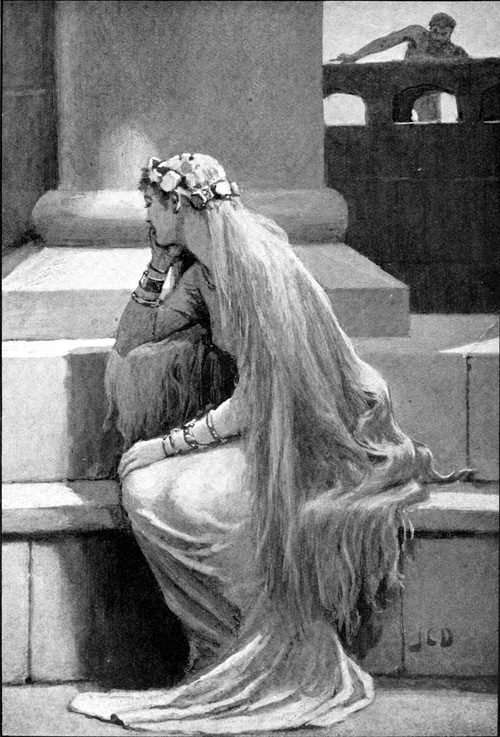
For mischief's sake, Loki cut off all the hair of Sif, Thor's wife. Thor caught him and would have broken every bone in his body, but Loki swore to get the black elves to make Sif new hair out of gold, hair that would grow like any other. Snorri uses "black elves" and "dwarves" interchangeably here.
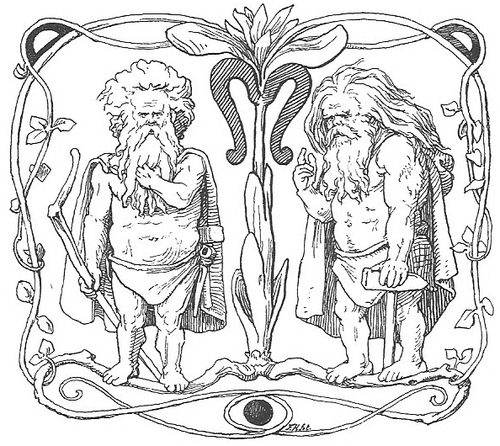
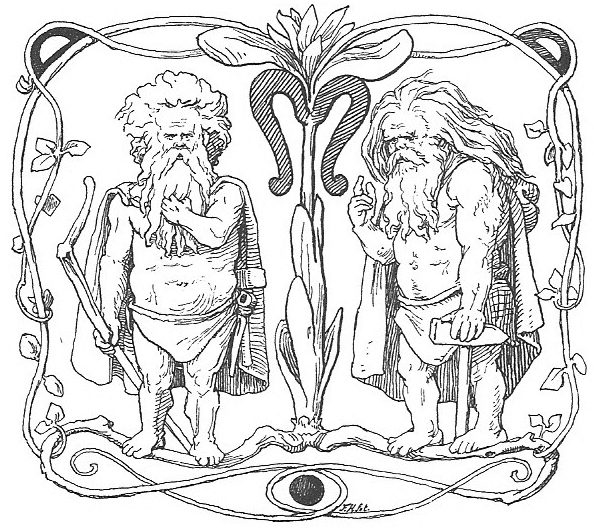
Loki went to the dwarfs known as the sons of Ívaldi. They made the hair. They also made the ship Skíðblaðnir and a spear, Gungnir, which would become Odin's. Snorri does not say whether Loki asked for these or the smiths offered them.
The wager
Loki then did something reckless. He bet his head with a dwarf called Brokkr that Brokkr's brother — called Sindri in the text Brodeur translates — could not make three treasures as good as these.
In the smithy, the smith laid a pigskin in the forge and told Brokkr to work the bellows without stopping until he came back to take the work out. As soon as he left, a fly settled on Brokkr's hand and stung him. Brokkr kept blowing. When the smith returned he drew out a boar with a mane and bristles of gold.
Next the smith put gold in the hearth. Again the fly came, this time on Brokkr's neck, biting "half again as hard as before". He kept blowing, and the smith drew out a gold ring, Draupnir.
The third time the smith laid iron in the forge and warned that it would be ruined if the bellows stopped.
Straightway the fly settled between Brokkr's eyes and stung his eyelid, but when the blood fell into his eyes so that he could not see, then he clutched at it with his hand as swiftly as he could,—while the bellows grew flat,—and he swept the fly from him.Skáldskaparmál 35
The smith came back and said it had nearly been spoiled. He took out a hammer, gave all three treasures to Brokkr, and sent him to Ásgard to claim the wager. Snorri never says who the fly was. Most readers assume it was Loki, protecting his bet; the text leaves it for the listener to work out.
The judgement
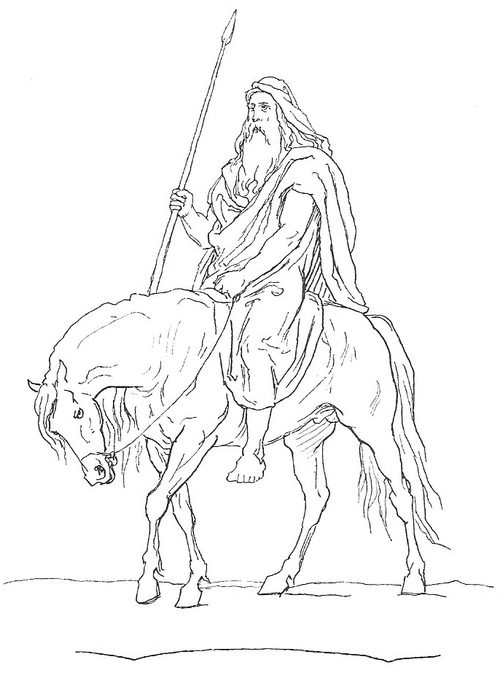
The Æsir took their seats of judgement, and agreed that Odin, Thor and Freyr would decide. Loki presented his gifts first. To Odin he gave the spear Gungnir, which never stops in its thrust. To Thor he gave Sif's hair, which would take root as soon as it touched her head. To Freyr he gave Skíðblaðnir, which always has a fair wind wherever it sails, and yet can be folded "like a napkin" and carried in a pouch.
Brokkr then brought out his. To Odin he gave the ring, from which eight rings of the same weight drop every ninth night. To Freyr he gave the boar, which can run through air and over water faster than any horse and whose golden bristles light up the darkest night. To Thor he gave the hammer.
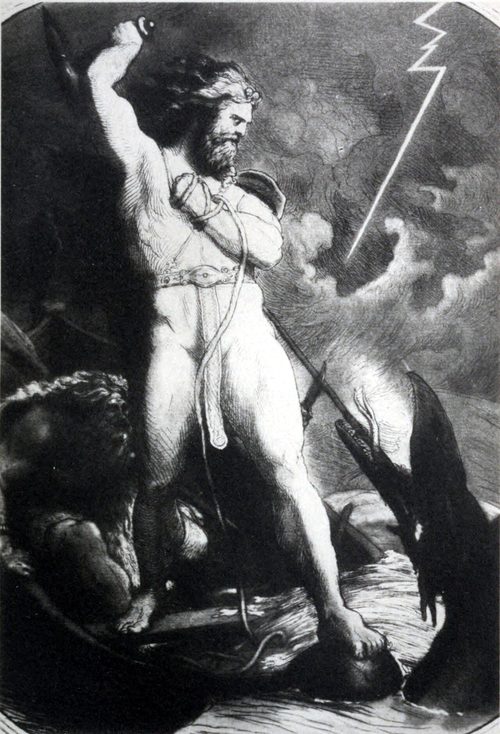
Then he gave the hammer to Thor, and said that Thor might smite as hard as he desired, whatsoever might be before him, and the hammer would not fail; and if he threw it at anything, it would never miss, and never fly so far as not to return to his hand; and if be desired, he might keep it in his sark, it was so small; but indeed it was a flaw in the hammer that the fore-haft was somewhat short.Skáldskaparmál 35
The judges ruled that the hammer was the best of all, because it was the greatest defence against the frost-giants. Brokkr had won.
Loki's head
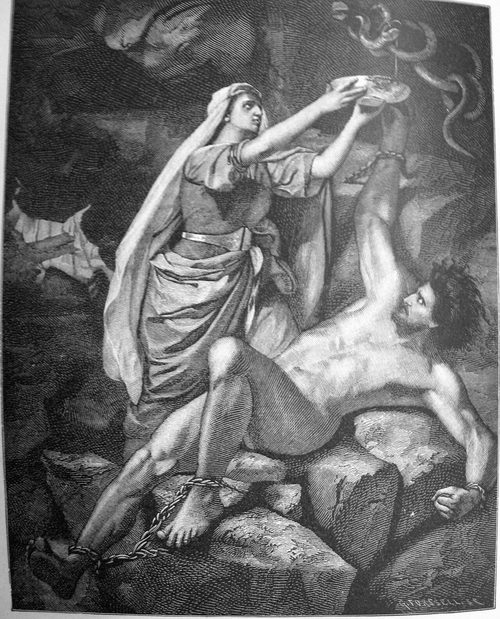
Loki offered to buy back his head. Brokkr refused. "Take me, then," said Loki — and when Brokkr reached for him he was far away, wearing shoes that could run through air and over water. Brokkr asked Thor to catch him, and Thor did. Brokkr was about to cut off his head when Loki objected that the head was Brokkr's, but not the neck.
So Brokkr settled for something else. He took a thong and a knife to bore holes in Loki's lips and sew his mouth shut, but the knife would not cut. He wished aloud for his brother's awl, and as soon as he said it the awl was there and pierced the lips. He sewed them together. Loki tore the thong out through the edges. Snorri ends with the thong's name: Vartari Skáldskaparmál 35.
Where the story comes from
The full story exists only in Skáldskaparmál (chapter 35 in Brodeur's numbering), written by Snorri in the 1220s. No surviving poem tells it. Grímnismál does confirm that "Ivaldi's sons" made Skíðblaðnir for Freyr Grímnismál 43, and Snorri repeats that in Gylfaginning Gylfaginning 43. The treasures themselves are well attested elsewhere: Gungnir is named in the poetry Sigrdrífumál 17; Thor's hammer is everywhere; and Freyr's boar is named Gold-Bristle (Gullinbursti) or Fearful-Tusk in Snorri's other works Skáldskaparmál 7 Gylfaginning 49, though not in this chapter.
There are some loose ends between the sources:
- The smith's name. In Brodeur's translation Brokkr's brother is Sindri. Many modern editions and translations, following other manuscripts, call him Eitri. This site's entry is Eitri.
- Draupnir. Here Brokkr gives the ring to Odin. In Gylfaginning, Odin lays Draupnir on Baldr's funeral pyre, and Baldr sends it back from Hel Gylfaginning 49. In Skírnismál, Freyr's servant offers Gerðr "the ring that was burned of old with Othin's son", from which eight rings fall every ninth night Skírnismál 21; the poem does not name it, but it is plainly the same ring, now in Freyr's household.
- Mjöllnir's power. Gylfaginning says that Thor needs his iron gloves to wield the hammer Gylfaginning 21; this story says nothing of gloves, only of the short handle.
Reading it today
The story works on several levels at once. As a just-so story it explains a kenning: gold is "Sif's hair" because Sif's hair is gold. As comedy it is a trickster tale in which the trickster wins the first round and loses the second. And as a myth it gives the origin of the gods' power: the weapons that defend them were made by dwarfs, in a contest that the gods' worst troublemaker started.
The hammer's short handle has attracted interpretation. Some readers see it as a reflection of the shape of the small "Thor's hammer" amulets found across Scandinavia from the Viking Age, which do have short shafts; others take it simply as the price of Loki's interference. Both are reasonable; neither is stated in the text.
Key passages
Loki Laufeyarson, for mischief's sake, cut off all Sif's hair.
Then Loki wagered his head with the dwarf called Brokkr that Brokkr's brother Sindri could not make three other precious things equal in virtue to these.
This was their decision: that the hammer was best of all the precious works, and in it there was the greatest defence against the Rime-Giants
Loki said that he might have the head, but not the neck.
In days of old did Ivaldi's sons Skithblathnir fashion fair, The best of ships for the bright god Freyr
Odin laid on the pyre that gold ring which is called Draupnir; this quality attended it, that every ninth night there dropped from it eight gold rings of equal weight.