A myth retold · about 6 minutes
Thor's duel with Hrungnir
A horse race with Odin brings the stone-headed giant Hrungnir drunk and boasting into Asgard. Thor challenges him to the first single combat of his life, kills him with Mjölnir, and carries a piece of the giant's whetstone in his skull for ever after.
Hrungnir was, in Snorri's words, the strongest of the giants Skáldskaparmál 17, and his fight with Thor is the one formal duel in Thor's career. The full story is in Skáldskaparmál, where Bragi tells it to Ægir and Snorri backs it up with stanzas of Haustlöng, a poem of about 900.
A horse race into Asgard
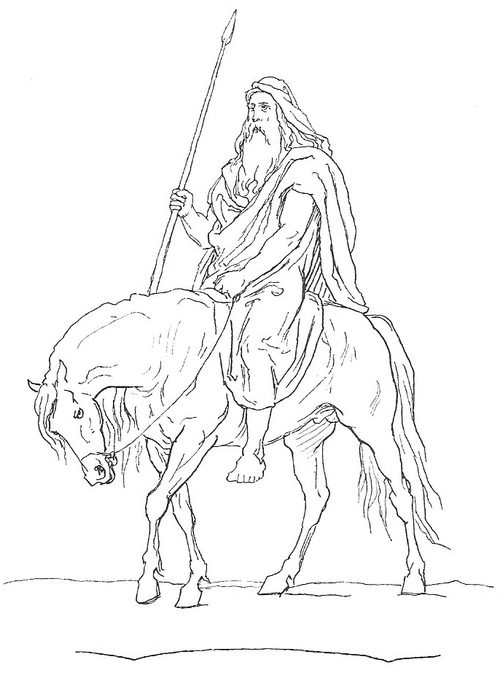
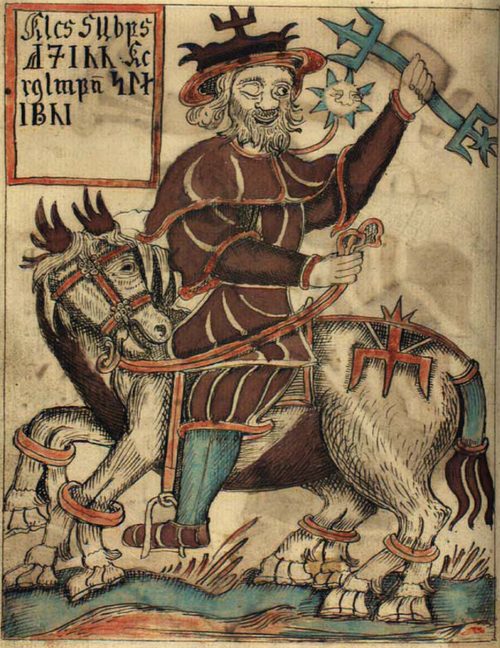
It began while Thor was away in the east killing trolls. Odin rode Sleipnir into Jötunheimr and came to the giant Hrungnir. Hrungnir asked who this was in the golden helmet who rode through air and water, and praised the horse. Odin bet his head that no horse in Jötunheimr was as good. Hrungnir said his own horse, Gullfaxi ("Gold-Mane"), had a far longer stride, leapt on it in a rage and galloped after Odin Skáldskaparmál 17.
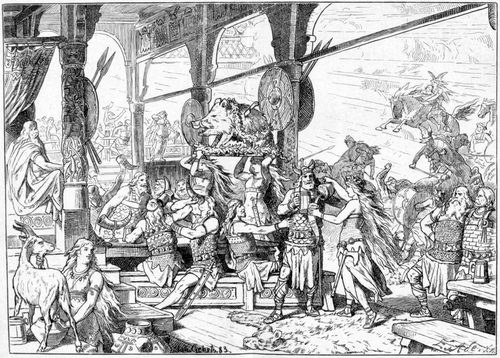
Odin rode so hard that he was always over the next hill first, and Hrungnir was in such a giant's fury that he did not notice where he was until he was inside the gates of Asgard. At the hall door the gods invited him in to drink. He was served from the great bowls Thor used, drained them all, and became drunk and loud:
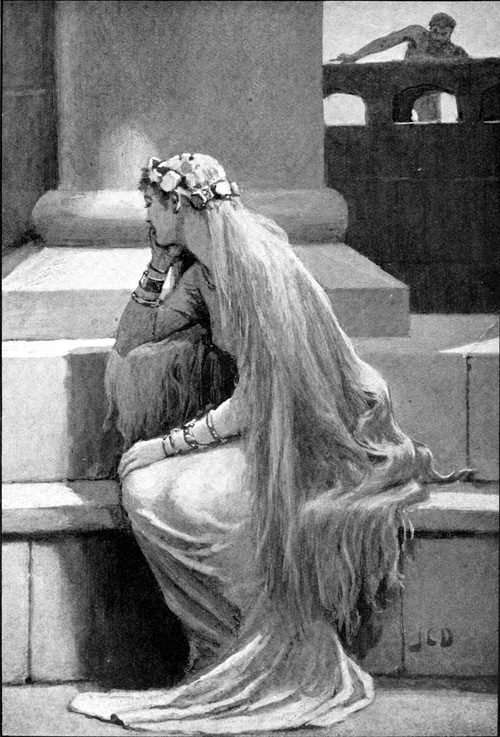
he boasted that he would lift up Valhall and carry it to Jötunheim, and sink Ásgard and kill all the gods, save that he would take Freyja and Sif home with him.Skáldskaparmál 17
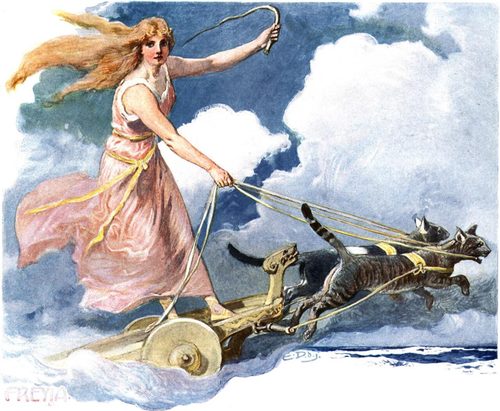
Only Freyja dared to pour for him, and he swore he would drink up all the gods' ale. At last the gods, tired of him, called out Thor's name.
The challenge
Thor came straight into the hall with his hammer raised, in a fury. Who had let a giant drink here, he demanded, who had given Hrungnir safe-conduct in Valhalla, and why was Freyja pouring for him as if at a feast of the gods? Hrungnir, glaring back, said Odin had invited him and he was under Odin's protection. Thor said he would regret that invitation before he left Skáldskaparmál 17.
Hrungnir answered that there was little glory in killing an unarmed man. He had foolishly left his shield and whetstone at home. If Thor had any courage he would meet him in single combat at Grjótúnagarðar on the border; otherwise he would call him a coward. Thor accepted at once: no one had ever challenged him to a duel before Skáldskaparmál 17.
The clay giant
Hrungnir rode home, and the giants heard of the meeting. They thought a great deal depended on it: if their strongest man died, they could expect worse from Thor. So at Grjótúnagarðar they built a man of clay, nine miles high and three miles broad under the arms, called Mökkurkálfi. No heart was big enough for him until they used a mare's, and even that did not hold firm when Thor came Skáldskaparmál 17.
Hrungnir himself was made for the fight:
Hrungnir had the heart which is notorious, of hard stone and spiked with three corners, even as the written character is since formed, which men call Hrungnir's Heart. His head also was of stone; his shield too was stone, wide and thickSkáldskaparmál 17
He stood with the stone shield in front of him and a whetstone over his shoulder for a weapon, "and he was not a pretty sight". The clay giant beside him was so frightened, Snorri says, that he wet himself when he saw Thor.
Hammer against whetstone
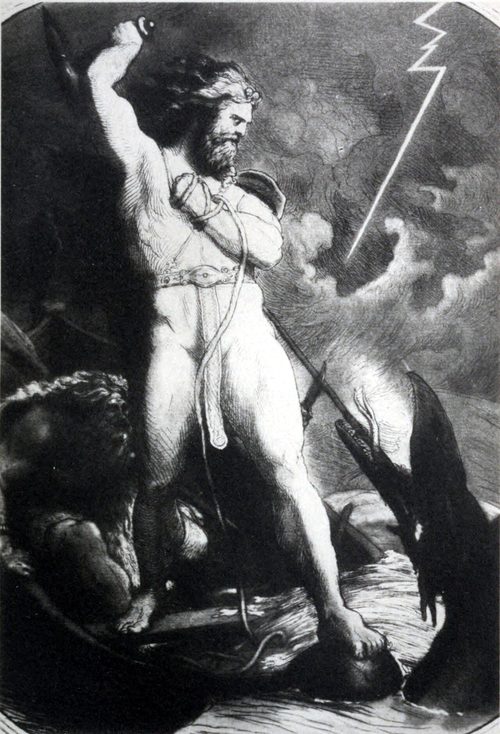
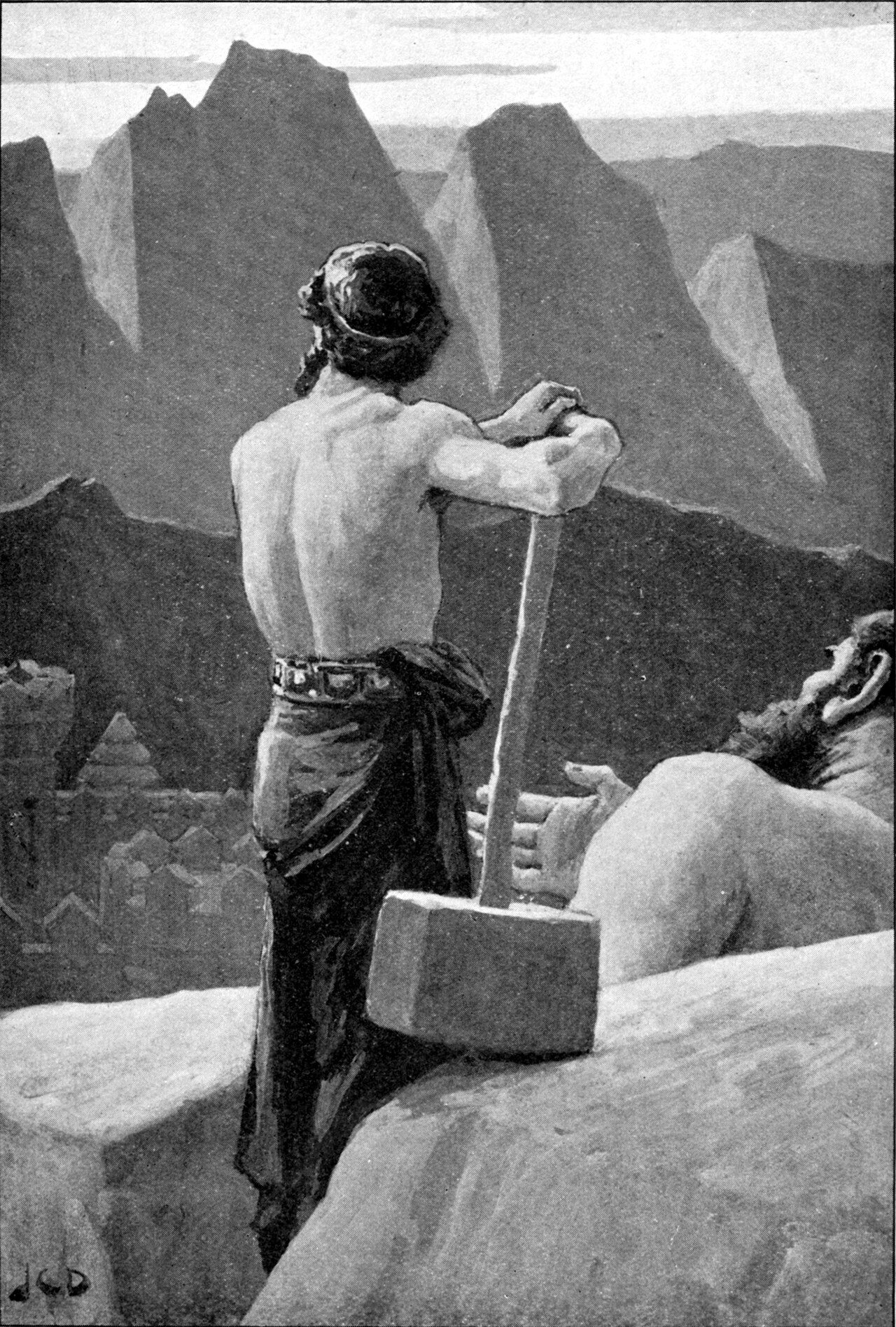
Thor came with Þjálfi. Þjálfi ran ahead and told Hrungnir he was standing carelessly with his shield in front of him: Thor had seen him and was coming at him from under the ground. Hrungnir threw the shield down and stood on it, holding the whetstone in both hands. Then he saw lightning and heard thunder, and Thor came on in his godlike rage and hurled Mjölnir from far off Skáldskaparmál 17.
Hrungnir threw the whetstone. It met the hammer in the air and broke apart. One part fell to the ground, and that is where all flint-rocks come from; the other struck Thor in the head, and he fell forward. The hammer hit Hrungnir in the middle of the head and smashed his skull to crumbs, and the giant fell forward on top of Thor, one leg across his neck. Þjálfi struck down Mökkurkálfi, "and he fell with little glory" Skáldskaparmál 17.
No one could move Hrungnir's leg: not Þjálfi, not all the gods together. Then Magni, Thor's son by the giantess Járnsaxa, three nights old, came up and threw it off, saying it was a pity he had come so late; he would have killed the giant with his fist. Thor gave him Gullfaxi. Odin said Thor was wrong to give such a horse to the son of a giantess and not to his own father Skáldskaparmál 17.
The stone in Thor's head
Thor went home to Þrúðvangar with the stone still in his head. The wise woman Gróa, wife of Aurvandill, sang spells over him until it began to loosen. Hoping to please her, Thor told her that he had carried Aurvandill out of Jötunheimr in a basket on his back across the icy rivers, and that when one of Aurvandill's toes stuck out and froze, he broke it off and threw it into the sky as the star called Aurvandill's Toe; her husband would soon be home. Gróa was so delighted that she forgot her spells. The stone is still in Thor's head, and that, Snorri says, is why one must never throw a whetstone across the floor: it stirs the stone in Thor's head Skáldskaparmál 17.
Where the story comes from
Snorri's prose (around 1220) is the only full telling, but he quotes the much older Haustlöng by Thjóðólfr of Hvin, a poem of about 900 describing the fight as painted on a shield Skáldskaparmál 17. The poem has Thor drive to the duel in his goat-chariot while the heavens burn and the earth is split by hail, details not in Snorri's prose. It also differs on a key point: it says the shield shot under Hrungnir's feet because "the wise gods" and the valkyries willed it, with no word of Þjálfi's trick. At the end, Haustlöng says the "wise ale-goddess" (Gróa) enchanted the stone "from the Wain-God's sloping temples", which reads as though her charms worked; in Snorri they fail, and the stone is still there.
The Poetic Edda knows the fight but never tells it. In Hárbarðsljóð Thor boasts that he felled Hrungnir, "whose head of stone was made" Hárbarðsljóð 15. In Lokasenna he calls Mjölnir "the slayer of Hrungnir" Lokasenna 63. Sigrdrífumál calls Thor's chariot that of "Hrungnir's killer" Sigrdrífumál 15, and the skald Bragi calls Thor "Skull-Splitter of Hrungnir" Skáldskaparmál 4.
Reading it today
The story is crowded with explanations: of flint, of a star, of a custom about whetstones, and of the triangular symbol called "Hrungnir's heart", a figure of three interlocked triangles that appears on some Viking-Age picture stones, though whether that is what Snorri meant is uncertain. Some scholars have read the duel as a reflection of the formal Norse single combat (hólmganga), with its fixed meeting-place and seconds: Þjálfi and Mökkurkálfi face each other as the two champions' attendants. Magni's birth-strength and Odin's sulk over the horse are typical of the family comedy in Snorri's stories about the gods.
Key passages
he boasted that he would lift up Valhall and carry it to Jötunheim, and sink Ásgard and kill all the gods, save that he would take Freyja and Sif home with him
Hrungnir had the heart which is notorious, of hard stone and spiked with three corners
But the hammer Mjöllnir struck Hrungnir in the middle of the head, and smashed his skull into small crumbs, and he fell forward upon Thor, so that his foot lay over Thor's neck.
Swiftly the shining shield-rim / Shot 'neath the Cliff-Ward's shoe-soles; / That was the wise gods' mandate, / The War-Valkyrs willed it.
Fain art thou to tell how with Hrungnir I fought, / The haughty giant, whose head of stone was made; / And yet I felled him, and stretched him before me.
The slayer of Hrungnir shall send thee to hell