A myth retold · about 6 minutes
The binding of Fenrir
The gods raise Loki's wolf-son Fenrir at home until they fear him, then trick him into a magic fetter made of impossible things. Týr puts his hand in the wolf's mouth as a pledge, and loses it.
The binding of Fenrir is the gods' most successful act of prevention and their most shameful. They know from prophecy that a wolf will destroy them. They raise it, flatter it, lie to it and chain it, and they win time. They do not win.
Loki's children
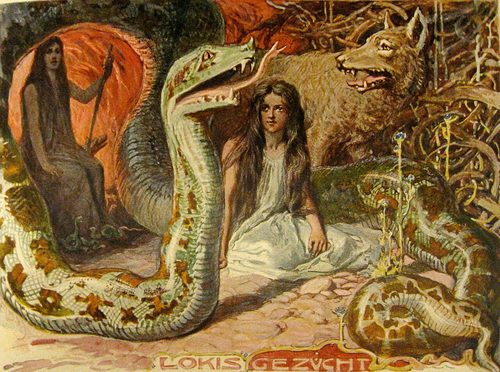
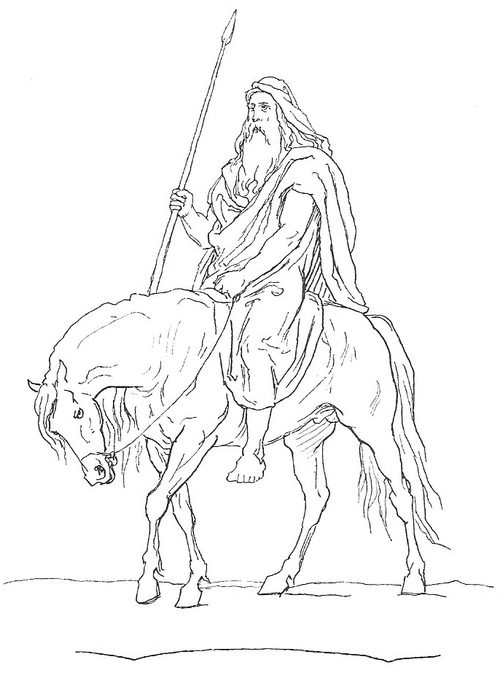
Loki, Snorri says, had three children with a giantess in Jötunheimr named Angrboða: the wolf Fenrir, the serpent Jörmungandr, and Hel Gylfaginning 34. The gods learned that these children were being raised among the giants, and prophecies told them that great harm would come from this family, "first from the mother's blood, and yet worse from the father's". So Allfather sent gods to fetch the three. Odin threw the serpent into the ocean, where it grew until it encircled the earth; he cast Hel down into Niflheim to rule the dead. The wolf the gods kept.
Hyndluljóð confirms the parentage — "the wolf did Loki with Angrbotha win" Hyndluljóð 42 — but only Snorri tells of the gods taking the children away.
Two chains
Fenrir was raised at home, among the Æsir, and only Týr dared go near him to feed him Gylfaginning 34. He grew every day, and every prophecy said he would be the gods' ruin. So the gods made a fetter of great strength, called Lœðingr, and invited the wolf to test himself against it. He saw no great danger and let them put it on. With his first kick it broke.
They made a second, twice as strong, called Drómi, and told him that if he broke this one he would be famous for his strength. Fenrir judged that this one was very strong, but also that he had grown since breaking Lœðingr, and "that he must expose himself to danger, if he would become famous". He let them chain him. Then he shook himself, threw himself against the ground and strained until Drómi burst and the pieces flew far. Snorri notes that people still say "to loose out of Lœðingr" or "to dash out of Drómi" of anything that takes enormous effort.
The fetter from nothing
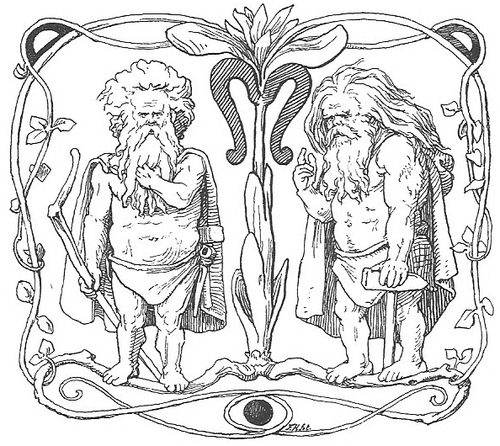
After that the gods despaired of binding him by force. Allfather sent Skírnir, Freyr's messenger, down to certain Dwarves in the world of the black elves, and they made a fetter called Gleipnir Gylfaginning 34.
It was made of six things: the noise a cat makes in foot-fall, the beard of a woman, the roots of a rock, the sinews of a bear, the breath of a fish, and the spittle of a bird.Gylfaginning 34
Hárr, Snorri's narrator, adds a deadpan proof: you have surely noticed that women have no beards, cats' footfalls make no noise and rocks have no roots — that is why. The finished fetter was "soft and smooth as a silken ribbon", but stronger than any chain.
The pledge
The gods rowed out onto the lake Ámsvartnir, to the island of Lyngvi, and took the wolf with them. They showed him the ribbon, passed it hand to hand, pulled at it and said it was stronger than it looked — though of course he could break it.
Fenrir was not fooled. If it was only a ribbon, he said, there was no glory in breaking it; if it was made "with cunning and wiles", it would never go on his feet. The gods answered that a wolf who had snapped iron fetters could surely break a silk band, and that if he could not, he was no threat, and they would let him go. Fenrir saw through that too: if they bound him so that he could not get free, it would be a long time before he got help from them. But he would not have his courage called into question. He made his own condition: one of them must lay a hand in his mouth as a pledge of good faith.
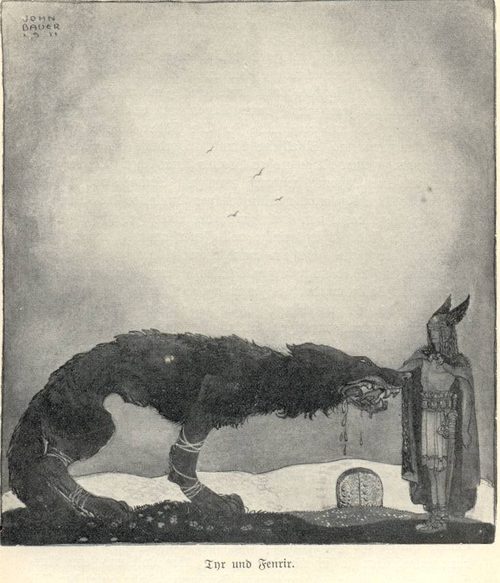
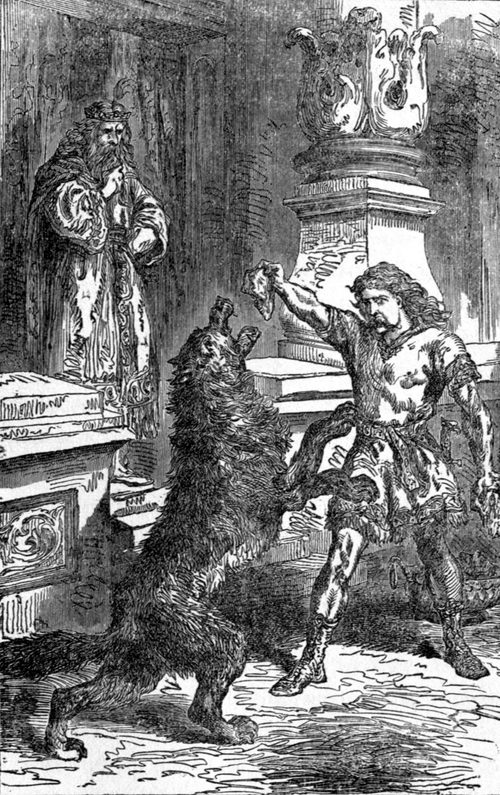
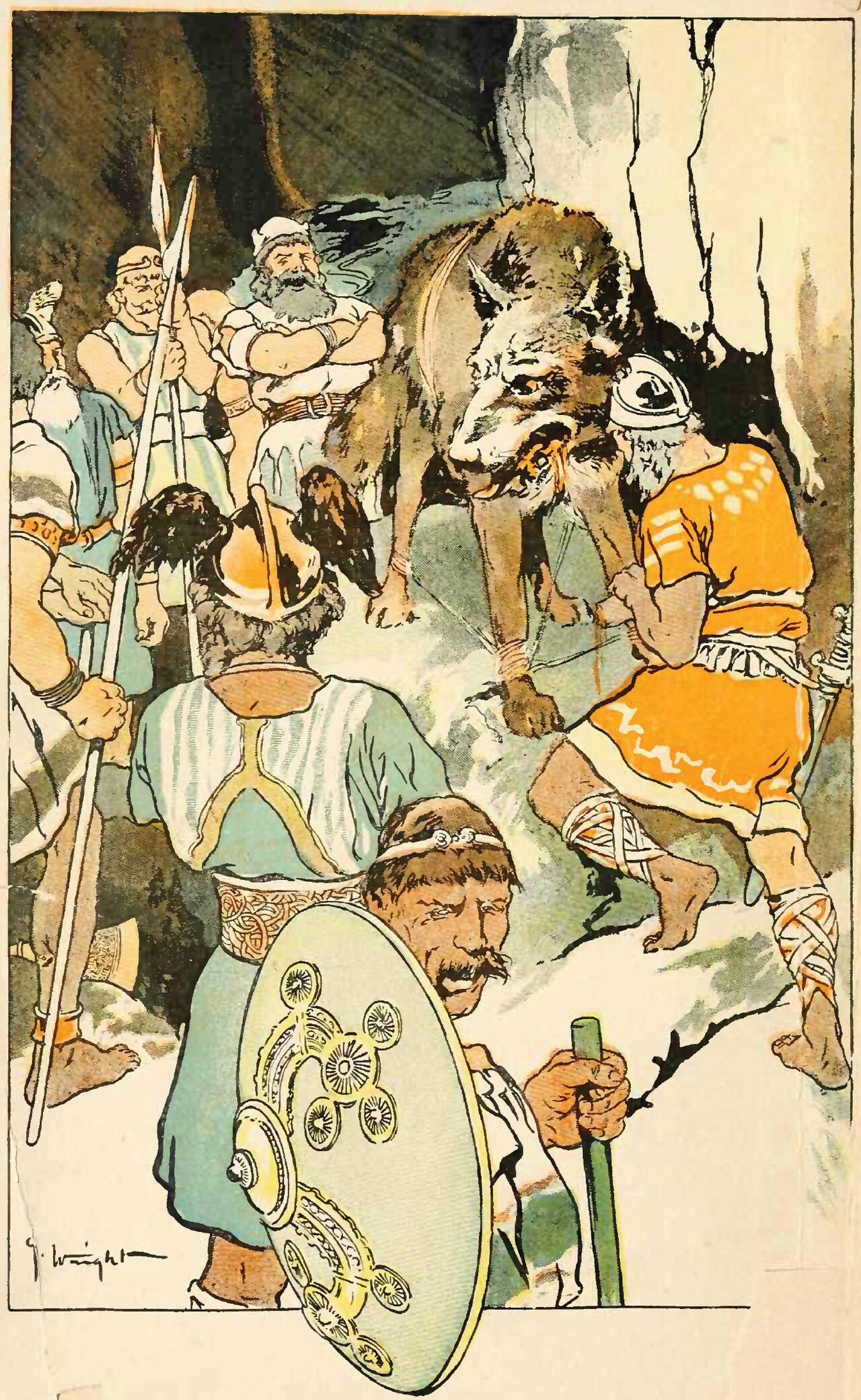
Each of the Æsir looked at his neighbor, and none was willing to part with his hand, until Týr stretched out his right hand and laid it in the Wolf's mouth.Gylfaginning 34
They tied him. The wolf kicked, and the band tightened; the harder he struggled, the harder it held. "Then all laughed except Týr: he lost his hand." In his portrait of Týr, Snorri says the wolf bit the hand off at the joint that is still called "the wolf's joint" Gylfaginning 25.
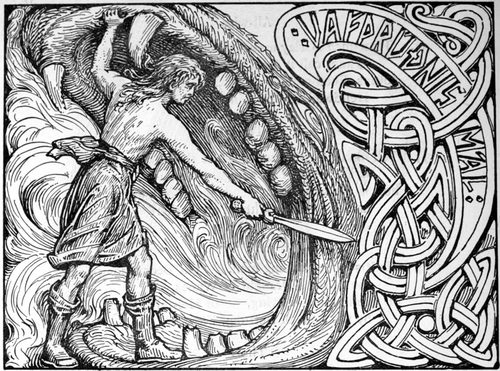
The gods fixed the fetter's chain, Gelgja, through a great rock called Gjöll and drove it deep into the earth, pinned with a stone called Þviti. Fenrir gaped and snapped at them, so they wedged a sword in his mouth, hilt against the lower jaw and point against the upper. He howls, and the slaver running from his jaws is the river Ván. Why not simply kill him? Because, Hárr says, the gods held their sanctuary so holy that they would not stain it with the wolf's blood Gylfaginning 34.
Waiting for the end
The poems know the binding as a past event and look forward from it. In Lokasenna Loki taunts Týr with the hand Fenrir tore from him, and Týr answers that Loki has lost his son, and that the wolf will wait in fetters for the fall of the gods Lokasenna 38-39. Freyr adds that the wolf lies "by the mouth of the river" until the end Lokasenna 41, which matches Snorri's river Ván.
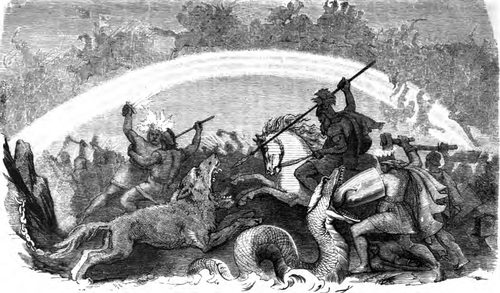
At Ragnarök all bonds break and Fenrir runs free Gylfaginning 51. Völuspá's refrain sounds it again and again: "The fetters will burst, and the wolf run free" Völuspá 44. He kills Odin, and Odin's son Víðarr avenges him Vafþrúðnismál 53 Völuspá 53-54.
Where the story comes from
The narrative is Snorri's: Gylfaginning 34, with Týr's lost hand repeated in chapter 25, written in the 1220s. The poems confirm its frame — Loki's fatherhood, Týr's lost hand, the bound wolf awaiting the end — but none tells the story of the binding itself. The names of the fetters, the island, Gleipnir's ingredients and the sword in the jaws appear only in Snorri.
The sources differ on details. Völuspá's refrain sets the bursting fetters beside the hound Garmr howling before a cave, Gnipahellir Völuspá 44; Snorri puts the wolf on an island in a lake, and in his Ragnarök chapter makes Garmr a separate monster bound "before Gnipa's Cave" Gylfaginning 51. Whether the poem's bound wolf and baying hound were originally the same creature is debated. Snorri's Ragnarök also has Víðarr kill the wolf by tearing its jaws apart with one foot on the lower jaw, while Völuspá has him drive his sword into its heart Völuspá 54; Vafþrúðnismál says only that he tears the jaws Vafþrúðnismál 53.
Reading it today
Týr's sacrifice is the moral centre of the story, and readers have taken it in different ways. One common reading sees it as an act of law: Týr is the god who stands surety for an oath he knows is false, and pays the price so that the community is safe. Snorri himself draws a less heroic lesson — Týr "is not called a reconciler of men" Gylfaginning 25. The French scholar Georges Dumézil compared the story with Roman legends of a hero who loses a hand in a pledge; the comparison is suggestive, not proven.
Fenrir himself is drawn with surprising sympathy. He is clever, cautious and proud, and he is right about the gods. That ambiguity has made the bound wolf a favourite image in modern fantasy and art.
Key passages
The Wolf the Æsir brought up at home, and Týr alone dared go to him to give him meat.
It was made of six things: the noise a cat makes in foot-fall, the beard of a woman, the roots of a rock, the sinews of a bear, the breath of a fish, and the spittle of a bird.
Then all laughed except Týr: he lost his hand.
Fain would I tell how Fenrir once Thy right hand rent from thee.
My hand do I lack, but Hrothvitnir thou, And the loss brings longing to both; Ill fares the wolf who shall ever await In fetters the fall of the gods.
The fetters will burst, and the wolf run free
The wolf shall fell the father of men, And this shall Vithar avenge