A myth retold · about 5 minutes
Ask and Embla: the first humans
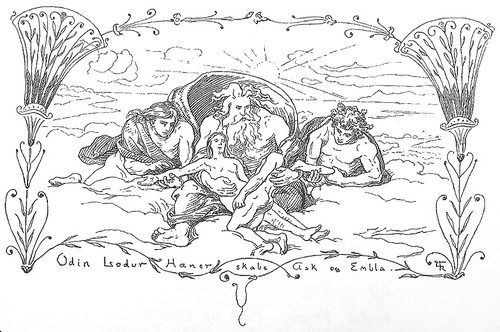
Three gods walking by the shore find two lifeless pieces of wood, Ask and Embla, and give them breath, mind, warmth and colour. Völuspá and Snorri agree on the gifts but not on who gave them.
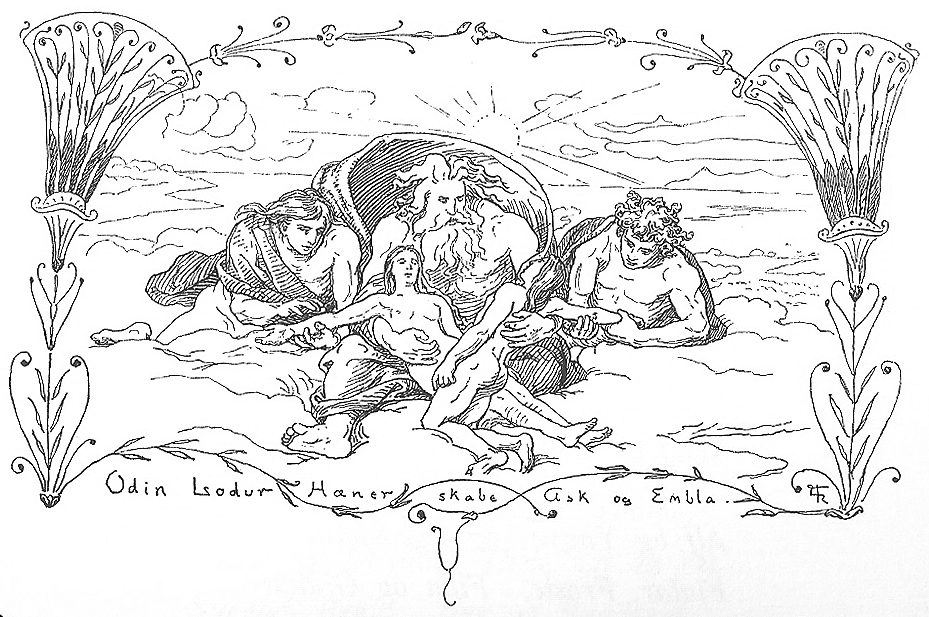
The Norse story of the first people is one of the shortest myths that survives, and one of the most quoted. It takes two stanzas of Völuspá and a paragraph of Snorri. In both, humans are not born but found: two shapes lying on the shore, waiting for the gods to finish them.
Two without fate
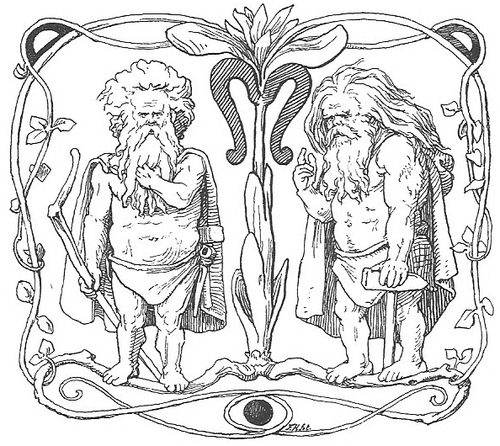
In Völuspá the scene follows the long list of dwarfs. The seeress turns back to the gods: three of them come out of the throng, "mighty and gracious", from the home of the gods, and on the land they find two beings Völuspá 17. They are Ask and Embla, "empty of might" and "without fate". The poem does not say what they are made of or where they came from. They are simply there.
Then from the throng did three come forth,From the home of the gods, the mighty and gracious;Two without fate on the land they found,Ask and Embla, empty of might.Völuspá 17
The next stanza lists what they lacked, then what they were given, in a near-perfect mirror Völuspá 18. They had no soul, no sense, no heat, no motion, no good colour. Odin gave them soul; Hœnir gave them sense; Lóðurr gave them heat and good colour. The Old Norse words behind Bellows's "soul", "sense" and "heat" are önd (breath, spirit), óðr (mind, inspiration) and lá (a word of uncertain meaning, often taken as blood, warmth or vital moisture). Translators differ a good deal here, and Bellows's choices are one reasonable set among several.
Soul they had not, sense they had not,Heat nor motion, nor goodly hue;Soul gave Othin, sense gave Hönir,Heat gave Lothur and goodly hue.Völuspá 18
That is the whole of the poem's story. The next stanza moves straight on to the world-tree and the Norns, who "set their fates" for the sons of men Völuspá 20. Read in sequence, the two beings "without fate" receive life from the gods and then a destiny from the Norns, though the poem does not draw the link itself.
Snorri's version: the sons of Borr on the strand
Snorri's Gylfaginning tells it as the next step after the gods had built the world from Ymir's body and set the lights in the sky. Gangleri asks where the people of the world came from Gylfaginning 9. The answer: the sons of Borr — that is, Odin and his brothers Vili and Vé — were walking along the sea-strand and found two trees. They picked them up and shaped people out of them.
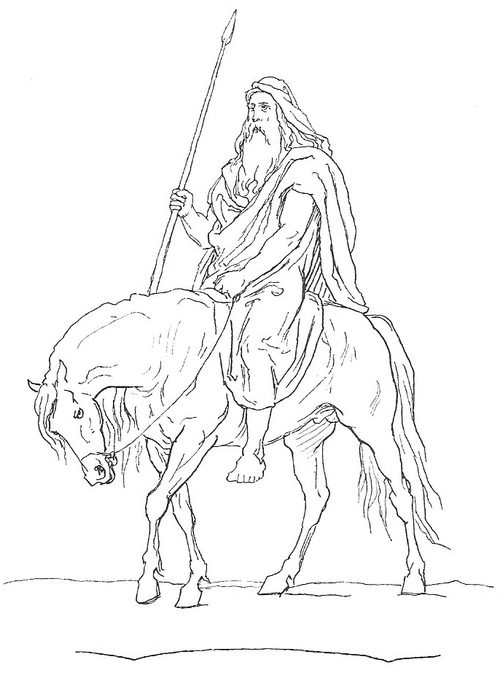
Each brother gave a gift. "The first gave them spirit and life; the second, wit and feeling; the third, form, speech, hearing, and sight." Snorri does not name which brother gave which, but since he has just named them in order (Odin, Vili, Vé) the reader is meant to supply it. Then the gods did something Völuspá does not mention: they gave the new people clothing and names. The man was Askr, the woman Embla. From them all humankind descends, and the gods gave them a home in Miðgarðr, the land walled off from the giants with Ymir's eyebrows.
They gave them clothing and names: the male was called Askr, and the female Embla, and of them was mankind begotten, which received a dwelling-place under Midgard.Gylfaginning 9
Only after this, in Snorri's order, do the gods build Ásgard for themselves in the middle of the world. Humans come first, then the gods' own city.
Where the story comes from
There are just two witnesses. Völuspá stanzas 17–18 are the older, preserved in the Codex Regius (about 1270) and in Hauksbók, though the poem itself is usually dated earlier, often to around the year 1000. Snorri's Gylfaginning chapter 9 was written in the 1220s and clearly knows a version of Völuspá, which he quotes elsewhere.
They differ in three concrete ways:
- The makers. Völuspá names Odin, Hœnir and Lóðurr. Snorri gives the job to the sons of Borr, Odin, Vili and Vé — the same trio who killed Ymir Gylfaginning 9. Odin is the only god in both lists.
- The material. Völuspá never says Ask and Embla are trees. Snorri says outright that the gods "found two trees". The names support him at least for Ask: askr is the ordinary word for an ash tree. Embla is harder; it has been explained as "elm", as "vine" or as something else entirely, and no explanation has won general agreement.
- The gifts. Völuspá's list is three gifts, with Lóðurr giving two. Snorri expands the third gift into form, speech, hearing and sight, and adds clothes and names.
Lóðurr appears nowhere else in the hosted texts. Who he is has been argued for well over a century. A popular identification is with Loki, and some have linked him with Vé; neither rests on anything in the sources themselves.
Reading it today
The obvious reading is the one the names invite: people are trees brought to life, rooted in the land the gods made, and humanity's first parents mirror the world-ash Yggdrasil that stands over everything. Some scholars have gone further and connected the scene with the image of driftwood washed up on a treeless Icelandic shore, which would explain why the pair are found "on the land" by the sea; that is an appealing guess rather than anything the texts state.
It is also worth noticing what the story leaves out. There is no fall, no garden and no special creation of the woman from the man: the two are found together and made at the same moment. Snorri, who knew Genesis well, keeps that symmetry.
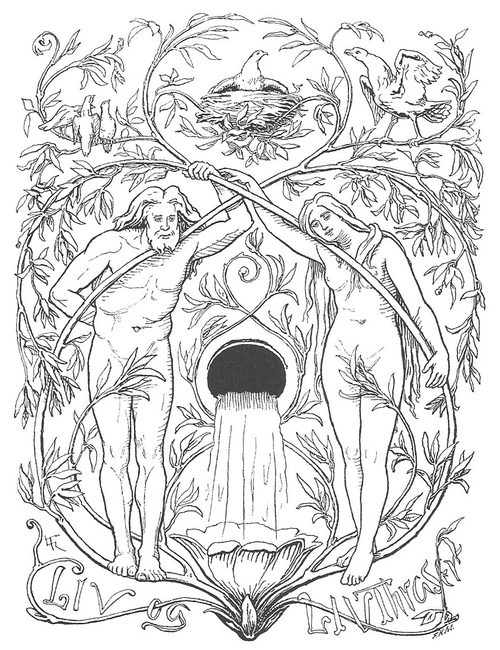
The story has an echo at the other end of time. After Ragnarök, two more humans, Líf and Lífþrasir, survive hidden in Hoddmímir's Holt, living on morning dew, and from them "all the world shall be peopled" again Gylfaginning 53 Vafþrúðnismál 45. Ask and Embla begin humanity; Líf and Lífþrasir begin it a second time.
Key passages
Two without fate on the land they found, Ask and Embla, empty of might.
Soul they had not, sense they had not, Heat nor motion, nor goodly hue; Soul gave Othin, sense gave Hönir, Heat gave Lothur and goodly hue.
they found two trees, and took up the trees and shaped men of them
the male was called Askr, and the female Embla, and of them was mankind begotten, which received a dwelling-place under Midgard
From these folk shall come so numerous an offspring that all the world shall be peopled