world
The nine worlds
níu heimar
The Eddas say there are nine worlds but never list them; the familiar list of nine realms is a modern reconstruction built mostly from Snorri's place-names.
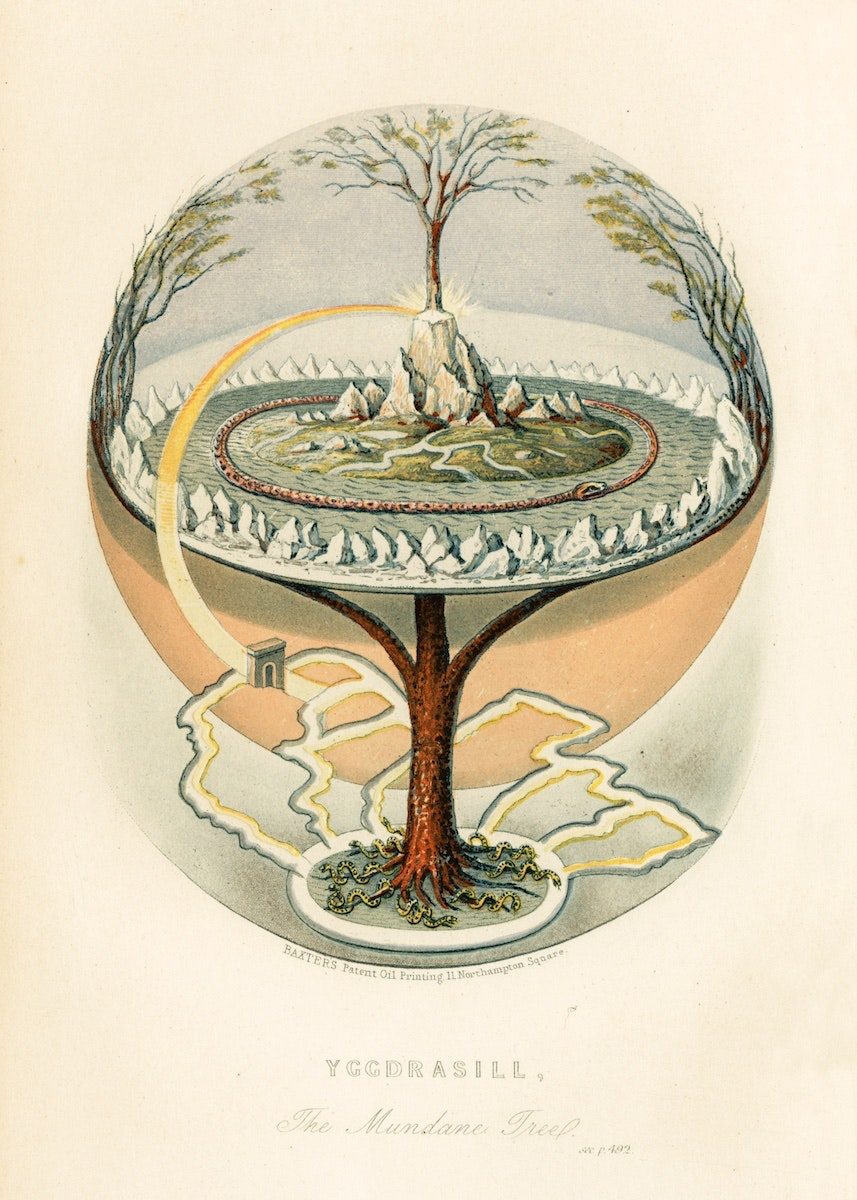
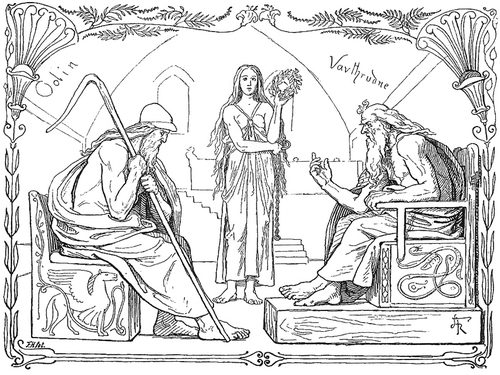
The number is old; the list is not. The seeress who speaks Völuspá begins her memory with "nine worlds … the nine in the tree" Völuspá 2, and in Vafþrúðnismál the giant Vafþrúðnir boasts that he has come "to nine worlds" and to Niflhel below them Vafþrúðnismál 43. Neither poem names the nine. No other poem in the Poetic Edda names them either, and Snorri never does. The neat roster of nine realms found in modern books is a reconstruction, put together by later readers from names scattered through the sources.
What the sources actually say
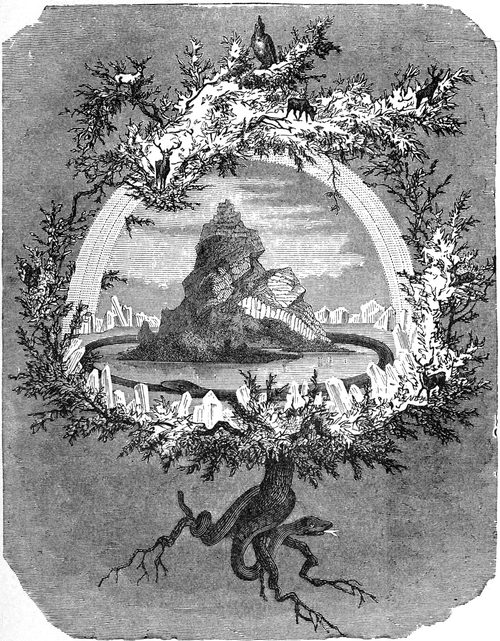
The poems give the number and a few fixed points. Völuspá ties the worlds to the tree Yggdrasil Völuspá 2. Grímnismál gives the tree three roots, over Hel, over the frost-giants and over "the lands of men" Grímnismál 31: three regions, not nine. Vafþrúðnir's nine worlds seem to sit above Niflhel, "the home where dead men dwell" Vafþrúðnismál 43.
Snorri uses the number twice, both times about the dead. The wicked go "to Hel and thence down to the Misty Hel; and that is down in the ninth world" Gylfaginning 3. And when Odin casts Hel into Niflheim he gives her "power over nine worlds", to share out lodgings among those who die of sickness or old age Gylfaginning 34. In these passages the nine worlds look like levels of the underworld, or the whole cosmos seen from below. Snorri does not stop to explain.
Alvíssmál is often cited as a key to the nine. Thor asks the dwarf Alvíss what the earth, sky, moon and so on are called "in each and every world" Alvíssmál 9. The answers name peoples, not places: men, gods, Vanir ("the Wanes"), giants, elves, dwarfs, "the holy ones high", the dwellers in hell, and once "Suttung's sons" Alvíssmál 10 Alvíssmál 34. No single answer uses all of them, and the poem never counts them. It suggests a world shared by several races, each with its own speech, which is close to the modern idea, but it is not a list of nine worlds.
'Heaven' men call it, 'The Height' the gods,The Wanes 'The Weaver of Winds';Giants 'The Up-World,' elves 'The Fair-Roof,'The dwarfs 'The Dripping Hall.'Alvíssmál 12
Where the modern list comes from
Each name in the familiar list is medieval; the selection is not.
- Ásgarðr and Miðgarðr: in the poems Þrymskviða 17 Völuspá 4 and in Snorri Gylfaginning 9.
- Jötunheimr: in the poems Völuspá 8 and in Snorri.
- Álfheimr: Freyr's home in Grímnismál Grímnismál 5; a home of light-elves in heaven in Snorri Gylfaginning 17.
- Vanaheimr: implied by "the home of the Wanes" Vafþrúðnismál 39; Snorri says only "the land of the Vanir" Gylfaginning 23.
- Niflheimr and Múspellsheimr: only in Snorri's creation story Gylfaginning 4 Gylfaginning 5. The poems know Niflhel, not Niflheim.
- Svartálfaheimr: only in Snorri's prose, which Brodeur translates "the region of the Black Elves" Gylfaginning 34.
- Hel: everywhere, but as a place of the dead, not a named "heim".
- Niðavellir: one line of Völuspá Völuspá 37; it enters modern lists as a substitute for Svartálfaheimr.
That makes ten candidates for nine places, and two of them (Niflheim and Hel) overlap in Snorri himself. Modern lists usually choose Svartálfaheimr or Niðavellir as the dwarves' world and keep both Niflheim and Hel. The arrangement in three tiers, with Ásgarðr at the top and Hel at the bottom, is likewise a modern diagram; the closest medieval source is Snorri's account of the three roots Gylfaginning 15, which does not match Grímnismál's Grímnismál 31.
How to read it
Scholars generally treat "nine" as a sacred or formulaic number in Norse tradition (Odin hangs nine nights on the tree Hávamál 139, Heimdallr has nine mothers Gylfaginning 27) rather than as the end of a fixed catalogue. A common reading is that the poets knew the cosmos had nine parts without needing to recite them, much as the listener knew the names of the gods. Whether a fixed list of nine ever existed is unknown. What the sources offer is a crowded cosmos — gods, Vanir, elves, men, giants, dwarves and the dead, each in their own home — held together by the tree.
In the sources
Quoted from the hosted translations; each line is checked against the text when the site is built. Select a reference to read it in context.
Nine worlds I knew, the nine in the tree With mighty roots beneath the mold.
To nine worlds came I, to Niflhel beneath, The home where dead men dwell.
Hel he cast into Niflheim, and gave to her power over nine worlds
evil men go to Hel and thence down to the Misty Hel; and that is down in the ninth world.
What call they the earth, that lies before all, In each and every world?
Where the sources disagree or fall silent
- No medieval source lists the nine worlds by name; any list of nine is a modern reconstruction.
- The Old Norse of Völuspá 2 pairs 'nine worlds' with a second, obscure phrase that Bellows renders 'the nine in the tree'; some editors read it as 'nine giantesses' or 'nine wood-dwellers'. Its meaning is disputed.
- Whether Snorri's 'nine worlds' under Hel (Gylfaginning 34) are the same nine as Völuspá's is unclear.
In modern culture
Not from the medieval sources.
Almost every modern book, game and film gives a tidy list of nine: Asgard, Vanaheim, Alfheim, Midgard, Jotunheim, Muspelheim, Niflheim, Svartalfheim (or Nidavellir) and Hel, often stacked on three levels of Yggdrasil. Marvel's Thor films and comics and the God of War games (2018 onward) made this scheme familiar worldwide; Marvel swaps in Nidavellir as a dwarf forge-world. The list is a reasonable modern synthesis, but no medieval text gives it.