A myth retold · about 6 minutes
The war of the Æsir and the Vanir
The first war in the world, fought between the two families of gods. The surviving texts give only fragments — a witch burned three times, Odin's spear, a broken wall, a truce sealed with spittle and hostages — but they add up to the story of how the Vanir came to live among the Æsir.
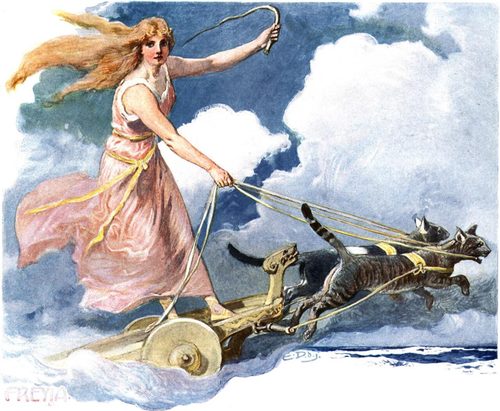
Norse myth has two families of gods. The Æsir — Odin, Thor, Týr and the rest — are the larger group. The Vanir are associated with wealth, fertility and the sea; the ones we know by name are Njörðr and his children Freyr and Freyja. In the mythology as it reaches us, the three Vanir live among the Æsir and are counted with them. The war between the two families explains how that happened.
No surviving text tells this story whole. The Poetic Edda gives four obscure stanzas of Völuspá; the Prose Edda mentions the war only in passing, twice; and a few lines elsewhere recall the hostages. What follows pieces the fragments together and says where each one comes from. Readers should know that the order of events is partly a reconstruction.
Gollveig in the hall
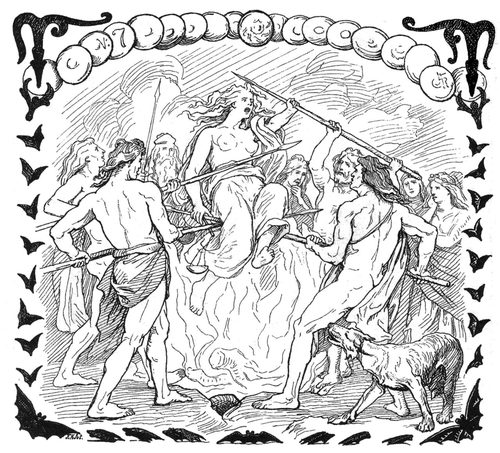
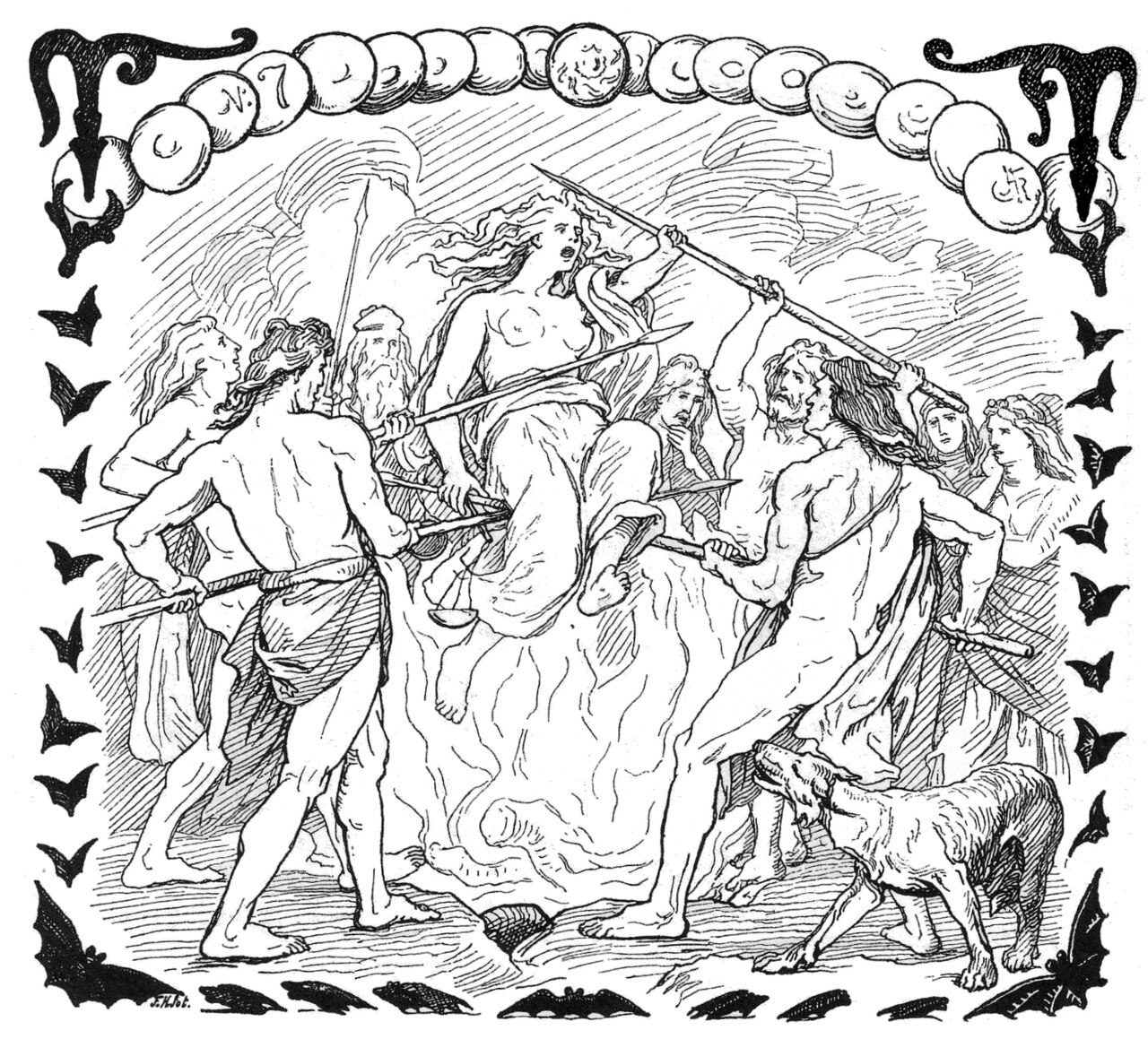
The seeress of Völuspá opens with a memory: "The war I remember, the first in the world" Völuspá 21. It began, she says, when the gods stabbed a woman called Gollveig with spears and burned her in the hall of Hár — one of Odin's names. They burned her three times, and three times she was born again. "Oft and again, yet ever she lives."
The war I remember, the first in the world,When the gods with spears had smitten Gollveig,And in the hall of Hor had burned her,—Three times burned, and three times born,Oft and again, yet ever she lives.Völuspá 21
The next stanza describes a woman called Heiðr, "the wide-seeing witch, in magic wise", who came to people's houses and bewitched their minds; "to evil women a joy she was" Völuspá 22. Most readers take Heiðr to be Gollveig under a new name, after her rebirth, practising the kind of magic called seiðr. The poem does not say so, nor does it say who Gollveig was, where she came from, or why the gods attacked her. Her name is usually explained as "gold-drink" or "gold-intoxication", which has led many to read her as greed for gold personified; that is an interpretation.
Odin's spear and the broken wall
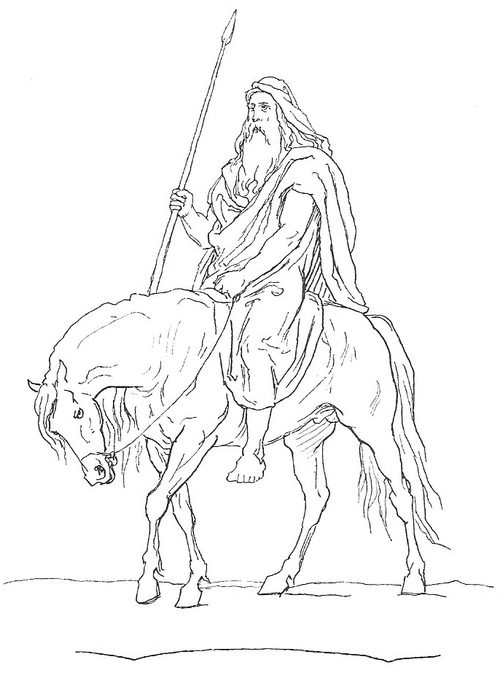
Then war came. Odin hurled his spear over the enemy host, "then in the world did war first come" Völuspá 23. The wall around the gods' stronghold was broken, and the "warlike Wanes" — Bellows's word for the Vanir — trampled the field. The poem implies that the Vanir had the upper hand.
On the host his spear did Othin hurl,Then in the world did war first come;The wall that girdled the gods was broken,And the field by the warlike Wanes was trodden.Völuspá 23
Völuspá never explicitly says that the Vanir were angry about Gollveig, though placing the stanzas side by side suggests a connection. It also never describes the fighting. The scene shifts at once to the gods sitting in council on their judgment seats, debating "whether the gods should tribute give, or to all alike should worship belong" Völuspá 24. In other words: should the Æsir pay the Vanir off, or accept them as equals and share the sacrifices that people offer? The poem does not give the answer, but the rest of the mythology implies the second.
The peace: spittle and hostages
Snorri Sturluson, writing in the 1220s, knew a version in which the war ended in a treaty. In Skáldskaparmál, the god Bragi explains the origin of poetry by going back to it: "The gods had a dispute with the folk which are called Vanir", they appointed a peace-meeting, and they sealed the peace by each side spitting into a vat Skáldskaparmál 1. The gods would not let that token of peace go to waste, so they made a man from it. He was Kvasir, so wise that no question could defeat him. His murder by two dwarfs, who brewed his blood into the mead of poetry, is another story.
The other half of the peace was an exchange of hostages. In Gylfaginning Snorri says that Njörðr "is not of the race of the Æsir": he grew up among the Vanir, who gave him to the gods as a hostage and took Hœnir in return, so that Njörðr "became an atonement between the gods and the Vanir" Gylfaginning 23. Vafþrúðnismál agrees that Njörðr was made "in the home of the Wanes" and given "as pledge to the gods", and adds a prophecy that at the end of the world he will go home to the Vanir Vafþrúðnismál 39. In Lokasenna, Loki taunts Njörðr with having been sent east "to the gods as a hostage given", and Njörðr answers that the exchange did him good: it gave him a son whom no one hates Lokasenna 34-35.
Njorth spake:"Great was my gain, though long was I gone,To the gods as a hostage given;The son did I have whom no man hates,And foremost of gods is found."Lokasenna 35
Snorri's Ynglinga saga, the opening of his history of the Norwegian kings (Heimskringla), tells the war more fully, but treats the gods as human kings and is not hosted here. In that version the Vanir send Njörðr and Freyr, and the Æsir send Hœnir and Mímir. The Vanir later feel cheated, because Hœnir is useless without Mímir's advice, and they behead Mímir and send the head back to Odin. The same saga makes Freyja the one who first taught seiðr to the Æsir, and has Kvasir as one of the Vanir rather than a being made from spittle.
Where the story comes from
The sources, in order of age as usually reckoned:
- Völuspá 21–24 (Codex Regius, about 1270; the poem is generally dated earlier). Gollveig, Heiðr, Odin's spear, the broken wall, the debate about tribute. No hostages, no peace.
- Vafþrúðnismál 39 and Lokasenna 34–35: Njörðr as a hostage, nothing about the war itself.
- Gylfaginning 23 (Snorri, 1220s): Njörðr given in exchange for Hœnir.
- Skáldskaparmál 1 (Snorri): the war, the peace-meeting and Kvasir made from spittle.
- Ynglinga saga (Snorri, about 1230, not hosted): the fullest narrative, euhemerised.
They do not all fit together. Snorri himself gives two incompatible origins for Kvasir: made from the gods' spittle in Skáldskaparmál, a Vanir hostage in Ynglinga saga. Gylfaginning names only Njörðr and Hœnir in the exchange, while Ynglinga saga adds Freyr and Mímir. And Völuspá links the war to a woman burned in Odin's hall, a detail Snorri never mentions anywhere.
Reading it today
Interpretations of this war have been unusually bold, because the fragments leave so much room. Some nineteenth-century scholars read it as a memory of a real conflict between two peoples or two cults, one of which absorbed the other. The French comparativist Georges Dumézil read it as an Indo-European myth explaining how the "third function" of wealth and fertility (the Vanir) was joined to the functions of sovereignty and war (the Æsir), and compared it with the Roman story of the war with the Sabines. Others read Gollveig as gold, or as seiðr, being forced on the Æsir from outside. None of these readings can be proved from the texts, and the stanzas themselves remain among the most debated in Old Norse poetry.
What the sources do agree on is the outcome. Njörðr, Freyr and Freyja end up living among the Æsir, sitting in their councils and drinking at their feasts, and the gods' greatest treasure, poetry, traces its ancestry to the peace that ended their first war.
Key passages
The war I remember, the first in the world, When the gods with spears had smitten Gollveig, And in the hall of Hor had burned her,— Three times burned, and three times born, Oft and again, yet ever she lives.
On the host his spear did Othin hurl, Then in the world did war first come; The wall that girdled the gods was broken, And the field by the warlike Wanes was trodden.
Whether the gods should tribute give, Or to all alike should worship belong.
The gods had a dispute with the folk which are called Vanir, and they appointed a peace-meeting between them and established peace in this way: they each went to a vat and spat their spittle therein.
the Vanir delivered him as hostage to the gods, and took for hostage in exchange him that men call Hœnir
In the home of the Wanes did the wise ones create him, And gave him as pledge to the gods; At the fall of the world shall he fare once more Home to the Wanes so wise.