fire-giant
Surtr
The fire-giant who guards Múspell with a flaming sword; at Ragnarök he rides out from the south, kills Freyr and burns the whole world.
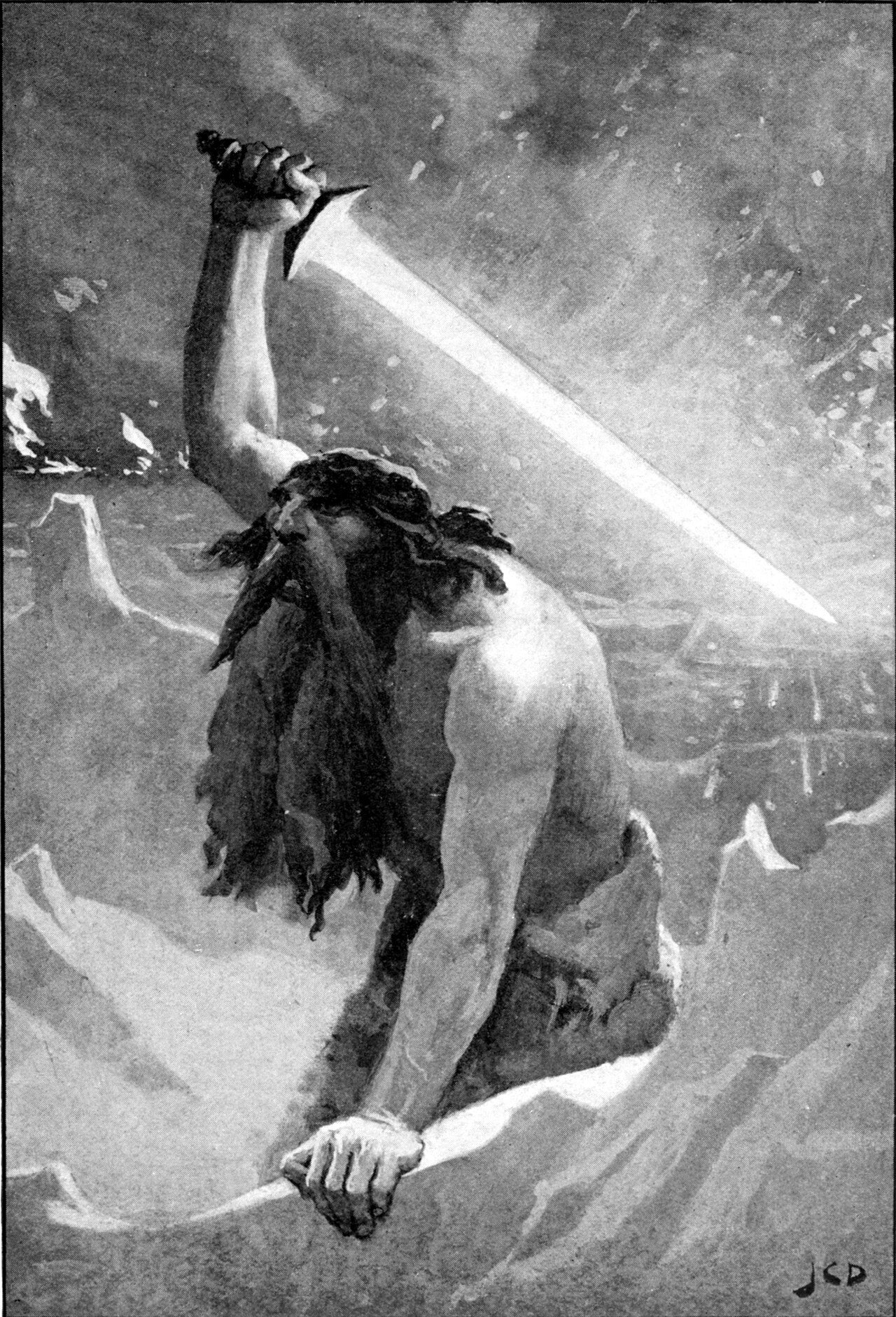
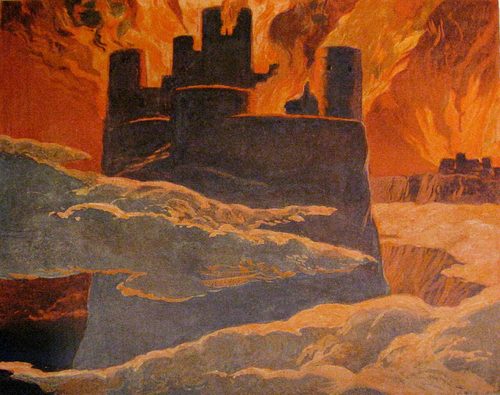
Surtr is the fire-giant of the far south. He appears at both ends of Snorri's history of the world. Before anything was made there was Múspell, a glowing, burning region in the south, and "He who sits there at the land's-end, to defend the land, is called Surtr; he brandishes a flaming sword." Snorri adds at once what he will do at the end: harry, overcome the gods and "burn all the world with fire" Gylfaginning 4. See Múspellsheimr.
At Ragnarök
Völuspá gives his arrival a single, dense stanza:
Surt fares from the south with the scourge of branches,The sun of the battle-gods shone from his sword;The crags are sundered, the giant-women sink,The dead throng Hel-way, and heaven is cloven.Völuspá 52
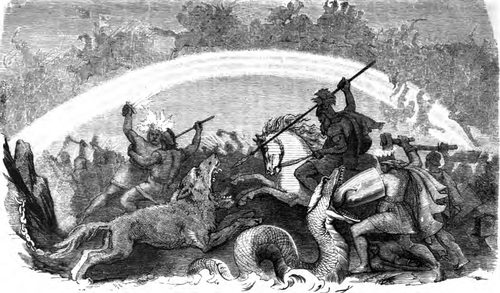
"The scourge of branches" is fire, the destroyer of wood. In Snorri, Surtr rides first among the sons of Múspell, with fire before and behind him, and his sword shines brighter than the sun. When they ride over Bifröst the bridge breaks Gylfaginning 51. He meets Freyr on the field of Vígríðr. Freyr had given his sword away to win Gerðr, and fights without it; "a hard encounter shall there be between them before Freyr falls" Gylfaginning 51. Völuspá puts the same duel in a line: "Beli's fair slayer seeks out Surt, / For there must fall the joy of Frigg" Völuspá 53. Loki taunts Freyr with exactly this in Lokasenna: "when Muspell's sons through Myrkwood ride, / Thou shalt weaponless wait" Lokasenna 42.
When the other gods have fallen, "straightway shall Surtr cast fire over the earth and burn all the world" Gylfaginning 51. The poems call the world-fire by his name: the new gods rule "When the fires of Surt have sunk" Vafþrúðnismál 51, and Snorri's survivors hide "during the Fire of Surtr" Gylfaginning 53.
The gods' chief enemy
Vafþrúðnismál treats Surtr as the leader of the enemy: the last battlefield is where "Surt and the gracious gods" shall meet Vafþrúðnismál 18, and Fáfnismál likewise names the place where "all the gods / And Surt shall sword-sweat mingle" Fáfnismál 14. Yet the sources say almost nothing about him beyond his fire, his sword and his coming. Völuspá also calls the wolf that kills Odin "the kinsman of Surt" Völuspá 47, a relationship that is never explained.
Scholars have suggested that the Icelanders' experience of volcanic eruptions may have shaped the picture of a fire-giant who burns the world, though Surtr's name and role may well be older than the settlement of Iceland.
In the sources
Quoted from the hosted translations; each line is checked against the text when the site is built. Select a reference to read it in context.
He who sits there at the land's-end, to defend the land, is called Surtr; he brandishes a flaming sword, and at the end of the world he shall go forth and harry, and overcome all the gods, and burn all the world with fire
Surt fares from the south with the scourge of branches, The sun of the battle-gods shone from his sword
And Beli's fair slayer seeks out Surt, For there must fall the joy of Frigg.
Vigrith is the field where in fight shall meet Surt and the gracious gods
In the gods' home Vithar and Vali shall dwell, When the fires of Surt have sunk
Where the sources disagree or fall silent
- Snorri says Surtr will 'overcome all the gods' (Gylfaginning 4), but in his detailed account Surtr fights only Freyr; most gods fall to other enemies (Gylfaginning 51).
- Völuspá calls Fenrir 'the kinsman of Surt' (Völuspá 47); no source explains the kinship.
In modern culture
Not from the medieval sources.
Surtr gives his name to Surtsey, the volcanic island that rose from the sea south of Iceland in 1963. In Marvel's comics and films (notably Thor: Ragnarok, 2017) he is a fire demon called Surtur.