A myth retold · about 7 minutes
The making of the world
Before anything existed there was only a yawning gap. Fire and ice met in it, the giant Ymir woke out of the melting rime, and Odin and his brothers killed him and built the world from his body.
Every Norse account of the beginning starts with an absence. The seeress of Völuspá remembers an age "when Ymir lived" in which there was no sand, no sea, no earth and no sky, only "a yawning gap, and grass nowhere" Völuspá 3. That gap is Ginnungagap. Snorri Sturluson, writing his Gylfaginning in the 1220s, fills it with a whole physics of fire and frost. The poems give only flashes. What follows uses Snorri for the order of events, because he is the only source that tells it start to finish, and marks where the poems say something else.
Fire, ice and the first giant
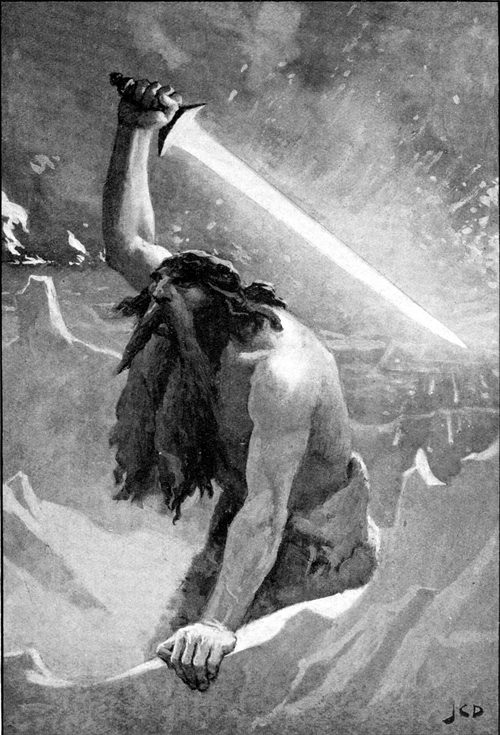
Long before the earth was shaped, Snorri says, there was the mist-world, Niflheim, and in its middle the spring Hvergelmir, from which a long list of cold rivers flowed Gylfaginning 4. Even earlier, far to the south, lay Múspell, bright and burning and closed to anyone not born there. Surtr sits at its border with a flaming sword, and Snorri looks ahead to the end of the world, when Surtr will ride out and burn everything.
The rivers out of Niflheim carried a "yeasty venom" that hardened into ice. Rime piled on rime and spread into the gap. The northern half of Ginnungagap filled with ice and gusting drizzle; the southern half glowed with sparks blown out of Múspellheim; the middle was "as mild as windless air" Gylfaginning 5. Where the warm air met the rime it melted and dripped, and out of the drops a man's shape quickened. He was Ymir. The frost-giants, Snorri adds, call him Aurgelmir.
and when the breath of heat met the rime, so that it melted and dripped, life was quickened from the yeast-drops, by the power of that which sent the heat, and became a man's form.Gylfaginning 5
Ymir had no wife. While he slept he sweated, and a man and a woman grew under his left arm, and one of his legs begot a son on the other Gylfaginning 5. From these came the frost-giants. Snorri is firm that Ymir was no god: "he was evil and all his kindred."
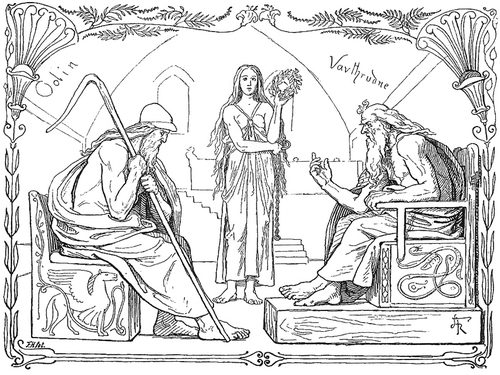
Vafþrúðnismál knows the same story in compressed form, told by a giant who is proud of it. Venom dripped from the rivers called Élivágar "and waxed till a giant it was", and that, says Vafþrúðnir, is why giants are so fierce Vafþrúðnismál 31. He also knows the strange birth from Ymir's body, and adds a detail Snorri leaves out: the son that Ymir's feet produced "six heads bore" Vafþrúðnismál 33.
The cow and the grandfather of the gods
What did Ymir eat? Out of the same melting rime came a cow, Auðumla, and four rivers of milk ran from her udders Gylfaginning 6. She in turn licked the salty blocks of ice. On the first evening a man's hair appeared out of the ice, on the second his head, on the third the whole man. This was Búri, fair and mighty. His son Borr married Bestla, daughter of the giant Bölþorn, and they had three sons: Odin, Vili and Vé. The gods, then, are giants on their mother's side from the very start.
Auðumla and Búri appear only in Snorri. No poem mentions them. Völuspá simply calls the world-makers "Bur's sons" Völuspá 4, which agrees with Snorri's genealogy without telling the story behind it.
The killing of Ymir
Snorri gives no reason for what happened next. Asked what passed between the two races, Hárr answers flatly: "The sons of Borr slew Ymir the giant" Gylfaginning 7. So much blood poured from the wounds that it drowned every frost-giant except one, Bergelmir, who escaped with his wife on a ship. From that couple the giants were renewed.
Here Snorri and his source seem to part company. The stanza he quotes comes from Vafþrúðnismál, where the giant says the first thing he can remember is Bergelmir, born "winters unmeasured ere earth was made", being "in a boat of old … borne" Vafþrúðnismál 35. The poem says nothing of a flood, and its other stanza on Bergelmir makes him the grandson of Aurgelmir through Þrúðgelmir Vafþrúðnismál 29. Many scholars think the Old Norse word for the "boat" may originally have meant something else, such as a cradle or a mill-box, and that Snorri built the flood from his reading of the line; that remains a reading, not a certainty.
A world made of a body
The brothers carried Ymir into the middle of the gap and took him apart Gylfaginning 8. His flesh became the earth, his blood the sea and lakes, his bones the crags, and his teeth and broken bones the gravel and stones. They laid the sea in a ring round the land. His skull they raised as the sky, propping its four corners on four dwarfs named East, West, North and South (the four dwarves). Sparks from Múspellheim were set in the sky to light it.
Two poems tell the same anatomy, each with its own details. Vafþrúðnismál makes the earth from Ymir's flesh, the mountains from his bones, the sky from his skull and the ocean from his blood Vafþrúðnismál 21. Grímnismál adds trees from his hair Grímnismál 40, and gives the most memorable image of all:
Mithgarth the gods from his eyebrows made,And set for the sons of men;And out of his brain the baleful cloudsThey made to move on high.Grímnismál 41
Snorri, who quotes a version of these lines, explains the eyebrows: the earth is round, the giants were given the coasts beyond the sea, and the gods built a wall of Ymir's brows around the inner land to keep the giants out. That walled middle land is Miðgarðr Gylfaginning 8.
Völuspá tells it differently. It never mentions the body at all. "Bur's sons lifted the level land", the sun warmed the stones, and the ground grew green with leeks Völuspá 4. The earth seems to rise out of the sea, not to be carved from a corpse. The gods then met in council, named night, morning, noon and evening "the years to number" Völuspá 6, and built shrines and forges at Iðavöllr, where they played at tables in a golden age that lasted until three giant-maids arrived from Jötunheimr Völuspá 7-8. The poem does not say who those maids were.
Where the story comes from
Three poems of the Poetic Edda and one prose work carry the story. Völuspá (stanzas 3–8) gives the bare outline in the seeress's voice: emptiness, the lifting of the land, the naming of times. Vafþrúðnismál (20–35) and Grímnismál (40–41) both supply the Ymir anatomy, in question-and-answer and catalogue form. The poems survive in the Codex Regius, written in Iceland around 1270, but are generally thought to be older; how much older is debated.
Gylfaginning (chapters 4–8) is Snorri's work of the 1220s. Most of its distinctive material — the twelve rivers, the mild middle of the gap, Auðumla, Búri licking out of the ice, the flood of blood, the four dwarfs under the sky — has no surviving poetic source. Snorri may have had poems now lost, or he may have reasoned out a sequence from the ones we have. He also quotes his sources in versions that differ in wording from the Codex Regius poems, which suggests he knew other copies.
Snorri's own quotations even differ from the poems he quotes. His Völuspá begins "Erst was the age when nothing was" Gylfaginning 4, where the Codex Regius has "when Ymir lived" Völuspá 3. His version of the Ymir stanza makes the sea "of his sweat" Gylfaginning 8, where Grímnismál and Vafþrúðnismál say blood, and his own prose says blood too.
The concrete disagreements: Völuspá raises the earth from nothing; the other sources build it from Ymir. Vafþrúðnismál has Bergelmir in a boat but no flood; Snorri has a flood. Snorri names Odin, Vili and Vé as the killers; the poems only say "the gods" or "Bur's sons".
Reading it today
Scholars have long compared the dismemberment of Ymir with other Indo-European stories in which the world is made from the body of a primeval being, such as the Vedic hymn of Purusha. A common reading of Snorri's fire-and-ice opening is that it reflects an Icelandic landscape of glaciers and volcanoes, though the idea is attractive rather than provable. Others note Snorri's learned, Christian framing: he was presenting the old cosmology as a coherent system, and the neatness may be partly his.
The story has also been read for its uncomfortable politics. The world exists because the gods killed their own mother's kin, and the giants they drowned come back to fight them at Ragnarök. The beginning already contains the end.
Key passages
Of old was the age when Ymir lived; Sea nor cool waves nor sand there were; Earth had not been, nor heaven above, But a yawning gap, and grass nowhere.
Then Bur's sons lifted the level land, Mithgarth the mighty there they made
when the breath of heat met the rime, so that it melted and dripped, life was quickened from the yeast-drops
She licked the ice-blocks, which were salty
Out of Ymir's flesh was fashioned the earth, And the mountains were made of his bones; The sky from the frost-cold giant's skull, And the ocean out of his blood.
Mithgarth the gods from his eyebrows made, And set for the sons of men
with it they drowned all the race of the Rime-Giants, save that one, whom giants call Bergelmir, escaped with his household