Æsir
Týr
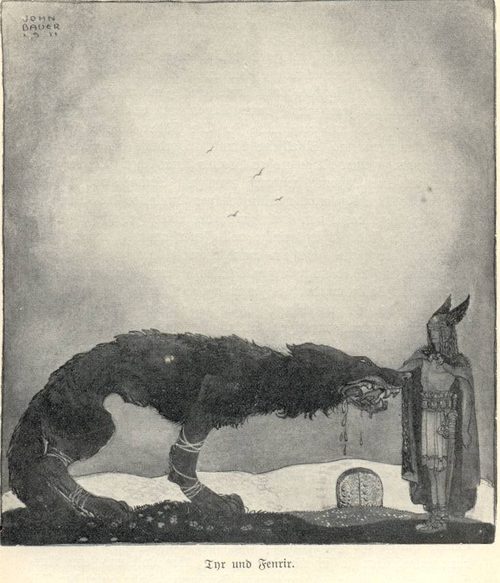
The one-handed god of battle and courage, who put his hand in the wolf Fenrir's mouth as a pledge so that the gods could bind it, and lost the hand.
Týr is the god of courage. Snorri calls him "most daring, and best in stoutness of heart", with "much authority over victory in battle" Gylfaginning 25. A brave man who does not waver is said to be "Týr-valiant", a wise one "Týr-prudent" Gylfaginning 25. He has one hand, and every source that mentions him knows how he lost the other.
The hand in the wolf's mouth
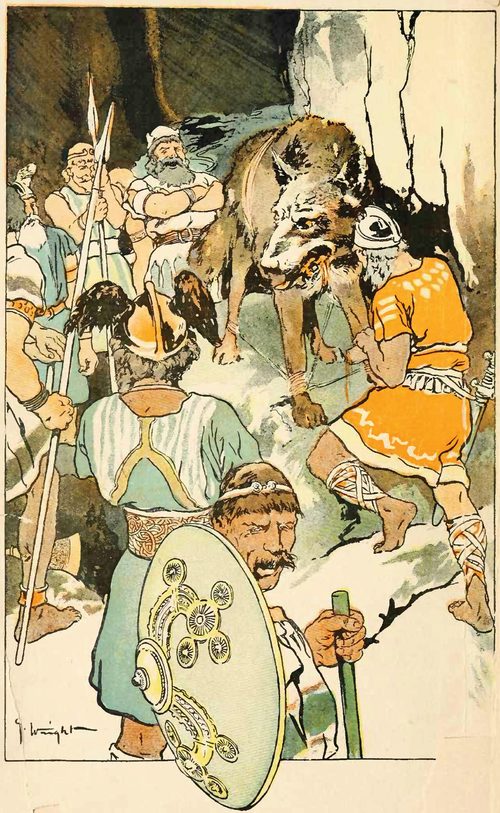
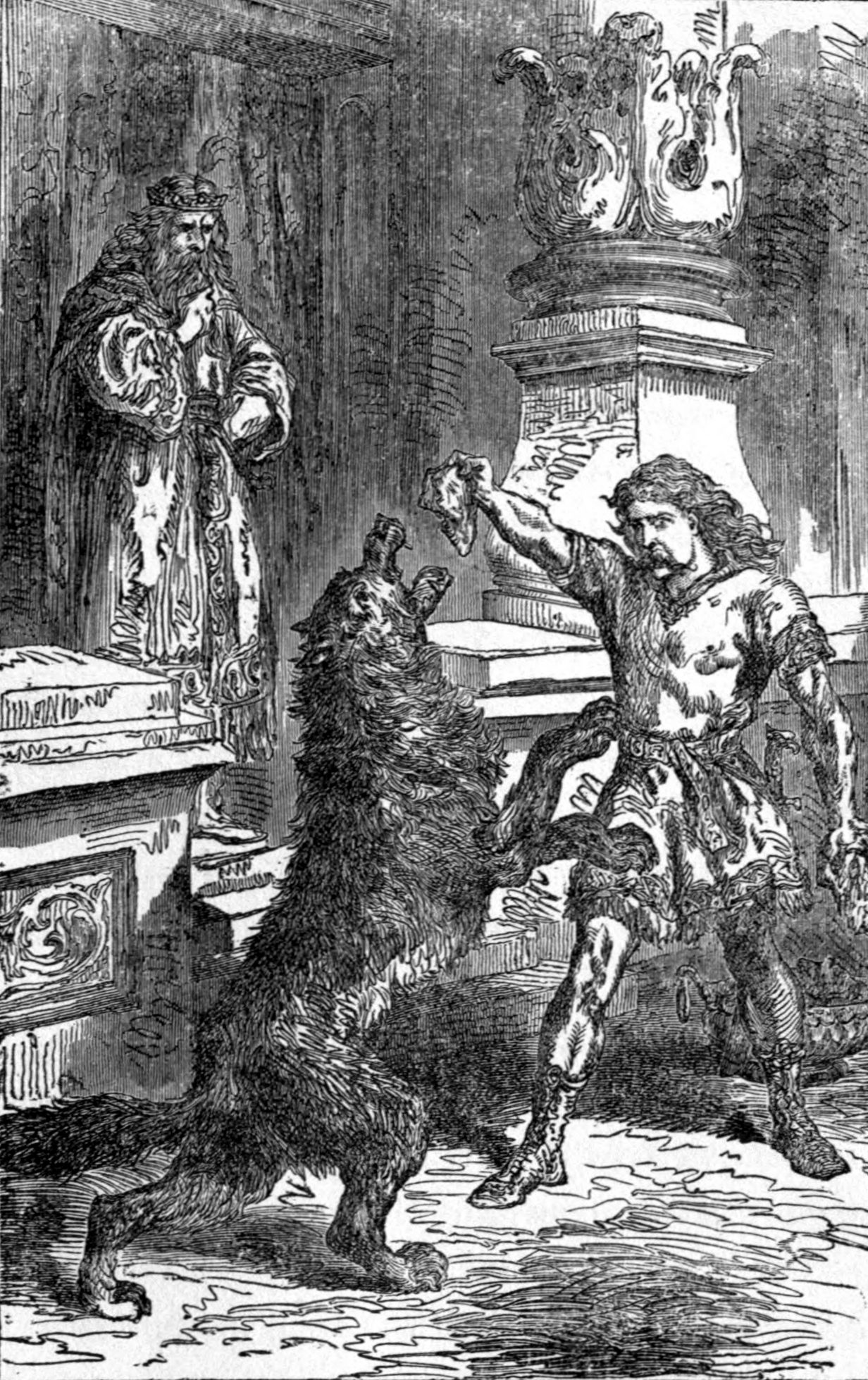
The story is told in full in Snorri's Gylfaginning (see The binding of Fenrir). The gods raised the wolf Fenrir at home, "and Týr alone dared go to him to give him meat" Gylfaginning 34. When prophecies warned that the wolf would destroy them, they tried to bind him. He broke two great fetters, and then grew suspicious of the third, the silk-soft Gleipnir. He would let it be put on him only if one of the gods laid a hand in his mouth as a pledge of good faith:
Each of the Æsir looked at his neighbor, and none was willing to part with his hand, until Týr stretched out his right hand and laid it in the Wolf's mouth.Gylfaginning 34
The fetter held, "Then all laughed except Týr: he lost his hand" Gylfaginning 34. Snorri draws the lesson in one dry clause: Týr "is one-handed, and is not called a reconciler of men" Gylfaginning 25. The poets call him "the One-handed God" and "Fosterer of the Wolf" Skáldskaparmál 9.
In Lokasenna Loki throws the story back at him: "Fain would I tell how Fenrir once Thy right hand rent from thee" Lokasenna 38. Týr's reply is the best line he has in the poems: he lacks his hand, but Loki lacks his son, and "Ill fares the wolf who shall ever await In fetters the fall of the gods" Lokasenna 39. Loki answers that Týr's wife once bore Loki a son, and Týr was never compensated Lokasenna 40. Earlier in the same poem Týr is the one god who speaks up for Freyr Lokasenna 37.
Whose son?
The sources disagree about Týr's family. Snorri's list of kennings calls him "Son of Odin" Skáldskaparmál 9. In Hymiskviða Týr guides Thor to the giant Hymir to fetch a giant brewing-kettle, and calls Hymir "my father" Hymiskviða 5. At Hymir's hall Týr meets his grandmother, a giantess with nine hundred heads, and his mother, "fair with gold", who hides the guests from her husband Hymiskviða 8-9. Later Týr tries twice to lift the kettle and fails; Thor carries it off Hymiskviða 34-35. The two accounts cannot both be right, and neither text explains the other.
Battle and the end
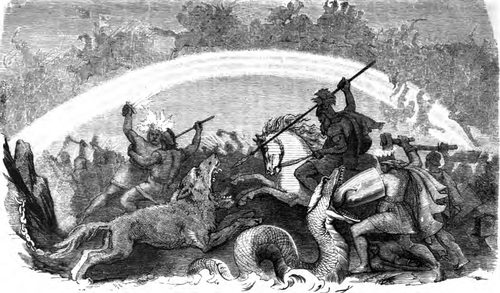
Týr was a god warriors called on. Sigrdrífumál advises cutting "winning-runes" on a sword-hilt and calling twice on Týr Sigrdrífumál 6. At Ragnarök Snorri pairs him with the hound Garmr, freed from Gnipa's Cave: "he shall do battle with Týr, and each become the other's slayer" Gylfaginning 51. Völuspá, Snorri's main source for the battle, has Garm howling but does not mention Týr Völuspá 44.
The name and the cult
Týr's name is the clearest sign that he was an old and important god. It comes from the same Indo-European root as Latin deus and Greek Zeus, and in Old Norse týr could simply mean "god": Snorri explains that skalds call Odin "Victory-Týr" or "Týr of the Hanged" Skáldskaparmál 1. The Anglo-Saxons called him Tīw and named Tuesday after him, and the Romans matched him with Mars. On this evidence scholars generally think Týr once mattered more than the few Eddic episodes about him suggest.
In the sources
Quoted from the hosted translations; each line is checked against the text when the site is built. Select a reference to read it in context.
he is most daring, and best in stoutness of heart, and he has much authority over victory in battle; it is good for men of valor to invoke him.
Each of the Æsir looked at his neighbor, and none was willing to part with his hand, until Týr stretched out his right hand and laid it in the Wolf's mouth.
My hand do I lack, but Hrothvitnir thou, And the loss brings longing to both
There dwells to the east of Elivagar Hymir the wise at the end of heaven; A kettle my father fierce doth own
Winning-runes learn, if thou longest to win, And the runes on thy sword-hilt write; Some on the furrow, and some on the flat, And twice shalt thou call on Tyr.
he shall do battle with Týr, and each become the other's slayer.
Where the sources disagree or fall silent
- Whether Týr's father is Odin (Skáldskaparmál 9) or the giant Hymir (Hymiskviða 5). The texts disagree and nothing resolves it.
- Who Týr's wife was. Loki claims she had a son by him (Lokasenna 40), but no source names her.
- Whether Týr was once the chief sky-god of the Germanic peoples, later pushed aside by Odin. The idea is old and popular, but it rests on the etymology of his name, not on any surviving myth.
In modern culture
Not from the medieval sources.
Týr's name survives in English 'Tuesday', from Old English Tīwesdæg, 'Tīw's day', a translation of Latin dies Martis, 'Mars's day'. The rune ᛏ (t), called týr in Old Norse, bears his name and is a popular modern symbol, sometimes misused by extremist groups. Týr appears in games such as God of War Ragnarök (2022).