
Poetic Edda · heroic poems
Fáfnismál
The Lay of Fafnir
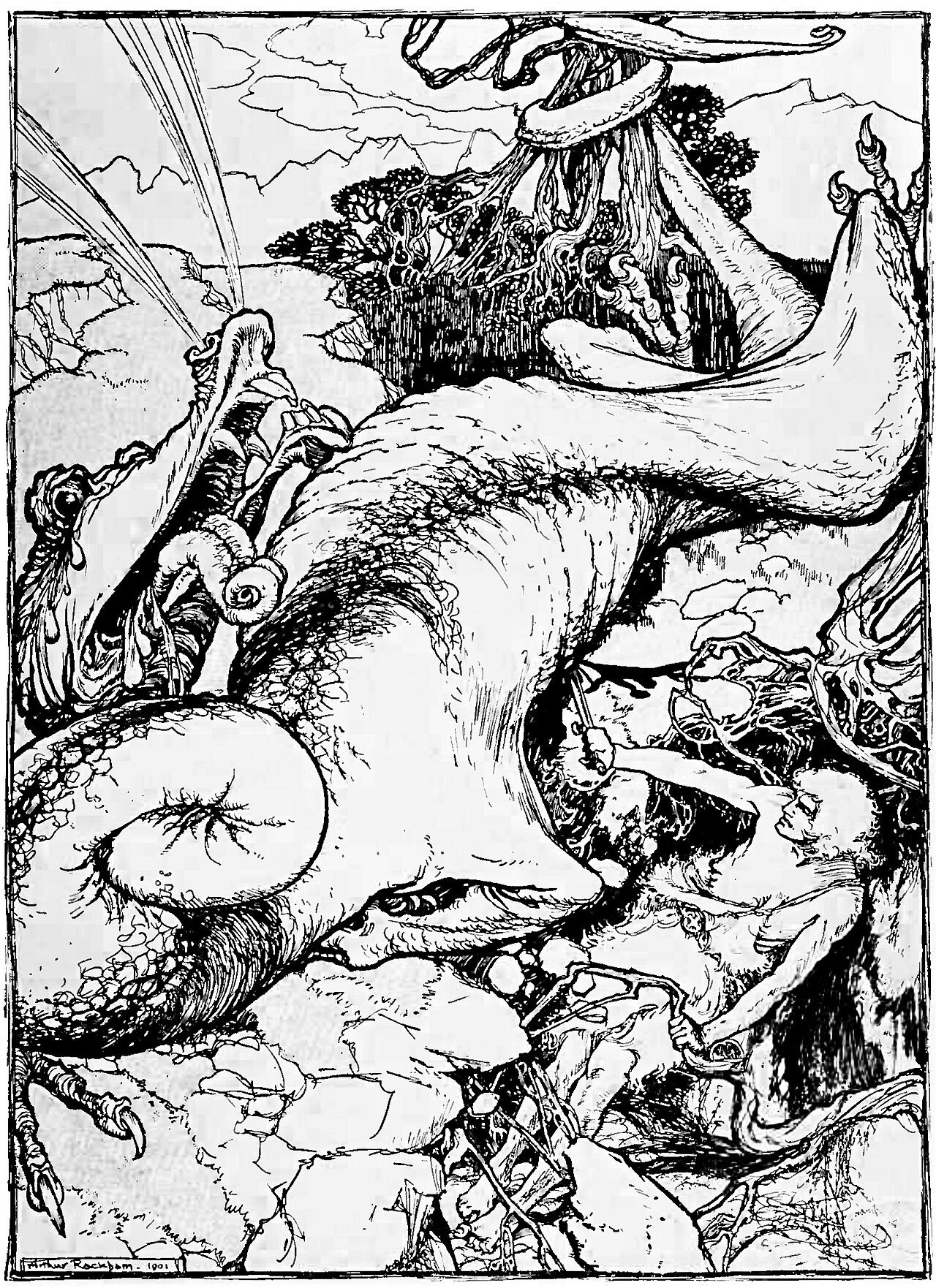
Bellows's introduction
The so-called Fafnismol, contained in full in the Codex Regius, where it immediately follows the Reginsmol without any indication of a break, is quoted by Snorri in the Gylfaginning (stanza 13) and the Skaldskaparmal (stanzas 32 and 33), and stanzas 6, 3, and 4 appear in the Sverrissaga. Although the Volsungasaga does not actually quote any of the stanzas, it gives a very close prose parallel to the whole poem in chapters 18 and 19.
The general character of the Fafnismol, and its probable relation to the Reginsmol and the Sigrdrifumol, have been discussed in the introductory note to the Reginsmol. While it is far more nearly a unit than the Reginsmol, it shows many of the same characteristics. It has the same mixture of stanza forms, although in this case only nine stanzas (32-33, 35-36 and 40-44) vary from the normal Ljothahattr measure. It shows, though to a much less marked extent, the same tendency to introduce passages from extraneous sources, such as the question-and-answer passage in stanzas 11-15. At the same time, in this instance it is quite clear that one distinct poem, including probably stanzas 1-10, 16-23, 25-31, and 34-39, underlay the compilation which we here have. This may, perhaps, have been a long poem (not, however, the "Long" Sigurth Lay; see introductory note to Brot af Sigurtharkvithu) dealing with the Regin-Fafnir-Sigurth-Brynhild story, and including, besides most of the Fafnismol, stanzas 1-4 and 6-11 of the Reginsmol and part of the so-called Sigrdrifumol, together with much that has been lost. The original poem may, on the other hand, have confined itself to the Fafnir episode.
In any case, and while the extant Fafnismol can be spoken of as a distinct poem far more justly than the Reginsmol, there is still no indication that the compiler regarded it as a poem by itself. His prose notes run on without a break, and the verses simply cover a dramatic episode in Sigurth's early life. The fact that the work of compilation has been done more intelligently than in the case of the Reginsmol seems to have resulted chiefly from the compiler's having been familiar with longer consecutive verse passages dealing with the Fafnir episode. The Reginsmol is little more than a clumsy mosaic, but in the Fafnismol it is possible to distinguish between the main substance of the poem and the interpolations.
Here, as in the Reginsmol, there is very little that bespeaks the German origin of the Sigurth story. Sigurth's winning of the treasure is in itself undoubtedly a part of the earlier southern legend, but the manner in which he does it is thoroughly Norse. Moreover, the concluding section, which points toward the finding of the sleeping Brynhild, relates entirely to the northern Valkyrie, the warrior-maiden punished by Othin, and not at all to the southern Brynhild the daughter of Buthli. The Fafnismol is, however, sharply distinguished from the Reginsmol by showing no clear traces of the Helgi tradition, although a part of the bird song (stanzas 40-44, in Fornyrthislag form, as distinct from the body of the poem) sounds suspiciously like the bird passage in the beginning of the Helgakvitha Hjorvarthssonar. Regarding the general relations of the various sets of traditions in shaping the story of Sigurth, see the introductory note to Gripisspo.
The Fafnismol, together with a part of the Sigrdrifumol, has indirectly become the best known of all the Eddic poems, for the reason that Wagner used it, with remarkably little change of outline, as the basis for his "Siegfried."
Sigurth and Regin went up to the Gnitaheith, and found there the track that Fafnir made when he crawled to water. Then Sigurth made a great trench across the path, and took his place therein. When Fafnir crawled from his gold, he blew out venom, and it ran down from above on Sigurth's head. But when Fafnir crawled over the trench, then Sigurth thrust his sword into his body to the heart. Fafnir writhed and struck out with his head and tail. Sigurth leaped from the trench, and each looked at the other. Fafnir said:
Note
Prose. The prose follows the concluding prose passage of the Reginsmol without any interruption; the heading "Of Fafnir's Death" is written in the manuscript very faintly just before stanza 1.
Gnitaheith: cf. Gripisspo, 11 and note.
Fafnir: Regin's brother: cf. Reginsmol, prose after stanza 14.
Venom: in the Volsungasaga it was the blood, and not the venom, that poured down on Sigurth's head. Sigurth was much worried about this danger, and before he dug the trench asked Regin what would happen if the dragon's blood overcame him. Regin thereupon taunted him with cowardice (Sigurth refers to this taunt in stanza 30, but the stanza embodying it has disappeared). After Sigurth had dug his trench, an old man (Othin, of course) appeared and advised him to dig other trenches to carry off the blood, which he did, thereby escaping harm.
Cited on Fáfnir, Sigurðr, Sigurðr slays Fáfnir
"Youth, oh, youth!of whom then, youth, art thou born?Say whose son thou art,Who in Fafnir's bloodthy bright blade reddened,And struck thy sword to my heart."
Note
The first line in the original, as here, is unusually long, but dramatically very effective on that account.
Sigurth concealed his name because it was believed in olden times that the word of a dying man might have great power if he cursed his foe by his name. He said:
Cited on Fáfnir, Sigurðr slays Fáfnir
"The Noble Hartmy name, and I goA motherless man abroad;Father I had not,as others have,And lonely ever I live."
Cited on Sigurðr slays Fáfnir
Fafnir spake:"If father thou hadst not,as others have,By what wonder wast thou born?(Though thy name on the dayof my death thou hidest,Thou knowest now thou dost lie.)"
Note
The names of the speakers do not appear in the manuscript, though they seem originally to have been indicated in the margin for stanzas 3-30. The last two lines of stanza 3 are missing in the manuscript, with no gap indicated, but the Volsungasaga prose paraphrase indicates that something was omitted, and the lines here given are conjecturally reconstructed from this paraphrase.
Sigurth spake:"My race, methinks,is unknown to thee,And so am I myself;Sigurth my name,and Sigmund's son,Who smote thee thus with the sword."
Note
The manuscript marks line 3 as the beginning of a stanza.
Cited on Sigurðr, Sigurðr slays Fáfnir
Fafnir spake:"Who drove thee on?why wert thou drivenMy life to make me lose?A father bravehad the bright-eyed youth,For bold in boyhood thou art."
Note
Line 4, utterly obscured in the manuscript, is guesswork.
Sigurth spake:"My heart did drive me,my hand fulfilled,And my shining sword so sharp;Few are keenwhen old age comes,Who timid in boyhood be."
Fafnir spake:"If thou mightest growthy friends among,One might see thee fiercely fight;But bound thou art,and in battle taken,And to fear are prisoners prone."
Note
Fafnir here refers to the fact that Hjordis, mother of the still unborn Sigurth, was captured by Alf after Sigmund's death; cf. Fra Dautha Sinfjotla, note.
Cited on Sigurðr slays Fáfnir
Sigurth spake:"Thou blamest me, Fafnir,that I see from afarThe wealth that my father's was;Not bound am I,though in battle taken,Thou hast found that free I live."
Fafnir spake:"In all I saydost thou hatred see,Yet truth alone do I tell;The sounding gold,the glow-red wealth,And the rings thy bane shall be."
Cited on Fáfnir, Sigurðr slays Fáfnir
Sigurth spake:"Some one the hoardshall ever hold,Till the destined day shall come;For a time there iswhen every manShall journey hence to hell."
Cited on Sigurðr slays Fáfnir
Fafnir spake:"The fate of the Nornsbefore the headlandThou findest, and doom of a fool;In the water shalt drownif thou row 'gainst the wind,All danger is near to death."
Note
Stanzas 11-15 are probably interpolated, and come from a poem similar to Vafthruthnismol. The headland: Fafnir is apparently quoting proverbs; this one seems to mean that disaster ("the fate of the Norns") awaits when one rounds the first headland (i. e., at the beginning of life's voyage, in youth). The third line is a commentary on obstinate rashness. The Volsungasaga paraphrases stanzas 11-15 throughout.
Sigurth spake:"Tell me then, Fafnir,for wise thou art famed,And much thou knowest now:Who are the Nornswho are helpful in need,And the babe from the mother bring?"
Note
Norns: cf. stanza 13 and note. Sigurth has no possible interest in knowing what Norns are helpful in childbirth, but interpolations were seldom logical.
Cited on Fáfnir, The Norns, Sigurðr slays Fáfnir
Fafnir spake:"Of many birthsthe Norns must be,Nor one in race they were;Some to gods, othersto elves are kin,And Dvalin's daughters some."
Note
Snorri quotes this stanza. There were minor Norns, or fates, in addition to the three great Norns, regarding whom cf. Voluspo, 20. Dvalin: chief of the dwarfs; cf. Voluspo, 14.
Sigurth spake:"Tell me then, Fafnir,for wise thou art famed,And much thou knowest now:How call they the islewhere all the godsAnd Surt shall sword-sweat mingle?"
Note
Surt: ruler of the fire world; the reference is to the last great battle. Sword-sweat: blood.
Cited on Surtr, Vígríðr, Ragnarök: the doom of the gods, Sigurðr slays Fáfnir
Fafnir spake:"Oskopnir is it,where all the godsShall seek the play of swords;Bilrost breakswhen they cross the bridge,And the steeds shall swim in the flood.
Note
Oskopnir ("Not-Made"): apparently another name for Vigrith, which is named in Vafthruthnismol, 18, as the final battle-ground. Bilrost (or Bifrost): the rainbow bridge which breaks beneath Surt's followers; cf. Grimnismol, 29 and note.
"The fear-helm I woreto afright mankind,While guarding my gold I lay;Mightier seemed Ithan any man,For a fiercer never I found."
Note
With this stanza Fafnir returns to the situation. Fear-helm: regarding the "ægis-hjalmr" cf. Reginsmol, prose after stanza 14 and note.
Cited on Fáfnir, Sigurðr slays Fáfnir
Sigurth spake:"The fear-helm surelyno man shieldsWhen he faces a valiant foe;Oft one finds,when the foe he meets,That he is not the bravest of all."
Fafnir spake:"Venom I breathedwhen bright I layBy the hoard my father had;(There was none so mightyas dared to meet me,And weapons nor wiles I feared.)"
Note
Lines 3-4 do not appear in the manuscript, and no gap is indicated; they are here conjecturally paraphrased from the prose passage in the Volsungasaga.
Cited on Fáfnir
Sigurth spake:"Glittering worm,thy hissing was great,And hard didst show thy heart;But hatred morehave the sons of menFor him who owns the helm."
Fafnir spake:"I counsel thee, Sigurth,heed my speech,And ride thou homeward hence;The sounding gold,the glow-red wealth,And the rings thy bane shall be."
Note
It has been suggested that this stanza is spurious, and that stanza 21 ought to follow stanza 22. Lines 3-4, abbreviated in the manuscript, are identical with lines 3-4 of stanza 9. The Volsungasaga paraphrase in place of these two lines makes Fafnir say: "For it often happens that he who gets a deadly wound yet avenges himself." It is quite likely that two stanzas have been lost.
Cited on Fáfnir, Sigurðr slays Fáfnir
Sigurth spake:"Thy counsel is given,but go I shallTo the gold in the heather hidden;And, Fafnir, thouwith death dost fight,Lying where Hel shall have thee."
Cited on Hel (the realm)
Fafnir spake:"Regin betrayed me,and thee will betray,Us both to death will he bring;His life, methinks,must Fafnir lose,For the mightier man wast thou."
Note
The Volsungasaga places its paraphrase of this stanza between those of stanzas 15 and 16.
Regin had gone to a distance while Sigurth fought Fafnir, and came back while Sigurth was wiping the blood from his sword. Regin said:
Cited on Sigurðr slays Fáfnir
"Hail to thee, Sigurth!Thou victory hast,And Fafnir in fight hast slain;Of all the menwho tread the earth,Most fearless art thou, methinks."
Sigurth spake:"Unknown it is,when all are together,(The sons of the glorious gods,)Who bravest born shall seem;Some are valiantwho redden no swordIn the blood of a foeman's breast."
Note
Line 2 is probably spurious, but it is a phrase typical of such poems as Grimnismol or Vafthruthnismol.
Regin spake:"Glad art thou, Sigurth,of battle gained,As Gram with grass thou cleansest;My brother fiercein fight hast slain,And somewhat I did myself."
Note
Gram: Sigurth's sword; cf. Reginsmol, prose after 14.
Cited on Gramr, Sigurðr slays Fáfnir
Sigurth spake:"Afar didst thou gowhile Fafnir reddenedWith his blood my blade so keen;With the might of the dragonmy strength I matched,While thou in the heather didst hide."
Note
In the manuscript stanzas 26-29 stand after stanza 31, which fails to make clear sense; they are here rearranged in accordance with the Volsungasaga paraphrase.
Cited on Reginn
Regin spake:"Longer wouldst thouin the heather have letYon hoary giant hide,Had the weapon availed notthat once I forged,The keen-edged blade thou didst bear."
Cited on Gramr, Reginn, Sigurðr slays Fáfnir
Sigurth spake:"Better is heartthan a mighty bladeFor him who shall fiercely fight;The brave man wellshall fight and win,Though dull his blade may be.
Note
Almost certainly interpolated from some such poem as the Hovamol. Even the faithful Volsungasaga fails to paraphrase stanza 29.
"Brave men betterthan cowards be,When the clash of battle comes;And better the gladthan the gloomy manShall face what before him lies.
Note
Almost certainly interpolated from some such poem as the Hovamol. Even the faithful Volsungasaga fails to paraphrase stanza 29.
"Thy rede it wasthat I should rideHither o'er mountains high;The glittering wormwould have wealth and lifeIf thou hadst not mocked at my might."
Note
Something has evidently been lost before this stanza. Sigurth clearly refers to Regin's reproach when he was digging the trench (cf. note on introductory prose), but the poem does not give such a passage.
Then Regin went up to Fafnir and cut out his heart with his sword, that was named Rithil, and then he drank blood from the wounds. Regin said:
Note
Prose.
Rithil ("Swift-Moving"): Snorri calls the sword Refil ("Serpent").
Cited on Sigurðr slays Fáfnir
"Sit now, Sigurth,for sleep will I,Hold Fafnir's heart to the fire;For all his heartshall eaten be,Since deep of blood I have drunk."
Cited on Reginn, Sigurðr slays Fáfnir
Sigurth took Fafnir's heart and cooked it on a spit. When he thought that it was fully cooked, and the blood foamed out of the heart, then he tried it with his finger to see whether it was fully cooked. He burned his finger, and put it in his mouth. But when Fafnir's heart's-blood came on his tongue, he understood the speech of birds. He heard nut-hatches chattering in the thickets. A nut-hatch said:
Cited on Fáfnir, Sigurðr, Sigurðr slays Fáfnir
"There sits Sigurth,sprinkled with blood,And Fafnir's heartwith fire he cooks;Wise were the breakerof rings, I ween,To eat the life-musclesall so bright."
Note
That the birds' stanzas come from more than one source is fairly apparent, but whether from two or from three or more is uncertain. It is also far from clear how many birds are speaking. The manuscript numbers II, III, and IV in the margin with numerals; the Volsungasaga makes a different bird speak each time. There are almost as many guesses as there are editions. I suspect that in the original poem there was one bird, speaking stanzas 34 and 37. Stanza 38 is little more than a repetition of stanza 34, and may well have been a later addition. As for the stanzas in Fornyrthislag (32-33 and 35-36), they apparently come from another poem, in which several birds speak (cf. "we sisters" in stanza 35). This may be the same poem from which stanzas 40-44 were taken, as well as some of the Fornyrthislag stanzas in the Sigrdrifumol.
Cited on Sigurðr slays Fáfnir
A second spake:"There Regin lies,and plans he laysThe youth to betraywho trusts him well;Lying wordswith wiles will he speak,Till his brother the makerof mischief avenges."
Cited on Reginn, Sigurðr slays Fáfnir
A third spake:"Less by a headlet the chatterer hoaryGo from here to hell;Then all of the wealthhe alone can wield,The gold that Fafnir guarded."
Note
Some editions turn this speech from the third person into the second, but the manuscript is clear enough.
Cited on Sigurðr slays Fáfnir
A fourth spake:"Wise would he seemif so he would heedThe counsel goodwe sisters give;Thought he would give,and the ravens gladden,There is ever a wolfwhere his ears I spy."
Note
Wolf, etc.: the phrase is nearly equivalent to "there must be fire where there is smoke." The proverb appears elsewhere in Old Norse.
A fifth spake:"Less wise must bethe tree of battleThan to me would seemthe leader of men,If forth he letsone brother fare,When he of the otherthe slayer is."
Note
Tree of battle: warrior.
A sixth spake:"Most foolish he seemsif he shall spareHis foe, the bane of the folk;There Regin lies,who hath wronged him so,Yet falsehood knows he not."
Note
Here, as in stanza 34, some editions turn the speech from the third person into the second.
A seventh spake:"Let the head from the frost-coldgiant be hewed,And let him of rings be robbed;Then all the wealthwhich Fafnir's wasShall belong to thee alone."
Note
Giant: Regin was certainly not a frost-giant, and the whole stanza looks like some copyist's blundering reproduction of stanza 34.
Sigurth spake:"Not so rich a fateshall Regin haveAs the tale of my death to tell;For soon the brothersboth shall die,And hence to hell shall go."
Cited on Sigurðr slays Fáfnir
Sigurth hewed off Regin's head, and then he ate Fafnir's heart, and drank the blood of both Regin and Fafnir. Then Sigurth heard what the nut-hatch said:
Cited on Reginn, Sigurðr, Sigurðr slays Fáfnir
"Bind, Sigurth, the goldenrings together,Not kingly is itaught to fear;I know a maid,there is none so fair,Rich in gold,if thou mightest get her.
Note
Neither the manuscript nor any of the editions suggest the existence of more than one bird in stanzas 40-44. It seems to me, however, that there are not only two birds, but two distinct stories. Stanzas 40-41 apply solely to Guthrun, and suggest that Sigurth will go straight to Gunnar's hall. Stanzas 42-44, on the other hand, apply solely to Brynhild, and indicate that Sigurth will find her before he visits the Gjukungs. The confusion which existed between these two versions of the story, and which involved a fundamental difference in the final working out of Brynhild's revenge, is commented on in the note on Gripisspo, 13. In the present passage it is possible that two birds are speaking, each reflecting one version of the story; it seems even more likely that one speech or the other (40-41 or 42-44) reflects the original form of the narrative, the other having been added, either later or from another poem. In the Volsungasaga the whole passage is condensed into a few words by one bird: "Wiser were it if he should then ride up on Hindarfjoll, where Brynhild sleeps, and there would he get much wisdom." The Guthrun-bird does not appear at all.
Cited on Sigurðr slays Fáfnir
"Green the pathsthat to Gjuki lead,And his fate the wayto the wanderer shows;The doughty kinga daughter has,That thou as a bridemayst, Sigurth, buy."
Note
Gjuki: father of Gunnar and Guthrun: cf. Gripisspo, 13 and note.
Cited on Sigurðr
Another spake:"A hall stands highon Hindarfjoll,All with flameis it ringed without;Warriors wisedid make it onceOut of the flaminglight of the flood.
Note
Hindarfjoll: "Mountain of the Hind." Light of the flood: gold; cf. Reginsmol, 1 and note.
"On the mountain sleepsa battle-maid,And about her playsthe bane of the wood;Ygg with the thornhath smitten her thus,For she felled the fighterhe fain would save.
Note
Battle-maid: Brynhild, here clearly defined as a Valkyrie. Bane of the wood: fire. Ygg: Othin; cf. Grimnismol, 53. The thorn: a prose note in Sigrdrifumol calls it "sleep-thorn." The fighter: the story of the reason for Brynhild's punishment is told in the prose following stanza 4 of Sigrdrifumol.
"There mayst thou beholdthe maiden helmed,Who forth on Vingskornirrode from the fight;The victory-bringerher sleep shall break not,Thou heroes' son,so the Norns have set."
Note
Vingskornir: Brynhild's horse, not elsewhere mentioned. Victory-bringer: the word thus translated is in the original "sigrdrifa." The compiler of the collection, not being familiar with this word, assumed that it was a proper name, and in the prose following stanza 4 of the Sigrdrifumol he specifically states that this was the Valkyrie's name. Editors, until recently, have followed him in this error, failing to recognize that "sigrdrifa" was simply an epithet for Brynhild. It is from this blunder that the so-called Sigrdrifumol takes its name. Brynhild's dual personality as a Valkyrie and as the daughter of Buthli has made plenty of trouble, but the addition of a second Valkyrie in the person of the supposed "Sigrdrifa" has made still more.