place
Bifröst
The bridge between earth and heaven, which Snorri identifies with the rainbow; the gods ride over it each day, Heimdallr guards it, and it breaks at Ragnarök.
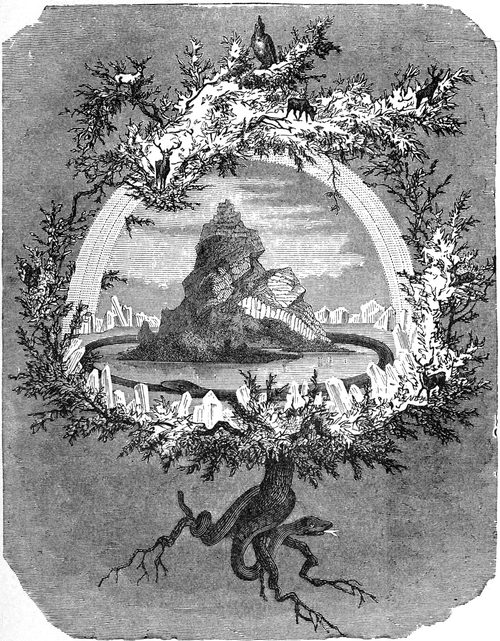
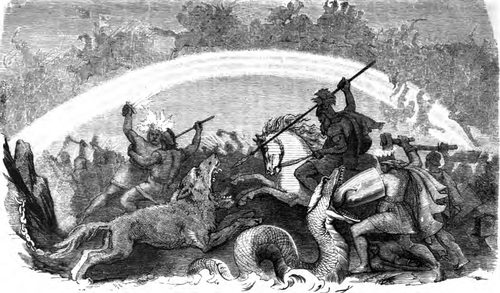
Bifröst is the bridge from earth to heaven. Snorri, through Hárr, laughs at Gangleri for asking about it: everyone knows the gods built a bridge called Bifröst, "it may be that ye call it 'rainbow'". It has three colours and is very strong, and yet it must break when the sons of Múspell ride over it Gylfaginning 13.
What it is for
The gods use the bridge every day. In Snorri's account their court is held at Urðr's well under the root of Yggdrasill that stands in heaven, and the Æsir ride there over Bifröst, "which is also called the Æsir's Bridge" Gylfaginning 15. Thor does not ride; he wades four rivers, because the bridge "burns all with flame". Grímnismál has the same stanza in Bellows's words: "heaven's bridge burns all in flame" Grímnismál 29. Snorri explains the burning as the red in the rainbow, a fire that keeps the hill-giants from climbing to heaven Gylfaginning 15.
Heimdallr lives at Himinbjörg "hard by Bifröst" as "the warder of the gods", guarding the bridge from the giants Gylfaginning 27 Gylfaginning 17.
Two names
The poems call it Bilröst. Grímnismál ranks it the best of bridges, as Yggdrasil is the best of trees and Sleipnir of horses Grímnismál 44. Snorri quotes a version of the same verse with "Bifröst of bridges" Gylfaginning 41. Whether the change is a scribe's, Snorri's or older tradition is not known; the two forms may carry different meanings ("trembling way" against "fleeting way"), but both etymologies are uncertain.
The breaking
The bridge's end is foretold in two places, and they do not tell it the same way. Snorri says that at Ragnarök the sons of Múspell, led by Surtr, ride over Bifröst and "the bridge shall break" Gylfaginning 51. In Fáfnismál the dying dragon says "Bilrost breaks when they cross the bridge", where "they" are the gods riding to the battle on the isle Óskópnir, and their horses "shall swim in the flood" Fáfnismál 15. In one source the enemy breaks the bridge; in the other it fails under the gods themselves.
In the sources
Quoted from the hosted translations; each line is checked against the text when the site is built. Select a reference to read it in context.
the gods made a bridge from earth, to heaven, called Bifröst? Thou must have seen it; it may be that ye call it 'rainbow.'
Bilrost of bridges, Bragi of skalds
For heaven's bridge burns all in flame, And the sacred waters seethe.
That which thou seest to be red in the bow is burning fire
he is the warder of the gods, and sits there by heaven's end to guard the bridge from the Hill-Giants.
Bilrost breaks when they cross the bridge, And the steeds shall swim in the flood.
Where the sources disagree or fall silent
- The poems call the bridge Bilröst; only Snorri uses Bifröst. Whether these are variant forms of one name or two names is debated.
- Snorri's identification with the rainbow is explicit; the poems never mention a rainbow.
- Snorri says the sons of Múspell break the bridge; Fáfnismál says it breaks when the gods cross it. The two may describe the same event from different sides.
In modern culture
Not from the medieval sources.
The rainbow bridge is one of the best-known Norse images: Wagner ends Das Rheingold (1869) with the gods crossing a rainbow bridge into Valhalla, and Marvel's Thor films (2011 onward) show Bifrost as a glowing bridge and a teleporting beam guarded by Heimdall. Neither the films' crystal span nor the teleportation is in the sources.