
Poetic Edda · poems of the gods
Svipdagsmál
The Lay of Svipdag
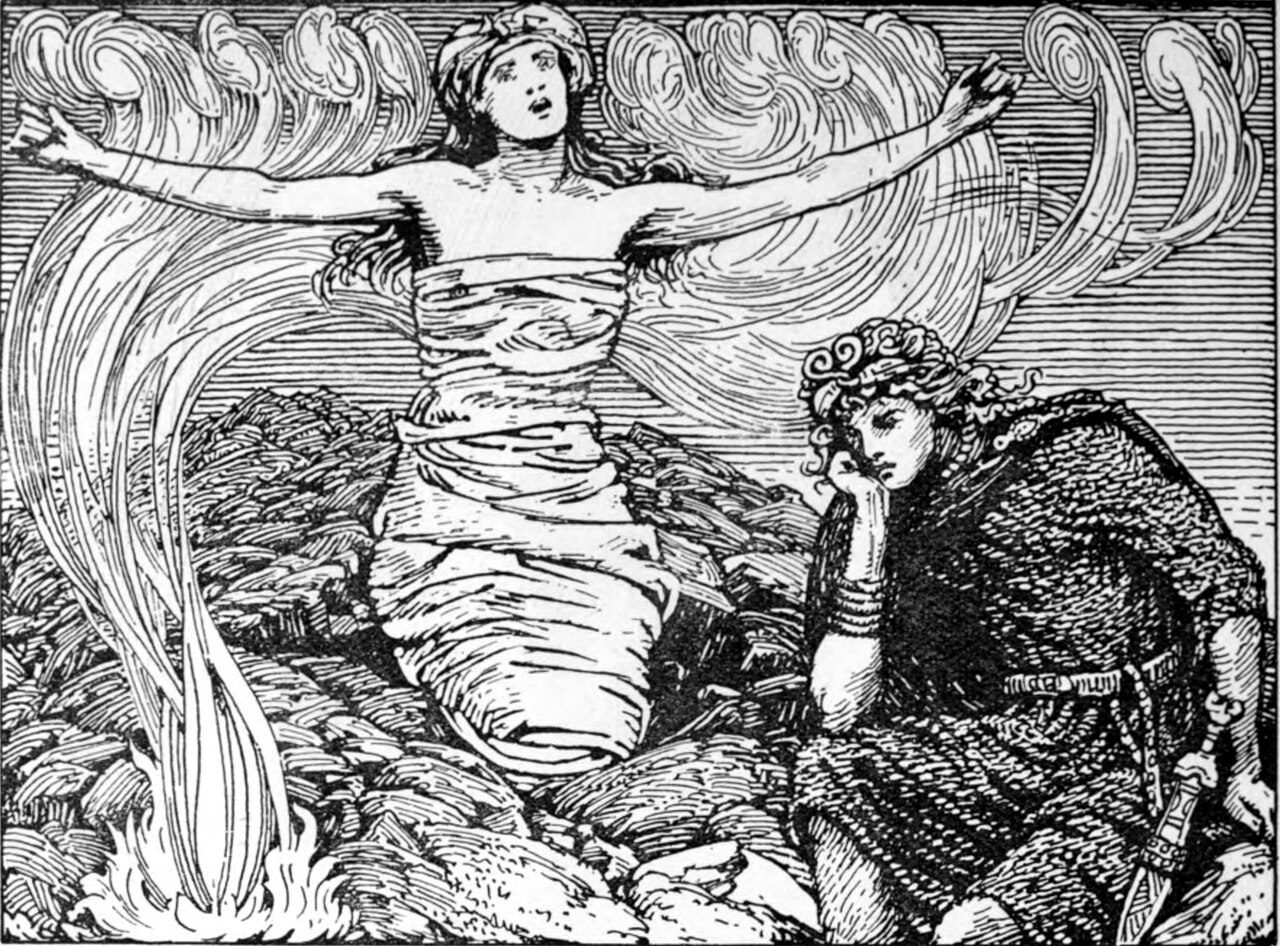
Bellows's introduction
The two poems, Grougaldr (Groa's Spell) and Fjolsvinnsmol (the Ballad of Fjolsvith), which many editors have, very wisely, united under the single title of Svipdagsmol, are found only in paper manuscripts, none of them antedating the seventeenth century. Everything points to a relatively late origin for the poems: their extensive use of "kennings" or poetical circumlocutions, their romantic spirit, quite foreign to the character of the unquestionably older poems, the absence of any reference to them in the earlier documents, the frequent errors in mythology, and, finally, the fact that the poems appear to have been preserved in unusually good condition. Whether or not a connecting link of narrative verse joining the two parts has been lost is an open question; on the whole it seems likely that the story was sufficiently well known so that the reciter of the poem (or poems) merely filled in the gap with a brief prose summary in pretty much his own words. The general relationship between dialogue and narrative in the Eddic poems is discussed in the introductory note to the Grimnismol, in connection with the use of prose links.
The love story of Svipdag and Mengloth is not referred to elsewhere in the Poetic Edda, nor does Snorri mention it; however, Groa, who here appears as Svipdag's mother, is spoken of by Snorri as a wise woman, the wife of Orvandil, who helps Thor with her magic charms. On the other hand, the essence of the story, the hero's winning of a bride ringed about by flames, is strongly suggestive of parts of the Sigurth-Brynhild traditions. Whether or not it is to be regarded as a nature or solar myth depends entirely on one's view of the whole "solar myth" school of criticism, not so highly esteemed today as formerly; such an interpretation is certainly not necessary to explain what is, under any circumstances, a very charming romance told, in the main, with dramatic effectiveness.
In later years the story of Svipdag and Mengloth became popular throughout the North, and was made the subject of many Danish and Swedish as well as Norwegian ballads. These have greatly assisted in the reconstruction of the outlines of the narrative surrounding the dialogue poems here given.
Svipdag spake:"Wake thee, Groa!wake, mother good!At the doors of the dead I call thee;Thy son, bethink thee,thou badst to seekThy help at the hill of death."
Note
Svipdag ("Swift Day"): the names of the speakers are lacking in the manuscripts.
Cited on Svipdagr and Menglöð
Groa spake:"What evil vexesmine only son,What baleful fate hast thou found,That thou callest thy mother,who lies in the mould,And the world of the living has left?"
Svipdag spake:"The woman falsewhom my father embracedHas brought me a baleful game;For she bade me go forthwhere none may fare,And Mengloth the maid to seek."
Note
The woman: Svipdag's stepmother, who is responsible for his search for Mengloth ("Necklace-Glad"). This name has suggested that Mengloth is really Frigg, possessor of the famous Brisings' necklace, or else Freyja (cf. Lokasenna, 20, note).
Cited on Svipdagr and Menglöð
Groa spake:"Long is the way,long must thou wander,But long is love as well;Thou mayst find, perchance,what thou fain wouldst have,If the fates their favor will give."
Svipdag spake:"Charms full goodthen chant to me, mother,And seek thy son to guard;For death do I fearon the way I shall fare,And in years am I young, methinks."
Groa spake:"Then first I will chant theethe charm oft-tried,That Rani taught to Rind;From the shoulder whate'ermislikes thee shake,For helper thyself shalt thou have.
Note
For this catalogue of charms (stanzas 6-14) cf. the Ljothatal (Hovamol, 147-165). Rani and Rind: the manuscripts have these words in inverse relation; I have followed Neckel's emendation. Rind was the giantess who became the mother of Vali, Othin's son, the one-night-old avenger of Baldr (cf. Voluspo, 33-34, and Baldrs Draumar, 11 and note). Rani is presumably Othin, who, according to a skaldic poem, won Rind by magic.
Cited on Galdr, Svipdagr and Menglöð
"Then next I will chant thee,if needs thou must travel,And wander a purposeless way:The bolts of Urthshall on every sideBe thy guards on the road thou goest.
Note
Urth: one of the three Norns, or Fates; cf. Voluspo, 20.
Cited on Urðr
"Then third I will chant thee,if threatening streamsThe danger of death shall bring:Yet to Hel shall turnboth Horn and Ruth,And before thee the waters shall fail.
Note
Horn and Ruth: these two rivers, here used merely to symbolize all dangerous streams, are not included in the catalogue of rivers given in Grimnismol, 27-29, for which reason some editors have changed the names to Hron and Hrith.
"Then fourth I will chant thee,if come thy foesOn the gallows-way against thee:Into thine handsshall their hearts be given,And peace shall the warriors wish.
"Then fifth I will chant thee,if fetters perchanceShall bind thy bending limbs:O'er thy thighs do I chanta loosening-charm,And the lock is burst from the limbs,And the fetters fall from the feet.
Note
This stanza is a close parallel to Hovamol, 150, and the fifth line may well be an interpolation from line 4 of that stanza.
"Then sixth I will chant thee,if storms on the seaHave might unknown to man:Yet never shall windor wave do harm,And calm is the course of thy boat.
"Then seventh I chant thee,if frost shall seekTo kill thee on lofty crags:The fatal coldshall not grip thy flesh,And whole thy body shall be.
"Then eighth will I chant thee,if ever by nightThou shalt wander on murky ways:Yet never the curseof a Christian womanFrom the dead shall do thee harm.
Note
A dead Christian woman: this passage has distressed many editors, who have sought to emend the text so as to make it mean simply "a dead witch." The fact seems to be, however, that this particular charm was composed at a time when Christians were regarded by all conservative pagans as emissaries of darkness. A dead woman's curse would naturally be more potent, whether she was Christian or otherwise, than a living one's. Presumably this charm is much older than the poem in which it here stands.
Cited on Galdr
"Then ninth will I chant thee,if needs thou must striveWith a warlike giant in words:Thy heart good storeof wit shall have,And thy mouth of words full wise.
"Now fare on the waywhere danger waits,Let evils not lessen thy love!I have stood at the doorof the earth-fixed stones,The while I chanted thee charms.
"Bear hence, my son,what thy mother hath said,And let it live in thy breast;Thine ever shall bethe best of fortune,So long as my words shall last."
Note
At this point Groa's song ends, and Svipdag, thus fortified, goes to seek Mengloth. All the link that is needed between the poems is approximately this: "Then Svipdag searched long for Mengloth, and at last he came to a great house set all about with flames. And before the house there was a giant."
Before the househe beheld one comingTo the home of the giants high.Svipdag spake:"What giant is here,in front of the house,And around him fires are flaming?"
Note
Most editors have here begun a new series of stanza numbers, but if the Grougaldr and the Fjolsvinnsmol are to be considered as a single poem, it seems more reasonable to continue the stanza numbers consecutively. Bugge thinks a stanza has been lost before 17, including Fjolsvith's name, so that the "he" in line 1 might have something to refer to. However, just such a prose link as I have suggested in the note on stanza 16 would serve the purpose. Editors have suggested various rearrangements in the lines of stanzas 17-19. The substance, however, is clear enough. The giant Fjolsvith ("Much-Wise"), the warder of the house in which Mengloth dwells, sees Svipdag coming and stops him with the customary threats. The assignment of the speeches in stanzas 17-20, in the absence of any indications in the manuscripts, is more or less guesswork.
Fjolsvith spake:"What seekest thou here?for what is thy search?What, friendless one, fain wouldst thou know?By the ways so wetmust thou wander hence,For, weakling, no home hast thou here."
Svipdag spake:"What giant is here,in front of the house,To the wayfarer welcome denying?"Fjolsvith spake:"Greeting full fairthou never shalt find,So hence shalt thou get thee home.
"Fjolsvith am I,and wise am I found,But miserly am I with meat;Thou never shalt enterwithin the house,—Go forth like a wolf on thy way!"
Svipdag spake:"Few from the joyof their eyes will go forth,When the sight of their loves they seek;Full bright are the gatesof the golden hall,And a home shall I here enjoy."
Fjolsvith spake:"Tell me now, fellow,what father thou hast,And the kindred of whom thou camst."Svipdag spake:"Vindkald am I,and Varkald's son,And Fjolkald his father was.
Note
Vindkald ("Wind-Cold"), Varkald ("Cold of Early Spring") and Fjolkald ("Much Cold"): Svipdag apparently seeks to persuade Fjolsvith that he belongs to the frost giants.
Cited on Svipdagr and Menglöð
"Now answer me, Fjolsvith,the question I ask,For now the truth would I know:Who is it that holdsand has for his ownThe rule of the hall so rich?"
Fjolsvith spake:"Mengloth is she,her mother bore herTo the son of Svafrthorin;She is it that holdsand has for her ownThe rule of the hall so rich."
Note
Svafrthorin: who he was, or what his name means, or who his son was, are all unknown.
Svipdag spake:"Now answer me, Fjolsvith,the question I ask,For now the truth would I know:What call they the gate?for among the godsNe'er saw man so grim a sight."
Cited on Svipdagr and Menglöð
Fjolsvith spake:"Thrymgjol they call it;'twas made by the three,The sons of Solblindi;And fast as a fetterthe farer it holds,Whoever shall lift the latch."
Note
Thrymgjol ("Loud-Clanging"): this gate, like the gate of the dead, shuts so fast as to trap those who attempt to use it (cf. Sigurtharkvitha en skamma, 68 and note). It was made by the dwarfs, sons of Solblindi ("Sun-Blinded"), the traditional craftsmen, who could not endure the light of day.
Svipdag spake:"Now answer me, Fjolsvith,the question I ask,For now the truth would I know:What call they the house?for no man beheld'Mongst the gods so grim a sight."
Fjolsvith spake:"Gastropnir is it,of old I made itFrom the limbs of Leirbrimir;I braced it so stronglythat fast it shall standSo long as the world shall last."
Note
Gastropnir: "Guest-Crusher." Leirbrimir's ("Clay-Giant's") limbs: a poetic circumlocution for "clay"; cf. the description of the making of earth from the body of the giant Ymir, Vafthruthnismol, 21.
Svipdag spake:"Now answer me, Fjolsvith,the question I ask,For now the truth would I know:What call they the treethat casts abroadIts limbs o'er every land?"
Fjolsvith spake:"Mimameith its name,and no man knowsWhat root beneath it runs;And few can guesswhat shall fell the tree,For fire nor iron shall fell it."
Note
Mimameith ("Mimir's Tree"): the ash Yggdrasil, that overshadows the whole world. The well of Mimir was situated at its base; cf. Voluspo, 27-29.
Cited on Mímir, Svipdagr and Menglöð, Odin on the tree: how the runes were won
Svipdag spake:"Now answer me, Fjolsvith,the question I ask,For now the truth would I know:What grows from the seedof the tree so great,That fire nor iron shall fell?"
Fjolsvith spake:"Women, sickwith child, shall seekIts fruit to the flames to bear;Then out shall comewhat within was hid,And so is it mighty with men."
Note
Gering suggests that two stanzas have been lost between stanzas 15 and 16, but the giant's answer fits the question quite well enough. The fruit of Yggdrasil, when cooked, is here assumed to have the power of assuring safe childbirth.
Svipdag spake:"Now answer me, Fjolsvith,the question I ask,For now the truth would I know:What cock is heon the highest bough,That glitters all with gold?"
Fjolsvith spake:"Vithofnir his name,and now he shinesLike lightning on Mimameith's limbs;And great is the troublewith which he grievesBoth Surt and Sinmora."
Note
Vithofnir ("Tree-Snake"): apparently identical with either the cock Gollinkambi (cf. Voluspo, 43) or Fjalar (cf. Voluspo, 42), the former of which wakes the gods to battle, and the latter the giants. Surt: the giant mentioned in Voluspo, 52, as ruler of the fire-world; here used to represent the giants in general, who are constantly in terror of the cock's eternal watchfulness. Sinmora: presumably Surt's wife, the giantess who possesses the weapon by which alone the cock Vithofnir may be slain.
Cited on Lævateinn
Svipdag spake:"Now answer me, Fjolsvith,the question I ask,For now the truth would I know:What call they the hounds,that before the houseSo fierce and angry are?"
Note
The last two lines have been variously emended.
Fjolsvith spake:"Gif call they one,and Geri the other,If now the truth thou wouldst know;Great they are,and their might will grow,Till the gods to death are doomed."
Note
Gif and Geri: both names signify "Greedy." The first part of line 3 is conjectural; the manuscripts indicate the word "eleven," which clearly fails to make sense.
Cited on Geri and Freki
Svipdag spake:"Now answer me, Fjolsvith,the question I ask,For now the truth would I know:May no man hopethe house to enter,While the hungry hounds are sleeping?"
Fjolsvith spake:"Together they sleep not,for so was it fixedWhen the guard to them was given;One sleeps by night,the next by day,So no man may enter ever."
Svipdag spake:"Now answer me, Fjolsvith,the question I ask,For now the truth would I know:Is there no meatthat men may give them,And leap within while they eat?"
Fjolsvith spake:"Two wing-joints there bein Vithofnir's body,If now the truth thou wouldst know;That alone is the meatthat men may give them,And leap within while they eat."
Cited on Lævateinn
Svipdag spake:"Now answer me, Fjolsvith,the question I ask,For now the truth would I know:What weapon can sendVithofnir to seekThe house of Hel below?"
Cited on Lævateinn, Svipdagr and Menglöð
Fjolsvith spake:"Lævatein is there,that Lopt with runesOnce made by the doors of death;In Lægjarn's chestby Sinmora lies it,And nine locks fasten it firm."
Note
Lævatein ("Wounding Wand"): the manuscripts differ as to the form of this name. The suggestion that the reference is to the mistletoe with which Baldr was killed seems hardly reasonable. Lopt: Loki. Lægjarn ("Lover of Ill"): Loki; cf. Voluspo, 35, where the term appears as an adjective applied to Loki. This is Falk's emendation for the manuscripts' "Sægjarn," meaning "Sea Lover." Sinmora: cf. stanza 34.
Cited on Lævateinn
Svipdag spake:"Now answer me, Fjolsvith,the question I ask,For now the truth would I know:May a man come thencewho thither goes,And tries the sword to take?"
Cited on Lævateinn
Fjolsvith spake:"Thence may he comewho thither goes,And tries the sword to take,If with him he carrieswhat few can win,To give to the goddess of gold."
Note
Goddess of gold: poetic circumlocution for "woman," here meaning Sinmora.
Cited on Lævateinn
Svipdag spake:"Now answer me, Fjolsvith,the question I ask,For now the truth would I know:What treasure is therethat men may takeTo rejoice the giantess pale?"
Fjolsvith spake:"The sickle brightin thy wallet bear,Mid Vithofnir's feathers found;To Sinmora give it,and then shall she grantThat the weapon by thee be won."
Note
Sickle: i.e., tail feather. With this the circle of impossibilities is completed. To get past the dogs, they must be fed with the wing-joints of the cock Vithofnir; the cock can be killed only with the sword in Sinmora's possession, and Sinmora will give up the sword only in return for the tail feather of the cock.
Cited on Lævateinn
Svipdag spake:"Now answer me, Fjolsvith,the question I ask,For now the truth would I know:What call they the hall,encompassed hereWith flickering magic flames?"
Fjolsvith spake:"Lyr is it called,and long it shallOn the tip of a spear-point tremble;Of the noble housemankind has heard,But more has it never known."
Note
Lyr ("Heat-Holding"): just what the spear-point reference means is not altogether clear. Presumably it refers to the way in which the glowing brightness of the lofty hall makes it seem to quiver and turn in the air, but the tradition, never baffled by physical laws, may have actually balanced the whole building on a single point to add to the difficulties of entrance.
Svipdag spake:"Now answer me, Fjolsvith,the question I ask,For now the truth would I know:What one of the godshas made so greatThe hall I behold within?"
Fjolsvith spake:"Uni and Iri,Bari and Jari,Var and Vegdrasil,Dori and Ori,Delling, and thereWas Loki, the fear of the folk."
Note
Loki, the one god named, was the builder of the hall, with the aid of the nine dwarfs. Jari, Dori, and Ori appear in the Voluspo catalogue of the dwarfs (stanzas 13 and 15); Delling appears in Hovamol, 161, and Vafthruthnismol, 25, in the latter case, however, the name quite possibly referring to some one else. The other dwarfs' names do not appear elsewhere. The manuscripts differ as to the forms of many of these names.
Svipdag spake:"Now answer me, Fjolsvith,the question I ask,For now the truth would I know:What call they the mountainon which the maidIs lying so lovely to see?"
Cited on Svipdagr and Menglöð
Fjolsvith spake:"Lyfjaberg is it,and long shall it beA joy to the sick and the sore;For well shall groweach woman who climbs it,Though sick full long she has lain."
Note
Lyfjaberg ("Hill of Healing"): the manuscripts vary as to this name; I have followed Bugge's suggestion. This stanza implies that Mengloth is a goddess of healing, and hence, perhaps, an hypostasis of Frigg, as already intimated by her name (cf. stanza 3, note). In stanza 54 Eir appears as one of Mengloth's handmaidens, and Eir, according to Snorri (Gylfaginning, 35) is herself the Norse Hygeia. Compare this stanza with stanza 32.
Svipdag spake:"Now answer me, Fjolsvith,the question I ask,For now the truth would I know:What maidens are theythat at Mengloth's kneesAre sitting so gladly together?"
Fjolsvith spake:"Hlif is one named,Hlifthrasa another,Thjothvara call they the third;Bjort and Bleik,Blith and Frith,Eir and Aurbotha."
Note
The manuscripts and editions show many variations in these names. They may be approximately rendered thus: Helper, Help-Breather, Folk-Guardian, Shining, White, Blithe, Peaceful, Kindly (?), and Gold-Giver.
Cited on Eir
Svipdag spake:"Now answer me, Fjolsvith,the question I ask,For now the truth would I know:Aid bring they to allwho offerings give,If need be found therefor?"
Note
One of the manuscripts omits stanzas 55 and 56.
Fjolsvith spake:"Soon aid they allwho offerings giveOn the holy altars high;And if danger they seefor the sons of men,Then each from ill do they guard."
Note
The first line is based on a conjectural emendation.
Cited on Eir
Svipdag spake:"Now answer me, Fjolsvith,the question I ask,For now the truth would I know:Lives there the manwho in Mengloth's armsSo fair may seek to sleep?"
Cited on Svipdagr and Menglöð
Fjolsvith spake:"No man there iswho in Mengloth's armsSo fair may seek to sleep.Save Svipdag alone,for the sun-bright maidIs destined his bride to be."
Cited on Svipdagr and Menglöð
Svipdag spake:"Fling back the gates!make the gateway wide!Here mayst thou Svipdag see!Hence get thee to findif gladness soonMengloth to me will give."
Fjolsvith spake:"Hearken, Mengloth,a man is come;Go thou the guest to see!The hounds are fawning,the house bursts open,—Svipdag, methinks, is there."
Mengloth spake:"On the gallows highshall hungry ravensSoon thine eyes pluck out,If thou liest in sayingthat here at lastThe hero is come to my hall.
Cited on Svipdagr and Menglöð
"Whence camest thou hither?how camest thou here?What name do thy kinsmen call thee?Thy race and thy nameas a sign must I know,That thy bride I am destined to be."
Svipdag spake:"Svipdag am I,and Solbjart's son;Thence came I by wind-cold ways;With the words of Urthshall no man war,Though unearned her gifts be given."
Note
Solbjart ("Sun-Bright"): not elsewhere mentioned. The words of Urth: i.e., the decrees of fate; cf. stanza 7.
Cited on Urðr
Mengloth spake:"Welcome thou art,for long have I waited;The welcoming kiss shalt thou win!For two who loveis the longed-for meetingThe greatest gladness of all.
Cited on Svipdagr and Menglöð
"Long have I saton Lyfjaberg here,Awaiting thee day by day;And now I havewhat I ever hoped,For here thou art come to my hall.
Note
Lyfjaberg cf. stanza 52 and note.
"Alike we yearned;I longed for thee,And thou for my love hast longed;But now henceforthtogether we knowOur lives to the end we shall live."