
Poetic Edda · poems of the gods
Rígsþula
The List of Rig
Bellows's introduction
The Rigsthula is found in neither of the principal codices. The only manuscript containing it is the so-called Codex Wormanius, a manuscript of Snorri's Prose Edda. The poem appears on the last sheet of this manuscript, which unluckily is incomplete, and thus the end of the poem is lacking. In the Codex Wormanius itself the poem has no title, but a fragmentary parchment included with it calls the poem the Rigsthula. Some late paper manuscripts give it the title of Rigsmol.
The Rigsthula is essentially unlike anything else which editors have agreed to include in the so-called Edda. It is a definitely cultural poem, explaining, on a mythological basis, the origin of the different castes of early society: the thralls, the peasants, and the warriors. From the warriors, finally, springs one who is destined to become a king, and thus the whole poem is a song in praise of the royal estate. This fact in itself would suffice to indicate that the Rigsthula was not composed in Iceland, where for centuries kings were regarded with profound disapproval.
Not only does the Rigsthula praise royalty, but it has many of the earmarks of a poem composed in praise of a particular king. The manuscript breaks off at a most exasperating point, just as the connection between the mythical "Young Kon" (Konr ungr, konungr, "king"; but cf. stanza 44, note) and the monarch in question is about to be established. Owing to the character of the Norse settlements in Iceland, Ireland, and the western islands generally, search for a specific king leads back to either Norway or Denmark; despite the arguments advanced by Edzardi, Vigfusson, Powell, and others, it seems most improbable that such a poem should have been produced elsewhere than on the Continent, the region where Scandinavian royalty most flourished. Finnur Jonsson's claim for Norway, with Harald the Fair-Haired as the probable king in question, is much less impressive than Mogk's ingenious demonstration that the poem was in all probability composed in Denmark, in honor of either Gorm the Old or Harald Blue-Tooth. His proof is based chiefly on the evidence provided by stanza 49, and is summarized in the note to that stanza.
The poet, however, was certainly not a Dane, but probably a wandering Norse singer, who may have had a dozen homes, and who clearly had spent much time in some part of the western island world chiefly inhabited by Celts. The extent of Celtic influence on the Eddic poems in general is a matter of sharp dispute. Powell, for example, claims almost all the poems for the "Western Isles," and attributes nearly all their good qualities to Celtic influence. Without here attempting to enter into the details of the argument, it may be said that the weight of authoritative opinion, while clearly recognizing the marks of Celtic influence in the poems, is against this view; contact between the roving Norsemen of Norway and Iceland and the Celts of Ireland and the "Western Isles," and particularly the Orkneys, was so extensive as to make the presumption of an actual Celtic home for the poems seem quite unnecessary.
In the case of the Rigsthula the poet unquestionably had not only picked up bits of the Celtic speech (the name Rig itself is almost certainly of Celtic origin, and there are various other Celtic words employed), but also had caught something of the Celtic literary spirit. This explains the cultural nature of the poem, quite foreign to Norse poetry in general. On the other hand, the style as a whole is vigorously Norse, and thus the explanation that the poem was composed by an itinerant Norse poet who had lived for some time in the Celtic islands, and who was on a visit to the court of a Danish king, fits the ascertainable facts exceedingly well. As Christianity was introduced into Denmark around 960, the Rigsthula is not likely to have been composed much after that date, and probably belongs to the first half of the tenth century. Gorm the Old died about the year 935, and was succeeded by Harald Blue-Tooth, who died about 985.
The fourteenth (or late thirteenth) century annotator identifies Rig with Heimdall, but there is nothing in the poem itself, and very little anywhere else, to warrant this, and it seems likely that the poet had Othin, and not Heimdall, in mind, his purpose being to trace the origin of the royal estate to the chief of the gods. The evidence bearing on this identification is briefly summed up in the note on the introductory prose passage, but the question involves complex and baffling problems in mythology, and from very early times the status of Heimdall was unquestionably confusing to the Norse mind.
They tell in old stories that one of the gods, whose name was Heimdall, went on his way along a certain seashore, and came to a dwelling, where he called himself Rig. According to these stories is the following poem:
Note
Prose.
It would be interesting to know how much the annotator meant by the phrase old stories. Was he familiar with the tradition in forms other than that of the poem? If so, his introductory note was scanty, for, outside of identifying Rig as Heimdall, he provides no information not found in the poem. Probably he meant simply to refer to the poem itself as a relic of antiquity, and the identification of Rig as Heimdall may well have been an attempt at constructive criticism of his own. The note was presumably written somewhere about 1300, or even later, and there is no reason for crediting the annotator with any considerable knowledge of mythology. There is little to favor the identification of Rig with Heimdall, the watchman of the gods, beyond a few rather vague passages in the other poems. Thus in Voluspo, 1, the Volva asks hearing "from Heimdall's sons both high and low"; in Grimnismol, 13, there is a very doubtful line which may mean that Heimdall "o'er men holds sway, it is said," and in "the Short Voluspo" (Hyndluljoth, 40) he is called "the kinsman of men." On the other hand, everything in the Rigsthula, including the phrase "the aged and wise" in stanza 1, and the references to runes in stanzas 36, 44, and 46, fits Othin exceedingly well. It seems probable that the annotator was wrong, and that Rig is Othin, and not Heimdall.
Rig: almost certainly based on the Old Irish word for "king," "ri" or "rig."
Cited on Heimdall, Rígr, Ríg walks among men
Men say there wentby ways so greenOf old the god,the aged and wise,Mighty and strongdid Rig go striding...............................
Note
No gap is indicated, but editors have generally assumed one. Some editors, however, add line 1 of stanza 2 to stanza 1.
Cited on Rígr, Ríg walks among men
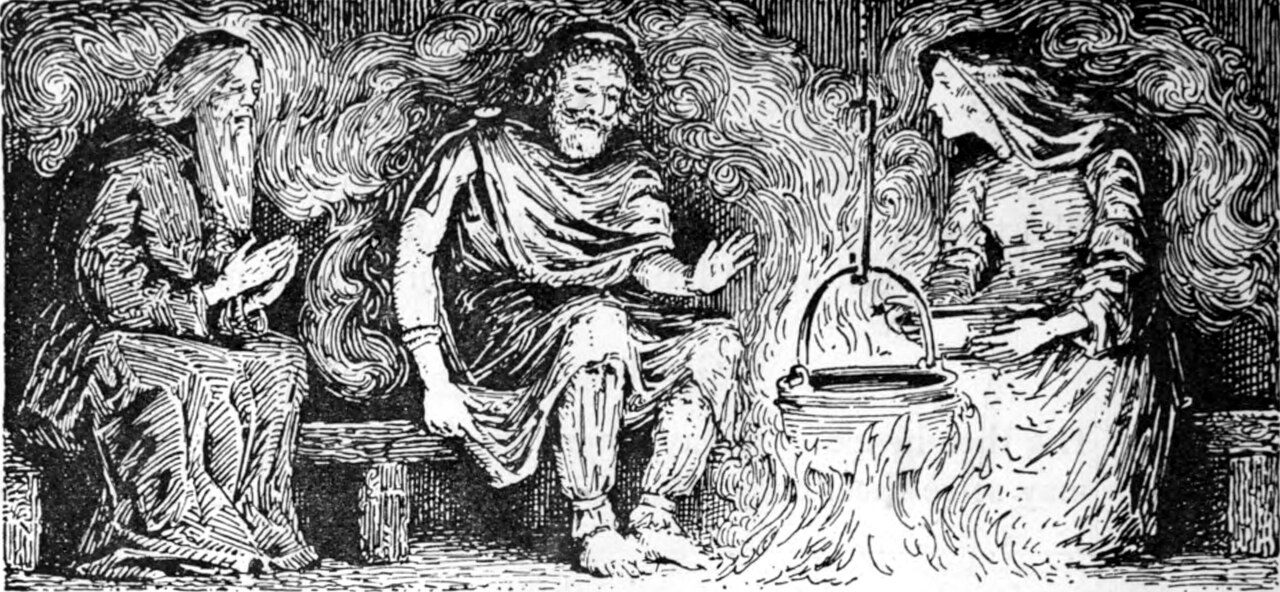
Forward he wenton the midmost way,He came to a dwelling,a door on its posts;In did he fare,on the floor was a fire,Two hoary onesby the hearth there sat,Ai and Edda,in olden dress.
Note
Most editions make line 5 a part of the stanza, as here, but some indicate it as the sole remnant of one or more stanzas descriptive of Ai and Edda, just as Afi and Amma, Fathir and Mothir, are later described. Ai and Edda: Great-Grandfather and Great-Grandmother; the latter name was responsible for Jakob Grimm's famous guess at the meaning of the word "Edda" as applied to the whole collection (cf. Introduction).
Cited on Ríg walks among men
Rig knew wellwise words to speak,Soon in the midstof the room he sat,And on either sidethe others were.
Note
A line may have been lost from this stanza.
Cited on Ríg walks among men
A loaf of breaddid Edda bring,Heavy and thickand swollen with husks;Forth on the tableshe set the fare,And broth for the mealin a bowl there was.(Calf's flesh boiledwas the best of the dainties.)
Note
Line 5 has generally been rejected as spurious.
Cited on Rígr, Ríg walks among men
Rig knew wellwise words to speak,Thence did he rise,made ready to sleep;Soon in the bedhimself did he lay,And on either sidethe others were.
Note
The manuscript has lines 1-2 in inverse order, but marks the word "Rig" as the beginning of a stanza.
Cited on Ríg walks among men
Thus was he therefor three nights long,Then forward he wenton the midmost way,And so nine monthswere soon passed by.
Note
The manuscript does not indicate that these lines form a separate stanza, and as only one line and a fragment of another are left of stanza 7, the editions have grouped the lines in all sorts of ways, with, of course, various conjectures as to where lines may have been lost.
A son bore Edda,with water they sprinkled him,With a cloth his hairso black they covered;Thræll they named him,. . . . . . . . . . . . . . .
Note
After line 1 the manuscript has only four words: "cloth," "black," "named," and "Thræll." No gap is anywhere indicated. Editors have pieced out the passage in various ways. Water, etc.: concerning the custom of sprinkling water on children, which long antedated the introduction of Christianity, cf. Hovamol, 159 and note. Black: dark hair, among the blond Scandinavians, was the mark of a foreigner, hence of a slave. Thræll: Thrall or Slave.
Cited on Ríg walks among men
The skin was wrinkledand rough on his hands,Knotted his knuckles,. . . . . . . . . . . . . . .Thick his fingers,and ugly his face,Twisted his back,and big his heels.
Note
In the manuscript line 1 of stanza 9 stands before stanza 8, neither line being capitalized as the beginning of a stanza. I have followed Bugge's rearrangement. The manuscript indicates no gap in line 2, but nearly all editors have assumed one, Grundtvig supplying "and rough his nails."
He began to grow,and to gain in strength,Soon of his mightgood use he made;With bast he bound,and burdens carried,Home bore faggotsthe whole day long.
Note
The manuscript marks line 2 as the beginning of a stanza.
Cited on Ríg walks among men
One came to their home,crooked her legs,Stained were her feet,and sunburned her arms,Flat was her nose;her name was Thir.
Note
A line may well have dropped out, but the manuscript is too uncertain as to the stanza-divisions to make any guess safe. Crooked: the word in the original is obscure. Stained: literally, "water was on her soles." Thir: "Serving-Woman."
Soon in the midstof the room she sat,By her side there satthe son of the house;They whispered both,and the bed made ready,Thræll and Thir,till the day was through.
Children they had,they lived and were happy,Fjosnir and Klurthey were called, methinks,Hreim and Kleggi,Kefsir, Fulnir,Drumb, Digraldi,Drott and Leggjaldi,Lut and Hosvir;the house they cared for,Ground they dunged,and swine they guarded,Goats they tended,and turf they dug.
Note
There is some confusion as to the arrangement of the lines and division into stanzas of 12 and 13. The names mean: Fjosnir, "Cattle-Man"; Klur, "The Coarse"; Hreim, "The Shouter"; Kleggi, "The Horse-Fly"; Kefsir, "Concubine-Keeper"; Fulnir, "The Stinking"; Drumb, "The Log"; Digraldi, "The Fat"; Drott, "The Sluggard", Leggjaldi, "The Big-Legged"; Lut, "The Bent"; Hosvir, "The Grey."
Cited on Ríg walks among men
Daughters had they,Drumba and Kumba,Ökkvinkalfa,Arinnefja,Ysja and Ambott,Eikintjasna,Totrughypjaand Tronubeina;And thence has risenthe race of thralls.
Note
The names mean: Drumba, "The Log"; Kumba, "The Stumpy"; Ökkvinkalfa, "Fat-Legged"; Arinnefja, "Homely-Nosed"; Ysja, "The Noisy"; Ambott, "The Servant"; Eikintjasna, "The Oaken Peg" (?); Totrughypja, "Clothed in Rags"; Tronubeina, "Crane-Legged."
Cited on Rígr, Ríg walks among men
Forward went Rig,his road was straight,To a hall he came,and a door there hung;In did he fare,on the floor was a fire:Ail and Ammaowned the house.
Note
In the manuscript line 4 stands after line 4 of stanza 16, but several editors have rearranged the lines, as here. Afi and Amma: Grandfather and Grandmother.
Cited on Ríg walks among men
There sat the twain,and worked at their tasks:The man hewed woodfor the weaver's beam;His beard was trimmed,o'er his brow a curl,His clothes fitted close;in the corner a chest.
Note
There is considerable confusion among the editors as to where this stanza begins and ends.
Cited on Ríg walks among men
The woman satand the distaff wielded,At the weaving with armsoutstretched she worked;On her head was a band,on her breast a smock;On her shoulders a kerchiefwith clasps there was.
Note
The manuscript marks line 3 as the beginning of a stanza.
Rig knew wellwise words to speak,Soon in the midstof the room he sat,And on either sidethe others were.
Note
The manuscript jumps from stanza 17, line 1, to stanza 19, line 2. Bugge points out that the copyist's eye was presumably led astray by the fact that 17, 1, and 19, 1, were identical. Lines 2-3 of 17 are supplied from stanzas 3 and 29.
Cited on Ríg walks among men
Then took Amma. . . . . . . . . . . . . . .The vessels fullwith the fare she set,Calf's flesh boiledwas the best of the dainties.
Note
I have followed Bugge's conjectural construction of the missing stanza, taking lines 2 and 3 from stanzas 31 and 4.
Cited on Ríg walks among men
Rig knew wellwise words to speak,He rose from the board,made ready to sleep;Soon in the bedhimself did he lay,And on either sidethe others were.
Note
The manuscript marks line 2 as the beginning of a stanza.
Thus was he therefor three nights long,Then forward he wenton the midmost way,And so nine monthswere soon passed by.
Note
The manuscript omits line 2, supplied by analogy with stanza 6
A son bore Amma,with water they sprinkled him,Karl they named him;in a cloth she wrapped him,He was ruddy of face,and flashing his eyes.
Note
Most editors assume a lacuna, after either line 2 or line 3. Sijmons assumes, on the analogy of stanza 8, that a complete stanza describing Karl ("Yeoman") has been lost between stanzas 21 and 22.
Cited on Rígr, Ríg walks among men
He began to grow,and to gain in strength,Oxen he ruled,and plows made ready,Houses he built,and barns he fashioned,Carts he made,and the plow he managed.
Note
No line indicated in the manuscript as beginning a stanza. Cart: the word in the original, "kartr," is one of the clear signs of the Celtic influence noted in the introduction.
Home did they bringthe bride for Karl,In goatskins clad,and keys she bore;Snör was her name,'neath the veil she sat;A home they made ready,and rings exchanged,The bed they decked,and a dwelling made.
Note
Bring: the word literally means "drove in a wagon"—a mark of the bride's social status. Snör: "Daughter-in-Law." Bugge, followed by several editors, maintains that line 4 was wrongly interpolated here from a missing stanza describing the marriage of Kon.
Cited on Ríg walks among men
Sons they had,they lived and were happy:Hal and Dreng,Holth, Thegn and Smith,Breith and Bondi,Bundinskeggi,Bui and Boddi,Brattskegg and Segg.
Note
No line indicated in the manuscript as beginning a stanza. The names mean: Hal, "Man"; Dreng, "The Strong"; Holth, "The Holder of Land"; Thegn, "Freeman"; Smith, "Craftsman"; Breith, "The Broad-Shouldered"; Bondi, "Yeoman"; Bundinskeggi, "With Beard Bound" (i.e., not allowed to hang unkempt); Bui, "Dwelling-Owner"; Boddi, "Farm-Holder"; Brattskegg, "With Beard Carried High"; Segg, "Man."
Cited on Ríg walks among men
Daughters they had,and their names are here:Snot, Bruth, Svanni,Svarri, Sprakki,Fljoth, Sprund and Vif,Feima, Ristil:And thence has risenthe yeomen's race.
Note
No line indicated in the manuscript as beginning a stanza. The names mean: Snot, "Worthy Woman"; Bruth, "Bride"; Svanni, "The Slender"; Svarri, "The Proud"; Sprakki, "The Fair"; Fljoth, "Woman" (?); Sprund, "The Proud"; Vif, "Wife"; Feima, "The Bashful"; Ristil, "The Graceful."
Cited on Rígr
Thence went Rig,his road was straight,A hall he saw,the doors faced south;The portal stood wide,on the posts was a ring,Then in he fared;the floor was strewn.
Note
Many editors make a stanza out of line 4 and lines 1-2 of the following stanza. Strewn: with fresh straw in preparation for a feast; cf. Thrymskvitha, 22.
Cited on Ríg walks among men
Within two gazedin each other's eyes,Fathir and Mothir,and played with their fingers;There sat the house-lord,wound strings for the bow,Shafts he fashioned,and bows he shaped.
Note
Fathir and Mothir: Father and Mother. Perhaps lines 3-4 should form a stanza with 28, 1-2.
Cited on Ríg walks among men
The lady sat,at her arms she looked,She smoothed the cloth,and fitted the sleeves;Gay was her cap,on her breast were clasps,Broad was her train,of blue was her gown,Her brows were bright,her breast was shining,Whiter her neckthan new-fallen snow.
Note
Bugge thinks lines 5-6, like 23, 4, got in here from the lost stanzas describing Kon's bride and his marriage.
Rig knew wellwise words to speak,Soon in the midstof the room he sat,And on either sidethe others were.
Then Mothir broughta broidered cloth,Of linen bright,and the board she covered;And then she tookthe loaves so thin,And laid them, whitefrom the wheat, on the cloth.
Cited on Ríg walks among men
Then forth she broughtthe vessels full,With silver covered,and set before them,Meat all browned,and well-cooked birds;In the pitcher was wine,of plate were the cups,So drank they and talkedtill the day was gone.
Note
The manuscript of lines 1-3 is obviously defective, as there are too many words for two lines, and not enough for the full three. The meaning, however, is clearly very much as indicated in the translation. Gering's emendation, which I have followed, consists simply in shifting "set before them" from the first line to the second—where the manuscript has no verb,—and supplying the verb "brought" in line 1. The various editions contain all sorts of suggestions.
Rig knew wellwise words to speak,Soon did he rise,made ready to sleep;So in the bedhimself did he lay,And on either sidethe others were.
Note
The manuscript begins both line 1 and line 2 with a capital preceded by a period, which has led to all sorts of strange stanza-combinations and guesses at lost lines in the various editions. The confusion includes stanza 33, wherein no line is marked in the manuscript as beginning a stanza.
Cited on Ríg walks among men
Thus was he therefor three nights long,Then forward he wenton the midmost way,And so nine monthswere soon passed by.
A son had Mothir,in silk they wrapped him,With water they sprinkled him,Jarl he was;Blond was his hair,and bright his cheeks,Grim as a snake'swere his glowing eyes.
Note
Jarl: "Nobly-Born."
Cited on Rígr, Ríg walks among men
To grow in the housedid Jarl begin,Shields he brandished,and bow-strings wound,Bows he shot,and shafts he fashioned,Arrows he loosened,and lances wielded,Horses he rode,and hounds unleashed,Swords he handled,and sounds he swam.
Note
Various lines have been regarded as interpolations, 3 and 6 being most often thus rejected.
Cited on Ríg walks among men
Straight from the grovecame striding Rig,Rig came striding,and runes he taught him;By his name he called him,as son he claimed him,And bade him holdhis heritage wide,His heritage wide,the ancient homes.
Note
Lines 1, 2, and 5 all begin with capitals preceded by periods, a fact which, taken in conjunction with the obviously defective state of the following stanza, has led to all sorts of conjectural emendations. The exact significane of Rig's giving his own name to Jarl (cf. stanza 46), and thus recognizing him, potentially at least, as a king, depends on the conditions under which the poem was composed (cf. Introductory Note). The whole stanza, particularly the reference to the teaching of magic (runes), fits Othin far better than Heimdall.
Cited on Rígr, Runes, Ríg walks among men
..............................Forward he rodethrough the forest dark,O'er the frosty crags,till a hall he found.
Note
Something—one or two lines, or a longer passage—has clearly been lost, describing the beginning of Jarl's journey. Yet many editors, relying on the manuscript punctuation, make 37 and 38 into a single stanza.
Cited on Ríg walks among men
His spear he shook,his shield he brandished,His horse he spurred,with his sword he hewed;Wars he raised,and reddened the field,Warriors slew he,and land he won.
Eighteen hallsere long did he hold,Wealth did he get,and gave to all,Stones and jewelsand slim-flanked steeds,Rings he offered,and arm-rings shared.
Note
The manuscript marks both lines 1 and 2 as beginning stanzas.
His messengers wentby the ways so wet,And came to the hallwhere Hersir dwelt;His daughter was fairand slender-fingered,Erna the wisethe maiden was.
Note
Hersir: "Lord"; the hersir was, in the early days before the establishment of a kingdom in Norway, the local chief, and hence the highest recognized authority. During and after the time of Harald the Fair-Haired the name lost something of its distinction, the hersir coming to take rank below the jarl. Erna: "The Capable."
Cited on Ríg walks among men
Her hand they sought,and home they brought her,Wedded to Jarlthe veil she wore;Together they dwelt,their joy was great,Children they had,and happy they lived.
Bur was the eldest,and Barn the next,Joth and Athal,Arfi, Mog,Nith and Svein,soon they began—Sun and Nithjung—to play and swim;Kund was one,and the youngest Kon.
Note
The names mean: Bur, "Son"; Barn, "Child"; Joth, "Child"; Athal, "Offspring"; Arfi, "Heir"; Mog, "Son"; Nith, "Descendant"; Svein, "Boy"; Sun, "Son"; Nithjung, "Descendant"; Kund, "Kinsman"; Kon, "Son" (of noble birth). Concerning the use made of this last name, see note on stanza 44. It is curious that there is no list of daughters of Jarl and Erna, and accordingly Vigfusson inserts here the names listed in stanza 25. Grundtvig rearranges the lines of stanzas 42 and 43.
Soon grew upthe sons of Jarl,Beasts they tamed,and bucklers rounded,Shafts they fashioned,and spears they shook.
Cited on Ríg walks among men
But Kon the Younglearned runes to use,Runes everlasting,the runes of life;Soon could he wellthe warriors shield,Dull the swordblade,and still the seas.
Note
The manuscript indicates no line as beginning a stanza. Kon the Young: a remarkable bit of fanciful etymology; the phrase is "Konr ungr," which could readily be contracted into "Konungr," the regular word meaning "king." The "kon" part is actually not far out, but the second syllable of "konungr" has nothing to do with "ungr" meaning "young." Runes: a long list of just such magic charms, dulling swordblades, quenching flames, and so on, is given in Hovamol, 147-163.
Cited on Rígr, Runes, Ríg walks among men
Bird-chatter learned he,flames could he lessen,Minds could quiet,and sorrows calm;..............................The might and strengthof twice four men.
Note
The manuscript indicates no line as beginning a stanza. Minds: possibly "seas," the word being doubtful. Most editors assume the gap as indicated.
With Rig-Jarl soonthe runes he shared,More crafty he was,and greater his wisdom;The right he sought,and soon he won it,Rig to be called,and runes to know.
Note
The manuscript indicates no line as beginning a stanza. Rig-Jarl: Kon's father; cf. stanza 36.
Cited on Rígr, Ríg walks among men
Young Kon rode forththrough forest and grove,Shafts let loose,and birds he lured;There spake a crowon a bough that sat:"Why lurest thou, Kon,the birds to come?
Note
This stanza has often been combined with 48, either as a whole or in part. Crow: birds frequently play the part of mentor in Norse literature; cf., for example, Helgakvitha Hundingsbana I, 5, and Fafnismol, 32.
Cited on Ríg walks among men
"'Twere better forthon thy steed to fare,. . . . . . . . . . . . . . .and the host to slay.
Note
This fragment is not indicated as a separate stanza in the manuscript. Perhaps half a line has disappeared, or, as seems more likely, the gap includes two lines and a half. Sijmons actually constructs these lines, largely on the basis of stanzas 35 and 38. Bugge fills in the half-line lacuna as indicated above with "The sword to wield."
"The halls of Danand Danp are noble,Greater their wealththan thou hast gained;Good are theyat guiding the keel,Trying of weapons,and giving of wounds.***
Note
Dan and Danp: These names are largely responsible for the theory that the Rigsthula was composed in Denmark. According to the Latin epitome of the Skjöldungasaga by Arngrimur Jonsson, "Rig (Rigus) was a man not the least among the great ones of his time. He married the daughter of a certain Danp, lord of Danpsted, whose name was Dana; and later, having won the royal title for his province, left as his heir his son by Dana, called Dan or Danum, all of whose subjects were called Danes." This may or may not be conclusive, and it is a great pity that the manuscript breaks off abruptly at this stanza.
Cited on Rígr, Ríg walks among men