Goth
Jörmunrekkr
King of the Goths who has his young wife Svanhildr trampled by horses and his son Randvér hanged; Guðrún's sons cut off his hands and feet.
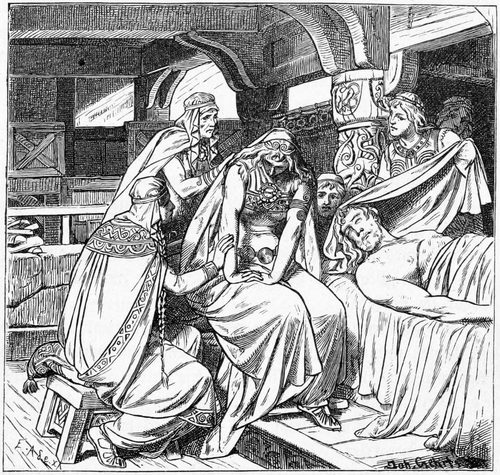
Jörmunrekkr, "the Mighty" in Snorri, is the Gothic king who ends the Gjúkung line. He married Svanhildr, daughter of Sigurðr and Guðrún. When his counsellor Bikki told him that his son Randvér had taken her for himself, he had Randvér hanged and Svanhildr trampled to death under horses Guðrúnarhvöt, prose 1. Snorri adds that Randvér sent his father a plucked hawk, and the king understood too late that his realm was now as helpless as the bird, "since he was old and childless" Skáldskaparmál 41.
In Hamðismál he is drinking in his hall when Guðrún's sons Hamðir and Sörli arrive. He laughs, strokes his beard and boasts that he will hang them. Within minutes his hands and feet lie in the fire Hamðismál 21-25. Steel will not bite the brothers, and he roars like a bear for his men to stone them Hamðismál 26. The poem calls him "of the race of the gods" at that moment, and the phrase is unexplained. Hyndluljóð says the sons of Jörmunrekkr were "to the gods in death ... as offerings given", and calls him a kinsman of Sigurðr Hyndluljóð 25.
Behind him stands the historical Ermanaric, a king of the Goths who died in the 370s when the Huns overran his realm. He is one of the few Eddic figures who can be tied to a real reign, about two generations before Attila. The legend has drawn the two together: in the poems, Jörmunrekkr's wife Svanhildr is Atli's stepdaughter.
In the sources
Quoted from the hosted translations; each line is checked against the text when the site is built. Select a reference to read it in context.
Then Jormunrek laughed, his hand laid on his beard
The men would I bind with strings of bows, And Gjuki's heirs on the gallows hang.
even as the hawk was featherless and powerless to fly, so was his kingdom shorn of its might, since he was old and childless.
Where the sources disagree or fall silent
- Whether he dies in Hamðismál: the poem leaves him maimed, hands and feet cut off, and does not say whether he lived.
In modern culture
Not from the medieval sources.
Ermanaric was a real 4th-century king of the Goths. The Roman historian Ammianus Marcellinus says he killed himself when the Huns overran his kingdom in the 370s. The 6th-century Jordanes tells instead of Sunilda torn apart by horses and of her brothers Sarus and Ammius wounding the king. As Eormenric he appears in Old English poetry (Widsith, Deor) as a byword for a cruel king.