concept
Dwarves
dvergar
The underground smiths of Norse myth, made from the giant Ymir's flesh or blood; they forge the gods' greatest treasures, brew the mead of poetry, and fear the daylight.
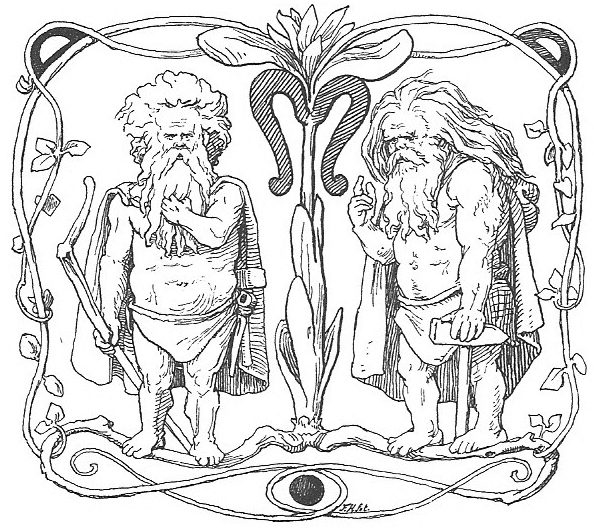
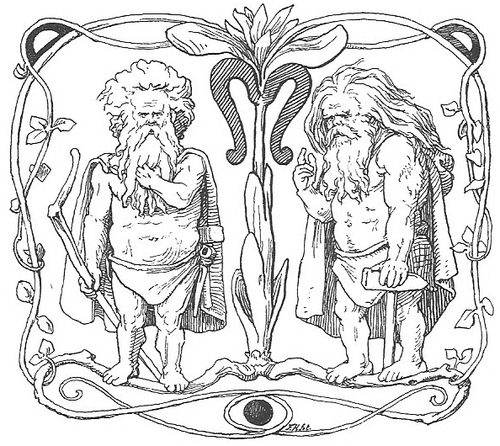
Dwarves in Norse myth are makers. Almost everything precious the gods own — Thor's hammer, Odin's spear and ring, Freyr's ship and boar, Sif's golden hair, the fetter that binds Fenrir — was forged by dwarves. They live in the earth and in stones, they are clever and greedy, and daylight is dangerous to them.
Origins
Völuspá tells their making in the midst of creation. The gods meet in council "to find who should raise the race of dwarfs / Out of Brimir's blood and the legs of Blain" Völuspá 9. Mótsognir is made first and mightiest, Durinn second, and "many a likeness of men they made, / The dwarfs in the earth, as Durin said" Völuspá 10. Then comes a long list of dwarf names, among them Norðri, Suðri, Austri and Vestri, Dvalinn, Andvari and Gandálfr Völuspá 11 Völuspá 12 Völuspá 15.
Snorri tells a cruder version. The dwarves "had first received shape and life in the flesh of Ymir, and were then maggots", until the gods gave them human understanding and shape; "nevertheless they dwell in the earth and in stones" Gylfaginning 14. He also gives four of them a cosmic job, holding up the four corners of the sky made from Ymir's skull Gylfaginning 8.
What dwarves do
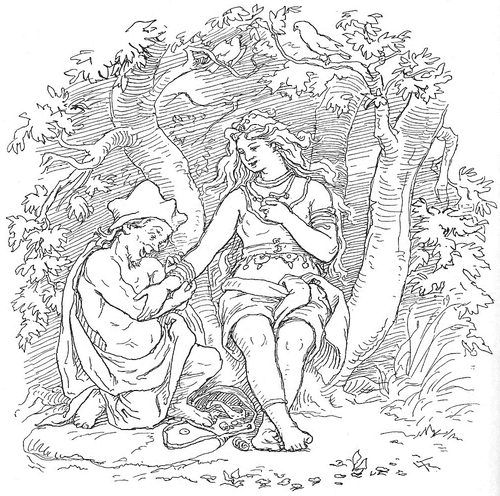
They forge. Ívaldi's sons make Sif's hair, the ship Skíðblaðnir and the spear Gungnir; Brokkr and his brother make the boar Gullinbursti, the ring Draupnir and the hammer Mjöllnir Skáldskaparmál 35. The dwarves Dáinn and Nabbi make Freyja's boar Hildisvíni Hyndluljóð 7. Unnamed dwarves in the land of the black elves make Gleipnir from the noise of a cat's footfall and the roots of a rock Gylfaginning 34.
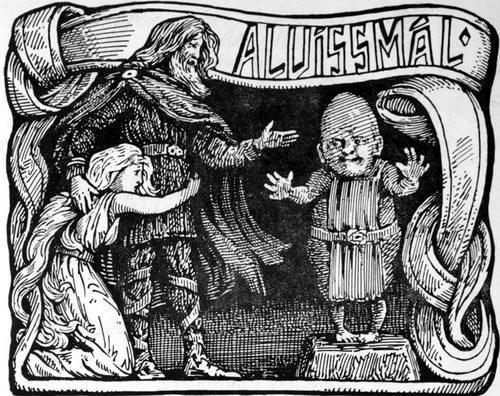
They are also dangerous. The dwarves Fjalar and Galarr kill the wise Kvasir and brew the mead of poetry from his blood, then drown a giant and drop a millstone on his wife Skáldskaparmál 1; poetry is therefore called "Dwarves' Drink" Skáldskaparmál 1. Andvari, robbed of his gold by Loki, lays a curse on his ring that runs through the whole Völsung story Skáldskaparmál 39. Alvíss comes to claim Thor's daughter as his bride and is refused by her father Alvíssmál 1 Alvíssmál 4.
Daylight and the end
Alvíssmál shows the dwarves' weakness. Thor keeps Alvíss answering questions all night, then springs the trap: "The day has caught thee, dwarf! / (Now the sun shines here in the hall.)" Alvíssmál 35. The dwarves' own name for the sun, "The Deceiver of Dvalin" Alvíssmál 16, may hint at a similar story. At Ragnarök the dwarves are heard but not seen: "Loud roar the dwarfs by the doors of stone, / The masters of the rocks" Völuspá 48.
Dwarves and elves
Snorri sometimes calls the dwarves "Black Elves" and their land the land of the black elves Skáldskaparmál 35 Gylfaginning 34. The poems keep the two apart: Alvíssmál gives elves and dwarfs separate vocabularies, and in Hávamál Dáinn carves runes for the elves while Dvalinn carves them for the dwarfs Hávamál 144. Whether the two were ever thought of as one people is debated (see Svartálfaheimr and Elves).
In the sources
Quoted from the hosted translations; each line is checked against the text when the site is built. Select a reference to read it in context.
To find who should raise the race of dwarfs Out of Brimir's blood and the legs of Blain.
Many a likeness of men they made, The dwarfs in the earth, as Durin said.
The dwarves had first received shape and life in the flesh of Ymir, and were then maggots; but by decree of the gods had become conscious with the intelligence of men, and had human shape. And nevertheless they dwell in the earth and in stones.
Loud roar the dwarfs by the doors of stone, The masters of the rocks
The day has caught thee, dwarf! (Now the sun shines here in the hall.)
had he not sworn to get the Black Elves to make Sif hair of gold
Where the sources disagree or fall silent
- Völuspá's 'Brimir's blood and the legs of Blain' is usually taken to mean Ymir's blood and bones, but Brimir and Bláinn are not otherwise identified as Ymir.
- Whether dwarves were thought to be turned to stone by sunlight, as in later folklore, or simply destroyed, is not stated; Alvíssmál says only that the day has caught him.
- Snorri's equation of dwarves with 'black elves' and the relation of both to his 'dark-elves' are debated (see Svartálfaheimr).
In modern culture
Not from the medieval sources.
Modern dwarves owe more to Tolkien than to the Eddas. He took the names of most of the dwarves in The Hobbit (1937), and Gandalf's, from the Eddic dwarf lists (Thorin, Dwalin, Fili, Kili, Bombur, Bifur, Bofur, Dori, Nori, Ori, Gloin, Oin), and gave them the beards and battle-axes that later fantasy copied. The Eddas never describe a dwarf's appearance and never mention beards. The Brothers Grimm's Snow White dwarfs come from German folklore, a related but separate tradition.