giant
Hel
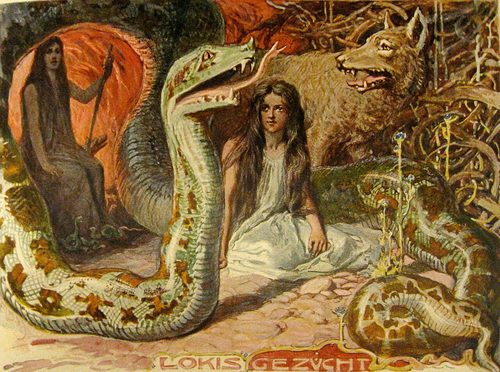
Loki's daughter by Angrboða, half dark and half flesh-coloured, whom Odin cast down to rule the dead in Niflheim; she holds Baldr and sets the price of his return.
Hel is the ruler of the dead and the third-named of the three children of Loki and the giantess Angrboða Gylfaginning 34. The same word names both her and the place she rules (see Hel (the realm)); in many poems one cannot tell which is meant. As a person, she is almost entirely Snorri's creation on the page: the poems speak of going "to Hel" or of "the house of Hel," but only Snorri describes her.
Snorri's portrait
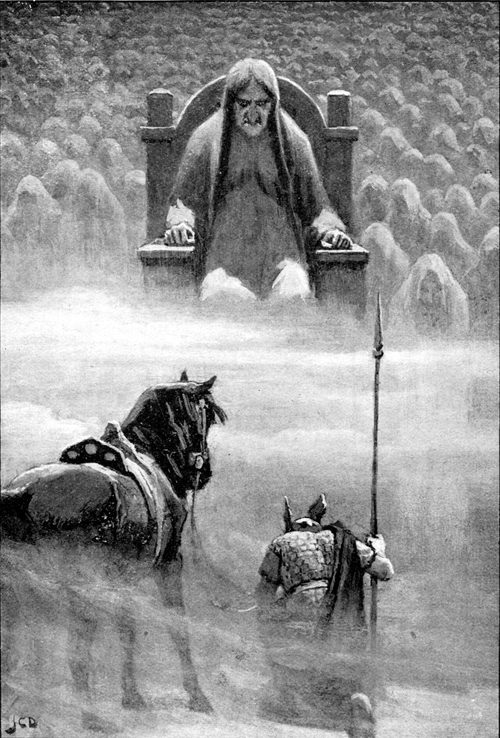
When the gods learned that Loki's children were being raised in Jötunheim and that they would bring disaster, Odin had them brought to him. He threw the serpent into the sea, and "Hel he cast into Niflheim, and gave to her power over nine worlds." Her share of the dead is "men dead of sickness or of old age." Snorri then gives a grim inventory, each item a personification: her hall is Sleet-Cold, her dish Hunger, her knife Famine, her servants Idler and Sloven, her threshold Pit of Stumbling, her bed Disease. She is "half blue-black and half flesh-color," and "very lowering and fierce" Gylfaginning 34. Scholars often read this list as a learned elaboration, built from the kind of allegory medieval writers enjoyed, rather than old tradition.
Hel and Baldr
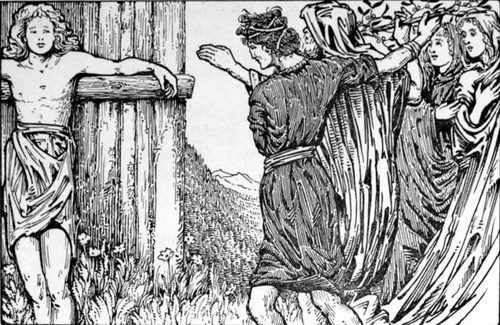
Hel's one great scene is the attempt to bring Baldr back (see Hermóðr's ride to Hel). Hermóðr rides nine nights to her hall, finds Baldr sitting in the high seat, and begs for his return. Hel answers by setting a test: if all things in the world, alive and dead, weep for Baldr, he may go back; if any refuses, he stays Gylfaginning 49. Everything weeps except one giantess, Þökk, whose answer is "Let Hel hold to that she hath!" Hel is not cruel here so much as exact; the rule she sets is fair, and it is Loki, Snorri implies, who defeats it.
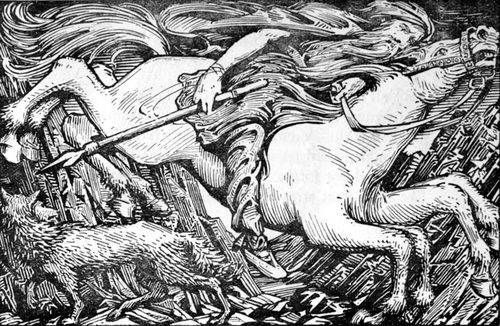
The poem Baldrs draumar shows the other side of this. Odin rides down to "the house so high of Hel" Baldrs draumar 3, asks a dead seeress for whom the benches there are decked with rings and gold, and learns that the mead is already brewed for Baldr Baldrs draumar 6-7.
At the end
At Ragnarök Völuspá puts "the people of Hel" in the ship that Loki steers Völuspá 51, and Snorri says "All the champions of Hel follow Loki" Gylfaginning 51. Neither source says what becomes of Hel herself. In Völuspá Baldr comes back to the new world Völuspá 62, so in the end her hold on him is broken.
The word
Hel is an old Germanic word for the world of the dead, related to Old English hell and Gothic halja; the Christian "hell" took over the older name. Whether a personal goddess of death named Hel was believed in before Snorri's time, or grew from poetic personification of the place, is debated.
In the sources
Quoted from the hosted translations; each line is checked against the text when the site is built. Select a reference to read it in context.
Hel he cast into Niflheim, and gave to her power over nine worlds
She is half blue-black and half flesh-color (by which she is easily recognized), and very lowering and fierce.
If all things in the world, quick and dead, weep for him, then he shall go back to the Æsir
Forward rode Othin, the earth resounded Till the house so high of Hel he reached.
Where the sources disagree or fall silent
- In many passages it is impossible to tell whether 'Hel' means the woman or the place; Bellows sometimes translates the same word as 'hell'.
- Snorri's list of the names of Hel's hall, dish, knife and servants is found only in Gylfaginning; there is no telling how old it is.
In modern culture
Not from the medieval sources.
Marvel's Hela, a death goddess who first appeared in Journey into Mystery #102 (1964), was played by Cate Blanchett in Thor: Ragnarok (2017); the films make her Odin's daughter, which the sources do not. Hel is also a recurring figure in fantasy and games.