world
Svartálfaheimr
Snorri's 'home of the black elves', where the gods go to have dwarves forge their treasures; the name occurs only in his prose, and his merging of black elves with dwarves is debated.
Svartálfaheimr, "home of the black elves", is a word of Snorri's. No poem in the Poetic Edda uses it. Brodeur's translation renders it as "the region of the Black Elves" or "the Land of the Black Elves", so readers will not meet the Old Norse form in the hosted text at all.
What Snorri says
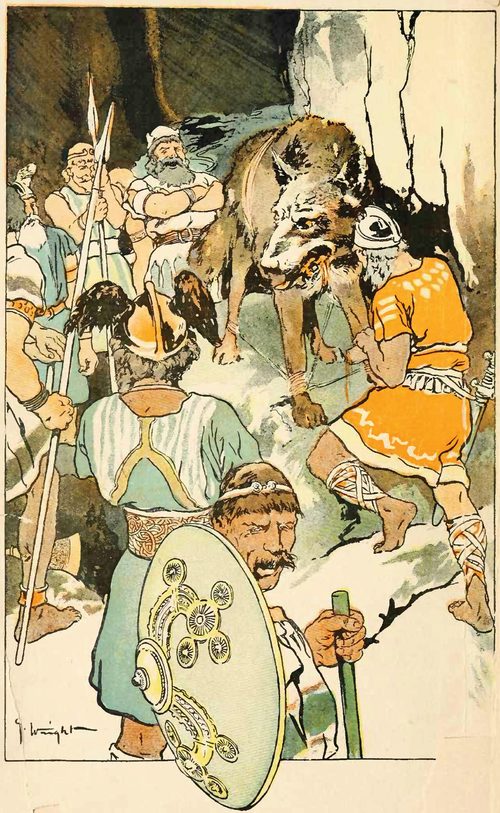
The place appears when the gods need something made. When two fetters have failed to hold Fenrir, Odin sends Skírnir "down into the region of the Black Elves, to certain dwarves", who make Gleipnir Gylfaginning 34. When the gods must pay the otter's ransom, Odin sends Loki "into the Land of the Black Elves", where he catches the dwarf Andvari Skáldskaparmál 39. And Loki swears to get "the Black Elves" to make Sif new hair, then goes to the dwarves called Ívaldi's Sons Skáldskaparmál 35.
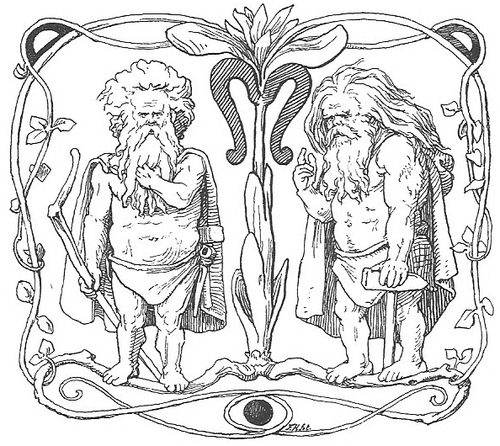
In all three passages the people who live there are dwarves. Snorri appears to use "black elves" as another name for Dwarves.
Black elves, dark elves and dwarves
That identification is Snorri's, and it is not straightforward. Elsewhere he describes two kinds of elves: light-elves in Álfheimr, "fairer to look upon than the sun", and dark-elves who "dwell down in the earth" and are "blacker than pitch" Gylfaginning 17. He does not say there that the dark-elves are dwarves, and his account of the dwarves' origin — maggots in Ymir's flesh given human shape Gylfaginning 14 — says nothing about elves.
The poems keep elves and dwarves apart. Alvíssmál gives elves and dwarfs different words for the same things Alvíssmál 12, and Hávamál has Dáinn carve runes "for the elves" and Dvalinn "for the dwarfs" Hávamál 144. Scholars disagree about what to make of this. Some think Snorri's light/dark division is his own learned scheme, perhaps influenced by Christian ideas of angels and demons; others think "black elf" was a genuine traditional name for dwarves, which some dwarf names containing -álfr (Gandálfr, Vindálfr Gylfaginning 14) might support. Neither view is settled.
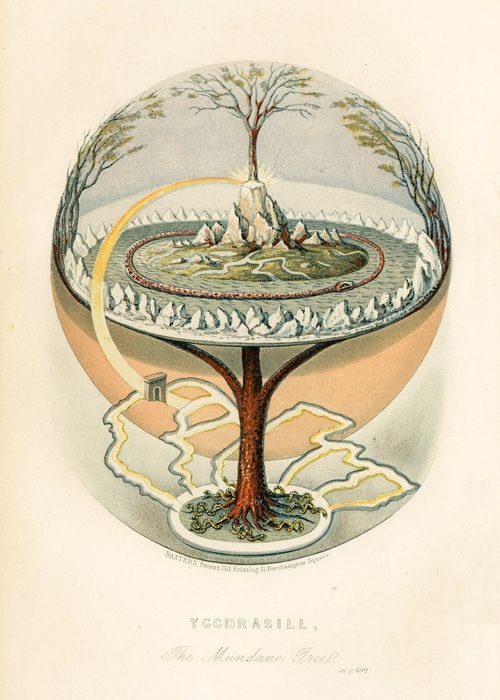
Modern lists of the nine worlds usually include Svartálfaheimr as the dwarves' world, or replace it with Niðavellir. Both choices are reconstructions.
In the sources
Quoted from the hosted translations; each line is checked against the text when the site is built. Select a reference to read it in context.
Allfather sent him who is called Skírnir, Freyr's messenger, down into the region of the Black Elves, to certain dwarves, and caused to be made the fetter named Gleipnir.
Thereupon Odin sent Loki into the Land of the Black Elves, and he came to the dwarf who is called Andvari
had he not sworn to get the Black Elves to make Sif hair of gold
the Dark-Elves dwell down in the earth, and they are unlike in appearance, but by far more unlike in nature.
Where the sources disagree or fall silent
- The name Svartálfaheimr is attested only in Snorri's prose; no poem uses it.
- Whether Snorri's black elves (svartálfar), dark elves (døkkálfar) and dwarves (dvergar) were three groups, two or one is debated; Snorri himself seems to treat black elves and dwarves as the same.
- Where Svartálfaheimr lies is not stated beyond Snorri's 'down' (Gylfaginning 34) and the dark-elves living 'down in the earth' (Gylfaginning 17).
In modern culture
Not from the medieval sources.
Svartalfheim appears in most modern lists of the nine worlds as the dwarves' realm; Marvel's Thor: The Dark World (2013) used it as the home of the 'Dark Elves', and God of War (2018 onward) makes it the dwarves' homeland. Some modern lists replace it with Nidavellir.