A myth retold · about 5 minutes
Odin on the tree: how the runes were won
In Hávamál Odin tells how he hung for nine nights on a windswept tree, wounded with a spear and given to himself, without food or drink, until he seized the runes and fell back. It is the most famous passage in Old Norse poetry, and one of the most mysterious.
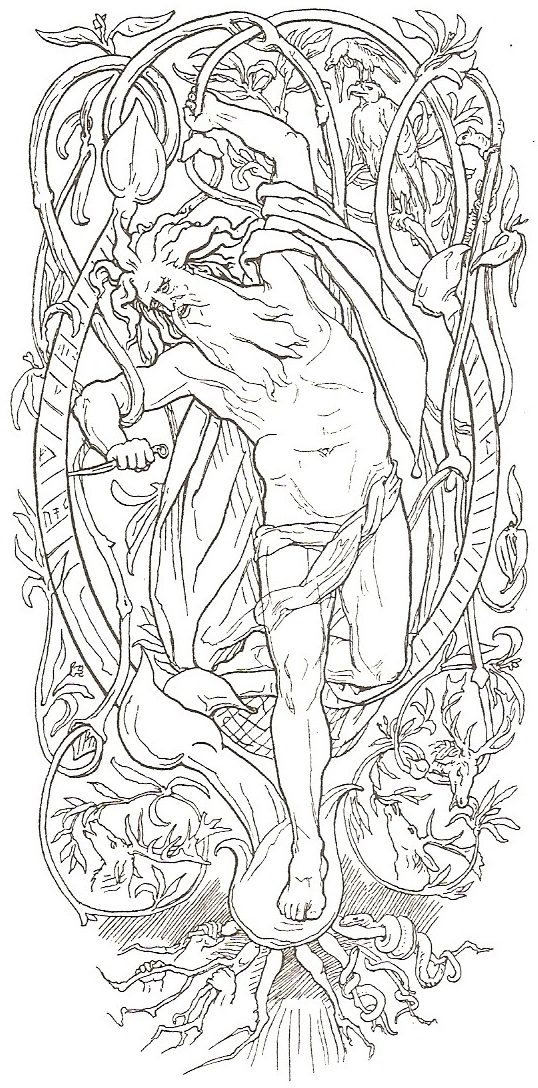
Most Norse myths are told about Odin. This one is told by him. Near the end of Hávamál, the long poem of advice spoken in Odin's voice, the tone suddenly changes from proverbs about guests and drinking to a first-person account of an ordeal. It runs for eight stanzas. It has been quoted, translated and argued over more than almost any other passage in the Poetic Edda.
Nine nights on the windy tree
The speaker begins without preamble.
I ween that I hung on the windy tree,Hung there for nights full nine;With the spear I was wounded, and offered I wasTo Othin, myself to myself,On the tree that none may ever knowWhat root beneath it runs.Hávamál 139
Everything in the stanza is strange. Odin hangs on a tree in the wind for nine nights. He is wounded with a spear. He is "offered … to Othin, myself to myself" — the god is both the sacrifice and the one to whom it is made. And the tree is one whose roots no one knows Hávamál 139.
No one gave him bread or a drink from a horn Hávamál 140. He looked down. Then, crying out, he "took up the runes", and fell back.
None made me happy with loaf or horn,And there below I looked;I took up the runes, shrieking I took them,And forthwith back I fell.Hávamál 140
The poem does not say where the runes were — below him, presumably, since he looks down — or what form they took. It does not say how he got down from the tree, or whether he died and came back. It records only the moment of seizing them and the fall.
What he gained
The next stanzas list the rewards. Odin learned nine "mighty songs" from the son of Bölþorn, Bestla's father Hávamál 141. Snorri makes Bestla Odin's mother and Bölþorn her father Gylfaginning 6, so the teacher is Odin's maternal uncle, a giant. The poem does not name him; some scholars have suggested he is Mímir, but nothing in the texts says so. Odin also got "a drink … of the goodly mead poured out from Othrörir" — the Óðrerir that in other sources holds the mead of poetry.
Then he began to thrive. "Each word led me on to another word, each deed to another deed" Hávamál 142. The image is of knowledge that grows on itself once begun.
The poem then turns to the listener. "Runes shalt thou find, and fateful signs" that "the king of singers colored" and the gods made Hávamál 143. Runes, it says, were carved by Odin for the gods, by Dáinn for the elves, by Dvalinn for the dwarfs, by Alsviðr for giants and mankind Hávamál 144. A string of questions follows — "Knowest how one shall write, knowest how one shall rede? … Knowest how one shall send, knowest how one shall sacrifice?" Hávamál 145 — and a warning that a gift should match what one hopes to receive: "Better no prayer than too big an offering" Hávamál 146.
The eighteen charms
Straight after, Odin lists eighteen spells he knows, the section editors call the Ljóðatal, "the list of songs" Hávamál 147-165. Most are practical magic of a kind that galdr was believed to perform: to heal, to blunt an enemy's sword, to spring fetters, to stop an arrow in flight, to quench a burning hall, to calm the sea, to send witches riding the air astray, to win a woman's love. One returns to the image of the tree:
A twelfth I know, if high on a treeI see a hanged man swing;So do I write and color the runesThat forth he fares,And to me talks.Hávamál 158
The god who hung on a tree can make the hanged speak. The eighteenth charm he will tell to no one, "save only to her in whose arms I lie, or who else my sister is" Hávamál 165.
Where the story comes from
The only narrative source is Hávamál 139–146 (Bellows's numbering; most editions count from 138), preserved in the Codex Regius of about 1270. Hávamál is plainly a compilation of several older poems, and this rune section was probably once separate from the advice that comes before it. Snorri never retells the hanging. He does list "God of the Hanged" among Odin's names Gylfaginning 20, and the skaldic verses he quotes in Skáldskaparmál speak of "the Hanged-God's gifts and feasting" and "the Hanged-God's helmet" Skáldskaparmál 2, which shows that the idea of Odin as a god of hanged men was old and widespread.
The poem never names the tree. Its "windy tree" whose roots no one knows is very like Yggdrasil, and Svipdagsmál uses the same phrase about the world-tree Mímameiðr, "no man knows what root beneath it runs" Svipdagsmál 30. The usual explanation of the name Yggdrasil as "the horse of Yggr" (Odin), with "horse" meaning gallows, strengthens the link. But identifying the two is an inference, not a statement in the source.
Sigrdrífumál gives a different and independent picture of how the runes came into the world. There Hroptr — Odin — devises them from a liquid that dripped from the head of Heiðdraupnir and the horn of Hoddrofnir, the head of Mímir speaks "words of truth" Sigrdrífumál 13-14, and the runes are shaved off what they were carved on, mixed with the holy mead and sent out to gods, elves, Vanir and men Sigrdrífumál 18. That poem says nothing about hanging.
Reading it today
The resemblance to the Crucifixion — a god wounded by a spear, hanging on a tree, thirsting, offered as a sacrifice — has been obvious to readers since the nineteenth century, and scholars have argued both ways: that the passage shows Christian influence on a late heathen poet, or that it preserves a genuinely pre-Christian idea that only looks similar. Neither side can prove its case, and the differences matter as much as the likenesses. Odin's sacrifice redeems no one. It is a bargain made for knowledge, by himself and for himself.
Another line of interpretation compares the ordeal with initiation rites or with the trance-journeys of shamans, in which the initiate undergoes a symbolic death to gain secret knowledge. Others point to reports of hanging and spearing as sacrifices to Odin in later saga and chronicle literature. All of these are readings brought to the poem, not things it says.
What the poem does say is enough to explain its fame. Knowledge is not given; it is taken, at a cost, alone, and the god who has it keeps some of it back.
Key passages
I ween that I hung on the windy tree, Hung there for nights full nine; With the spear I was wounded, and offered I was To Othin, myself to myself
I took up the runes, shrieking I took them, And forthwith back I fell.
Nine mighty songs I got from the son Of Bolthorn, Bestla's father; And a drink I got of the goodly mead Poured out from Othrörir.
Each word led me on to another word, Each deed to another deed.
A twelfth I know, if high on a tree I see a hanged man swing; So do I write and color the runes That forth he fares, And to me talks.
He is also called God of the Hanged, God of Gods, God of Cargoes