concept
Valkyries
valkyrjur
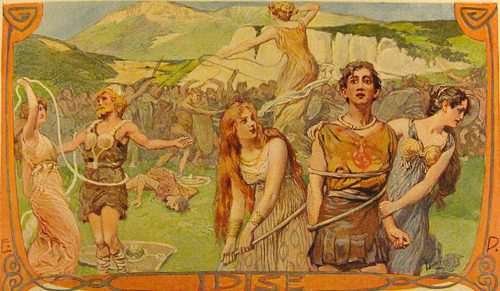
Odin's battle-maidens, who ride to war to decide who falls and bring chosen warriors to Valhalla; in the heroic poems some are also mortal princesses who love and protect a hero.
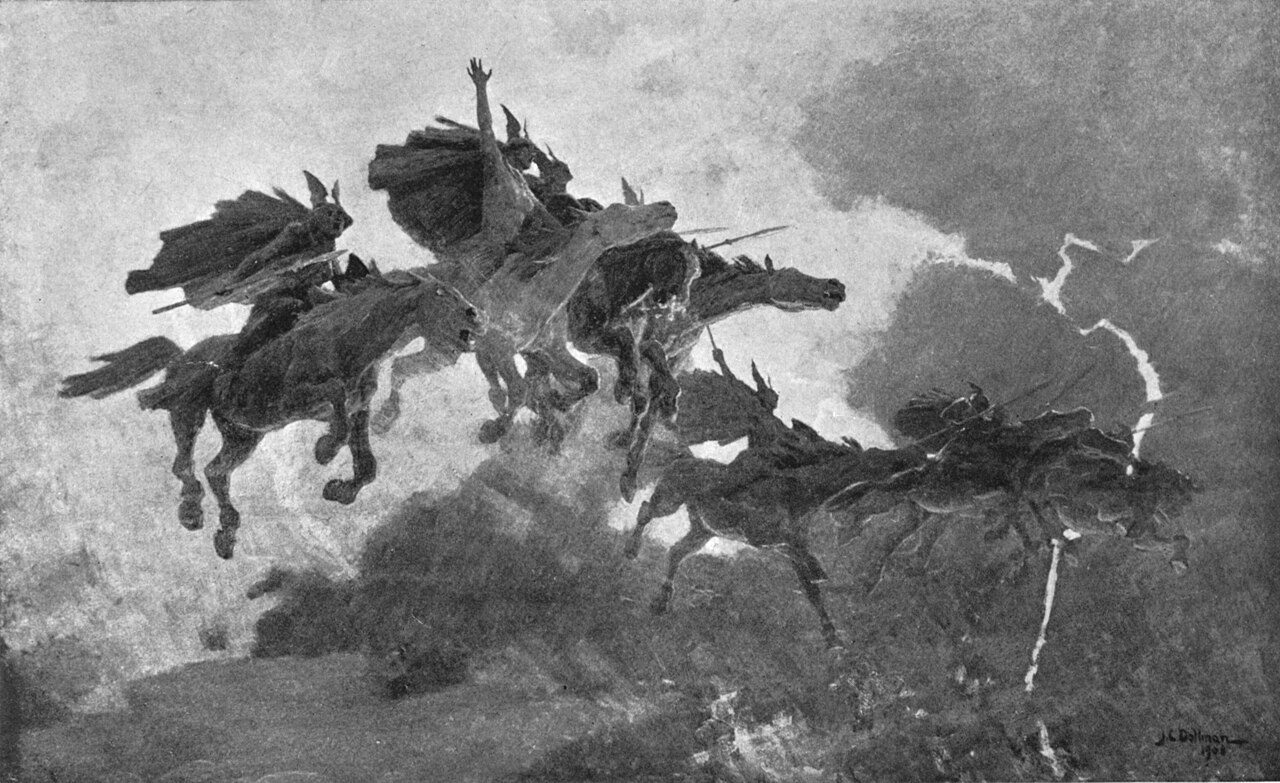
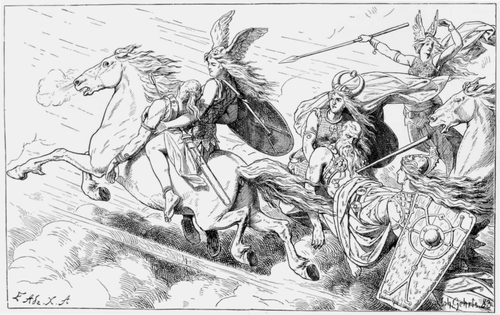
The valkyries are the women who choose who dies in battle. Their name says so: valkyrja is "chooser of the slain". The Eddas show them in two quite different forms. In the mythological poems and in Snorri they are a troop of supernatural women in Odin's service. In the heroic poems a valkyrie is often a named king's daughter who rides through the air, falls in love with a hero and shields him in battle. The two pictures overlap, but no source reconciles them.
Odin's maidens
Snorri's definition is short: "them Odin sends to every battle; they determine men's feyness and award victory" Gylfaginning 36. "Feyness" means being doomed to die. The valkyries decide which men are fey, and so which side wins. Snorri adds that Gudr, Róta and "the youngest Norn, she who is called Skuld" ride "to take the slain and decide fights".
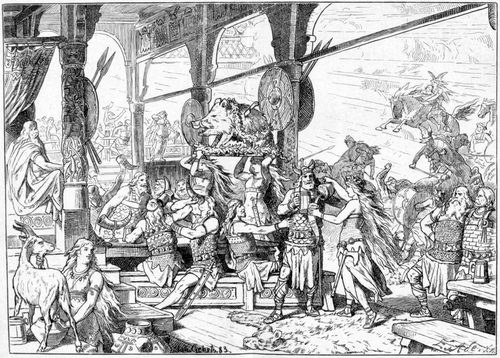
They have a second, more domestic job. In Valhalla they serve the einherjar, the dead warriors. In Grímnismál, Odin names thirteen of them:
Hrist and Mist bring the horn at my will,Skeggjold and Skogul;Hild and Thruth, Hlok and Herfjotur,Gol and Geironul,Randgrith and Rathgrith and ReginleifBeer to the warriors bring.Grímnismál 36
Snorri quotes this stanza to describe the women who serve at table in Valhall Gylfaginning 36. The seeress of Völuspá gives another list, "Herjan's maidens", Herjan being a name of Odin, "ready to ride o'er the earth" Völuspá 31. Skuld is the first name on it. She is also one of the three Norns, and the overlap is probably not an accident. Both groups are women who decide fate. The Norns decide it at birth and the valkyries on the battlefield.
The names themselves are mostly words for battle: Hild ("battle"), Göndul, Skögul, Geirskögul ("spear-Skögul"), Hlökk ("din"). Skaldic poetry shows the same idea. Eyvindr's poem on the death of King Hákon, quoted by Snorri, has Odin send "Göndull and Skögull … to choose from kings" who should "be in Valhall" Skáldskaparmál 2. Eiríksmál has Odin dream of preparing his hall for a dead king, with "the Valkyrs to pour wine" Skáldskaparmál 2. At Baldr's funeral Snorri brings Odin with "Frigg and the Valkyrs" and his ravens Gylfaginning 49.
Valkyries of the heroic poems
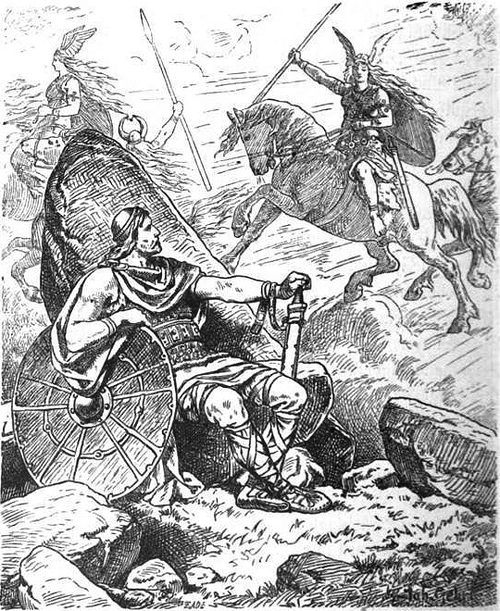
In the heroic poems, valkyries are people with fathers, lovers and griefs. Svava, daughter of King Eylimi, "was a Valkyrie, and rode air and sea"; she gave Helgi Hjorvarthsson his name and shielded him in battle Helgakviða Hjörvarðssonar, prose 4. Sigrun, daughter of King Hogni, "was a Valkyrie and rode air and water", and the prose says she "was Svava reborn" Helgakviða Hundingsbana II, prose 6. In Helgakviða Hundingsbana I, she and her companions come down "from heaven … the maidens helmed" to watch over Helgi in his great battle Helgakviða Hundingsbana I 56, and earlier Sigrun saves his ships from the storm Helgakviða Hundingsbana I 31.
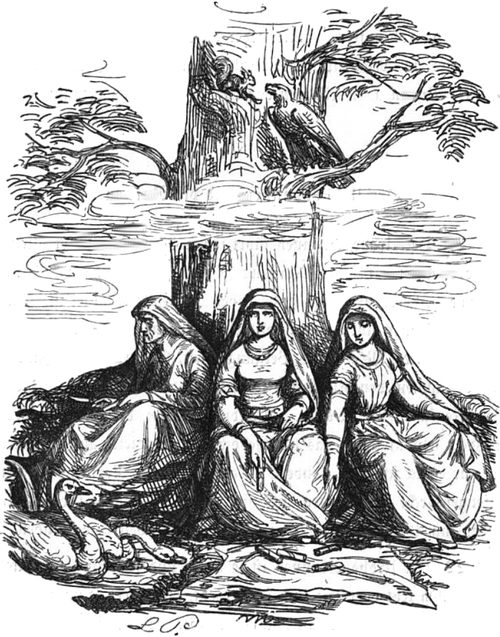
Völundarkviða begins with three valkyries found by a lake "spinning flax", their swan-garments beside them. They marry Völund and his brothers, stay seven winters, then "flew away to find battles, and came back no more" Völundarkviða, prose 1.
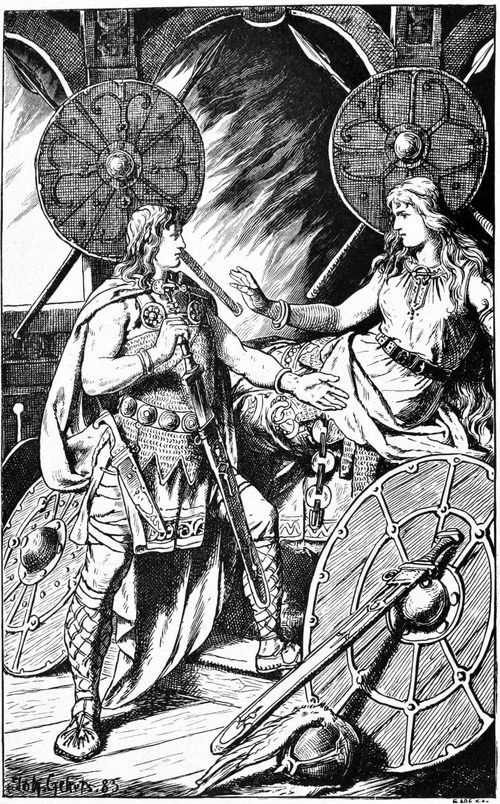
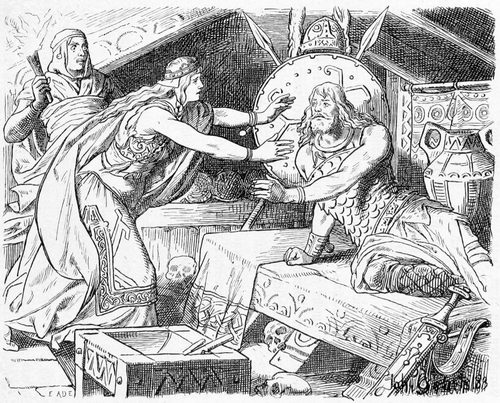
The most famous is the sleeping valkyrie whom Sigurth wakes on the mountain. In Sigrdrífumál she is called Sigrdrifa. She had given victory to the wrong king, Odin had pricked her with a sleep-thorn, and he decreed that she would never again win victory in battle but would marry Sigrdrífumál, prose 4. In Helreið Brynhildar, Brynhild tells the same story as her own: she sent "Hjalmgunnar the old" to hell, "For this was Othin's anger mighty" Helreið Brynhildar 8. In Oddrúnargrátr, her father wants her to be "a wish-maid bright" Oddrúnargrátr 15. Snorri flatly says the woman Sigurd found "gave her name as Hildr: she is called Brynhildr, and was a Valkyr" Skáldskaparmál 41. Whether Sigrdrifa and Brynhild are one woman or two is never settled: the stories match, Bellows heads one of Sigrdrifa's speeches "Brynhild spake" Sigrdrífumál 20, but the prose of the poem only ever calls her Sigrdrifa.
Weaving, swans and other images
The valkyries are tied to textiles only in passing in the Eddas. The swan-maidens of Völundarkviða sit spinning flax Völundarkviða 1. The grim image of valkyries weaving a battle on a loom weighted with men's heads comes from Darraðarljóð, a poem preserved in Njáls saga, where women are seen weaving and singing before the Battle of Clontarf (1014). It is not in either Edda.
Not every voice in the poems admires them. In the flyting of Helgakviða Hundingsbana I, Sinfjotli taunts his opponent: "A Valkyrie wast thou, loathly witch, Evil and base, in Allfather's home" Helgakviða Hundingsbana I 40. Even in insult, the valkyrie belongs to Odin's household.
In the sources
Quoted from the hosted translations; each line is checked against the text when the site is built. Select a reference to read it in context.
On all sides saw I Valkyries assemble, Ready to ride to the ranks of the gods; Skuld bore the shield, and Skogul rode next, Guth, Hild, Gondul, and Geirskogul.
Hrist and Mist bring the horn at my will, Skeggjold and Skogul;
These are called Valkyrs: them Odin sends to every battle; they determine men's feyness and award victory.
From heaven there came the maidens helmed,— The weapon-clang grew,— who watched o'er the king;
Early one morning they found on the shore of the lake three women, who were spinning flax. Near them were their swan-garments, for they were Valkyries.
Othin pricked her with the sleep-thorn in punishment for this, and said that she should never thereafter win victory in battle, but that she should be wedded.
Where the sources disagree or fall silent
- How the valkyries of myth relate to the valkyrie-princesses of the heroic poems; the poems never explain it.
- Whether the Viking Age silver figures of women holding drinking horns, often labelled 'valkyries' in museums, were meant as valkyries.
In modern culture
Not from the medieval sources.
Richard Wagner's opera Die Walküre (first performed 1870) made the valkyries, and Brünnhilde in particular, the best-known Norse figures in the 19th century; its 'Ride of the Valkyries' has been reused endlessly, most famously in the film Apocalypse Now (1979). The winged helmets and breastplates of the popular image come from 19th-century opera staging, not from Viking Age evidence. Valkyries appear in many games and comics; Marvel's Valkyrie was played by Tessa Thompson in Thor: Ragnarok (2017).