concept
Dísir
dísir
Female guardian spirits tied to fate, to families and to childbirth, who received sacrifices; the Eddas mention them only in passing, and Bellows translates the word in several different ways.
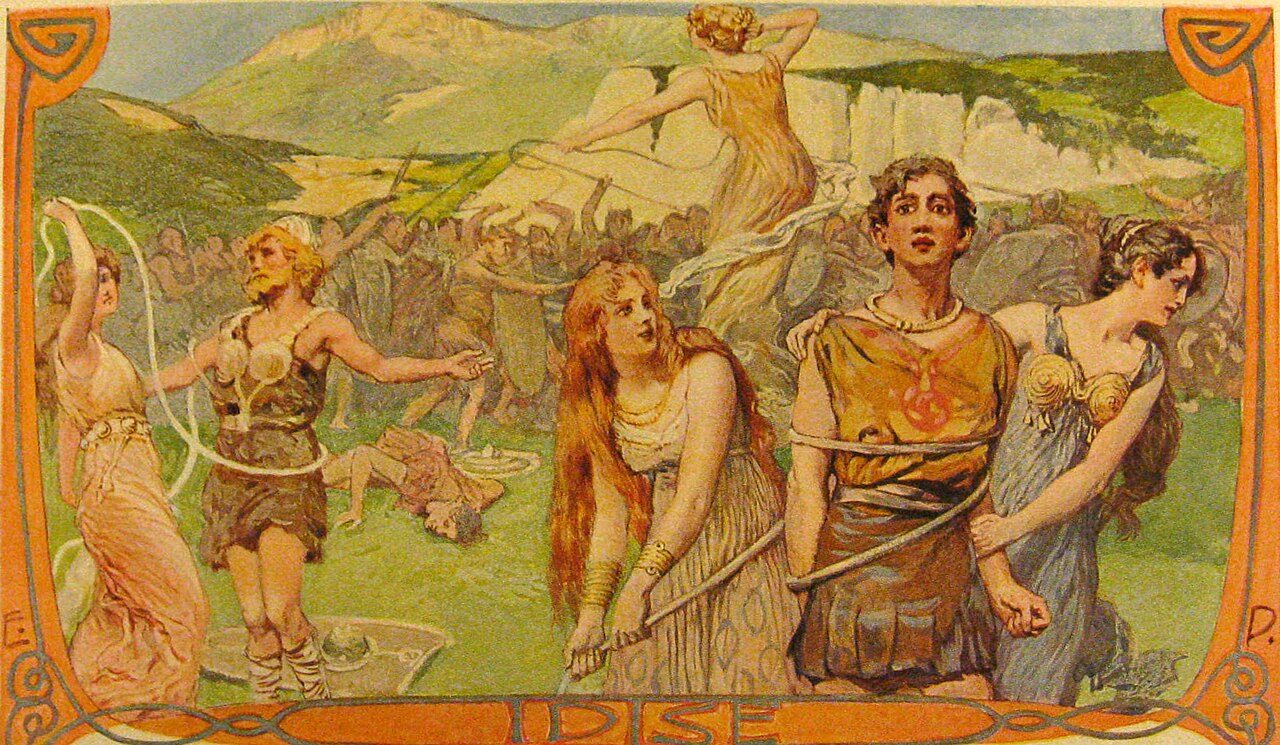
The dísir are female powers who watch over a person or a family, help at births and turn against a man when his luck is ending. They are a real presence in the Old Norse poems, but a reader of the English Eddas could miss them, because Bellows never uses the word. He translates dísir by whatever fits the line.
When Odin, disguised as Grímnir, tells King Geirröth that his life is over, he says "The maids are hostile" Grímnismál 53. The Old Norse says the dísir are hostile. In Reginsmál, one of the bad omens before battle is to stumble, for then "Goddesses baneful at both thy sides Will that wounds thou shalt get" Reginsmál 24; again the word is dísir. In Sigrdrífumál, the birth-runes are carved on the palms and joints of the helpers, who then "ask the fates to aid" Sigrdrífumál 8. The fates are the dísir. Snorri's name for Freyja, Vanadís, "the dís of the Vanir", appears in Brodeur as "Lady of the Vanir" Gylfaginning 35.
These passages give the core of what the Eddas say: dísir attend birth, stand beside a fighting man, and can withdraw their favour. That makes them hard to separate from the Norns, who also come to births, and the Valkyries, who also decide fights. Scholars generally treat the three as overlapping groups.
Outside the Eddas, the sagas show that dísir were worshipped. They mention a sacrifice called the dísablót. In Snorri's Ynglinga saga, the Swedish king Aðils dies when his horse stumbles as he rides around the hall of the dísir during this sacrifice. In Egils saga, Egill drinks at a dísablót in Norway, the occasion on which he carves runes on a poisoned drinking horn. These saga scenes give the ritual its setting but tell us little about what was believed.
In the sources
Quoted from the hosted translations; each line is checked against the text when the site is built. Select a reference to read it in context.
Thy sword-pierced body shall Ygg have soon, For thy life is ended at last; The maids are hostile; now Othin behold!
Goddesses baneful at both thy sides Will that wounds thou shalt get.
On thy palms shalt write them, and round thy joints, And ask the fates to aid.
She is also called Lady of the Vanir.
Where the sources disagree or fall silent
- In Atlamál 25 ('nothing, methinks, could the Norns avail thee') and Hamðismál 28 (''twas the Norns that drove me') Bellows's 'Norns' may also stand for dísir in the Old Norse; this page does not rely on them.
- Whether the dísir were a single class of beings or a general word that could cover Norns, valkyries and family guardians alike.