
Poetic Edda · heroic poems
Helgakviða Hundingsbana I
The First Lay of Helgi Hundingsbane
Bellows's introduction
The general subject of the Helgi lays is considered in the introduction to Helgakvitha Hjorvarthssonar, and it is needless here to repeat the statements there made. The first lay of Helgi Hundingsbane is unquestionably one of the latest of the Eddic poems, and was composed probably not earlier than the second quarter of the eleventh century. It presents several unusual characteristics. For one thing, it is among the few essentially narrative poems in the whole collection, telling a consecutive story in verse, and, except for the abusive dialogue between Sinfjotli and Gothmund, which clearly was based on another and older poem, it does so with relatively little use of dialogue. It is, in fact, a ballad, and in the main an exceedingly vigorous one. The annotator, who added his prose narrative notes so freely in the other Helgi poems, here found nothing to do. The available evidence indicates that narrative verse was a relatively late development in Old Norse poetry, and it is significant that most of the poems which consist chiefly, not of dialogue, but of narrative stanzas, such as the first Helgi Hundingsbane lay and the two Atli lays, can safely be dated, on the basis of other evidence, after the year 1000.
The first Helgi Hundingsbane lay is again differentiated from most of the Eddic poems by the character of its language. It is full of those verbal intricacies which were the delight of the Norse skalds, and which made Snorri's dictionary of poetic phrases an absolute necessity. Many of these I have paraphrased in the translation; some I have simplified or wholly avoided. A single line will serve to indicate the character of this form of complex diction (stanza 56, line 4): "And the horse of the giantess raven's-food had." This means simply that wolves (giantesses habitually rode on wolves) ate the bodies of the dead.
Except for its intricacies of diction, and the possible loss of a stanza here and there, the poem is comparatively simple. The story belongs in all its essentials to the Helgi tradition, with the Volsung cycle brought in only to the extent of making Helgi the son of Sigmund, and in the introduction of Sinfjotli, son of Sigmund and his sister Signy, in a passage which has little or nothing to do with the course of the narrative, and which looks like an expansion of a passage from some older poem, perhaps from the "old Volsung lay" to which the annotator of the second Helgi Hundingsbane lay refers (prose after stanza 12). There are many proper names, some of which betray the confusion caused by the blending of the two sets of traditions; for example, Helgi appears indiscriminately as an Ylfing (which presumably he was before the Volsung story became involved) and as a Volsung. Granmar and his sons are called Hniflungs (Nibelungen) in stanza 50, though they seem to have had no connection with this race. The place names have aroused much debate as to the localization of the action, but while some of them probably reflect actual places, there is so much geographical confusion, and such a profusion of names which are almost certainly mythical, that it is hard to believe that the poet had any definite locations in mind.
In olden days,when eagles screamed,And holy streamsfrom heaven's crags fell,Was Helgi then,the hero-hearted,Borghild's son,in Bralund born.
Note
The manuscript contains the superscription: "Here begins the lay of Helgi Hundingsbane and h. (Hothbrodd ?) The lay of the Volsungs." Eagles, etc.: the screaming of eagles and water pouring from heaven were portents of the birth of a hero. Borghild: Sigmund's first wife; Bralund was her home, not Sigmund's.
Cited on Sigmundr
'Twas night in the dwelling,and Norns there came,Who shaped the lifeof the lofty one;They bade him most famedof fighters allAnd best of princesever to be.
Note
Norns: cf. Voluspo, 20 and note. Here it is the Norns who preside ove Helgi's early destiny, and not a Valkyrie, as in Helgakvitha Hjorvarthssonar.
Cited on Helgi Hundingsbane, The Norns
Mightily wove theythe web of fate,While Bralund's townswere trembling all;And there the goldenthreads they wove,And in the moon's hallfast they made them.
Note
Line 2 is largely guesswork, the manuscript being obscure. Moon's hall: the sky.
Cited on The Norns
East and westthe ends they hid,In the middle the heroshould have his land;And Neri's kinswomannorthward castA chain, and bade itfirm ever to be.
Note
East, etc.: the Norns give Helgi fame in the East, West, and North; in the North his renown is particularly to endure. This suggests that the poet was aware of the spread of the Helgi story over many lands. Neri's kinswoman: evidently one of the Norns, but nothing further is known of Neri, and the word may not be a proper name at all.
Cited on The Norns
Once sorrow hadthe Ylfings' son,And grief the bridewho the loved one had borne.******Quoth raven to raven,on treetop resting,Seeking for food,"There is something I know.
Note
The manuscript indicates no gap, but it looks as though something had been lost after line 2. Ylfings' son: Sigmund is evidently meant, though calling him an Ylfing (cf. Hyndluljoth, 11 and note) is a manifest error. Helgi, in the tradition as it came from Denmark, was undoubtetly an Ylfing, and the poet, in order to combine the two legends, has to treat the Ylfings and Volsungs as if they were the same family.
"In mail-coat standsthe son of Sigmund,A half-day old;now day is here;His eyes flash sharpas the heroes' are,He is friend of the wolves;full glad are we."
Note
Sigmund: the chief link between the Helgi and Sigurth stories. He was the son of Volsung, great-grandson of Othin. His children by his first wife, Borghild, were Helgi and Hamund (belonging to the Helgi cycle); his son by his second wife, Hjordis, was Sigurth. An incestuous connection with his sister, Signy (cf. Wagner's Siegmund and Sieglinde) resulted in the birth of Sinfjotli (cf. Fra Dautha Sinfjotla and note).
The warrior thronga ruler thought him,Good times, they said,mankind should see;The king himselffrom battle-press came,To give the princea leek full proud.
Note
The king: Sigmund, who gives his son a symbol of the lands which he bestows on him. Regarding the leek, cf. Voluspo, 4; Guthrunarkvitha I, 17, and Sigrdrifumol, 7.
Helgi he named him,and Hringstathir gave him,Solfjoll, Snæfjoll,and Sigarsvoll,Hringstoth, Hotun,and Himinvangar,And a blood-snake bedeckedto Sinfjotli's brother.
Note
Hringstathir ("Ring-Stead"): quite possibly the historical Ringsted, long a possession of the Danish kings, and thus a relic of the old Helgi tradition. Hringstoth may be another form of the same name. Solfjoll ("Sun-Mountain") and Snæfjoll ("Snow-Mountain") are fictitious names. Regarding Sigarsvoll cf. Helgakvitha Hjorvarthssonar, stanzas 8 and 35. Saxo mentions a Danish king named Sigar, and the frequency with which the name appears in the Helgi poems may be taken as a reminiscence of Denmark. Hotun ("High Place"): possibly the village of Tune in Seeland. Himinvangar ("Heaven's Field"): an imaginary place. Blood-snake: a sword. Sinfjotli: cf. note on stanza 6.
Cited on Helgi Hundingsbane
Mighty he grewin the midst of his friends,The fair-born elm,in fortune's glow;To his comrades goldhe gladly gave,The hero spared notthe blood-flecked hoard.
Note
Elm: a not uncommon word for "man." Blood-flecked: i.e., won in battle.
Short time for warthe chieftain waited,When fifteen wintersold he was;Hunding he slew,the hardy wightWho long had ruledo'er lands and men.
Note
Fifteen: until early in the eleventh century a Norwegian or Icelandic boy became "of age" at twelve, and Maurer cites this passage as added proof of the poem's lateness. Hunding: the annotator (introductory prose to Helgakvitha Hundingsbana II) calls him king of Hundland, which shows no great originality. Saxo mentions a Hunding who was a Saxon king ruling in Jutland, probably the origin of Helgi's traditional foe.
Cited on Helgi Hundingsbane
Of Sigmund's sonthen next they soughtHoard and rings,the sons of Hunding;They bade the princerequital payFor booty stolenand father slain.
The prince let nottheir prayers avail,Nor gold for their deaddid the kinsmen get;Waiting, he said,was a mighty stormOf lances grayand Othin's grimness.
Note
Storm, etc.: war.
The warriors forthto the battle went,The field they choseat Logafjoll;Frothi's peacemidst foes they broke,Through the isle went hungrilyVithrir's hounds.
Note
Logafjoll ("Flame-Mountain"): a mythical name. Frothi: a traditional king of Denmark, whose peaceful reign was so famous that "Frothi's peace" became a by-word for peace of any kind. Vithrir's hounds: wolves; Vithrir is Othin, and his hounds are the wolves Freki and Geri.
The king then sat,when he had slainEyjolf and Alf,'neath the eagle-stone;Hjorvarth and Hovarth,Hunding's sons,The kin of the spear-wielder,all had he killed.
Note
In this poem Helgi kills all the sons of Hunding, but in the poems of the Sigurth cycle, and the prose notes attached thereto, Sigmund and his father-in-law, Eylimi, are killed by Hunding's sons, on whom Sigurth subsequently takes vengeance (cf. Fra Dautha Sinfjotla and Regïnsmol).
Then glittered lightfrom Logafjoll,And from the lightthe flashes leaped;..............
Note
No gap indicated in the manuscript, but almost certainly something has been lost mentioning more specifically the coming of the Valkyries. The lightning which accompanies them suggests again their identification with the clouds (cf. Helgakvitha Hjorvarthssonar, 28).
Cited on Helgi Hundingsbane
..............High under helmson heaven's field;Their byrnies allwith blood were red,And from their spearsthe sparks flew forth.
Note
Some editions fill out the first line: "He saw there mighty maidens riding." The manuscript indicates line 4 as the beginning of a new stanza.
Early thenin wolf-wood askedThe mighty kingof the southern maid,If with the herohome would sheCome that night;the weapons clashed.
Note
Wolf-wood: dark forest; the original word is not altogether clear. Southern: this variety of Valkyrie, like the swan-maidens of the Völundarkvitha, was clearly regarded as of southern (i.e., German) origin. Here again there is a confusion of traditions; the Valkyries of the Voluspo were as essentially Norse as any part of the older mythology. I doubt if a poet much earlier than the author of the first Helgi Hundingsbane lay would have made his Sigrun, daughter of Hogni, a Valkyrie. It is to be noted that the same complication appears in the Sigurth story, where the undoubted Valkyrie, Brynhild-Sigrdrifa (the latter name is really only an epithet) is hopelessly mixed up with the quite human Brynhild, daughter of Buthli.
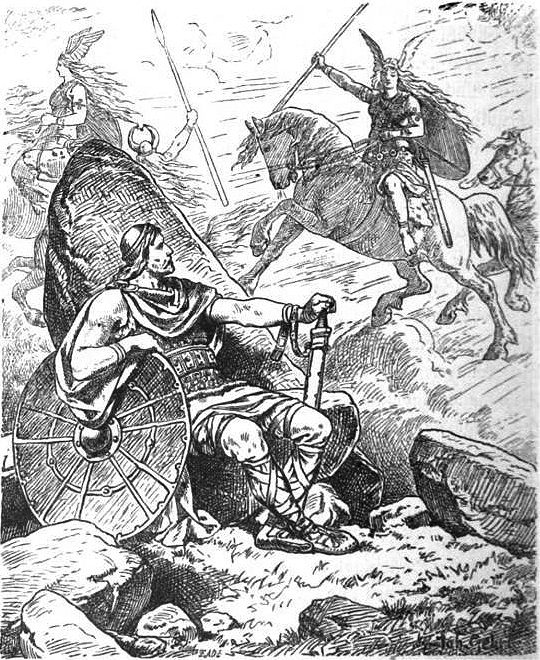
Down from her horsesprang Hogni's daughter,—The shields were still,—and spake to the hero:"Other tasksare ours, methinks,Than drinking beerwith the breaker of rings.
Note
Breaker of rings: generous prince, because the breaking of rings was the customary form of distributing gold.
Cited on Sigrún
"My father has pledgedhis daughter fairAs bride to Granmar'sson so grim;But, Helgi, Ionce Hothbrodd calledAs fine a kingas the son of a cat.
Note
Granmar: the annotator gives an account of him and his family in the prose following stanza 12 of Helgakvitha Hundingsbana II.
"Yet the hero will come a few nights hence,..............Unless thou dost bid him the battle-ground seek,Or takest the maid from the warrior mighty."
Note
No gap indicated in the manuscript; some editors combine the stanza with the fragmentary stanza 21, and others fill in with "And home will carry Hogni's daughter."
Helgi spake:"Fear him not,though Isung he felled,First must our couragekeen be tried,Before unwillingthou fare with the knave;Weapons will clash,if to death I come not."
Note
The manuscript has only lines 1 and 4 with the word "first" of line 2, and does not indicate Helgi as the speaker. The Volsungasaga, which follows this poem pretty closely, expands Helgi's speech, and lines 2-3 are conjectural versifications of the saga's prose. Isung: nothing is known of him beyond the fact, here indicated, that Hothbrodd killed him.
Messengers sentthe mighty one then,By land and by sea,a host to seek,Store of wealthof the water's gleam,And men to summon,and sons of men.
Note
Water's gleam: gold.
"Bid them straightwayseek the ships,And off Brandeyready to be!"There the chief waitedtill thither were comeMen by hundredsfrom Hethinsey.
Note
Brandey ("Brand-Isle"): not mentioned elsewhere. Hethinsey ("Hethin's Isle"): possibly the island of Hiddensee, east of Rügen.
Soon off Stafnsnesstood the ships,Fair they glidedand gay with gold;Then Helgi spaketo Hjorleif asking:"Hast thou countedthe gallant host?"
Note
Stafsnes ("Steersman's Cape"): an unidentifiable promontory. Fair: a guess, as the adjective in the manuscript is obscure. Hjorleif does not appear elsewhere, and seems to be simply one of Helgi's lieutenants.
The young king answeredthe other then:"Long were it to tellfrom TronueyrThe long-stemmed shipswith warriors ladenThat come from withoutinto Orvasund.
Note
Tronueyr: "Crane-Strand." Long-stemmed: literally "long-headed," as the high, curving stem of a Norse ship was often carved to represent a head and neck. Orvasund: almost certainly the Danish Öresund, off Seeland. Such bits of geography as this followed Helgi persistently.
.............."There are hundreds twelveof trusty men,But in Hotun liesthe host of the king.Greater by half;I have hope of battle."
Note
No gap indicated in the manuscript. Hotun: cf. stanza 8 and note.
The ship's-tents soonthe chieftain struck,And waked the throngof warriors all;(The heroes the redof dawn beheld;)And on the maststhe gallant menMade fast the sailsin Varinsfjord.
Note
Line 3 seems to have been interpolated from line 4 of Helgakvitha Hundingsbana II, 42. Ship's-tents: the awnings spread over the deck to shelter the crews from sun and rain when the ships were at anchor. Varinsfjord: cf. Helgakvitha Hjorvarthssonar, 22 and note.
There was beat of oarsand clash of iron,Shield smote shieldas the ships'-folk rowed;Swiftly wentthe warrior-ladenFleet of the rulerforth from the land.
Note
The manuscript indicates line 3 as the beginning of a new stanza, and some editions follow this arrangement, making lines 1-2 a separate stanza.
So did it sound,when together the sistersOf Kolga struckwith the keels full long,As if cliffs were brokenwith beating surf,..............
Note
The manuscript indicates no gap, and some editions combine the stanza with lines 3-4 of stanza 28. Sisters of Kolga: the waves, Kolga ("The Gold") being one of the daughters of the sea-god, Ægir. As the Volsungasaga says, "Now there was a great storm."
Helgi bade higherhoist the sails,Nor did the ships'-folkshun the waves,Though dreadfullydid Ægir's daughtersSeek the steedsof the sea to sink.
Note
Helgi demonstrates his courage, whatever one may think of his seamanship. Ægir's daughters: the waves, cf. stanza 29 and note.
But from abovedid Sigrun braveAid the menand all their faring;Mightily camefrom the claws of RonThe leader's sea-beastoff Gnipalund.
Note
Sigrun here appears again as a Valkyrie. Ron: Ægir's wife, cf. Helgakvitha Hjorvarthssonar, 18 and note. Sea-beast: ship. Gnipalund: "Crag-Wood."
Cited on Helgi Hundingsbane, Rán, Sigrún, Valkyries
At evening therein UnavagarFloated the fleetbedecked full fair;But they who sawfrom Svarin's hill,Bitter at heartthe host beheld.
Note
Unavagar: "Friendly Waves." Svarin's hill: the hill where Granmar had his dwelling.
Then Gothmund asked,goodly of birth,.............."Who is the monarchwho guides the host,And to the landthe warriors leads?"
Note
Here begins the long dialogue between Gothmund, one of Granmar's sons, and Sinfjotli, Helgi's half-brother. Two lines (stanza 33, lines 3-4) are quoted by the annotator in the prose note following stanza 16 of the second Helgi Hundingsbane lay, and the dialogue, in much abbreviated form, together with Helgi's admonition to Sinfjotli to cease talking, is closely paralleled in stanzas 22-27 of that poem. It has been suggested that this whole passage (stanzas 33-48) is an interpolation, perhaps from "the Old Volsung lay." This may be, but it seems more probable that the poet used an older poem simply as the basis for this passage, borrowing a little but making up a great deal more. The manuscript indicates no gap in stanza 33.
Sinfjotli answered,and up on an oarRaised a shield all redwith golden rim;A sea-sentry was he,skilled to speak,And in words with princeswell to strive.
Note
Sinfjotli: cf. note on stanza 6. Red: raising a red shield was the signal for war.
Cited on Sinfjötli
"Say tonightwhen you feed the swine,And send your bitchesto seek their swill,That out of the Easthave the Ylfings come,Greedy for battle,to Gnipalund.
Note
Ylfings: cf. stanza 5 and note.
"There will HothbroddHelgi find,In the midst of the fleet,and flight he scorns;Often has hethe eagles gorged,Whilst thou at the quernwert slave-girls kissing."
Note
Quern: turning the hand mill was, throughout antiquity, the task of slaves.
Gothmund spake:"Hero, the ancientsayings heed,And bring not liesto the nobly born.............................
Note
The manuscript does not name the speakers in this dialogue. No gap indicated in the manuscript, and editors have attempted various combinations of stanzas 37 and 38.
"Thou hast eatenthe entrails of wolves,And of thy brothersthe slayer been;Oft wounds to suckthy cold mouth sought,And loathed in rockydens didst lurk."
Note
Wolves: the Volsungasaga tells that Sigmund and Sinfjotli lived in the woods for a time as werewolves. Brothers: Sinfjotli killed the two sons of his mother, Signy, and her husband, Siggeir, as part of the vengeance wreaked on Siggeir for the treacherous murder of Sigmund's father, Volsung, and nine of his brothers (cf. Fra Dautha Sinfjotla and note). The manuscript marks line 3 as the beginning of a new stanza.
Cited on Sinfjötli
Sinfjotli spake:"A witch in Varin'sisle thou wast,A woman false,and lies didst fashion;Of the mail-clad heroesthou wouldst haveNo other, thou saidst,save Sinfjotli only.
Note
Varin's isle: cf. stanza 27 and note, and Helgakvitha Hjorvarthssonar, 22. Reproaching a man with having been a woman and borne children was not uncommon.
"A Valkyrie wast thou,loathly witch,Evil and base,in Allfather's home;The warriors allmust ever fight,Woman subtle,for sake of thee.
Note
This stanza may be an interpolation in the dialogue passage. Allfather: Othin. We have no information regarding Gothmund's career, but it looks as though Sinfjotli were drawing solely on his imagination for his taunts, whereas Gothmund's insults have a basis in Sinfjotli's previous life.
Cited on Valkyries
"............................Nine did wein SogunesOf wolf-cubs have;I their father was."
Note
No gap indicated in the manuscript; some editors combine the two lines with stanza 40, some regard them as the first instead of the last lines of a separate stanza, and some assume the lacuna here indicated. Sogunes ("Saga's Cape"): of the goddess Saga little is known; cf. Grimnismol, 7.
Cited on Sinfjötli
Gothmund spake:"Thou didst not fatherFenrir's-wolves,Though older thou artthan all I know;For they gelded theein Gnipalund,The giant-womenat Thorsnes once.
Note
Fenrir's-wolves: wolves in general. Thorsnes: "Thor's Cape."
"Under houses the stepsonof Siggeir lay,Fain of the wolf's cryout in the woods;Evil came thenall to thy hands,When thy brothers'breasts thou didst redden,Fame didst thou winfor foulest deeds.
Note
The phrase "under houses," which follows the manuscript, may be an error for "in wolf-caves." Line 3 (or 4) may be an interpolation. The manuscript indicates line 5 as the beginning of a new stanza. Siggeir: cf. stanza 38, note.
Cited on Sinfjötli
"In Bravoll wast thouGrani's bride,Golden-bittedand ready to gallop;I rode thee manya mile, and downDidst sink, thou giantess,under the saddle."
Note
Several editions assign this stanza to Sinfjotli instead of to Gothmund. Bravoll ("Field of the Brow"): not elsewhere mentioned in the poems. Grani: Sigurth's horse (cf. Völundarkvitha, 16 and note); Gothmund means that Sinfjotli had turned into a mare, after the fashion of Loki (cf. Grimnismol, 44, note). The meaning of line 4 in the original is uncertain.
Sinfjotli spake:"A brainless fellowdidst seem to be,When once for Gollnirgoats didst milk,And another timewhen as Imth's daughterIn rags thou wentest;wilt longer wrangle?"
Note
A few editions give this stanza to Gothmund. Gollnir: possibly a giant. Imth: nothing is known of him or his daughter.
Gothmund spake:"Sooner would Iat FrekasteinFeed the ravenswith flesh of thineThan send your bitchesto seek their swill,Or feed the swine;may the fiends take you!"
Note
A few editions give this stanza to Sinfjotli. Frekastein: cf. Helgakvitha Hjorvarthssonar, 39 and note. A stanza may have been lost after stanza 46, parallel to stanza 25 of the second Helgi Hundingsbane lay.
Helgi spake:"Better, Sinfjotli,thee 'twould beseemBattle to giveand eagles to gladden,Than vain and emptywords to utter,Though ring-breakers oftin speech do wrangle.
Note
Ring-breakers: cf. stanza 18 and note.
Cited on Sinfjötli
"Good I find notthe sons of Granmar,But for heroes 'tis seemlythe truth to speak;At Moinsheimarproved the menThat hearts for the wieldingof swords they had."
Note
Moinsheimar: a battlefield of which nothing is known, where, however, the sons of Granmar appear to have fought bravely.
Mightily thenthey made to runSviputh and Sveggjuthto Solheimar;(By dewy dalesand chasms dark,Mist's horse shookwhere the men went by;)The king they foundat his courtyard gate,And told him the foemanfierce was come.
Note
Here the scene shifts to the shore amoung Hothbrodd's followers. Sviputh and Sveggjuth ("Swift" and "Lithe"): horses' names. Mist's horse: the Valkyrie's name is the same as the English word "mist," and the "horse" on which the mist rides is the earth. The two lines in parenthesis may be interpolated, or line 5 may begin a new stanza, as the manuscript indicates.
Forth stood Hothbrodd,helmed for battle,Watched the ridingof his warriors;.............."Why are the Hniflungswhite with fear?"
Note
No gap indicated in the manuscript. Hniflungs: cf. introductory note.
Gothmund spake:"Swift keels liehard by the land,(Mast-ring hartsand mighty yards,Wealth of shieldsand well-planed oars;)The king's fair host,the Ylfings haughty;Fifteen bandsto land have fared,But out in Sognare seven thousand.
Note
Lines 2-3 may be interpolated, or a new stanza may begin, as the manuscript indicates, with line 5. Many editors combine lines 5-6 with all or part of stanza 52. Possibly Gothmund is not the speaker. Mast-ring harts: ships, so called from the ring attaching the yard to the mast. Ylfings: cf. stanza 5 and note. Sogn: this name, which actually belongs in western Norway, seems to have been used here with no particular significance.
"At anchor lyingoff GnipalundAre fire-beasts black,all fitted with gold;There wait mostof the foeman's men,Nor will Helgi longthe battle delay."
Note
The manuscript indicates line 3 as beginning a new stanza; some editors combine lines 3-4 with all or part of stanza 53, while others assume the loss of two lines following line 4. Fire-beasts: dragons, i.e., ships. The Norse ships of war, as distinguished from merchant vessels, were often called dragons because of their shape and the carving of their stems.
Hothbrodd spake:"Bid the horses runto the Reginthing,Melnir and Mylnirto Myrkwood now,(And Sporvitnirto Sparinsheith;)Let no man seekhenceforth to sitWho the flame of woundsknows well to wield.
Note
The manuscript does not indicate the speaker, and a few editors assume the loss of one or two lines embodying the phrase "Hothbrodd spake." In the manuscript line 3, which many editors have suspected of being spurious, stands before line 2. Possibly lines 4-5 are the remains of a separate stanza. Reginthing ("The Great Council"): apparently the council-place for the whole country, as distinct from the local council, or "herathsthing." Melnir ("Bit-Bearer"), Mylnir ("The Biter") and Spornvitnir ("Spur-Wolf"): horses' names. Myrkwood: a not uncommon name for a dark forest; cf. Lokasenna, 42, and Atlakvitha, 3. Sparinsheith ("Sparin's Heath"): nothing more is known of Sparin or his heath. Flame of wounds: sword.
"Summon Hogni,the sons of Hring,Atli and Yngviand Alf the Old;Glad they areof battle ever;Against the Volsungslet us go."
Note
Hogni: the father of Sigrun; cf. Helgakvitha Hundingsbana II, 18. Of Hring and his sons nothing further is known. Volsungs: here for the first time the poet gives Helgi and Sinfjotli the family name to which, as sons of Sigmund Volsungsson, they are entitled.
Swift as a stormthere smote togetherThe flashing bladesat Frekastein;Ever was Helgi,Hunding's slayer,First in the throngwhere warriors fought;(Fierce in battle,slow to fly,Hard the heartof the hero was.)
Note
The manuscript indicates line 5 as the beginning of a new stanza, but many editors have rejected lines 5-6 as spurious, while others regard them as the first half of a stanza the last two lines of which have been lost.
Cited on Helgi Hundingsbane
From heaven there camethe maidens helmed,—The weapon-clang grew,—who watched o'er the king;Spake Sigrun fair,—the wound-givers flew,And the horse of the giantessraven's-food had:—
Note
Wound-givers: probably this means "Valkyries," but there is considerable doubt as to the original word. Horse, etc.: i.e., the wolf (because giantesses customarily had wolves for their steeds) ate corpses (the food of birds of prey).
Cited on Valkyries
"Hail to thee, hero!full happy with men,Offspring of Yngvi,shalt ever live,For thou the fearlessfoe hast slainWho to many the dreadof death had brought.
Note
Yngvi: one of the sons of Halfdan the Old, and traditional ancestor of the Ynglings, with whom the Ylfings seem to have been confused (cf. Hyndluljoth, 11 and note). The confusion between the Ylfings (or Ynglings) and Volsungs was carried far enough so that Sigurth himself is once called a descendant of Yngvi (Reginsmol, 14). Gering identifies the name of Yngvi with the god Freyr, but the Volsungs certainly claimed descent from Othin, not Freyr, and there is nothing to indicate that Helgi in the Danish tradition was supposed to be descended from Freyr, whereas his descent from Yngvi Halfdansson fits well with the rest of his story. However, cf. Sigurtharkvitha en skamma, 24 and note.
"Warrior, wellfor thyself hast wonRed rings brightand the noble bride;Both now, warrior,thine shall be,Hogni's daughterand Hringstathir,Wealth and triumph;the battle wanes."
Note
This entire stanza may be an interpolation; nearly every edition has a different way of dealing with it. Hringstathir: as this place had been given to Helgi by his father (cf. stanza 8 and note), the poet had apparently made a mistake in naming it here as a conquest from Granmar's sons, unless, indeed, they had previously captured it from Helgi, which seems unlikely.