
Poetic Edda · heroic poems
Guðrúnarkviða I
The First Lay of Gudrun
Bellows's introduction
The First Lay of Guthrun, entitled in the Codex Regius simply Guthrunarkvitha, immediately follows the remaining fragment of the "long" Sigurth lay in that manuscript. Unlike the poems dealing with the earlier part of the Sigurth cycle, the so-called Reginsmol, Fafnismol, and Sigrdrifumol, it is a clear and distinct unit, apparently complete and with few and minor interpolations. It is also one of the finest poems in the entire collection, with an extraordinary emotional intensity and dramatic force. None of its stanzas are quoted elsewhere, and it is altogether probable that the compilers of the Volsungasaga were unfamiliar with it, for they do not mention the sister and daughter of Gjuki who appear in this poem, or Herborg, "queen of the Huns" (stanza 6).
The lament of Guthrun (Kriemhild) is almost certainly among the oldest parts of the story. The lament was one of the earliest forms of poetry to develop among the Germanic peoples, and I suspect, though the matter is not susceptible of proof, that the lament of Sigurth's wife had assumed lyric form as early as the seventh century, and reached the North in that shape rather than in prose tradition (cf. Guthrunarkvitha II, introductory note). We find traces of it in the seventeenth Aventiure of the Nibelungenlied, and in the poems of the Edda it dominates every appearance of Guthrun. The two first Guthrun lays (I and II) are both laments, one for Sigurth's death and the other including both that and the lament over the slaying of her brothers; the lament theme is apparent in the third Guthrun lay and in the Guthrunarhvot.
In their present forms the second Guthrun lay is undoubtedly older than the first; in the prose following the Brot the annotator refers to the "old" Guthrun lay in terms which can apply only to the second in the collection. The shorter and "first" lay, therefore, can scarcely have been composed much before the year 1000, and may be somewhat later. The poet appears to have known and made use of the older lament; stanza 17, for example, is a close parallel to stanza 2 of the earlier poem; but whatever material he used he fitted into a definite poetic scheme of his own. And while this particular poem is, as critics have generally agreed, one of the latest of the collection, it probably represents one of the earliest parts of the entire Sigurth cycle to take on verse form.
Guthrunarkvitha I, so far as the narrative underlying it is concerned, shows very little northern addition to the basic German tradition. Brynhild appears only as Guthrun's enemy and the cause of Sigurth's death; the three women who attempt to comfort Guthrun, though unknown to the southern stories, seem to have been rather distinct creations of the poet's than traditional additions to the legend. Regarding the relations of the various elements in the Sigurth cycle, cf. introductory note to Gripisspo.
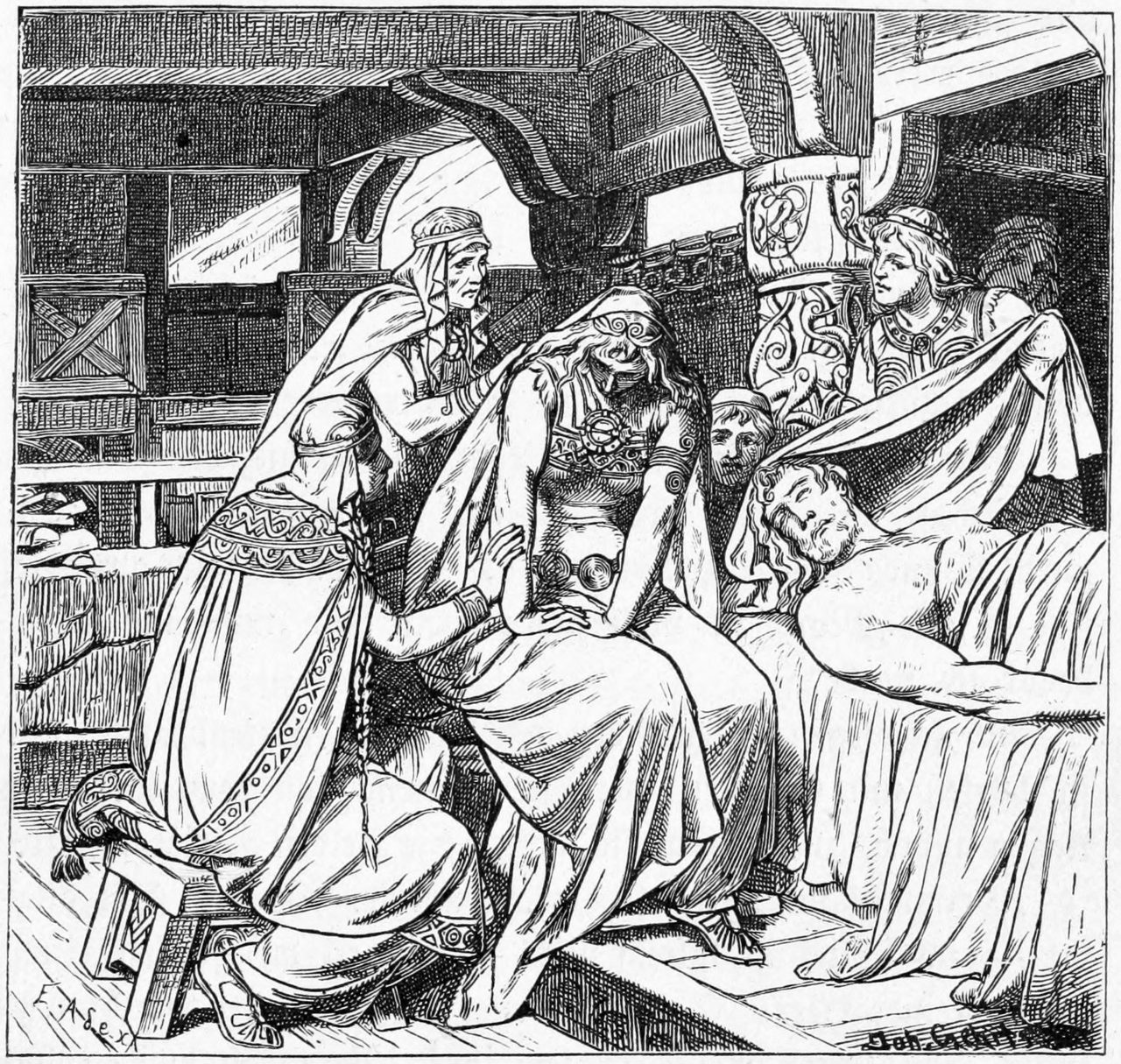
Guthrun sat by the dead Sigurth; she did not weep as other women, but her heart was near to bursting with grief. The men and women came to her to console her, but that was not easy to do. It is told of men that Guthrun had eaten of Fafnir's heart, and that she understood the speech of birds. This is a poem about Guthrun.
Note
Prose. The prose follows the concluding prose of the Brot without indication of a break, the heading standing immediately before stanza 1.
Fafnir's heart: this bit of information is here quite without point, and it is nowhere else stated that Guthrun understood the speech of birds. In the Volsungasaga it is stated that Sigurth gave Guthrun some of Fafnir's heart to eat, "and thereafter she was much grimmer than before, and wiser."
Cited on Guðrún
Then did Guthrunthink to die,When she by Sigurthsorrowing sat;Tears she had not,nor wrung her hands,Nor ever wailed,as other women.
Note
This stanza seems to be based on Guthrunarkvitha II, 11-12.
Cited on Guðrún
To her the warriorswise there came,Longing her heavywoe to lighten;Grieving could notGuthrun weep,So sad her heart,it seemed, would break.
Then the wivesof the warriors came,Gold-adorned,and Guthrun sought;Each one thenof her own grief spoke,The bitterest painshe had ever borne.
Then spake Gjaflaug,Gjuki's sister:"Most joyless of allon earth am I;Husbands fivewere from me taken,(Two daughters then,and sisters three,)Brothers eight,yet I have lived."
Note
Gjaflaug: nothing further is known of this aunt of Guthrun, or of the many relatives whom she has lost. Very likely she is an invention of the poet's, for it seems improbable that otherwise all further trace of her should have been lost. Line 4 has been marked by many editors as spurious.
Grieving could notGuthrun weep,Such grief she hadfor her husband dead,And so grim her heartby the hero's body.
Note
Some editors assume the loss of a line, after either line 1 or line 3. I prefer to believe that here and in stanza 10 the poet knew exactly what he was doing, and that both stanzas are correct.
Then Herborg spake,the queen of the Huns:"I have a greatergrief to tell;My seven sonsin the southern land,And my husband, fellin fight all eight.(Father and motherand brothers fourAmid the wavesthe wind once smote,And the seas crashed throughthe sides of the ship.)
Note
Herborg: neither she nor her sorrows are elsewhere mentioned, nor is it clear what a "queen of the Huns" is doing in Gunnar's home, but the word "Hun" has little definiteness of meaning in the poems, and is frequently applied to Sigurth himself (cf. note on stanza 24). Herborg appears from stanza 11 to have been the foster-mother of Gollrond, Guthrun's sister. Lines 5-7 may be interpolations, or may form a separate stanza.
"The bodies allwith my own hands thenI decked for the grave,and the dead I buried;A half-year brought methis to bear;And no one cameto comfort me.
Note
Lines 1 and 2 stand in reversed order in the manuscript; I have followed Gering's conjectural transposition.
"Then bound I was,and taken in war,A sorrow yetin the same half-year;They bade me deckand bind the shoesOf the wife of the monarchevery morn.
"In jealous rageher wrath she spake,And beat me oftwith heavy blows;Never a betterlord I knew,And never a womanworse I found."
Note
Herborg implies that the queen's jealousy was not altogether misplaced.
Grieving could notGuthrun weep,Such grief she hadfor her husband dead,And so grim her heartby the hero's body.
Note
Cf. stanza 5 and note. The manuscript abbreviates to first letters.
Then spake Gollrond,Gjuki's daughter:"Thy wisdom finds not,my foster-mother,The way to comfortthe wife so young."She bade them uncoverthe warrior's corpse.
Note
Gollrond: not elsewhere mentioned. Line 4 looks like an interpolation replacing a line previously lost.
The shroud she liftedfrom Sigurth, layingHis well-loved headon the knees of his wife:"Look on thy loved one,and lay thy lipsTo his as if yetthe hero lived."
Note
The manuscript indicates line 3 as the beginning of a stanza, and some editors have attempted to follow this arrangement.
Cited on Guðrún
Once alonedid Guthrun look;His hair all clottedwith blood beheld,The blinded eyesthat once shone bright,The hero's breastthat the blade had pierced.
Then Guthrun bent,on her pillow bowed,Her hair was loosened,her cheek was hot,And the tears like raindropsdownward ran.
Note
Many editors assume the loss of a line from this stanza.
Then Guthrun, daughterof Gjuki, wept,And through her tressesflowed the tears;And from the courtcame the cry of geese,The birds so fairof the hero's bride.
Note
The word here translated "tresses" is sheer guesswork. The detail of the geese is taken from Sigurtharkvitha en skamma, 29, line 3 here being identical with line 4 of that stanza.
Then Gollrond spake,the daughter of Gjuki;"Never a greaterlove I knewThan yours amongall men on earth;Nowhere wast happy,at home or abroad,Sister mine,with Sigurth away."
Note
Line 1, abbreviated in the manuscript, very likely should be simply "Gollrond spake."
Guthrun spake:"So was my Sigurtho'er Gjuki's sonsAs the spear-leek grownabove the grass,Or the jewel brightborne on the band,The precious stonethat princes wear.
Note
Cf. Guthrunarkvitha II, 2. The manuscript does not name the speaker, and some editions have a first line, "Then Guthrun spake, the daughter of Gjuki."
"To the leader of menI loftier seemedAnd higher than allof Herjan's maids;As little nowas the leaf I amOn the willow hanging;my hero is dead.
Note
Herjan: Othin; his maids are the Valkyries; cf. Voluspo, 31, where the same phrase is used.
"In his seat, in his bed,I see no moreMy heart's true friend;the fault is theirs,The sons of Gjuki,for all my grief,That so their sistersorely weeps.
"So shall your landits people loseAs ye have keptyour oaths of yore;Gunnar, no joythe gold shall give thee,(The rings shall soonthy slayers be,)Who swarest oathswith Sigurth once.
Note
Line 4 looks like an interpolation (cf. Fafnismol, 9, line 4), but some editors instead have queried line 5. How Guthrun's curse is fulfilled is told in the subsequent poems. That desire for Sigurth's treasure (the gold cursed by Andvari and Loki) was one of the motives for his murder is indicated in Sigurtharkvitha en skamma (stanza 16), and was clearly a part of the German tradition, as it appears in the Nibelungenlied.
"In the court was greatergladness thenThe day my SigurthGrani saddled,And went forth Brynhild'shand to win,That woman ill,in an evil hour."
Note
Cf. Gripisspo, 35 and note.
Then Brynhild spake,the daughter of Buthli:"May the witch now husbandand children wantWho, Guthrun, loosedthy tears at last,And with magic todayhath made thee speak."
Note
Line 1 is abbreviated in the manuscript.
Then Gollrond, daughterof Gjuki, spake:"Speak not such words,thou hated woman;Bane of the noblethou e'er hast been,(Borne thou arton an evil wave,Sorrow hast broughtto seven kings,)And many a womanhast loveless made."
Note
Editors are agreed that this stanza shows interpolations, but differ as to the lines to reject. Line 4 (literally "every wave of ill-doing drives thee") is substantially a proverb, and line 5, with its apparently meaningless reference to "seven" kings, may easily have come from some other source.
Then Brynhild, daughterof Buthli, spake:"Atli is guiltyof all the sorrow,(Son of Buthliand brother of mine,)When we saw in the hallof the Hunnish raceThe flame of the snake's bedflash round the hero;(For the journey sincefull sore have I paid,And ever I seekthe sight to forget.)"
Note
The stanza is obviously in bad shape; perhaps it represents two separate stanzas, or perhaps three of the lines are later additions. Atli: Brynhild here blames her brother, following the frequent custom of transferring the responsibility for a murder (cf. Helgakvitha Hundingsbana II, 33), because he compelled her to marry Gunnar against her will, an idea which the poet seems to have gained from Sigurtharkvitha en skamma, 32-39. These stanzas represent an entirely different version of the story, wherein Atli, attacked by Gunnar and Sigurth, buys them off by giving Gunnar his sister, Brynhild, as wife. He seems to have induced the latter to marry Gunnar by falsely telling her that Gunnar was Sigurth (a rationalistic explanation of the interchange of forms described in the Volsungasaga and Gripisspo, 37-39). In the present stanza Atli is made to do this out of desire for Sigurth's treasure. Hunnish race: this may be merely an error (neither Gunnar nor Sigurth could properly have been connected in any way with Atli and his Huns), based on Sigurtharkvitha en skamma, wherein Sigurth appears more than once as the "Hunnish king." The North was very much in the dark as to the differences between Germans, Burgundians, Franks, Goths, and Huns, and used the words without much discrimination. On the other hand, it may refer to Sigurth's appearance when, adorned with gold, he came with Gunnar to besiege Atli, in the alternative version of the story just cited (cf. Sigurtharkvitha en skamma, 36). Flame of the snake's bed: gold, so called because serpents and dragons were the traditional guardians of treasure, on which they lay.
By the pillars she stood,and gathered her strength,From the eyes of Brynhild,Buthli's daughter,Fire there burned,and venom she breathed,When the wounds she sawon Sigurth then.
Guthrun went thence away to a forest in the waste, and journeyed all the way to Denmark, and was there seven half-years with Thora, daughter of Hokon. Brynhild would not live after Sigurth. She had eight of her thralls slain and five serving-women. Then she killed herself with a sword, as is told in the Short Lay of Sigurth.
Note
Prose.
The manuscript has "Gunnar" in place of "Guthrun," but this is an obvious mistake; the entire prose passage is based on Guthrunarkvitha II, 14. The Volsungasaga likewise merely paraphrases Guthrunarkvitha II, and nothing further is known of Thora or her father, Hokon, though many inconclusive attempts have been made to identify the latter.
Brynhild: the story of her death is told in great detail in the latter part of Sigurtharkvitha en skamma.