smith
Völundr
The master smith, 'lord of elves', whom King Níðuðr hamstrings and imprisons; he kills the king's sons, rapes his daughter and escapes through the air.
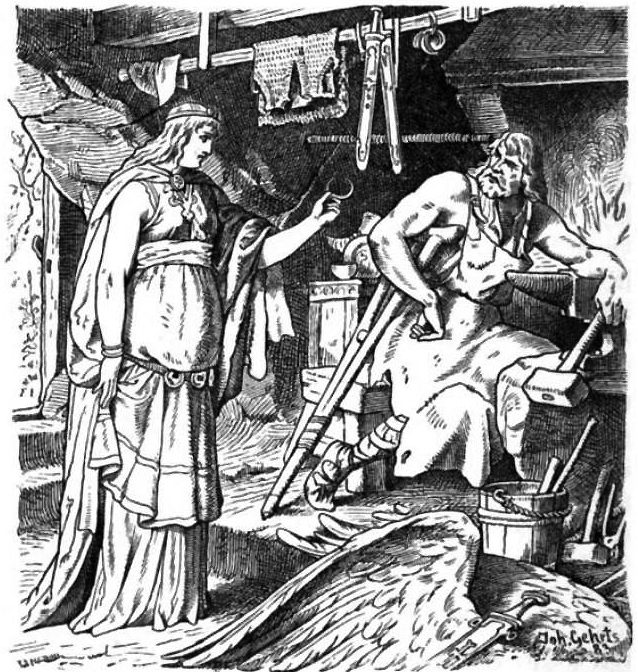
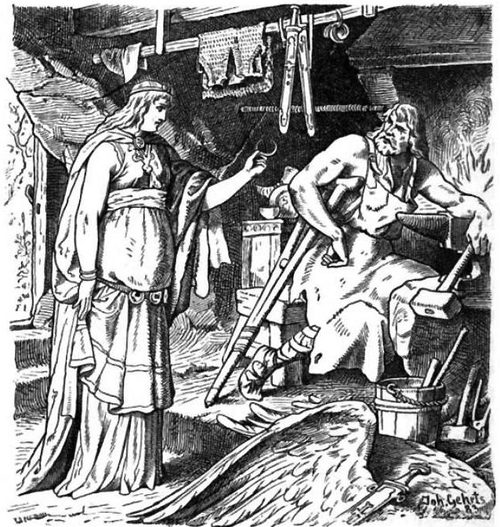
Völundr is the smith of Völundarkviða, one of the most violent poems in the Poetic Edda and, in the view of many scholars, one of the oldest. The prose introduction makes him one of three sons of a king of the Finns. With his brothers Egill and Slagfiðr he hunted on skis in Úlfdalir, and the three married swan-maidens they found spinning by a lake. After seven winters the women flew away. The brothers went to look for them, but Völundr stayed and forged rings, waiting for his wife to return Völundarkviða, prose 1 Völundarkviða 5-8.
Captivity
King Níðuðr of the Njárar sent men by night. They took one ring from the seven hundred hanging on a bast rope. Völundr came home, counted, missed it and fell asleep hoping his wife had come back. He woke in fetters Völundarkviða 9-14. The king gave the ring to his daughter Böðvildr and wore Völundr's sword himself. On the queen's advice they cut the sinews of his knees and set him on the island of Sævarstaðr to work for the king Völundarkviða, prose 2 Völundarkviða 18 Völundarkviða, prose 3. The poem never explains why the king calls the gold "ours", and Völundr's answer, that it was not taken from "Grani's way" near the Rhine, is an aside to the Sigurðr story Völundarkviða 16.
Revenge
The king's two young sons came to see his treasure chest. He told them to come back secretly, cut off their heads, hid their bodies under the bellows and made silver cups of their skulls, gems of their eyes and a brooch of their teeth, which he sent to the king, the queen and Böðvildr Völundarkviða 20-26. When Böðvildr brought him the broken ring to mend, he gave her beer until she slept and raped her Völundarkviða 27-29. Then he "rose aloft", laughing. From the air he made Níðuðr swear not to harm his wife and child, told him everything and left him in despair Völundarkviða 31 Völundarkviða 35-40. Böðvildr's last words admit what happened: "Nought was my might with such a man" Völundarkviða 43.
The prose never calls him anything but a man; the poem twice calls him the "greatest of elves" and once "master of elves" Völundarkviða 13 Völundarkviða 15. That mismatch is often taken as a sign that the poem is older than its prose frame. See also the myth page Völundr.
In the sources
Quoted from the hosted translations; each line is checked against the text when the site is built. Select a reference to read it in context.
How gottest thou, Völund, greatest of elves, These treasures of ours in Ulfdalir?
the sinews in his knee-joints were cut, and he was set in an island which was near the mainland, and was called Sævarstath.
Their skulls, once hid by their hair, he took, Set them in silver and sent them to Nithuth
Laughing Völund rose aloft, But left in sadness Nithuth sat.
Where the sources disagree or fall silent
- How he flew: a gap in the manuscript falls exactly there. Later German and Norwegian tradition (Þiðreks saga) gives him a garment of feathers, but the Edda poem does not say.
- Whether he is an elf or a man: the prose calls him the son of a king of the Finns, the poem calls him 'lord' and 'greatest' of elves.
In modern culture
Not from the medieval sources.
Wayland the Smith was known across the Germanic world. The Old English poem Deor recalls his suffering and Beadohild's (Böðvildr's) grief, and the 8th-century Northumbrian whalebone Franks Casket shows him at his forge with the king's daughter. A Neolithic long barrow in Oxfordshire has been called Wayland's Smithy since at least Anglo-Saxon times, and English folklore says a horse left there overnight with a coin will be found shod in the morning.