concept
The Norns
nornir
The female powers who fix the lives and deaths of gods and men: three named Norns by the well under Yggdrasil, and many lesser norns who come to every birth.
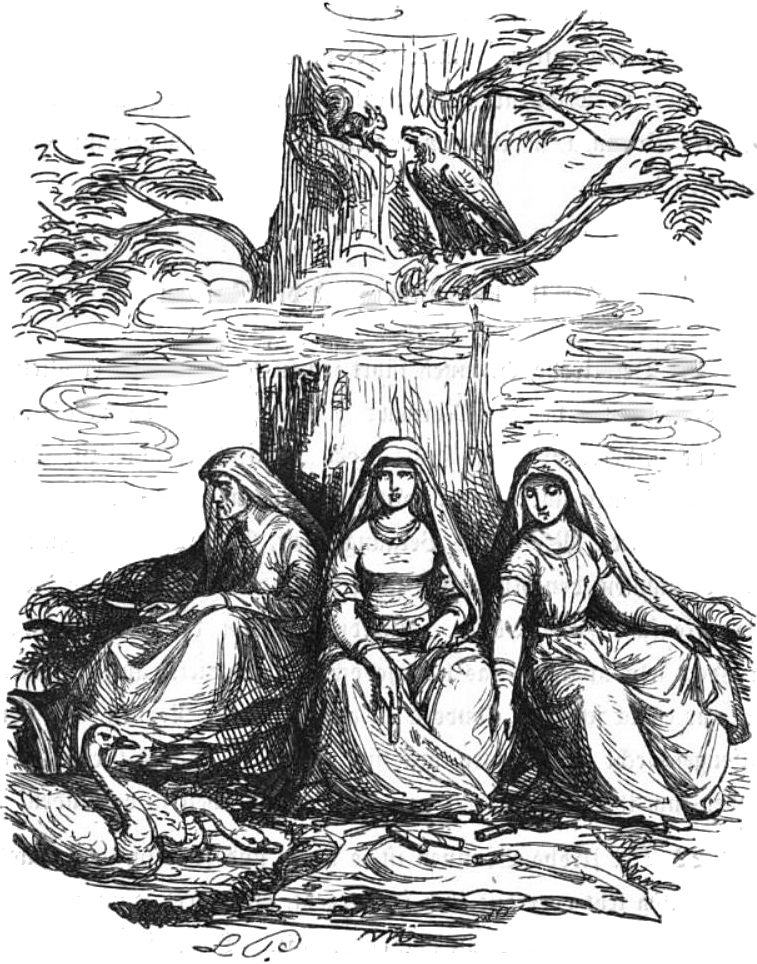
The Norns are the powers who decide how long a life will be and how it will go. The Eddas talk about them in two ways. Völuspá and Snorri name three great Norns who live by a well under the world-tree. Many other poems speak of norns in the plural, as many and unnamed, standing over a birth, a battle or an unlucky man. Snorri joins the two pictures, and the join still shows.
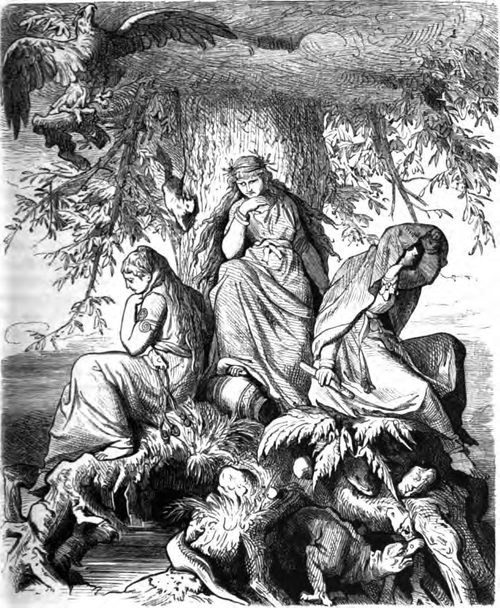
The three at the well
The seeress of Völuspá describes the ash Yggdrasil, green over "Urth's well" Völuspá 19, and then the beings who live there:
Thence come the maidens mighty in wisdom,Three from the dwelling down 'neath the tree;Urth is one named, Verthandi the next,—On the wood they scored,— and Skuld the third.Laws they made there, and life allottedTo the sons of men, and set their fates.Völuspá 20
The names are Urðr, Verðandi and Skuld. What the stanza shows them doing matters. They do not spin or weave. They carve marks on wood ("on the wood they scored"), lay down laws and allot lives. Snorri repeats the scene in Gylfaginning: three maids come out of a hall under the ash by the well, and "these maids determine the period of men's lives" Gylfaginning 15. He adds a job the poem leaves out. Every day the Norns take water and white clay from Urðr's well and pour it over the tree so that its limbs do not wither or rot Gylfaginning 16.
Many norns, good and bad
Outside Völuspá, norns are many. In Fáfnismál, Sigurth asks the dying Fafnir who the Norns are "who are helpful in need, And the babe from the mother bring" Fáfnismál 12. Fafnir answers that they are "of many births": some are kin to gods, some to elves, and some are "Dvalin's daughters" Fáfnismál 13. Snorri quotes a version of this stanza and draws a moral from it. There are good norns and evil norns, and that is why some people have long, happy lives and others do not Gylfaginning 15.
The heroic poems mostly mention the norns when things go wrong. The dwarf Andvari says "an evil Norn in olden days" doomed him to live in the water Reginsmál 2. Brynhild says "Ill Norns set for me long desire" Sigurðarkviða hin skamma 7. Guthrun tries to drown herself to escape them and fails Guðrúnarhvöt 13. Hamther, dying, sums up the whole outlook: "None outlives the night when the Norns have spoken" Hamðismál 30. Sigrdrífumál even lists "the nails of Norns" among the places runes were carved Sigrdrífumál 17. The norns of these poems are less goddesses than a name for fate itself, and the fate is usually hard.
Do the Norns weave?
People often say the Norns weave fate. The Eddas give this image only once, and even there it is partly the translator's. In Helgakviða Hundingsbana I, norns come at night to the house where Helgi has just been born. They "shaped the life of the lofty one" Helgakviða Hundingsbana I 2, and then:
Mightily wove they the web of fate,While Bralund's towns were trembling all;And there the golden threads they wove,And in the moon's hall fast they made them.Helgakviða Hundingsbana I 3
They hide the ends of the threads east and west, and one of them casts a chain northward and bids it hold forever Helgakviða Hundingsbana I 4. Bellows says "wove". The Old Norse verb in the first line means to twist, as when strands are twisted into cord. What the norns handle here are fate-strands that they twist and fasten, not cloth on a loom. Völuspá, as we saw, has them carving on wood.
The famous scene of women weaving on a loom of human heads and entrails, singing as they weave a battle, is not in the Eddas at all. It is the poem Darraðarljóð, preserved in Njáls saga, where the weavers are valkyries, not Norns, and the battle is Clontarf in Ireland in 1014. The nearest the Eddas come to it is the valkyries of Völundarkviða, who sit by a lake spinning flax Völundarkviða 1. The popular image of the Norns at a loom owes more to that saga poem, and to Greek and Roman spinners of fate, than to the Eddas, which speak of carving, allotting and twisting.
Norns and other women of fate
The lines between Norns, Valkyries and dísir are not sharp. Skuld is both a Norn and a valkyrie: she rides with the valkyries in Völuspá Völuspá 31, and Snorri calls her "the youngest Norn" in his list of valkyries Gylfaginning 36. Scholars generally see the three groups as overlapping kinds of female fate-spirit, attached to birth, battle and the family's luck, rather than as neatly separate classes. The sources never set them side by side and explain the difference.
Even the gods are subject to fate. Snorri places the Norns' hall at the well where the gods hold court every day Gylfaginning 15. The poems never show a god overruling the Norns.
In the sources
Quoted from the hosted translations; each line is checked against the text when the site is built. Select a reference to read it in context.
Urth is one named, Verthandi the next,— On the wood they scored,— and Skuld the third. Laws they made there, and life allotted To the sons of men, and set their fates.
Mightily wove they the web of fate, While Bralund's towns were trembling all;
Of many births the Norns must be, Nor one in race they were; Some to gods, others to elves are kin, And Dvalin's daughters some.
Good norns and of honorable race appoint good life; but those men that suffer evil fortunes are governed by evil norns.
these Norns who dwell by the Well of Urdr take water of the well every day, and with it that clay which lies about the well, and sprinkle it over the Ash
None outlives the night when the Norns have spoken.
Where the sources disagree or fall silent
- Whether the three Norns of Völuspá and the many birth-norns of Fáfnismál were ever one idea, or two traditions that Snorri joined.
- Whether the three 'giant-maids' who end the gods' golden age in Völuspá 8 are the Norns; some readers think so, the text does not say.
- Whether the maidens of giant kin who 'protect the dwellers on earth' in Vafþrúðnismál 49 are norns or some other guardian spirits.
In modern culture
Not from the medieval sources.
Richard Wagner opens Götterdämmerung (1876) with three Norns spinning the rope of fate until it snaps; much of the modern picture of the Norns as spinners comes from there and from Greek and Roman parallels. The English word 'weird' (originally 'fate') comes from Old English wyrd, a cognate of Urðr, which is how Shakespeare's 'weird sisters' in Macbeth came to be called that. The Norns appear in many fantasy novels and games, usually as three hooded spinners.