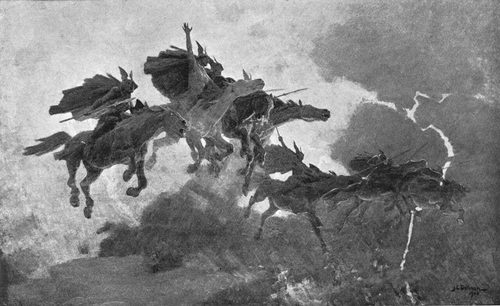
valkyrie
Brynhildr
Valkyrie, daughter of Buðli and sister of Atli, won for Gunnarr by Sigurðr's deception; she demands Sigurðr's death, then kills herself to follow him.
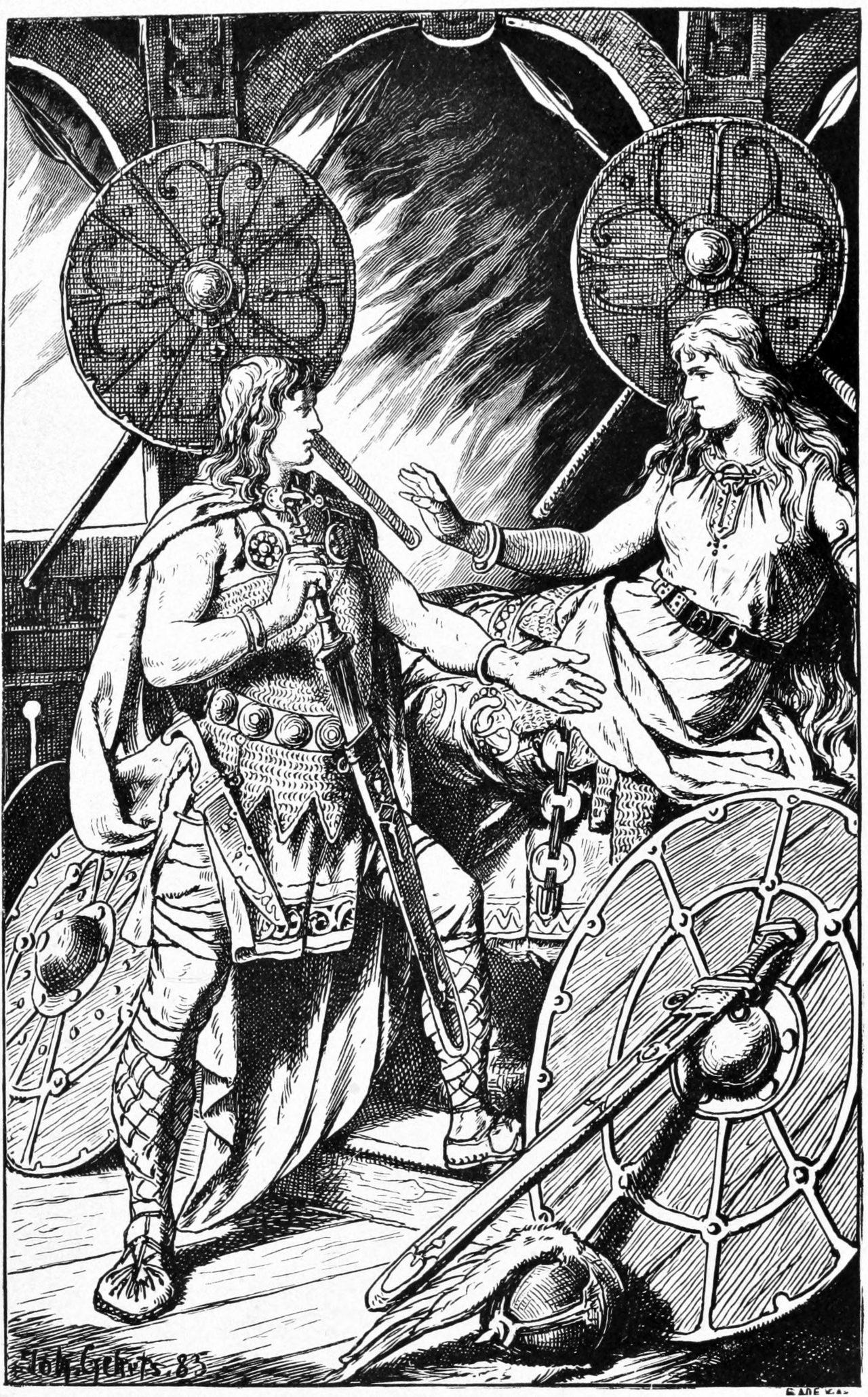
Brynhildr is the most argued-over woman in the heroic poems. She is a valkyrie and a king's daughter, sister of Atli, tricked into marrying Gunnarr when Sigurðr rode through her fire in Gunnarr's shape. When she learns the truth she demands Sigurðr's death, laughs once when it is done, and then kills herself so that she can lie beside him. The poems agree on that outline and disagree on almost everything else, including who she was before Sigurðr found her.
One woman or two?
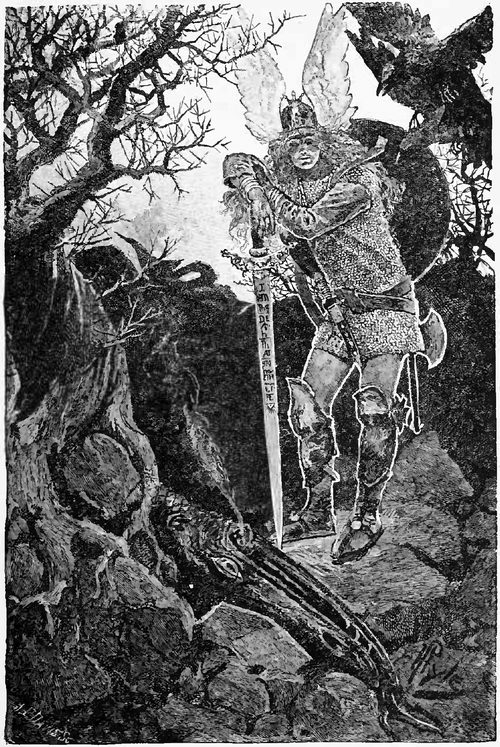
On the mountain Hindarfjall Sigurðr wakes a valkyrie who had been put to sleep by Odin for killing Hjalmgunnarr, the king Odin wanted to win. In the prose of Sigrdrífumál she is called Sigrdrífa Sigrdrífumál, prose 3. Yet in Bellows's text a later stanza of the same poem gives her lines under the heading "Brynhild spake" Sigrdrífumál 20.
The other sources divide:
- Helreið Brynhildar puts the valkyrie's whole story in Brynhildr's mouth: the swan-robes, Hjalmgunnarr's death, Odin's anger, the shield-wall at Skatalund and the fire that only a fearless man could cross Helreið Brynhildar 7-10.
- Snorri says plainly that the sleeper gave her name as Hildr and "is called Brynhildr" Skáldskaparmál 41.
- Grípisspá treats them as two women. Grípir first foretells the sleeping maid who will teach Sigurðr runes Grípisspá 15-17, then, separately, "Brynhild" at Heimir's home, Buðli's daughter, whom Sigurðr will love and lose Grípisspá 27.
- In the Short Lay of Sigurd Brynhildr says she lived carefree in her brother's home and never sought a husband until the Gjúkungs came riding Sigurðarkviða hin skamma 34-35. Nothing in that account makes her a valkyrie.
Scholars commonly think two figures, a valkyrie and a princess, were merged during the story's long life. The surviving texts show that merging at different stages.
The deception
All the versions agree that Gunnarr could not win her himself. Snorri explains that she had vowed to marry only the man who rode through the fire around her hall. Gunnarr's horse would not leap it, so Sigurðr and Gunnarr exchanged shapes and Sigurðr rode through on Grani Skáldskaparmál 41. Grípisspá foretells the same exchange of shapes Grípisspá 39. A sword lay between them in the bed Sigurðarkviða hin skamma 4, for three nights in Grípisspá Grípisspá 42 and for eight in Helreið Brynhildar, where Brynhildr says they slept "as he my brother born had been" Helreið Brynhildar 12.
The sources differ on why she agreed to the match. In the Short Lay she says her brother Atli threatened to keep her inheritance from her, and that she wanted the rings Sigurðr had won Sigurðarkviða hin skamma 37 Sigurðarkviða hin skamma 39. In Oddrúnargrátr her city is broken by force of arms Oddrúnargrátr 17. The truth comes out in a quarrel with Guðrún: in Snorri it happens in a river, where the queens argue over who should wash her hair upstream and Guðrún shows the ring Andvaranaut Skáldskaparmál 41. In Helreið Guðrún simply reproaches her for having slept in Sigurðr's arms Helreið Brynhildar 13.
Revenge and death
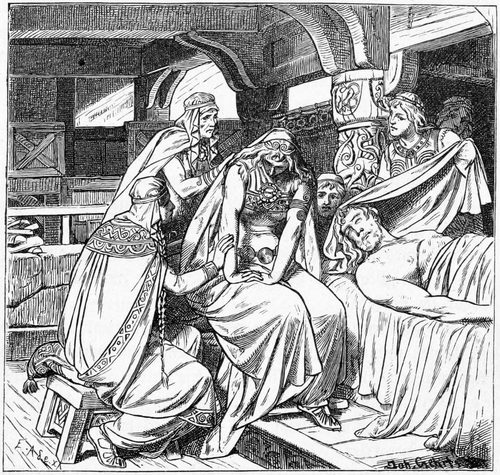
She tells Gunnarr that she will go home unless Sigurðr dies, and she wants his young son killed too Sigurðarkviða hin skamma 10-12. In the Fragment Högni says she is driven by jealousy of Guðrún's honour Brot af Sigurðarkviðu 3. When the killing is done she laughs, once Sigurðarkviða hin skamma 30. In the Fragment she also laughs once Brot af Sigurðarkviðu 10, but wakes before dawn in tears and tells Gunnarr that Sigurðr had kept his oaths and laid the sword between them Brot af Sigurðarkviðu 14 Brot af Sigurðarkviðu 19-20. In Guðrúnarkviða I she blames her brother Atli for all of it Guðrúnarkviða I 24.
In the Short Lay she gives away her gold, puts on her mail, stabs herself and, dying, foretells the rest of the cycle: Guðrún's marriage to Atli, Gunnarr's death in the snake-pit, the fates of Svanhildr and Oddrún Sigurðarkviða hin skamma 47 Sigurðarkviða hin skamma 55-63. She asks to be burned on one pyre beside Sigurðr, with the sword between them once more Sigurðarkviða hin skamma 64 Sigurðarkviða hin skamma 67. The prose that opens Helreið Brynhildar says instead that two pyres were built and Sigurðr's burned first Helreið Brynhildar, prose 1. Snorri says she "was burned with Sigurdr" Skáldskaparmál 41.
Riding to Hel
Helreið Brynhildar follows her after death. Riding her wagon on the road to Hel, she is stopped by a giantess who calls her the ruin of Gjúki's house. Brynhildr answers with her own life story and ends in defiance Helreið Brynhildar 14:
Ever with grief and all too longAre men and women born in the world;But yet we shall live our lives together,Sigurth and I. Sink down, Giantess!Helreið Brynhildar 14
Snorri adds that a daughter, Áslaug, lived after Sigurðr and was raised by Heimir in Hlymdalir Skáldskaparmál 41, the place Brynhildr names as her own early home Helreið Brynhildar 6. He does not say who Áslaug's mother was. The later Völsunga saga makes her the daughter of Sigurðr and Brynhildr.
In the sources
Quoted from the hosted translations; each line is checked against the text when the site is built. Select a reference to read it in context.
I shall Sigurth have, the hero young, E'en though within my arms he die.
Then Brynhild, daughter of Buthli, laughed, Only once, with all her heart
One alone of all I loved, Nor changing heart I ever had
Next I let the leader of Goths, Hjalmgunnar the old, go down to hell
Her name was Sigrdrifa, and she was a Valkyrie.
she awoke then, and gave her name as Hildr: she is called Brynhildr, and was a Valkyr.
But yet we shall live our lives together, Sigurth and I. Sink down, Giantess!
Where the sources disagree or fall silent
- Whether Brynhildr and the valkyrie Sigrdrífa are the same woman: the sources answer both ways (see the section below).
- How long Sigurðr lay beside her in Gunnarr's shape: three nights in Grípisspá, eight in Helreið Brynhildar.
- Whether she was burned on Sigurðr's pyre or on a separate one.
- Some historians have linked her name to the Merovingian queen Brunhild (died 613); the connection is debated and not proven.
In modern culture
Not from the medieval sources.
Brynhildr is the source of Brünnhilde in Wagner's Der Ring des Nibelungen, the valkyrie in a winged helmet who has become the stock image of opera; Wagner merged her with the sleeping valkyrie, as Snorri had done. The Brünhild of the German Nibelungenlied is a different figure: a warrior queen of Iceland who must be beaten in contests of strength, with no valkyrie past.