
Poetic Edda · heroic poems
Helgakviða Hundingsbana II
The Second Lay of Helgi Hundingsbane
Bellows's introduction
As the general nature of the Helgi tradition has been considered in the introductory note to Helgakvitha Hjorvarthssonar, it is necessary here to discuss only the characteristics of this particular poem. The second Helgi Hundingsbane lay is in most respects the exact opposite of the first one: it is in no sense consecutive; it is not a narrative poem, and all or most of it gives evidence of relatively early composition, its origin probably going well back into the tenth century.
It is frankly nothing but a piece of, in the main, very clumsy patchwork, made up of eight distinct fragments, pieced together awkwardly by the annotator with copious prose notes. One of these fragments (stanzas 13-16) is specifically identified as coming from "the old Volsung lay." What was that poem, and how much more of the extant Helgi-lay compilation was taken from it, and did the annotator know more of it than he included in his patchwork? Conclusive answers to these questions have baffled scholarship, and probably always will do so. My own guess is that the annotator knew little or nothing more than he wrote down; having got the first Helgi Hundingsbane lay, which was obviously in fairly good shape, out of the way, he proceeded to assemble all the odds and ends of verse about Helgi which he could get hold of, putting them together on the basis of the narrative told in the first Helgi lay and of such stories as his knowledge of prose sagas may have yielded.
Section I (stanzas 1-4) deals with an early adventure of Helgi's, in which he narrowly escapes capture when he ventures into Hunding's home in disguise. Section II (stanzas 5-12) is a dialogue between Helgi and Sigrun at their first meeting. Section III (stanzas 13-16, the "old Volsung lay" group) is another dialogue between Helgi and Sigrun when she invokes his aid to save her from Hothbrodd. Section IV (stanzas 17-21), which may well be from the same poem as Section III, is made up of speeches by Helgi and Sigrun after the battle in which Hothbrodd is killed; stanza 21, however, is certainly an interpolation from another poem, as it is in a different meter. Section V (stanzas 22-27) is the dispute between Sinfjotli and Gothmund, evidently in an older form than the one included in the first Helgi Hundingsbane lay. Section VI (stanzas 28-37) gives Dag's speech to his sister, Sigrun, telling of Helgi's death, her curse on her brother and her lament for her slain husband. Section VII (stanza 38) is the remnant of a dispute between Helgi and Hunding, here inserted absurdly out of place. Section VIII (stanzas 39-50) deals with the return of the dead Helgi and Sigrun's visit to him in the burial hill.
Sijmons maintains that sections I and II are fragments of the Kara lay mentioned by the annotator in his concluding prose note, and that sections IV, VI, and VIII are from a lost Helgi-Sigrun poem, while Section III comes, of course, from the "old Volsung lay." This seems as good a guess as any other, conclusive proof being quite out of the question.
Were it not for sections VI and VIII the poem would be little more than a battle-ground for scholars, but those two sections are in many ways as fine as anything in Old Norse poetry. Sigrun's curse of her brother for the slaying of Helgi and her lament for her dead husband, and the extraordinary vividness of the final scene in the burial hill, have a quality which fully offsets the baffling confusion of the rest of the poem.
King Sigmund, the son of Volsung, had as wife Borghild, from Bralund. They named their son Helgi, after Helgi Hjorvarthsson; Hagal was Helgi's foster-father. Hunding was the name of a powerful king, and Hundland is named from him. He was a mighty warrior, and had many sons with him on his campaigns. There was enmity and strife between these two, King Hunding and King Sigmund, and each slew the other's kinsmen. King Sigmund and his family were called Volsungs and Ylfings.
Note
Prose. In the manuscript the poem is headed "Of the Volsungs," but most editions give it the title used here.
Sigmund: cf. Helgakvitha Hundingsbana I, 6 and note, which also mentions Volsung.
Borghild and Bralund: cf. Helgakvitha Hundingsbana I, 1 and note.
Borghild and Bralund: cf. Helgakvitha Hundingsbana I, 1 and note.
Helgi: the annotator's explanation that the child was named after Helgi Hjorvarthsson is a naive way of getting around the difficulties created by the two sets of Helgi stories. He might equally well have said that the new Helgi was the old one born again, as he accounts for Sigrun in this way ("she was Svava reborn").
Hagal: not elsewhere mentioned; it was a common custom to have boys brought up by foster-parents.
Hunding and Hundland: cf. Helgakvitha Hundingsbana I, 10 and note.
Hunding and Hundland: cf. Helgakvitha Hundingsbana I, 10 and note.
Volsungs and Ylfings: regarding this confusion of family names cf. Helgakvitha Hundingsbana I, 5 and note.
Volsungs and Ylfings: regarding this confusion of family names cf. Helgakvitha Hundingsbana I, 5 and note.
Cited on Helgi Hjörvarðsson, Helgi Hundingsbane
Helgi went as a spy to the home of King Hunding in disguise. Hæming, a son of King Hunding's, was at home. When Helgi went forth, then he met a young herdsman, and said:
Note
Hæming: his name does not appear in the list of Hunding's sons. It is quite possible that these opening stanzas (1-4) do not refer to Hunding at all.
Cited on Helgi Hundingsbane
"Say to Hæmingthat Helgi knowsWhom the heroesin armor hid;A gray wolf had theywithin their hall,Whom King HundingHamal thought."
Note
Helgi appears to have stayed with Hunding under the name of Hamal, but now, thinking himself safe, he sends word of who he really is. Hunding: it has been suggested that the compiler may have inserted this name to fit what he thought the story ought to be, in place of Hæming, or even Hadding. If stanzas 1-4 are a fragment of the Karuljoth (Lay of Kara), this latter suggestion is quite reasonable, for in that poem, which we do not possess, but which supplied material for the compilers of the Hromundar saga Greipssonar, Helgi appears as Helgi Haddingjaskati (cf. final prose note). Nothing beyond this one name connects stanzas 1-4 with Hunding.
Hamal was the name of Hagal's son. King Hunding sent men to Hagal to seek Helgi, and Helgi could not save himself in any other way, so he put on the clothes of a bond-woman and set to work at the mill. They sought Helgi but found him not.
Note
Prose.
Hagal: Helgi's foster-father, who naturally protects him.
Then Blind spake out,the evil-minded:"Of Hagal's bond-womanbright are the eyes;Yon comes not of churlswho stands at the quern;The millstones break,the boards are shattered.
Note
The manuscript indicates line 2 as the beginning of the stanza, the copyist evidently regarding line 1 as prose. This has caused various rearrangements in the different editions. Blind: leader of the band sent to capture Helgi.
Cited on Helgi Hundingsbane
"The hero hasa doom full hard,That barley nowhe needs must grind;Better befitshis hand to feelThe hilt of the swordthan the millstone's handle."
Note
The manuscript marks line 3 as the beginning of a stanza. Barley: the word literally means "foreign grain," and would afford an interesting study to students of early commerce.
Hagal answered and said:
"Small is the wonderif boards are splintered;By a monarch's daughterthe mill is turned;Once through cloudsshe was wont to ride,And battles foughtlike fighting men,(Till Helgi a captiveheld her fast;Sister she isof Sigar and Hogni,Thus bright are the eyesof the Ylfings' maid.)"
Note
Possibly two stanzas with one line lost, or perhaps the lines in parenthesis are spurious; each editor has his own guess. Sigar and Hogni: it seems unlikely that Hagal refers to the Hogni who was Sigrun's father, for this part of the story has nothing whatever to do with Sigrun. As Hagal is, of course, deliberately lying, it is useless to test any part of his speech for accuracy.
Helgi escaped and went to a fighting ship. He slew King Hunding, and thenceforth was called Helgi Hundingsbane.
Note
Prose. No division indicated in the manuscript.
Cited on Helgi Hundingsbane
He lay with his host in Brunavagar, and they had there a strand-slaughtering, and ate the flesh raw. Hogni was the name of a king. His daughter was Sigrun; she was a Valkyrie and rode air and water; she was Svava reborn. Sigrun rode to Helgi's ship and said:
Note
Brunavagar ("Bruni's Sea"): mentioned only in this section.
Strand-slaughtering: a killing on the shore of cattle stolen in a raid.
Hogni and Sigrun: cf. Helgakvitha Hundingsbana I, 17 and note; the annotator's notion of Sigrun as the reincarnated Svava (cf. Helgakvitha Hjorvarthssonar, concluding prose note) represents a naive form of scholarship. There is nothing in stanzas 5-12 which clearly identifies Sigrun as a Valkyrie, or which, except for the last line of stanzas 12, identifies the speaker as Sigrun. Some editors, therefore, call here simply "the Valkyrie," while Vigfusson, who thinks this section is also a remnant of the Karuljoth, calls her Kara.
Hogni and Sigrun: cf. Helgakvitha Hundingsbana I, 17 and note; the annotator's notion of Sigrun as the reincarnated Svava (cf. Helgakvitha Hjorvarthssonar, concluding prose note) represents a naive form of scholarship. There is nothing in stanzas 5-12 which clearly identifies Sigrun as a Valkyrie, or which, except for the last line of stanzas 12, identifies the speaker as Sigrun. Some editors, therefore, call here simply "the Valkyrie," while Vigfusson, who thinks this section is also a remnant of the Karuljoth, calls her Kara.
Cited on Helgi Hjörvarðsson, Helgi Hundingsbane, Sigrún, Valkyries
"Who rules the shipby the shore so steep?Where is the homeye warriors have?Why do ye bidein Brunavagar,Or what the waythat ye wish to try?"
Helgi spake:"Hamal's the shipby the shore so steep,Our home in Hleseydo we have;For fair wind bide wein Brunavagar,Eastward the waythat we wish to try."
Note
The manuscript does not indicate the speakers. Hamal: Helgi's assumption of this name seems to link this section (stanzas 5-12) with stanza 1. Hlesey ("Island of Hler"—i.e., Ægir, the sea-god): generally identified as the Danish island of Läsö; cf. Harbarthsljoth, 37 and note.
Sigrun spake:"Where hast thou, warrior,battle wakened,Or gorged the birdsof the sisters of Guth?Why is thy byrniespattered with blood,Why helmed dost feaston food uncooked?"
Note
Guth: a Valkyrie (cf. Voluspo, 31); the birds of her sisters are the kites and ravens.
Helgi spake:"Latest of all,the Ylfings' sonOn the western sea,if know thou wilt,Captured bearsin Bragalund,And fed the eagleswith edge of sword.Now is it shownwhy our shirts are bloody,And little our foodwith fire is cooked."
Note
The manuscript indicates line 5 as the beginning of a new stanza; some editors reject lines 1-2, while others make lines 5-6 into a fragmentary stanza. Ylfings: cf. introductory prose and note. Bragalund ("Bragi's Wood"): a mythical place. Bears: presumably Berserkers, regarding whom cf. Hyndluljoth, 23.
Sigrun spake:"Of battle thou tellest,and there was bentHunding the kingbefore Helgi down;There was carnage when thoudidst avenge thy kin,And blood flowed faston the blade of the sword."
Helgi spake:"How didst thou knowthat now our kin,Maiden wise,we have well avenged?Many there areof the sons of the mightyWho share alikeour lofty race."
Note
Helgi's meaning in lines 3-4 is that, although he has already declared himself an Ylfing (stanza 8, line 1), there are many heroes of that race, and he does not understand how Sigrun knows him to be Helgi.
Sigrun spake:"Not far was Ifrom the lord of the folk,Yester morn,when the monarch was slain;Though crafty the sonof Sigmund, methinks,When he speaks of the fightin slaughter-runes.
Note
Slaughter-runes: equivocal or deceptive speech regarding the battle. The word "rune" had the meaning of "magic" or "mystery" long before it was applied to the signs or characters with which it was later identified.
"On the long-ship onceI saw thee well,When in the blood-stainedbow thou wast,(And round thee icywaves were raging;)Now would the herohide from me,But to Hogni's daughteris Helgi known."
Note
Some editors reject line 3, others line 5. The manuscript omits Helgi's name in line 5, thereby destroying both the sense and the meter. Vigfusson, following his Karuljoth theory (cf. note on prose following stanza 4), changes Hogni to Halfdan, father of Kara.
Granmar was the name of a mighty king, who dwelt at Svarin's hill. He had many sons; one was named Hothbrodd, another Gothmund, a third Starkath. Hothbrodd was in a kings' meeting, and he won the promise of having Sigrun, Hogni's daughter, for his wife. But when she heard this, she rode with the Valkyries over air and sea to seek Helgi. Helgi was then at Logafjoll, and had fought with Hunding's sons; there he killed Alf and Eyolf, Hjorvarth and Hervarth. He was all weary with battle, and sat under the eagle-stone. There Sigrun found him, and ran to throw her arms about his neck, and kissed him, and told him her tidings, as is set forth in the old Volsung lay:
Note
Prose. The manuscript indicates no division. Most of this prose passage is evidently based on Helgakvitha Hundingsbana I; the only new features are the introduction of Starkath as a third son of Granmar, which is clearly an error based on a misunderstanding of stanza 19, and the reference to the kings' meeting, based on stanza 15. Kings' meetings, or councils, were by no means unusual; the North in early days was prolific in kings. For the remaning names, cf. Helgakvitha Hundingsbana I: Granmar, stanza 19; Hothbrodd, stanza 19; Gothmund, stanza 33; Svarin's hill, stanza 32; Logafjoll, stanza 13; Alf, Eyjolf, Hjorvarth and Hervarth, stanza 14. The old Volsung lay: cf. Introductory Note.
Sigrun the joyfulchieftain sought,Forthwith Helgi'shand she took;She greeted the herohelmed and kissed him,The warrior's heartto the woman turned.
Note
Some editions combine lines 3-4, or line 4, with part of stanza 14.
From her heart the daughterof Hogni spake,Dear was Helgi,she said, to her;"Long with allmy heart I lovedSigmund's sonere ever I saw him.
Note
The lines of stanzas 14 and 15 are here rearranged in accordance with Bugge's emendation; in the manuscript they stand as follows: lines 3-4 of stanza 14; stanza 15; lines 1-2 of stanza 14. This confusion has given rise to various editorial conjectures.
Cited on Sigrún
"At the meeting to Hothbroddmated I was,But another heroI fain would have;Though, king, the wrathof my kin I fear,Since I broke my father'sfairest wish."
Helgi spake:"Fear not everHogni's anger,Nor yet thy kinsmen'scruel wrath;Maiden, thouwith me shalt live,Thy kindred, fair one,I shall not fear."
Helgi then assembled a great sea-host and went to Frekastein. On the sea he met a perilous storm; lightning flashed overhead and the bolts struck the ship. They saw in the air that nine Valkyries were riding, and recognized Sigrun among them. Then the storm abated, and they came safe and sound to land. Granmar's sons sat on a certain mountain as the ships sailed toward the land. Gothmund leaped on a horse and rode for news to a promontory near the harbor; the Volsungs were even then lowering their sails. Then Gothmund said, as is written before in the Helgi lay:
Note
Prose. The manuscript indicates no division. Here again, the annotator has drawn practically all his information from Helgakvitha Hundingsbana I, which he specifically mentions and even quotes. The only new features are the names of Hogni's sons, Bragi and Dag. Bragi is mentioned in stanza 18, though it is not there stated that he is Hogni's son. Dag, who figures largely in stanzas 28-34, is a puzzle, for the verse never names him, and it is an open question where the annotator got his name.
Frekastein: cf. Helgakvitha Hjorvarthssonar, 39 and note.
As is written: the two lines are quoted, with a change of two words, from Helgakvitha Hundingsbana I, 33.
"Who is the kingwho captains the fleet,And to the landthe warriors leads?"
Sinfjotli, Sigmund's son, answered him, and that too is written.
Note
Sinfjotli: cf. Helgakvitha Hundingsbana I, 6 and note, and stanzas 33-48, in which the whole dialogue is given.
Gothmund rode home with his tidings of the host; then Granmar's sons summoned an army. Many kings came there; there were Hogni, Sigrun's father, and his sons Bragi and Dag. There was a great battle, and all Granmar's sons were slain and all their allies; only Dag, Hogni's son, was spared, and he swore loyalty to the Volsungs. Sigrun went among the dead and found Hothbrodd at the coming of death. She said:
Note
Loyalty: apparently the annotator got this bit of information out of stanza 29, in which Sigrun refers to the oaths which her brother had sworn to Helgi.
Cited on Helgi Hundingsbane, Sigrún
"Never shall Sigrunfrom Sevafjoll,Hothbrodd king,be held in thine arms;Granmar's sonsfull cold have grown,And the giant-steeds grayon corpses gorge."
Note
Sevafjoll ("Wet Mountain"): mentioned only in this poem. Giant-steeds: wolves, the usual steeds of giantesses; cf. Helgakvitha Hundingsbana I, 56.
Cited on Sigrún
Then she sought out Helgi, and was full of joy. He said:
"Maid, not fairis all thy fortune,The Norns I blamethat this should be;This morn there fellat FrekasteinBragi and Hognibeneath my hand.
Note
Maid: the word thus rendered is the same doubtful one which appears in Völundarkvitha, 1 and 5, and which may mean specifically a Valkyrie (Gering translates it "helmed" or "heroic") or simply "wise." Cf. Völundarkvitha, note on introductory prose. Norns: cf. Voluspo, 20 and note. In stanza 33 Dag similarly lays the blame for the murder he has committed on Othin. Bragi: probably Sigrun's brother.
Cited on Helgi Hundingsbane
"At Hlebjorg fellthe sons of Hrollaug,Starkath the kingat Styrkleifar;Fighters more noblesaw I never,The body foughtwhen the head had fallen.
Note
This stanza looks like an interpolation, and there is little or nothing to connect it with the slaying of Granmar's sons. In the manuscript line 2, indicated as the beginning of a stanza, precedes line 1. Hlebjorg ("Sea-Mountain") and Styrkleifar ("Battle-Cliffs"): place names not elsewhere mentioned. Of Hrollaug's sons nothing further is known. Starkath: this name gives a hint of the origin of this stanza, for Saxo Grammaticus tells of the slaying of the Swedish hero Starkath ("The Strong") the son of Storverk, and describes how his severed head bit the ground in anger (cf. line 4). In all probability this stanza is from an entirely different poem, dealing with the Starkath story, and the annotator's attempt to identify the Swedish hero as a third son of Granmar is quite without foundation.
"On the ground full lowthe slain are lying,Most are thereof the men of thy race;Nought hast thou won,for thy fate it wasBrave men to bringto the battle-field."Then Sigrun wept.Helgi said:
"Grieve not, Sigrun,the battle is gained,The fighter can shun not his fate."Sigrun spake:"To life would I callthem who slaughtered lie,If safe on thy breast I might be."
Note
The difference of meter would of itself be enough to indicate that this stanza comes from an entirely different poem. A few editions assign the whole stanza to Helgi, but lines 3-4 are almost certainly Sigrun's, and the manuscript begins line 3 with a large capital letter following a period.
Cited on Sigrún
This Gothmund the son of Granmar spoke:
"What hero greatis guiding the ships?A golden flagon the stem he flies;I find not peacein the van of your faring,And round the fightersis battle-light red."
Note
With this stanza begins the dispute between Gothmund and Sinjotli which, together with Helgi's rebuke to his half-brother, appears at much greater length in Helgakvitha Hundingsbana I, 33-48. It is introduced here manifestly in the wrong place. The version here given is almost certainly the older of the two, but the resemblance is so striking, and in some cases (notably in Helgi's rebuke) the stanzas are so nearly identical, that it seems probable that the composer of the first Helgi Hundingsbane lay borrowed directly from the poem of which the present dialogue is a fragment. Flag: the banner ("gunnfani," cf. "gonfalon") here serves as the signal for war instead of the red shield mentioned in Helgakvitha Hundingsbana I, 34. Battle-light: perhaps the "northern lights."
Cited on Sinfjötli
Sinfjotli spake:"Here may HothbroddHelgi find,The hater of flight,in the midst of the fleet;The home of allthy race he has,And over the realmof the fishes he rules."
Note
Lines 3-4 are obscure, and in the manuscript show signs of error. Helgi had not at this time, so far as we know, conquered any of Hothbrodd's land. The realm of the fishes, in line 4, presumably means the sea, but the word here translated "fishes" is obscure, and many editors treat it as a proper name, "the realm of the Fjorsungs," but without further suggestion as to who or what the Fjorsungs are.
Gothmund spake:"First shall swordsat FrekasteinProve our worthin place of words;Time is it, Hothbrodd,vengeance to have,If in battle worstedonce we were."
Note
The word here translated swords is a conjectural emendation; the manuscript implies merely an invitation to continue the quarrel at Frekastein. Hothbrodd: apparently he is here considered as present during the dispute; some editors, in defiance of the meter, have emended the line to mean "Time is it for Hothbrodd vengeance to have."
Sinfjotli spake:"Better, Gothmund,to tend the goats,And climb the rocksof the mountain cliffs;A hazel switchto hold in thy handMore seemly werethan the hilt of a sword."
Helgi spake:"Better, Sinfjotli,thee 'twould beseemBattles to give,and eagles to gladden,Than vain and emptyspeech to utter,Though warriors oftwith words do strive.
Note
Cf. Helgakvitha Hundingsbana I, 47-48, which are nearly identical. Stanza 27 in the manuscript is abbreviated to the first letters of the words, except for line 5, which does not appear in the other poem, and which looks like an interpolation.
"Good I find notthe sons of Granmar,But for heroes 'tis seemlythe truth to speak;At Moinsheimarproved the menThat hearts for the wieldingof swords they had,(And ever bravethe warriors are.)"
Note
Cf. Helgakvitha Hundingsbana I, 47-48, which are nearly identical. Stanza 27 in the manuscript is abbreviated to the first letters of the words, except for line 5, which does not appear in the other poem, and which looks like an interpolation.
Helgi took Sigrun to wife, and they had sons. Helgi did not reach old age. Dag, the son of Hogni, offered sacrifice to Othin to be avenged for his father's death; Othin gave Dag his spear. Dag found Helgi, his brother-in-law, at a place which is called Fjoturlund. He thrust the spear through Helgi's body. Then Helgi fell, and Dag rode to Sevafjoll and told Sigrun the tidings:
Note
Prose. Here begins a new section of the poem, dealing with Helgi's death at the hands of Dag, Sigrun's brother. The note is based wholly on stanzas 28-34, except for the introduction of Dag's name (cf. note on prose following stanza 16), and the reference to Othin's spear, the weapon which made victory certain, and which the annotator brought in doubtless on the strength of Dag's statement that Othin was responsible for Helgi's death (stanza 33). Fjoturlund ("Fetter-Wood"): mentioned only here and in stanza 28.
Cited on Gungnir, Helgi Hundingsbane
"Sad am I, sister,sorrow to tell thee,Woe to my kinunwilling I worked;In the morn there fellat FjoturlundThe noblest princethe world has known,(And his heel he seton the heroes' necks.)"
Note
Line 5 looks like an interpolation.
Sigrun spake:"Now may everyoath thee biteThat with Helgisworn thou hast,By the waterbright of Leipt,And the ice-coldstone of Uth.
Note
Leipt: this river is mentioned in Grimnismol, 28. Uth: a daughter of the sea-god Ægir; regarding her sacred stone we know nothing. According to the annotator, Dag's life had been spared because he swore loyalty to Helgi.
Cited on Helgi Hundingsbane, Sigrún
"The ship shall sail notin which thou sailest,Though a favoring windshall follow after;The horse shall run notwhereon thou ridest,Though fain thou artthy foe to flee.
............................"The sword shall bite notwhich thou bearest,Till thy head itselfit sings about.
Note
No gap indicated in the manuscript, but most editors have assumed that either the first or the last two lines have been lost. Bugge adds a line: "The shield shall not help thee which thou holdest."
"Vengeance were minefor Helgi's murder,Wert thou a wolfin the woods without,Possessing noughtand knowing no joy,Having no foodsave corpses to feed on."
Dag spake:"Mad art thou, sister,and wild of mind,Such a curseon thy brother to cast;Othin is rulerof every ill,Who sunders kinwith runes of spite.
"Thy brother ringsso red will give thee,All Vandilsveand Vigdalir;Take half my landto pay the harm.Ring-decked maid,and as meed for thy sons."
Note
Vandilsve ("Vandil's Shrine"): who Vandil was we do not know; this and Vigdalir ("Battle-Dale") are purely mythical places.
Sigrun spake:"I shall sit not happyat Sevafjoll,Early or late,my life to love,If the light cannot show,in the leader's band,Vigblær bearing himback to his home,(The golden-bitted;I shall greet him never.)
Note
Line 5 may be spurious. Vigblær ("Battle-Breather"): Helgi's horse.
"Such the fearthat Helgi's foesEver felt,and all their kin,As makes the goatswith terror madRun from the wolfamong the rocks.
"Helgi roseabove heroes allLike the lofty ashabove lowly thorns,Or the noble stag,with dew besprinkled,Bearing his headabove all beasts,(And his horns gleam brightto heaven itself.)"
Note
Line 5 (or possibly line 4) may be spurious. Cf. Guthrunarkvitha I, 17, and Guthrunarkvitha II, 2.
A hill was made in Helgi's memory. And when he came to Valhall, then Othin bade him rule over everything with himself.
Note
Prose.
Valhall, etc.: there is no indication as to where the annotator got this notion of Helgi's sharing Othin's rule. It is most unlikely that such an idea ever found place in any of the Helgi poems, or at least in the earlier ones; probably it was a late development of the tradition in a period when Othin was no longer taken seriously.
Cited on Einherjar, Helgi Hundingsbane, Valhalla
Helgi said:
"Thou shalt, Hunding,of every heroWash the feet,and kindle the fire,Tie up dogs,and tend the horses,And feed the swineere to sleep thou goest."
Note
This stanza apparently comes from an otherwise lost passage containing a contest of words between Helgi and Hunding; indeed the name of Hunding may have been substituted for another one beginning with "H," and the stanza originally have had no connection with Helgi at all. The annotator inserts it here through an obvious misunderstanding, taking it to be Helgi's application of the power conferred on him by Othin.
Cited on Einherjar, Helgi Hundingsbane, Valhalla
One of Sigrun's maidens went one evening to Helgi's hill, and saw that Helgi rode to the hill with many men. The maiden said:
"Is this a dreamthat methinks I see,Or the doom of the gods,that dead men ride,And hither spurringurge your steeds,Or is home-coming nowto the heroes granted?"
Note
Here begins the final section (stanzas 39-50), wherein Sigrun visits the dead Helgi in his burial hill. Doom of the gods: the phrase "ragna rök" has been rather unfortunately Anglicized into the work "ragnarok" (the Norse term is not a proper name), and rök, "doom," has been confused with rökkr, "darkness," and so translated "dusk of the Gods," or "Götterdämmerung."
Cited on Helgi Hundingsbane
Helgi spake:"No dream is thisthat thou thinkest to see,Nor the end of the world,though us thou beholdest,And hither spurringwe urge our steeds,Nor is home-coming nowto the heroes granted."
Note
In the manuscript most of this stanza is abbreviated to the first letters of the words.
The maiden went home and said to Sigrun:
"Go forth, Sigrun,from Sevafjoll,If fain the lordof the folk wouldst find;(The hill is open,Helgi is come;)The sword-tracks bleed;the monarch badeThat thou his woundsshouldst now make well."
Note
Line 3 (or possibly line 2) may be spurious. Sword-tracks: wounds. One edition places stanza 48 after stanza 41, and another does the same with stanza 50.
Cited on Sigrún
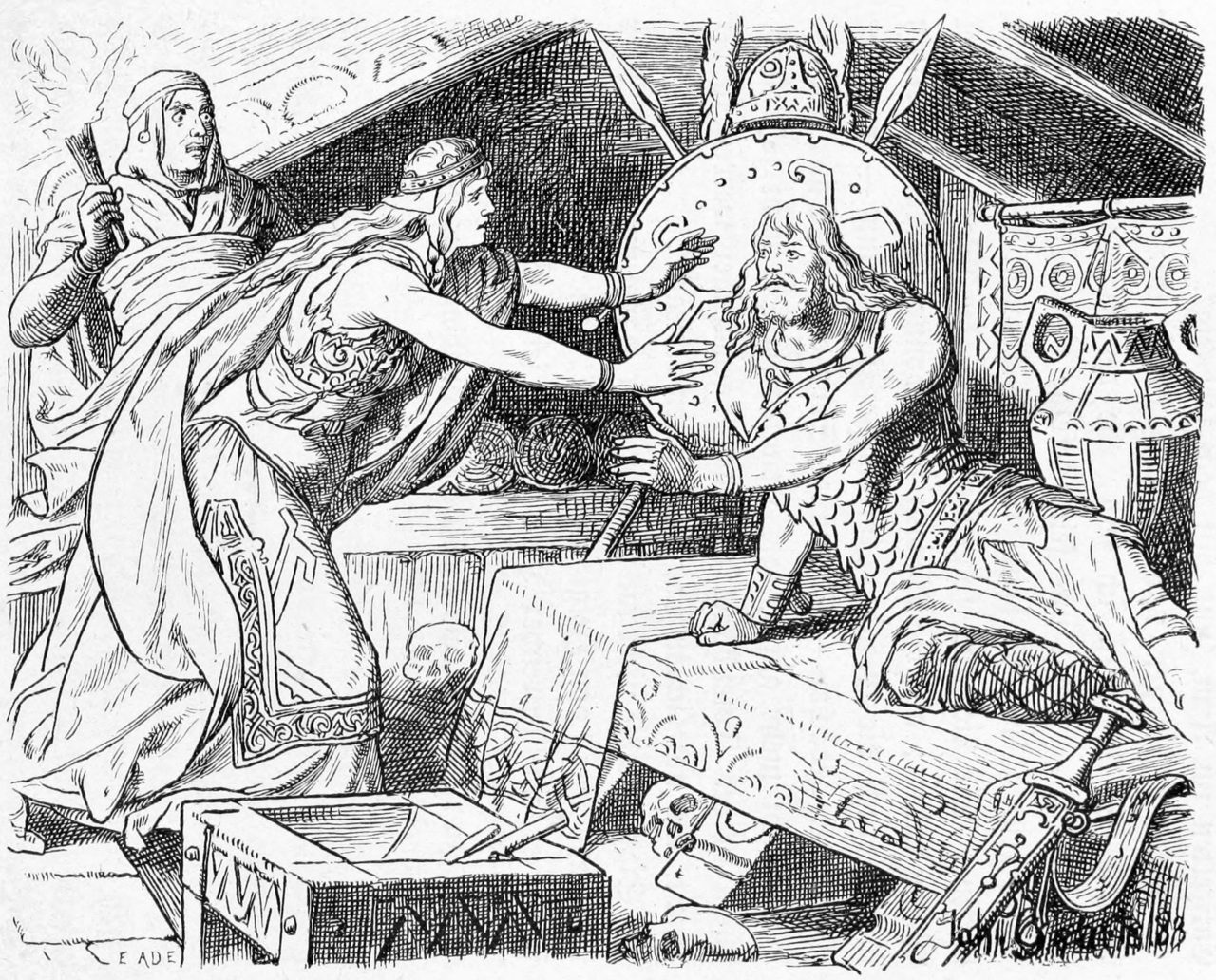
Sigrun went in the hill to Helgi, and said:
"Now am I gladof our meeting together,As Othin's hawks,so eager for prey,When slaughter and fleshall warm they scent,Or dew-wet seethe red of day.
"First will I kissthe lifeless king,Ere off the bloodybyrnie thou cast;With frost thy hairis heavy, Helgi,And damp thou artwith the dew of death;(Ice-cold handshas Hogni's kinsman,What, prince, can Ito bring thee ease?)"
Note
Possibly lines 5-6 are spurious, or part of a stanza the rest of which has been lost. It has also been suggested that two lines may have been lost after line 2, making a new stanza of lines 3-6. Kinsman: literally "son-in-law."
Helgi spake:"Thou alone, Sigrunof Sevafjoll,Art cause that Helgiwith dew is heavy;Gold-decked maid,thy tears are grievous,(Sun-bright south-maid,ere thou sleepest;)Each falls like bloodon the hero's breast,(Burned-out, cold,and crushed with care.)
Note
Lines 4 and 6 have been marked by various editors as probably spurious. Others regard lines 1-2 as the beginning of a stanza the rest of which has been lost, or combine lines 5-6 with lines 5-6 of stanza 45 to make a new stanza. South-maid: cf. Helgakvitha Hundingsbana I, 17 and note.
Cited on Helgi Hundingsbane
"Well shall we drinka noble draught,Though love and landsare lost to me;No man a songof sorrow shall sing,Though bleeding woundsare on my breast;Now in the hillour brides we hold,The heroes' loves,by their husbands dead."
Note
Both lines 3-4 and lines 5-6 have been suspected by editors of being interpolated, and the loss of two lines has also been suggested. Brides: the plural here is perplexing. Gering insists that only Sigrun is meant, and translates the word as singular, but both "brides" and "loves" are uncompromisingly plural in the text. Were the men of Helgi's ghostly following likewise visited by their wives? The annotator may have thought so, for in the prose he mentions the "women" returning to the house, although, of course, this may refer simply to Sigrun and the maid.
Sigrun made ready a bed in the hill.
"Here a bedI have made for thee, Helgi,To rest thee from care,thou kin of the Ylfings;I will make thee sinkto sleep in my arms,As once I laywith the living king."
Cited on Sigrún
Helgi spake:"Now do I saythat in SevafjollAught may happen,early or late,Since thou sleepest claspedin a corpse's arms,So fair in the hill,the daughter of Hogni!(Living thou comest,a daughter of kings.)
Note
Line 5 (or possibly line 4) may be interpolated.
"Now must I ridethe reddened ways,And my bay steed setto tread the sky;Westward I goto wind-helm's bridges,Ere Salgofnir wakesthe warrior throng."
Note
Wind-helm: the sky; the bridge is Bifrost, the rainbow (cf. Grimnismol, 29). Salgofnir ("Hall-Crower"): the cock Gollinkambi who awakes the gods and warriors for the last battle.
Cited on Helgi Hundingsbane
Then Helgi and his followers rode on their way, and the women went home to the dwelling. Another evening Sigrun bade the maiden keep watch at the hill. And at sunset when Sigrun came to the hill she said:
"Now were he come,if come he might,Sigmund's son,from Othin's seat;Hope grows dimof the hero's returnWhen eagles siton the ash-tree boughs,And men are seekingthe meeting of dreams."
Note
Many editors assign this speech to the maid. Line 5 (or 4) may be spurious. Meeting of dreams ("Dream-Thing"): sleep.
Cited on Sigrún
The Maiden said:"Mad thou wouldst seemalone to seek,Daughter of heroes,the house of the dead;For mightier nowat night are allThe ghosts of the deadthan when day is bright."
Sigrun was early dead of sorrow and grief. It was believed in olden times that people were born again, but that is now called old wives' folly. Of Helgi and Sigrun it is said that they were born again; he became Helgi Haddingjaskati, and she Kara the daughter of Halfdan, as is told in the Lay of Kara, and she was a Valkyrie.
Note
Prose. The attitude of the annotator is clearly revealed by his contempt for those who put any faith in such "old wives' folly" as the idea that men and women could be reborn. As in the case of Helgi Hjorvarthsson, the theory of the hero's rebirth seems to have developed in order to unite around a single Helgi the various stories in which the hero is slain. The Lay of Kara (Karuljoth) is lost, although, as has been pointed out, parts of the Helgakvitha Hundingsbana II may be remnants of it, but we find the main outlines of the story in the Hromundar saga Greipssonar, whose compilers appear to have known the Karuljoth. In the saga Helgi Haddingjaskati (Helgi the Haddings'-Hero) is protected by the Valkyrie Kara, who flies over him in the form of a swan (note once more the Valkyrie swan-maiden confusion); but in his fight with Hromund he swings his sword so high that he accidentally gives Kara a mortal wound, whereupon Hromund cuts off his head. As this makes the third recorded death of Helgi (once at the hands of Alf, once at those of Dag, and finally in the fight with Hromund), the phenomenon of his rebirth is not surprising. The points of resemblance in all the Helgi stories, including the one told in the lost Karuljoth, are sufficiently striking so that it is impossible not to see in them a common origin, and not to believe that Helgi the son of Hjorvarth, Helgi the son of Sigmund and Helgi the Haddings'-Hero (not to mention various other Helgis who probably figured in songs and stories now lost) were all originally the same Helgi who appears in the early traditions of Denmark.
Cited on Helgi Hundingsbane, Sigrún