A myth retold · about 6 minutes
Völundr the smith
Abandoned by his swan-maiden wife, the master smith Völundr is captured and lamed by King Níðuðr. He takes a terrible revenge on the king's sons and daughter, then rises laughing into the air.
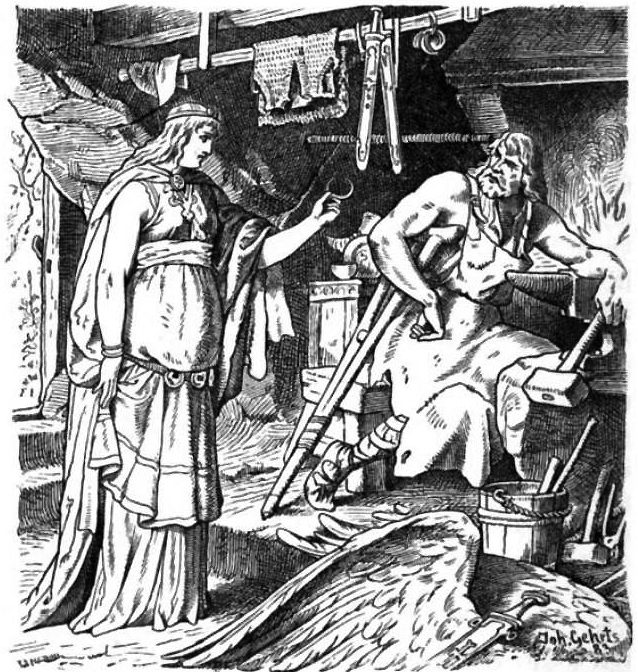
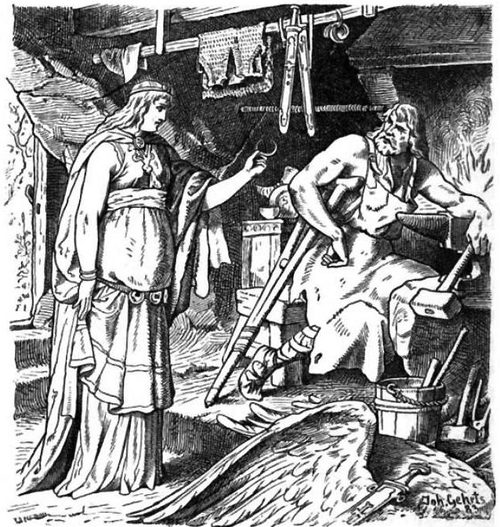
Völundarkviða is the only poem of the Poetic Edda about a smith, and one of its darkest. Its hero is neither god nor king. He is a craftsman whose skill draws a king's greed, and whose revenge shocks even readers used to Norse heroic poetry. The poem calls him "master of elves" and "greatest of elves" Völundarkviða 13 Völundarkviða 15, and he was known far beyond Scandinavia: the Old English Weland and the German Wieland are the same figure.
The swan-maidens
A prose introduction sets the scene. In Sweden there is a king named Níðuðr, with two sons and a daughter, Böðvildr. Three brothers, sons of a king of the Finns, live by hunting on skis: Slagfiðr, Egill and Völundr. They build a house in Úlfdalir, "wolf dales", beside a lake Völundarkviða, prose 1.
The poem itself begins with the women:
Maids from the south through Myrkwood flew,Fair and young, their fate to follow;On the shore of the sea to rest them they sat,The maids of the south, and flax they spun.Völundarkviða 1
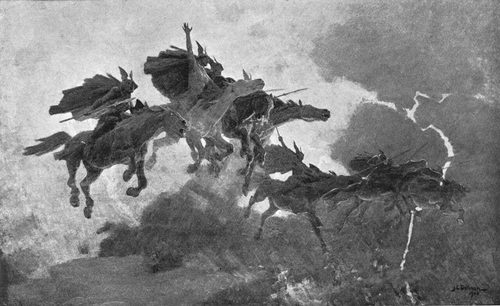
They are Hlaðguðr and Hervör, daughters of Hlöðvér, and Ölrún, daughter of Kjárr Völundarkviða 2. One takes Egill in her arms. The second is Swan-White, in swan-feathers. The third puts her arms round Völundr's neck Völundarkviða 3-4. The prose calls them valkyries and gives Völundr Hervör the All-Wise Völundarkviða, prose 1.
They stay seven winters. In the eighth they grow restless, and in the ninth they leave, "their fate to follow" Völundarkviða 5. The brothers come home from hunting to an empty hall. Egill goes east after his wife and Slagfiðr south after his. Völundr stays alone in Úlfdalir Völundarkviða 6-7, and does what he knows how to do:
Red gold he fashioned with fairest gems,And rings he strung on ropes of bast;So for his wife he waited long,If the fair one home might come to him.Völundarkviða 8
Captured
Níðuðr, "lord of the Njars", hears that Völundr is alone. His men ride out at night, their shields shining in the waning moonlight, and break into the house. They find seven hundred rings on a rope of bast. They take just one Völundarkviða 9-11.
Völundr comes home from hunting, roasts bear meat and counts his rings. One is missing. He thinks his wife has come back and taken it. He sits so long that he falls asleep, and wakes in chains Völundarkviða 12-14. Níðuðr asks him how he came by "these treasures of ours"; Völundr answers that the gold did not come from Grani's way, and that they had more when they were happy at home Völundarkviða 15-16. The king gives the stolen ring to his daughter Böðvildr and wears Völundr's sword himself Völundarkviða, prose 2.
The queen has the last word. He looks dangerous, she says: his eyes glitter like a snake's, and he grinds his teeth when he sees the sword or Böðvildr's ring. "Let them straightway cut his sinews of strength", and put him on the island of Sævarstaðr Völundarkviða 17-18. It is done. Lamed, Völundr works for the king on the island, and no one but the king may visit him Völundarkviða, prose 3. He grieves for the sword he forged, which he will never see again, and the ring that was his bride's Völundarkviða 19.
The revenge
Völundr sits at his anvil, sleepless, making wonders for Níðuðr Völundarkviða 20. The king's two sons come to look. They ask for the keys to his chest, and inside they see gold and gems. He tells them to come back the next day, alone, and to tell no one. They come. He cuts off their heads and hides their bodies under the bellows Völundarkviða 21-24.
Their skulls, once hid by their hair, he took,Set them in silver and sent them to Nithuth;Gems full fair from their eyes he fashioned,To Nithuth's wife so wise he gave them.Völundarkviða 25
From their teeth he makes a brooch and sends it to Böðvildr Völundarkviða 26.
Then Böðvildr comes to him herself. She has broken the ring, her father's gift and once Völundr's bride's, and dares tell no one else. Völundr promises to mend it so that it will look better than ever Völundarkviða 27-28. He gives her beer, and she falls asleep in her seat. "Now vengeance I have for all my hurts", he says, all except one Völundarkviða 29. Then the text is damaged. What survives next is Völundr wishing his maimed sinews were whole, and then:
Laughing Völund rose aloft,Weeping Bothvild went from the isle,For her lover's flight and her father's wrath.Völundarkviða 31
The last word
The queen finds Níðuðr awake and joyless; he has hardly slept since his sons were killed, and he wants to speak to Völundr Völundarkviða 32-34. Völundr, out of reach, makes him swear oaths first "by the rail of ship, and the rim of shield, By the shoulder of steed, and the edge of sword" that he will not harm Völundr's wife or the child born in his hall Völundarkviða 35. Then he tells him everything: the bellows sprinkled with blood, the skulls, the gems, the brooch, and "now big with child does Bothvild go" Völundarkviða 36-38.
Níðuðr has never heard words that hurt more. No one can reach Völundr now, on horseback or with an arrow, "while high in the clouds thy course thou takest" Völundarkviða 39. Völundr rises laughing, and the king is left sitting in grief Völundarkviða 40. He sends for his daughter and asks if it is true. It is: "Nought was my might with such a man, Nor from his strength could I save myself" Völundarkviða 41-43. There the poem ends.
Where the story comes from
Völundarkviða survives in the Codex Regius, placed between the mythological and the heroic poems. Neither of Snorri's books tells the story. The poem is often thought to be old, and some scholars detect West Germanic, perhaps English, influence in its language and setting, but its date is debated.
There are tensions between the prose and the verse. The prose makes Völundr a son of the king of the Finns Völundarkviða, prose 1, while the poem calls him "master of elves" Völundarkviða 13. The prose calls the women valkyries; the poem calls them "maids from the south" and gives one of them swan-feathers Völundarkviða 1 Völundarkviða 4. The prose sets Níðuðr in Sweden, while the poem calls him "lord of the Njars" Völundarkviða 9. Most importantly, the surviving text never says how Völundr flies. The lines between his last words to the sleeping Böðvildr and his laughing ascent are lost Völundarkviða 29-31. The "wife" Völundr protects in stanza 35 seems to be Böðvildr, whom the poem elsewhere suggests he took by force Völundarkviða 43.
Outside the Edda, the story is unusually well attested. The Old English poem Deor mentions Weland's sufferings and Beadohild's grief over her pregnancy. The whalebone Franks Casket (early eighth century) shows the smith at his forge with a headless body at his feet, offering a cup to a woman. The thirteenth-century Norwegian Þiðreks saga tells a longer version in which the smith's brother Egill helps him make a feather-garment to fly in.
Reading it today
The poem raises hard questions and does not answer them. Most readers see a revenge tragedy in which the oppressor's cruelty is repaid in kind. Others note that the poem gives the most painful lines to Böðvildr, who did nothing to Völundr. The swan-maiden opening has parallels in folktales across Europe and Asia, and the lamed, flying smith has often been compared with Daedalus and with the lame smith-god Hephaestus. Whether those parallels reflect a shared inheritance or just similar ideas about craftsmen is debated.
Key passages
Maids from the south through Myrkwood flew, Fair and young, their fate to follow
Red gold he fashioned with fairest gems, And rings he strung on ropes of bast
the sinews in his knee-joints were cut, and he was set in an island which was near the mainland, and was called Sævarstath
Their skulls, once hid by their hair, he took, Set them in silver and sent them to Nithuth
Laughing Völund rose aloft, Weeping Bothvild went from the isle
True is it, Nithuth, that which was told thee, Once in the isle with Völund was I