Völsung
Sigurðr
The Völsung dragon-slayer of the heroic poems: he kills Fáfnir, wakes a sleeping valkyrie, marries Guðrún and is murdered by his sworn brothers, the Gjúkungs.
Sigurðr is the hero at the centre of the Norse heroic poems: the young Völsung who kills the dragon Fáfnir, wins a cursed hoard, wakes a sleeping valkyrie, marries into the family of the Gjúkungs and is murdered by the men who swore to be his brothers. Most of the heroic poems of the Poetic Edda turn on him, his kin, or the revenge that follows his death. The poems do not make one story. They overlap, contradict each other and leave a gap where the manuscript has lost a gathering of leaves, so his life has to be pieced together from many voices.
Birth and the dragon
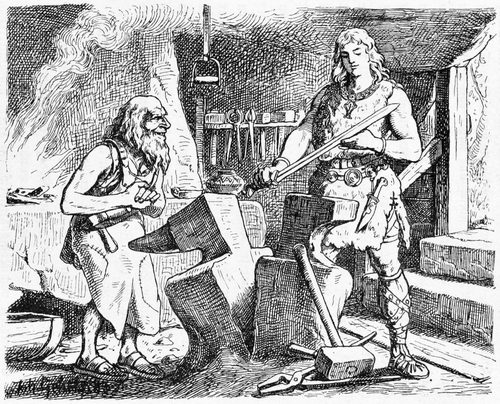
The prose piece Frá dauða Sinfjötla makes him the son of Sigmundr and Hjördís, daughter of King Eylimi; Sigmundr fell fighting the sons of Hunding, and Hjördís married Álfr, son of King Hjálprekr, at whose court the boy grew up Frá dauða Sinfjötla, prose 2. There Reginn, a smith "a dwarf in stature", fostered him, told him the tale of the otter's ransom, and let him choose the horse Grani Reginsmál, prose 1. His first deed is vengeance: with ships from Hjálprekr he sails against Hunding's sons, takes on a stranger on a headland who calls himself Hnikarr, one of Odin's names Reginsmál 18, and kills Lyngvi and his brothers Reginsmál, prose 9.
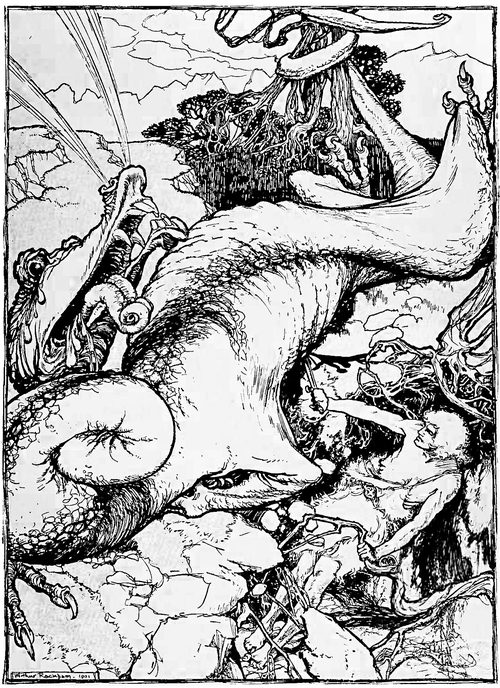
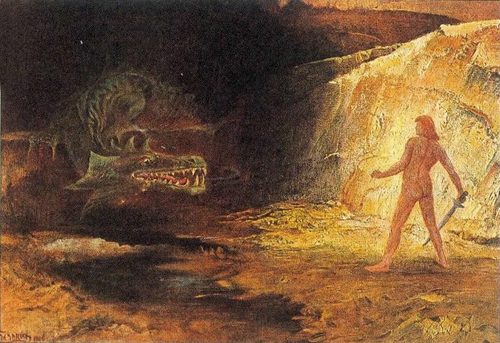
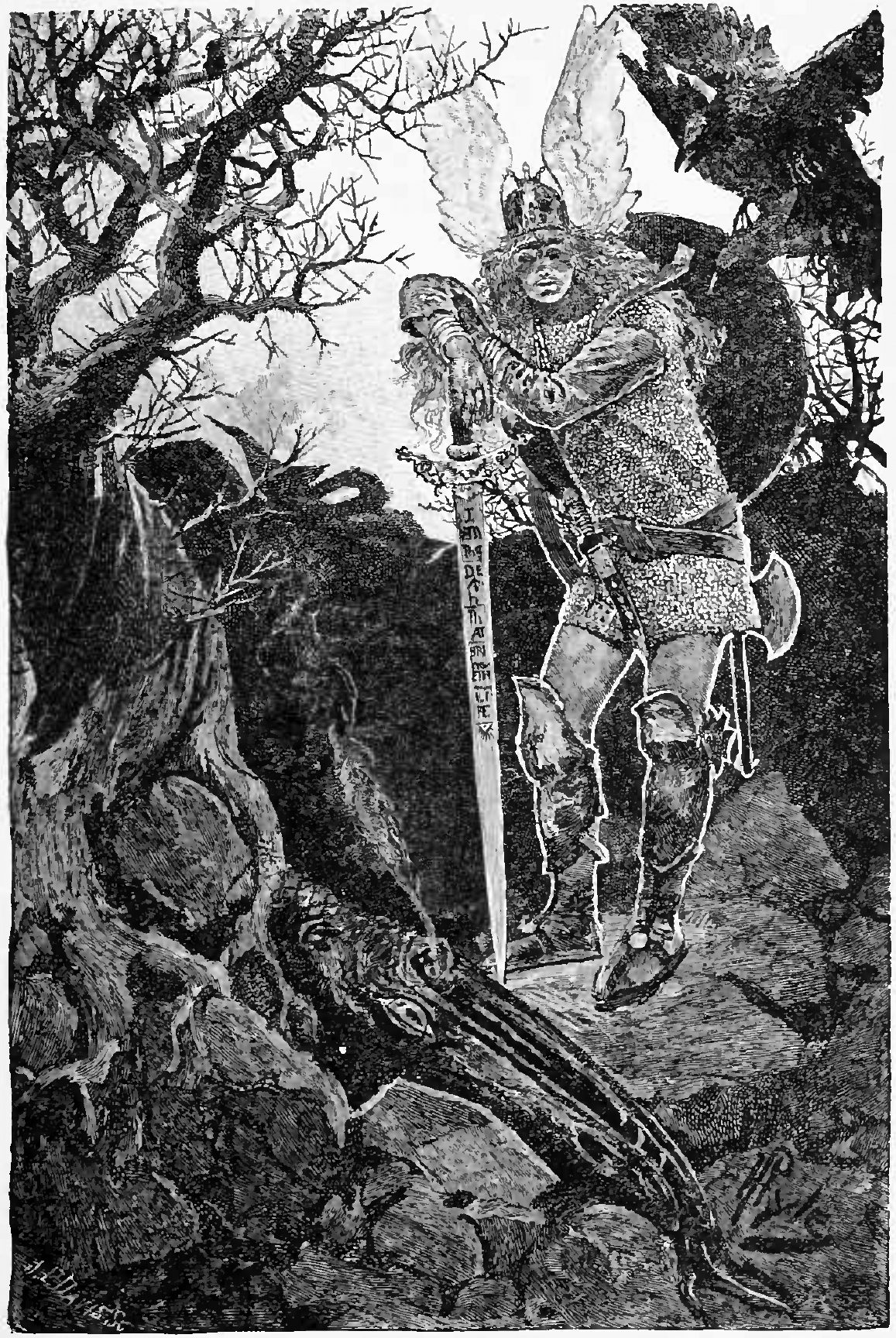
Then Reginn sends him against his own brother. On Gnitaheiðr Sigurðr digs a trench across the dragon's path and stabs Fáfnir from below as he crawls to water Fáfnismál, prose 1. In the dialogue that follows he first hides his name, since a dying man's curse was thought to be dangerous, then gives it Fáfnismál 4. Roasting the heart for Reginn, he burns his finger, tastes the blood and understands the birds, who warn him that Reginn means to betray him; he cuts off Reginn's head and takes the gold Fáfnismál, prose 5 Fáfnismál, prose 6. Snorri tells the same story more briefly, adding that Reginn forged the sword Gramr, which cut a tuft of wool floating in a stream and split Reginn's anvil Skáldskaparmál 40. See Sigurðr slays Fáfnir.
The valkyrie and the Gjúkungs
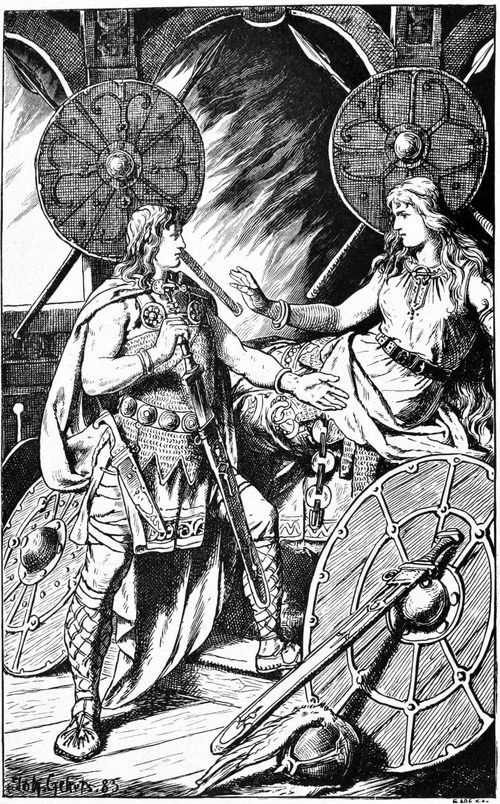
The birds point him two ways: to King Gjúki's daughter, and to a hall ringed with flame on Hindarfjall where a battle-maid sleeps Fáfnismál 41-43. In Sigrdrífumál he finds a sleeper in armour inside a wall of shields, cuts the mail-coat from her and wakes her; she is the valkyrie Sigrdrífa, put to sleep by Odin, and she teaches him runes and counsel Sigrdrífumál, prose 3. Here the manuscript breaks off. When the story resumes, Sigurðr is married to Guðrún, has sworn oaths with Gunnarr and Högni, and has ridden in Gunnarr's shape to win Brynhildr for him Grípisspá 37-39. In the bed he laid a naked sword between them Sigurðarkviða hin skamma 4. Snorri says that the next morning he gave her the cursed ring Andvaranaut, and that a quarrel between the two queens over that ring exposed the trick Skáldskaparmál 41.
How Sigurðr died: the sources disagree
Brynhildr demands his death, and the brothers set their young brother Gotthormr, who swore no oath, to do it Sigurðarkviða hin skamma 20. The poems then split three ways.
- Out of doors, south of the Rhine. In the Fragment of a Sigurd Lay "slain was Sigurth south of the Rhine", and Guðrún stands outside asking why her brothers ride home ahead of him Brot af Sigurðarkviðu 5 Brot af Sigurðarkviðu 6.
- At the assembly. In Guðrúnarkviða II Grani gallops riderless from the Thing, and Högni tells Guðrún she will find her husband "on the southern road" among the ravens Guðrúnarkviða II 4 Guðrúnarkviða II 8.
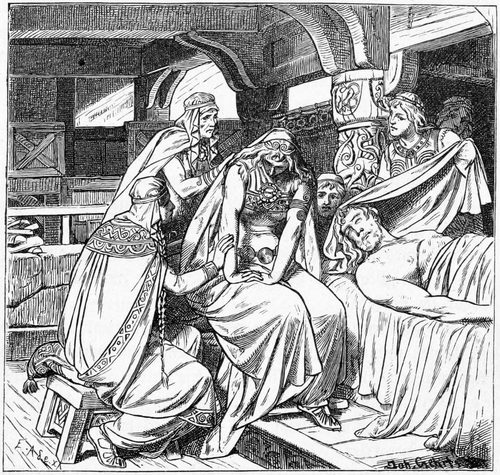
- In bed beside Guðrún. In the Short Lay of Sigurd Gotthormr stabs him in his bed; Sigurðr wakes, hurls Gramr and cuts his killer in two, and Guðrún wakes in his blood Sigurðarkviða hin skamma 21-24. Snorri agrees and adds that his three-year-old son was killed too Skáldskaparmál 41; Guðrún's sons later remember the bedclothes red with blood Hamðismál 7.
A medieval editor saw the problem and wrote a prose note after the Fragment:
But German men say that they killed him out of doors in the forest; and so it is told in the old Guthrun lay, that Sigurth and Gjuki's sons had ridden to the council-place, and that he was slain there.Brot af Sigurðarkviðu, prose 1
The "German" version is the one found in the Nibelungenlied, where Siegfried is killed while hunting. All the Norse versions agree that he was taken off guard by men he trusted.
Beyond the Eddas
The fullest Norse account is the 13th-century prose Völsunga saga, which used poems now lost. Sigurðr was also carved in stone and wood well before the Eddas were written down. The Ramsund carving in Sweden (early 11th century) shows him stabbing the dragon from below, roasting the heart and beheading Reginn. The carved portal of Hylestad stave church (around 1200) in Norway shows the same story. Who, if anyone, stood behind him in history is unknown; scholars have proposed several Frankish princes, and none of these suggestions is accepted by all.
In the sources
Quoted from the hosted translations; each line is checked against the text when the site is built. Select a reference to read it in context.
Sigurth my name, and Sigmund's son, Who smote thee thus with the sword.
Sigurth went to Hjalprek's stud and chose for himself a horse, who thereafter was called Grani.
But when Fafnir's heart's-blood came on his tongue, he understood the speech of birds.
Sigmund's son, with Sigurth's sword, That late with flesh hath fed the ravens.
The southern hero his naked sword, Fair-flashing, let between them lie
Slain was Sigurth south of the Rhine
some say that they slew him in the house, on his bed while he was sleeping. But German men say that they killed him out of doors in the forest
A nobler man shall never live Beneath the sun than Sigurth shall seem.
Where the sources disagree or fall silent
- Whether the valkyrie Sigurðr wakes (Sigrdrífa) is the same woman as Brynhildr: Sigrdrífumál names her Sigrdrífa, Helreið Brynhildar and Snorri make her Brynhildr, and Grípisspá seems to keep them apart.
- Where and how he was killed: out of doors south of the Rhine, at the assembly, or in his bed (see the section below).
- Much of his story between the waking of the valkyrie and his death fell in the lost gathering of the Codex Regius and is known only from fragments, Snorri and the later Völsunga saga.
In modern culture
Not from the medieval sources.
Sigurðr's German counterpart is Siegfried of the Middle High German Nibelungenlied (c. 1200), and Richard Wagner's Siegfried in Der Ring des Nibelungen (first staged complete in 1876) draws on both the German and the Norse versions; Wagner's reforged sword Nothung plays the part of Gram. William Morris retold the Norse story in Sigurd the Volsung (1876), and J. R. R. Tolkien's verse retelling was published as The Legend of Sigurd and Gudrún in 2009. These versions smooth out the contradictions that the Eddic poems leave standing.