dragon
Fáfnir
Son of Hreiðmarr who killed his father for the otter's ransom and lay on the gold as a dragon on Gnitaheiðr until Sigurðr killed him from a pit.
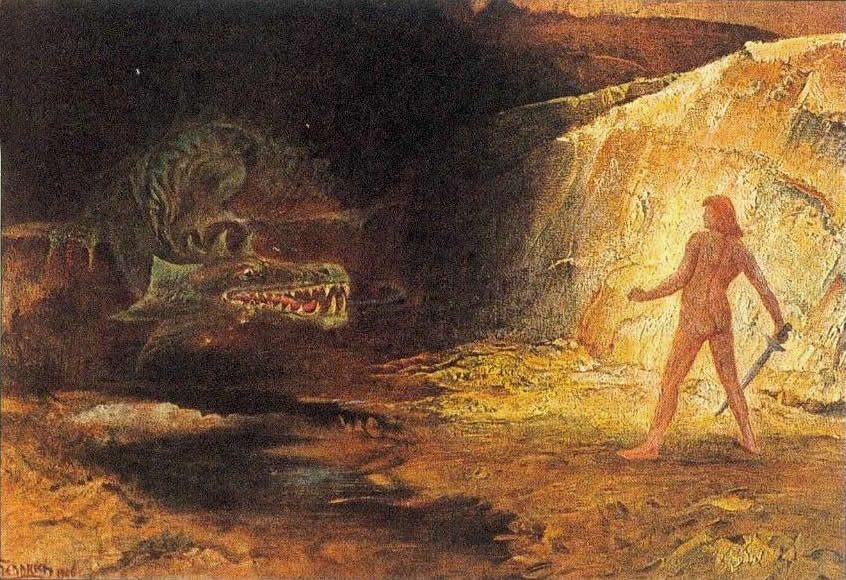
Fáfnir is the most famous dragon of the North, and he began as a man, one of the sons of Hreiðmarr. When his father refused to share the gold paid for Otr's death, Fáfnir killed him, took everything and refused his brother Reginn a share Reginsmál, prose 4 Reginsmál, prose 5. Snorri adds that he took his father's helmet, the Helm of Terror, which frightens every living creature, and a sword called Hrotti. Then he went up to Gnitaheiðr, turned himself into a serpent and lay down on the gold Skáldskaparmál 40.
The death of Fáfnir
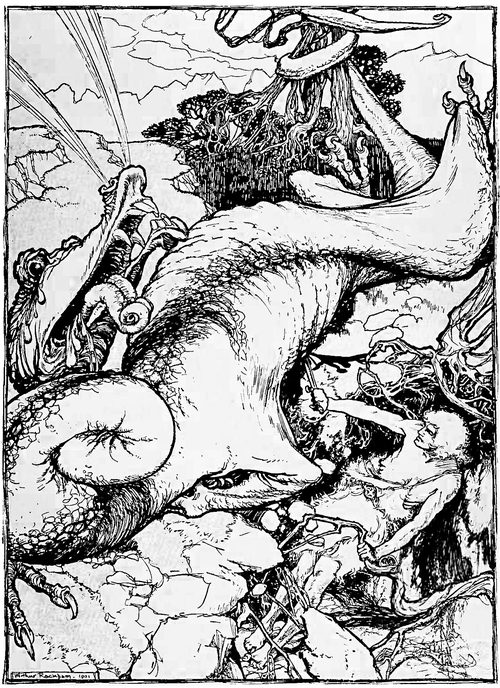
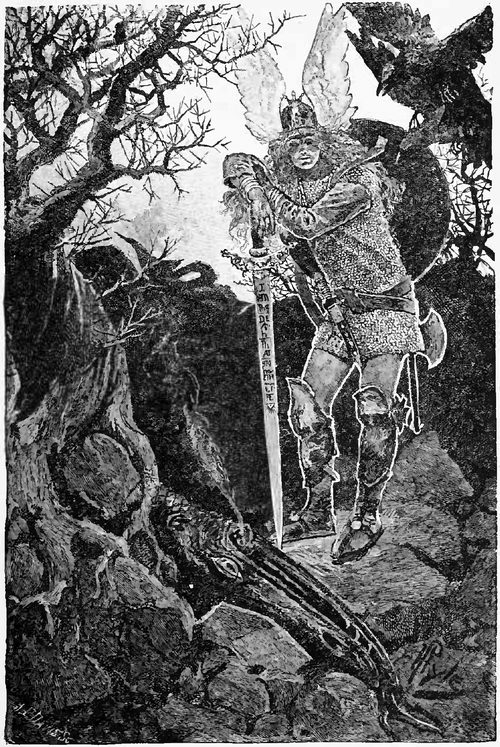
Sigurðr, urged on by Reginn, dug a trench across the track Fáfnir used to crawl to water. When the dragon passed over it, spitting venom, Sigurðr stabbed him to the heart from below Fáfnismál, prose 1. What follows in Fáfnismál is a conversation, not a fight. The dying dragon asks the young man's name and lineage, and Sigurðr at first hides it, because a dying man's curse was powerful Fáfnismál, prose 2. Fáfnir boasts of the fear-helm Fáfnismál 16. He answers questions about the Norns and the island where gods and Surtr will meet at the end of the world Fáfnismál 12-15. Twice he warns that the gold will be Sigurðr's death, and he foretells that Reginn will betray Sigurðr as he betrayed his brother Fáfnismál 9 Fáfnismál 20 Fáfnismál 22.
Sigurðr roasts Fáfnir's heart for Reginn, tastes its blood and understands the birds Fáfnismál, prose 5. Afterwards he loads the gold on Grani Skáldskaparmál 40. "Fáfnir's lair" and "Grani's burden" became kennings for gold.
"Venom I breathed when bright I layBy the hoard my father had;(There was none so mighty as dared to meet me,And weapons nor wiles I feared.)"Fáfnismál 18
See Sigurðr slays Fáfnir.
In the sources
Quoted from the hosted translations; each line is checked against the text when the site is built. Select a reference to read it in context.
Then Sigurth made a great trench across the path, and took his place therein.
Venom I breathed when bright I lay By the hoard my father had
The sounding gold, the glow-red wealth, And the rings thy bane shall be.
Fáfnir went up to Gnita Heath, and made himself a lair, and turned himself into a serpent, and laid him down upon the gold.
Regin betrayed me, and thee will betray, Us both to death will he bring
Where the sources disagree or fall silent
- Whether he was a dragon from the start or transformed: Snorri says he turned himself into a serpent; the poems simply call him a 'worm' and do not explain.
In modern culture
Not from the medieval sources.
Fáfnir is the model for the gold-hoarding dragon of modern fantasy. Tolkien called him, in his essay On Fairy-Stories, 'the prince of all dragons', and critics have often noted that Smaug's conversation with Bilbo echoes Fáfnir's with Sigurðr. In Wagner's Ring, Fafner is one of the two giants who built Valhalla and turns into a dragon to guard the hoard.