
Poetic Edda · heroic poems
Reginsmál
The Lay of Regin
Bellows's introduction
The Reginsmol immediately follows the Gripisspo in the Codex Regius, and in addition stanzas 1, 2, 6, and 18 are quoted in the Volsungasaga, and stanzas 13-26 in the Nornageststhattr. In no instance is the title of the poem stated, and in Regius there stands before the introductory prose, very faintly written, what appears to be "Of Sigurth." As a result, various titles have been affixed to it, the two most often used being "the Balled of Regin" and "the First Lay of Sigurth Fafnisbane."
As a matter of fact, it is by no means clear that the compiler of the Eddic collection regarded this or either of the two following poems, the Fafnismol and the Sigrdrifumol, as separate and distinct poems at all. There are no specific titles given, and the prose notes link the three poems in a fairly consecutive whole. Furthermore, the prose passage introducing the Reginsmol connects directly with Fra Dautha Sinfjotla, and only the insertion of the Gripisspo at this point, which may well have been done by some stupid copyist, breaks the continuity of the story.
For convenience I have here followed the usual plan of dividing this material into distinct parts, or poems, but I greatly doubt if this division is logically sound. The compiler seems, rather, to have undertaken to set down the story of Sigurth in consecutive form, making use of all the verse with which he was familiar, and which, by any stretch of the imagination, could be made to fit, filling up the gaps with prose narrative notes based on the living oral tradition.
This view is supported by the fact that not one of the three poems in question, and least of all the Reginsmol, can possibly be regarded as a unit. For one thing, each of them includes both types of stanza commonly used in the Eddic poems, and this, notwithstanding the efforts of Grundtvig and Müllenhoff to prove the contrary, is almost if not quite conclusive proof that each poem consists of material taken from more than one source. Furthermore, there is nowhere continuity within the verse itself for more than a very few stanzas. An analysis of the Reginsmol shows that stanzas 1-4, 6-10, and 12, all in Ljothahattr stanza form, seem to belong together as fragments of a poem dealing with Loki's (not Andvari's) curse on the gold taken by the gods from Andvari and paid to Hreithmar, together with Hreithmar's death at the hands of his son, Fafnir, as the first result of this curse. Stanza 5, in Fornyrthislag, is a curse on the gold, here ascribed to Andvari, but the only proper name in the stanza, Gust, is quite unidentifiable, and the stanza may originally have had to do with a totally different story. Stanza 11, likewise in Fornyrthislag, is merely a father's demand that his daughter rear a family to avenge his death; there is nothing in it to link it necessarily with the dying Hreithmar. Stanzas 13-18, all in Fornyrthislag, give Regin's welcome to Sigurth (stanzas 13-14), Sigurth's announcement that he will avenge his father's death on the sons of Hunding before he seeks any treasure (stanza 15), and a dialogue between a certain Hnikar, who is really Othin, and Regin, as the latter and Sigurth are on the point of being shipwrecked. This section (stanzas 13-18) bears a striking resemblance to the Helgi lays, and may well have come originally from that cycle. Next follows a passage in Ljothahattr form (stanzas 19-22 and 24-25) in which Hnikar-Othin gives some general advice as to lucky omens and good conduct in battle; the entire passage might equally well stand in the Hovamol, and I suspect that it originally came from just such a collection of wise saws. Inserted in this passage is stanza 23, in Fornyrthislag, likewise on the conduct of battle, with a bit of tactical advice included. The "poem" ends with a single stanza, in Fornyrthislag, simply stating that the bloody fight is over and that Sigurth fought well—a statement equally applicable to any part of the hero's career.
Finnur Jonsson has divided the Reginsmol into two poems, or rather into two sets of fragments, but this, as the foregoing analysis has indicated, does not appear to go nearly far enough. It accords much better with the facts to assume that the compiler of the collection represented by the Codex Regius, having set out to tell the story of Sigurth, took his verse fragments pretty much wherever he happened to find them. In this connection, it should be remembered that in the fluid state of oral tradition poems, fragments, and stanzas passed readily and frequently from one story to another. Tradition, never critical, doubtless connected with the Sigurth story much verse that never originated there.
If the entire passage beginning with the prose Fra Dautha Sinfjotla, and, except for the Gripisspo, including the Reginsmol, Fafnismol, and Sigrdrifumol, be regarded as a highly uncritical piece of compilation, rendered consecutive by the compiler's prose narrative, its difficulties are largely smoothed away; any other way of looking at it results in utterly inconclusive attempts to reconstruct poems some of which quite possibly never existed.
The twenty-six stanzas and accompanying prose notes included under the heading of Reginsmol belong almost wholly to the northern part of the Sigurth legend; the mythological features have no counterpart in the southern stories, and only here and there is there any betrayal of the tradition's Frankish home. The story of Andvari, Loki, and Hreithmar is purely Norse, as is the concluding section containing Othin's counsels. If we assume that the passage dealing with the victory over Hunding's sons belongs to the Helgi cycle (cf. introductory notes to Helgakvitha Hjorvarthssonar and Helgakvitha Hundingsbana I), there is very little left to reflect the Sigurth tradition proper.
Regarding the general development of the story of Sigurth in the North, see the introductory note to the Gripisspo.
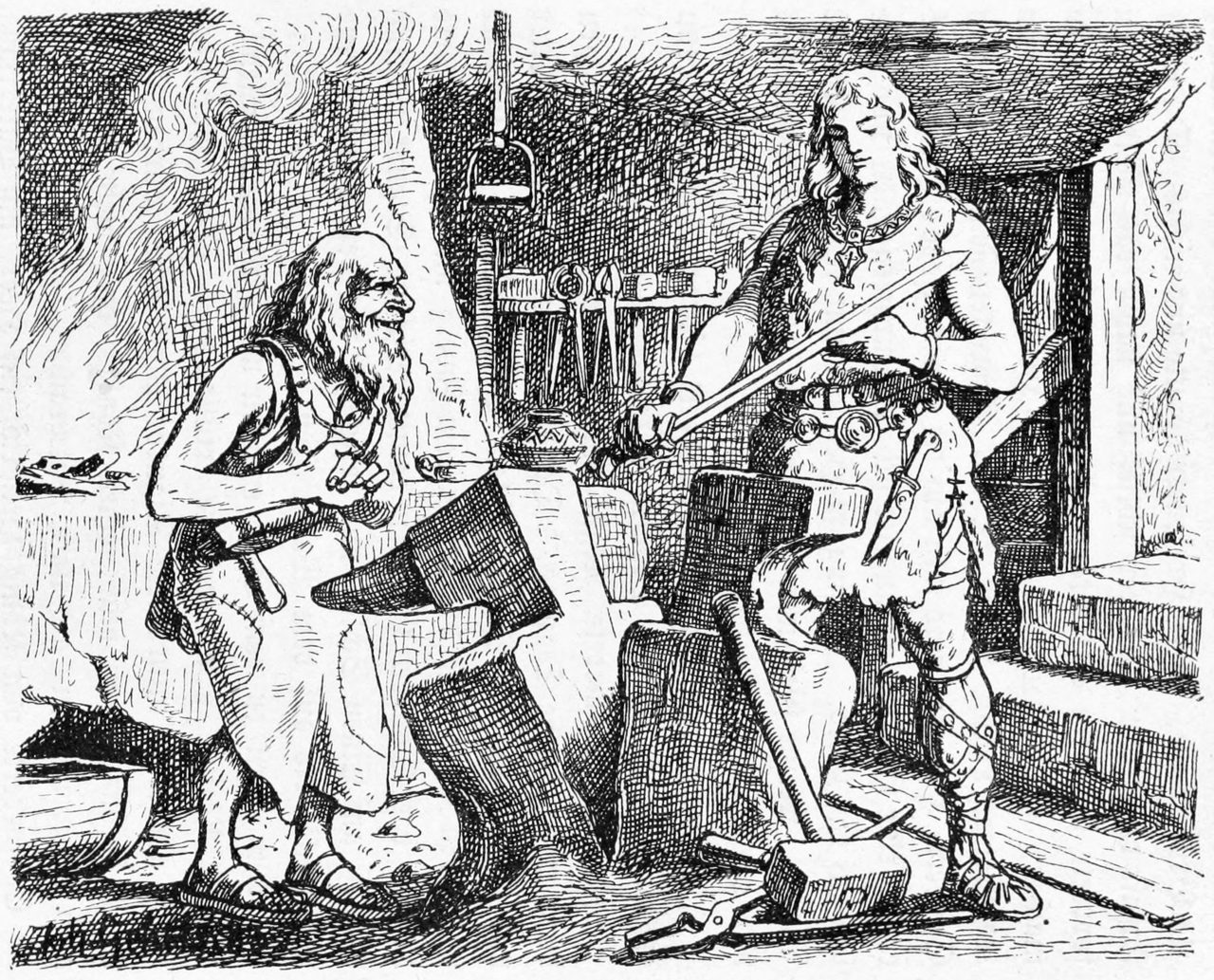
Sigurth went to Hjalprek's stud and chose for himself a horse, who thereafter was called Grani. At that time Regin, the son of Hreithmar, was come to Hjalprek's home; he was more ingenious than all other men, and a dwarf in stature; he was wise, fierce and skilled in magic. Regin undertook Sigurth's bringing up and teaching, and loved him much. He told Sigurth of his forefathers, and also of this: that once Othin and Hönir and Loki had come to Andvari's waterfall, and in the fall were many fish. Andvari was a dwarf, who had dwelt long in the waterfall in the shape of a pike, and there he got his food. "Otr was the name of a brother of ours," said Regin, "who often went into the fall in the shape of an otter; he had caught a salmon, and sat on the high bank eating it with his eyes shut. Loki threw a stone at him and killed him; the gods thought they had had great good luck, and stripped the skin off the otter. That same evening they sought a night's lodging at Hreithmar's house, and showed their booty. Then we seized them, and told them, as ransom for their lives, to fill the otter skin with gold, and completely cover it outside as well with red gold. Then they sent Loki to get the gold; he went to Ron and got her net, and went then to Andvari's fall and cast the net in front of the pike, and the pike leaped into the net." Then Loki said:
Note
Prose.
Hjalprek: father of Alf, Sigurth's step-father; cf. Fra Dautha Sinfjotla, and note.
Grani: cf. Gripisspo, 5 and note.
Regin ("Counsel-Giver"): undoubtetly he goes back to the smith of the German story; in the Thithrekssaga version he is called Mimir, while Regin is there the name of the dragon (here Regin's brother, Fafnir). The Voluspo (stanza 12) names a Regin among the dwarfs, and the name may have assisted in making Regin a dwarf here.
Hreithmar: nothing is known of him outside of this story.
Othin, Hönir and Loki: these same three gods appear in company in Voluspo, 17-18.
Andvari's fall: according to Snorri, who tells this entire story in the Skaldskaparmal, Andvari's fall was in the world of the dark elves, while the one where Loki killed the otter was not; here, however, the two are considered identical.
With his eyes shut: according to Snorri, Otr ate with his eyes shut because be was so greedy that he could not bear to see the food before him diminishing.
Ron: wife of the sea-god Ægir, who draws down drowning men with her net; cf. Helgakvitha Hjorvarthssonar, 18 and note. Snorri says that Loki caught the pike with his hands.
Cited on Andvari, Grani, Hœnir, Hreiðmarr, Otr, Rán and 4 more
"What is the fishthat runs in the flood,And itself from ill cannot save?If thy head thou wouldstfrom hell redeem,Find me the water's flame."
Note
Snorri quotes this stanza. Water's flame: gold, so called because Ægir, the sea-god, was wont to light his hall with gold.
Cited on Otter's ransom and Andvari's curse
Andvari spake:"Andvari am I,and Oin my father,In many a fall have I fared;An evil Nornin olden daysDoomed me in waters to dwell."
Note
Snorri quotes this stanza. The name of the speaker is not given in the manuscripts. Oin: nothing further is known of Andvari's father. Norn: cf. Voluspo, 20.
Cited on Andvari, The Norns, Otter's ransom and Andvari's curse
Loki spake:"Andvari, say,if thou seekest stillTo live in the land of men,What payment is setfor the sons of menWho war with lying words?"
Note
Stanzas 3-4 may well be fragments of some other poem. Certainly Loki's question does not fit the situation, and the passage looks like an extract from some such poem as Vafthruthnismol. In Regius the phrase "Loki spake" stands in the middle of line 1.
Cited on Otter's ransom and Andvari's curse
Andvari spake:"A mighty paymentthe men must makeWho in Vathgelmir's waters wade;On a long road leadthe lying wordsThat one to another utters."
Note
The manuscript does not name the speaker. Vathgelmir ("Raging to Wade"): a river not elsewhere mentioned, but cf. Voluspo, 39.
Loki saw all the gold that Andvari had. But when he had brought forth all the gold, he held back one ring, and Loki took this from him. The dwarf went into his rocky hole and said:
Note
Prose. Snorri says Andvari's ring had the power to create new gold. In this it resembled Baldr's ring, Draupnir; c.f. Skirnismol, 21 and note.
Cited on Andvaranaut, Andvari, Otter's ransom and Andvari's curse
"Now shall the goldthat Gust once hadBring their deathto brothers twain,And evil befor heroes eight;Joy of my wealthshall no man win."
Note
This stanza apparently comes from a different source from stanzas 1-4 (or 1-2 if 3-4 are interpolated) and 6-10; cf. Introductory Note. In the Volsungasaga Andvari lays his curse particularly on the ring. Gust: possibly a name for Andvari himself, or for an earlier possessor of the treasure. Brothers twain: Fafnir and Regin. Heroes eight: the word "eight" may easily have been substituted for something like "all" to make the stanza fit the case; the "eight" in question are presumably Sigurth, Gotthorm, Gunnar, Hogni, Atli, Erp, Sorli and Hamther, all of whom are slain in the course of the story. But the stanza may originally not have referred to Andvari's treasure at all.
Cited on Andvaranaut, Andvari, Otter's ransom and Andvari's curse
The gods gave Hreithmar the gold, and filled up the otter-skin, and stood it on its feet. Then the gods had to heap up gold and hide it. And when that was done, Hreithmar came forward and saw a single whisker, and bade them cover it. Then Othin brought out the ring Andvaranaut and covered the hair. Then Loki said:
Note
Prose.
Andvaranaut: "Andvari's Gem."
Cited on Andvaranaut, Hreiðmarr, Otter's ransom and Andvari's curse
"The gold is given,and great the priceThou hast my head to save;But fortune thy sonsshall find not there,The bane of ye both it is."
Note
Snorri quotes this stanza, introducing it, as here, with "Then Loki said" in the prose. Regius omits this phrase, but inserts "said Loki" in line 1.
Cited on Hreiðmarr, Otter's ransom and Andvari's curse
Hreithmar spake:"Gifts ye gave,but ye gave not kindly,Gave not with hearts that were whole;Your lives ere thisshould ye all have lost,If sooner this fate I had seen."
Cited on Otter's ransom and Andvari's curse
Loki spake:"Worse is thisthat methinks I see,For a maid shall kinsmen clash;Heroes unbornthereby shall be,I deem, to hatred doomed."
Note
The word translated "maid" in line 2 is obscure, and "gold" may be meant. Apparently, however, the reference is to the fight between Sigurth and the sons of Gjuki over Brynhild. The manuscript does not name the speaker, and many editions assign this stanza to Hreithmar.
Cited on Otter's ransom and Andvari's curse
Hreithmar spake:"The gold so redshall I rule, methinks,So long as I shall live;Nought of fearfor thy threats I feel,So get ye hence to your homes."
Note
The manuscript includes "said Hreithmar" (abbreviated) in the middle of line 1, and some editors have followed this.
Cited on Hreiðmarr, Otter's ransom and Andvari's curse
Fafnir and Regin asked Hreithmar for a share of the wealth that was paid for the slaying of their brother, Otr. This he refused, and Fafnir thrust his sword through the body of his father, Hreithmar, while he was sleeping. Hreithmar called to his daughters:
Cited on Fáfnir, Hreiðmarr, Otter's ransom and Andvari's curse
"Lyngheith and Lofnheith,fled is my life,And mighty now is my need!"Lyngheith spake:"Though a sister losesher father, seldomRevenge on her brother she brings."
Note
Hreithmar's daughters do not appear elsewhere. It has been suggested that originally stanza 10 was followed by one in which Lofnheith lamented her inability to avenge her father, as she was married and had no son.
Cited on Hreiðmarr, Otter's ransom and Andvari's curse
Hreithmar spake:"A daughter, womanwith wolf's heart, bear,If thou hast no sonwith the hero brave;If one weds the maid,for the need is mighty,Their son for thy hurtmay vengeance seek."
Note
Apparently an interpolation (cf. Introductory Note). Vigfusson tries to reconstruct lines 2 and 4 to fit the Ljothahattr rhythm, but without much success. Hreithmar urges his daughter, as she has no sons, to bear a daughter who, in turn, will have a son to avenge his great-grandfather. Grundtvig worked out an ingenious theory to fit this stanza, making Sigurth's grandfather, Eylimi, the husband of Lyngheith's daughter, but there is absolutely no evidence to support this. The stanza may have nothing to do with Hreithmar.
Then Hreithmar died, and Fafnir took all the gold. Thereupon Regin asked to have his inheritance from his father, but Fafnir refused this. Then Regin asked counsel of Lyngheith, his sister, how he should win his inheritance. She said:
Cited on Fáfnir, Reginn, Otter's ransom and Andvari's curse
"In friendly wisethe wealth shalt thou askOf thy brother, and better will;Not seemly is itto seek with the swordFafnir's treasure to take."
Cited on Reginn, Otter's ransom and Andvari's curse
All these happenings did Regin tell to Sigurth.
Cited on Reginn
One day, when he came to Regin's house, he was gladly welcomed. Regin said:
"Hither the sonof Sigmund is come,The hero eager,here to our hall;His courage is morethan an ancient man's,And battle I hopefrom the hardy wolf.
Note
This and the following stanza may be out of place here, really belonging, together with their introductory prose sentence, in the opening prose passage, following the first sentence describing Regin. Certainly they seem to relate to Regin's first meeting with Sigurth. Stanzas 13-26, interspersed with prose, are quoted in the Nornageststhattr. Stanzas 13-18 may be the remnants of a lost poem belonging to the Helgi cycle (cf. Introductory Note). Hardy wolf: warrior, i. e., Sigurth.
Cited on Reginn, Sigurðr slays Fáfnir
"Here shall I fosterthe fearless prince,Now Yngvi's heirto us is come;The noblest herobeneath the sun,The threads of his fateall lands enfold."
Note
Yngvi's heir: Yngvi was one of the sons of the Danish king Halfdan the Old, and traditionally an ancestor of Helgi (cf. Helgakvitha Hundingsbana I, 57 and note). Calling Sigurth a descendant of Yngvi is, of course, absurd, and the use of this phrase is one of the many reasons for believing that stanzas 13-18 belonged originally to the Helgi cycle. The threads, etc.: another link with Helgi; cf. Helgakvitha Hundingsbana I, 3-4. As Helgi was likewise regarded as a son of Sigmund, stanzas 13-14 would fit him just as well as Sigurth.
"Loud will the sonsof Hunding laugh,Who low did Eylimilay in death,If the hero soonerseeks the redRings to findthan his father's vengeance."
Note
Regarding the sons of Hunding and Eylimi, father of Sigurth's mother, all of whom belong to the Helgi tradition, cf. Fra Dautha Sinfjotla and note.
Cited on Sigurðr slays Fáfnir
King Hjalprek gave Sigurth a fleet for the avenging of his father. They ran into a great storm, and were off a certain headland. A man stood on the mountain, and said:
Note
Prose.
The fleet, and the subsequent storm, are also reminiscent of the Helgi cycle; cf. Helgakvitha Hundingsbana I, 29-31, and II, prose after stanza 16.
A man: Othin.
Cited on Sigurðr slays Fáfnir
"Who yonder rideson Rævil's steeds,O'er towering wavesand waters wild?The sail-horses allwith sweat are dripping,Nor can the sea-steedsthe gale withstand."
Note
Rævil's steeds (Rævil was a sea-king, possibly the grandson of Ragnar Lothbrok mentioned in the Hervararsaga), sail-horses and sea-steeds all mean "ships."
Cited on Sigurðr slays Fáfnir
Regin answered:"On the sea-trees hereare Sigurth and I,The storm wind drives uson to our death;The waves crash downon the forward deck,And the roller-steeds sink;who seeks our names?"
Note
Sea-trees and roller-steeds (the latter because ships were pulled up on shore by means of rollers) both mean "ships."
Cited on Reginn
The Man spake:"Hnikar I waswhen Volsung onceGladdened the ravensand battle gave;Call me the Manfrom the Mountain now,Feng or Fjolnir;with you will I fare."
Note
The Volsungasaga quotes this stanza. Hnikar and Fjolnir: Othin gives himself both these names in Grimnismol, 47; Feng ("The Seizer") does not appear elsewhere. According to the Volsungasaga, no one knew Othin's name when he came to Volsung's house and left the sword there for Sigmund.
Cited on Sigurðr
"Hnikar, say,for thou seest the fateThat to gods and men is given;What sign is fairestfor him who fights,And best for the swinging of swords?"
Note
This and the following stanzas are strongly suggestive of the Hovamol, and probably came originally from some such collection.
Hnikar spake:"Many the signs,if men but knew,That are good for the swinging of swords;It is well, methinks,if the warrior meetsA raven black on his road.
"Another it isif out thou art come,And art ready forth to fare,To behold on the pathbefore thy houseTwo fighters greedy of fame.
"Third it is wellif a howling wolfThou hearest under the ash;And fortune comesif thy foe thou seestEre thee the hero beholds.
"A man shall fight notwhen he must faceThe moon's bright sistersetting late;Win he shallwho well can see,And wedge-like formshis men for the fray.
Note
This stanza is clearly an interpolation, drawn in by the common-sense advice, as distinct from omens, given in the last lines of stanza 22. Moon's sister: the sun; cf. Vafthruthnismol, 23 and note. Wedge-like: the wedge formation (prescribed anew in 1920 for the United States Army under certain circumstances) was said to have been invented by Othin himself, and taught by him only to the most favored warriors.
"Foul is the signif thy foot shall stumbleAs thou goest forth to fight;Goddesses banefulat both thy sidesWill that wounds thou shalt get.
Note
Goddesses: Norse mythology included an almost limitless number of minor deities, the female ones, both kind and unkind, being generally classed among the lesser Norns.
Cited on Dísir
"Combed and washedshall the wise man go,And a meal at morn shall take;For unknown it iswhere at eve he may be;It is ill thy luck to lose."
Note
This stanza almost certainly had nothing originally to do with the others in this passage; it may have been taken from a longer version of the Hovamol itself.
Sigurth had a great battle with Lyngvi, the son of Hunding, and his brothers; there Lyngvi fell, and his two brothers with him. After the battle Regin said:
Note
Prose.
Lyngvi: the son of Hunding who killed Sigmund in jealousy of his marriage with Hjordis; cf. Fra Dautha Sinfjotla and note.
The Volsungasaga names one brother who was with Lyngvi in the battle, Hjorvarth, and Sigurth kills him as readily as if he had not already been killed long before by Helgi. But, as has been seen, it was nothing for a man to be killed in two or three different ways.
Cited on Sigurðr, Sigurðr slays Fáfnir
"Now the bloody eaglewith biting swordIs carved on the backof Sigmund's killer;Few were more fiercein fight than his son,Who reddened the earthand gladdened the ravens."
Note
Bloody eagle, etc.: the Nornageststhattr describes the manner in which the captured Lyngvi was put to death. "Regin advised that they should carve the bloody eagle on his back. So Regin took his sword and cleft Lyngvi's back so that he severed his back from his ribs, and then drew out his lungs. So died Lyngvi with great courage."
Cited on Sigmundr, Sigurðr slays Fáfnir
Sigurth went home to Hjalprek's house; thereupon Regin egged him on to fight with Fafnir.
Note
Prose. In Regius there is no break of any kind between this prose passage and the prose introduction to the Fafnismol (cf. Introductory Note).
Cited on Reginn, Sigurðr slays Fáfnir