Gjúkung
Guðrún
Daughter of Gjúki, wife of Sigurðr, then of Atli, then of Jónakr: the grieving widow who kills her own sons to avenge her brothers and sends her last sons to die.
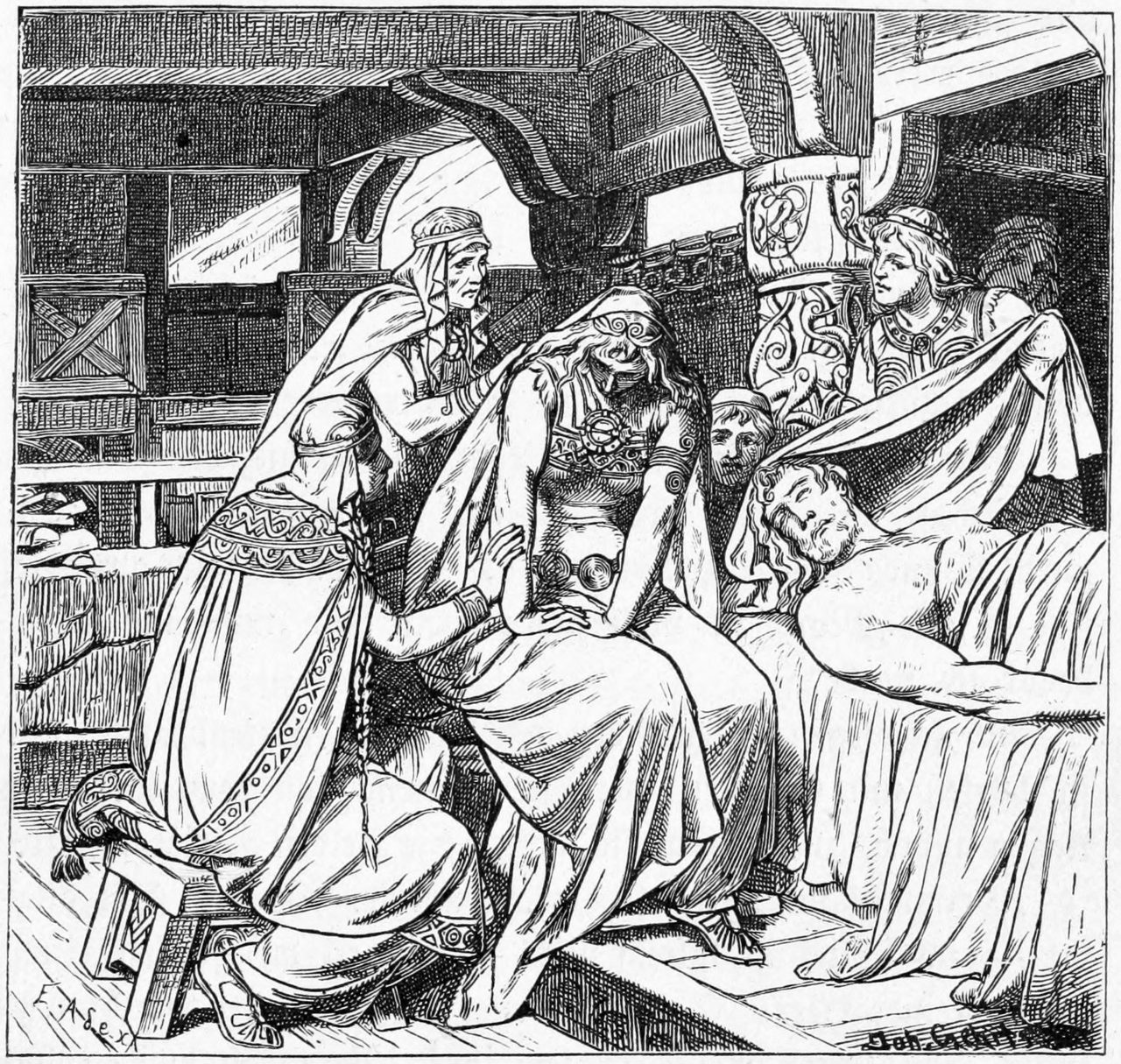
Guðrún is the one figure who lives through the whole heroic cycle. She is the daughter of King Gjúki and Grímhildr, sister of Gunnarr and Högni, wife of Sigurðr. When her brothers kill Sigurðr she is married against her will to Atli; when Atli kills her brothers she kills Atli and their sons; when her daughter Svanhildr is murdered she sends her last sons to die avenging her. Six Eddic poems are spoken by her or built around her: the three Guðrúnarkviður, the two Atli poems and Guðrúnarhvöt.
Sigurðr's widow
The poems disagree about where her husband died (see Sigurðr), and so about where she was. In the Fragment she stands outside and asks why her brothers come home without him, then curses Gunnarr Brot af Sigurðarkviðu 6 Brot af Sigurðarkviðu 11. In the Short Lay she wakes in his blood in their bed Sigurðarkviða hin skamma 24. In Guðrúnarkviða II Grani comes back riderless from the assembly, and she goes into the woods to find what the wolves have left Guðrúnarkviða II 5 Guðrúnarkviða II 11.
Guðrúnarkviða I is a set piece of grief. She sits by the body and cannot weep. Noblewomen try to comfort her by telling worse sorrows of their own, until her sister Gullrönd uncovers Sigurðr's head and lays it in her lap. Only then do the tears come Guðrúnarkviða I 1 Guðrúnarkviða I 12-15. The prose adds a tradition that she too had eaten Fáfnir's heart and understood the birds Guðrúnarkviða I, prose 1.
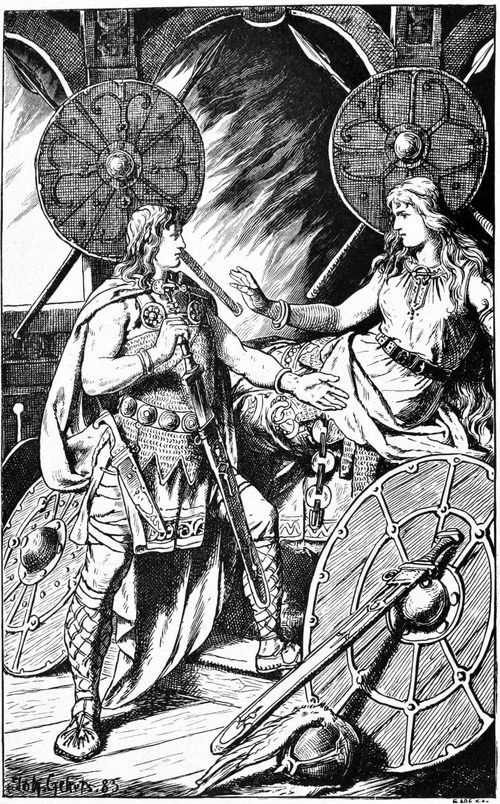
She leaves home and spends seven half-years in Denmark with Þóra, Hákon's daughter, weaving tapestries of heroes Guðrúnarkviða II 14-16. Her mother comes after her with a potion of forgetfulness and offers her to Atli. Guðrún refuses to marry "Brynhild's brother" and foretells that he will kill her brothers, but she gives way Guðrúnarkviða II 22 Guðrúnarkviða II 28 Guðrúnarkviða II 32.
Atli's queen
Two poems tell the fall of her brothers at Atli's court, and they draw her differently.
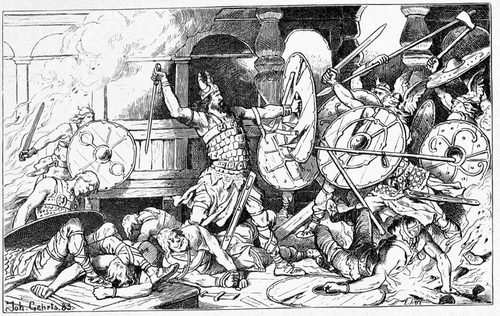
- In Atlakviða she sends her brothers a ring wound with a wolf's hair as a warning Atlakviða 8. When they arrive she tells Gunnarr he has been betrayed Atlakviða 16. After their deaths she feeds Atli the hearts of their sons Erpr and Eitill, kills him in his bed and burns the hall over his men Atlakviða 39-40 Atlakviða 44-45.
- In Atlamál her warning is written in runes and spoiled by the messenger Vingi Atlamál in grœnlenzku 4. When the fighting starts she throws off her cloak, takes up a sword and kills two men, one of them Atli's brother Atlamál in grœnlenzku 46-47. She kills her sons, serves their hearts and makes cups from their skulls Atlamál in grœnlenzku 77-78. Then she and Högni's son kill Atli, and she gives him a ship, a painted coffin and a waxed shroud as she promised Atlamál in grœnlenzku 84 Atlamál in grœnlenzku 97.
Snorri combines the two: the skull-cups and Högni's son from Atlamál, the burning hall from Atlakviða Skáldskaparmál 41. Guðrúnarkviða III adds a scene found nowhere else. Accused of sleeping with King Þjóðrekr, she clears herself by lifting stones from a boiling kettle unhurt, and her accuser Herkja is scalded and drowned in a bog Guðrúnarkviða III 7-10.
The third marriage
The prose of Guðrúnarhvöt says she walked into the sea to drown, but the waves carried her to King Jónakr, who married her. Their sons were Sörli, Erpr and Hamðir Guðrúnarhvöt, prose 1, though in Hamðismál the brothers call Erpr a bastard, a half-brother only Hamðismál 16. When Jörmunrekkr has Svanhildr trampled by horses, Guðrún shames her sons into vengeance by comparing them with Gunnarr and Högni Guðrúnarhvöt 2-3. Hamðir throws back at her that her own vengeance had cost the family two sons Guðrúnarhvöt 5. Laughing, she hands them mail-coats; then she sits at the gate and lists her sorrows Guðrúnarhvöt 7 Guðrúnarhvöt 9-10:
The sorest it was when Sigurth mineOn his couch, of victory robbed, they killed;And grimmest of all when to Gunnar's heartThere crept the bright-hued crawling snakes.Guðrúnarhvöt 17
The poem ends with her calling on the dead Sigurðr to ride to her from Hel and asking the jarls to build her pyre Guðrúnarhvöt 20-21. Atlamál had already said she sought death "but for days did she wait, and 'twas long ere she died" Atlamál in grœnlenzku 98. See Hamðir and Sörli.
Behind the legend
Her brothers' fall at Atli's court goes back, at a long distance, to real events: the Burgundian kingdom on the Rhine was destroyed by Hunnish forces in 437, and Atlakviða still calls Gunnarr "the Burgundians' king" Atlakviða 19. Attila died in 453 on the night of his marriage to a young bride, Ildico. Some later chroniclers said she killed him, and scholars often see the seed of Guðrún's revenge there.
In the sources
Quoted from the hosted translations; each line is checked against the text when the site is built. Select a reference to read it in context.
Then did Guthrun think to die, When she by Sigurth sorrowing sat; Tears she had not, nor wrung her hands
So Sigurth rose o'er Gjuki's sons As the leek grows green above the grass
A draught did Grimhild give me to drink, Bitter and cold; I forgot my cares
Thou giver of swords, of thy sons the hearts All heavy with blood in honey thou hast eaten
Her naked sword grasped she her kin's lives to guard
Three home-fires knew I, three hearths I knew, Home was I brought by husbands three; But Sigurth only of all was dear
Accursed be Gunnar, Sigurth's killer, Vengeance shall come for his cruel heart.
Where the sources disagree or fall silent
- Whether she fought alongside her brothers (Atlamál) or only warned them (Atlakviða).
- How Atli died and was buried: in a burning hall (Atlakviða) or killed by her and Högni's son and then given a proper funeral (Atlamál).
- How or when she died: Atlamál says she waited long for death; Guðrúnarhvöt ends with her calling for a pyre.
In modern culture
Not from the medieval sources.
In the German Nibelungenlied (c. 1200) Siegfried's widow is called Kriemhild, the name the Norse give to her mother, and her revenge runs the other way: she destroys her own brothers at Etzel's (Attila's) court to avenge her husband. Wagner's Gutrune in Götterdämmerung is a minor figure. Tolkien's verse retelling, The Legend of Sigurd and Gudrún (2009), gives her the second half of the story, as the Eddas do.