Æsir
Hœnir
A shadowy god, Odin's travelling companion, who gave sense to the first humans, went to the Vanir as a hostage after their war, and survives Ragnarök to take up the prophetic wand.
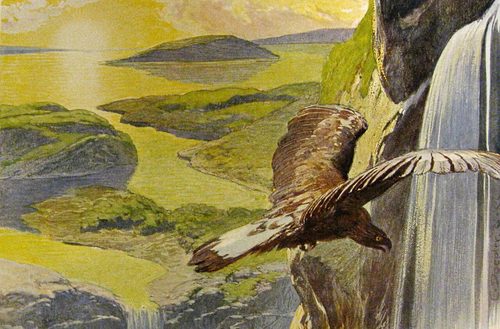
Hœnir is a god who appears often but does very little on his own. He is usually one of a travelling trio with Odin and Loki. The three are together when the eagle Þjazi spoils their meal and carries Loki off Skáldskaparmál 1, and when Loki kills Otr and the gods must pay his father the otter's ransom in gold Skáldskaparmál 39 Reginsmál, prose 1. The poets call him Odin's "Bench-Mate or Companion or Friend", "the Swift of God", "the Long-Footed" and "King of Clay" Skáldskaparmál 15.
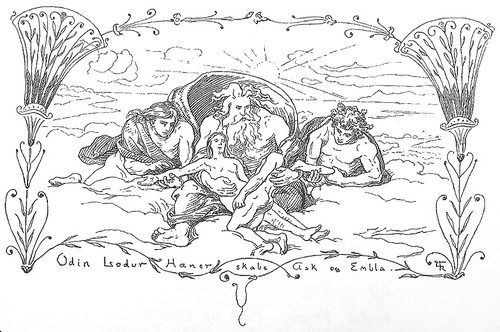
Völuspá gives him a part in making the first humans, Ask and Embla: "Soul gave Othin, sense gave Hönir, Heat gave Lothur and goodly hue" Völuspá 18. Snorri tells the same story about the three sons of Borr, Odin, Vili and Vé, without Hœnir Gylfaginning 9.
After the war between the Æsir and the Vanir, Hœnir was the hostage the Æsir sent in exchange for Njörðr Gylfaginning 23. Snorri's Ynglinga saga, outside the Eddas, adds that the Vanir made him a chieftain but found that he could decide nothing without his adviser Mímir, so they beheaded Mímir and sent the head back to Odin.
He outlives the end of the world. In Völuspá's vision of the renewed earth, "Hönir wins the prophetic wand" Völuspá 63, which many readers take to mean he becomes a priest or seer of the new age.
In the sources
Quoted from the hosted translations; each line is checked against the text when the site is built. Select a reference to read it in context.
Soul gave Othin, sense gave Hönir, Heat gave Lothur and goodly hue.
the Vanir delivered him as hostage to the gods, and took for hostage in exchange him that men call Hœnir
Then Hönir wins the prophetic wand
By calling him Bench-Mate or Companion or Friend of Odin, the Swift of God, the Long-Footed, and' King of Clay.
Where the sources disagree or fall silent
- Who gave life to the first humans: Odin, Hœnir and Lóðurr in Völuspá (Völuspá 17-18), or the three sons of Borr, Odin, Vili and Vé, in Snorri (Gylfaginning 9).
- What 'King of Clay' and 'Long-Footed' refer to (Skáldskaparmál 15); some connect them with the clay of the first humans or with a bird such as a stork or heron, but no story survives.