Gjúkung
Gunnarr
Gjúki's son, king of the Niflungs: he wins Brynhildr through Sigurðr's deception, has Sigurðr killed, and dies in Atli's snake-pit rather than reveal where the Rhine gold lies.
Gunnarr, son of Gjúki and Grímhildr, is king of the Gjúkungs, also called Niflungs. He is a man of two scenes. In the first he lets his sworn brother Sigurðr be murdered. In the second he dies at Atli's court rather than surrender his family's gold.
Brynhildr and the oath
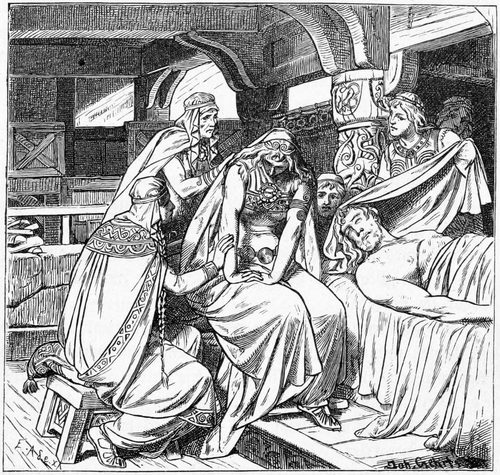
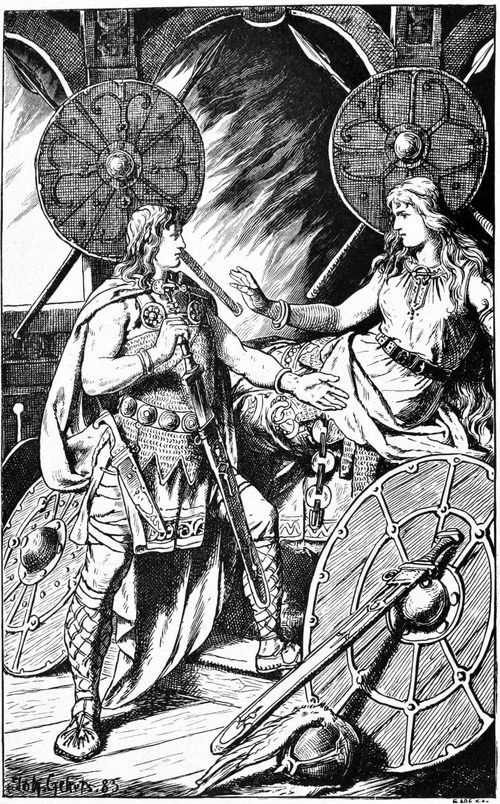
Gunnarr cannot win Brynhildr himself. Sigurðr rides through her fire in his shape Skáldskaparmál 41 Grípisspá 39. When Brynhildr turns against Sigurðr, the poems give different pictures of Gunnarr. In the Fragment he claims Sigurðr broke his oaths, and Högni answers that Brynhildr has whetted him to hate Brot af Sigurðarkviðu 2-3. In the Short Lay he broods all day, torn because "with mighty longing Sigurth he loved", but he would rather lose his life than Brynhildr. He tempts Högni with "the gold of the Rhine" and finally sets their younger brother Gotthormr, who swore no oath, to do the killing Sigurðarkviða hin skamma 13 Sigurðarkviða hin skamma 15-16 Sigurðarkviða hin skamma 20. Afterwards he lies awake remembering a raven's prophecy that Atli's blade will redden with their blood Brot af Sigurðarkviðu 5 Brot af Sigurðarkviðu 12-13.
Oddrúnargrátr gives him a later love. He wanted to marry Atli's sister Oddrún, and when Atli refused they met in secret Oddrúnargrátr 19-23.
The fall of the Niflungs
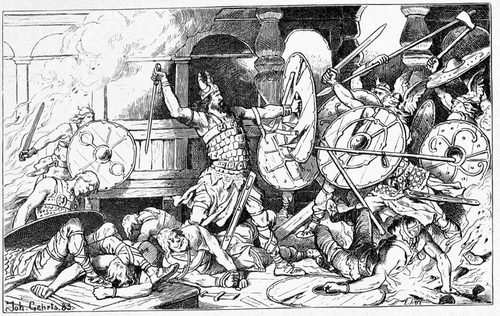
Atli invites Gunnarr and Högni to his court. In Atlakviða Gunnarr goes despite a warning ring wound with a wolf's hair, saying the wolves will rule the Niflungs' wealth if he does not come back Atlakviða 8 Atlakviða 11. He is bound, and offered his life for the gold. He demands Högni's heart first. When the trembling heart of the thrall Hjalli is brought, he knows it is not his brother's; when Högni's own heart is brought, steady on its platter, he says the secret now dies with him Atlakviða 22-28:
"The swift Rhine shall hold the strife-gold of heroes,That once was the gods', the wealth of the Niflungs,In the depths of the waters the death-rings shall glitter,And not shine on the hands of the Hunnish men."Atlakviða 29
Thrown into the snake-pit, he plays the harp Atlakviða 34. The later accounts disagree about the details. Atlamál and Snorri have him strike the harp with his toes because his hands were bound Atlamál in grœnlenzku 62 Skáldskaparmál 41. The prose Dráp Niflunga and Snorri say the music put the snakes to sleep except one adder, which reached his liver Dráp Niflunga, prose 1. Oddrún, who heard the harp from far away and set out to save him, says Atli's own mother came crawling and bit him to the heart Oddrúnargrátr 28-30.
History
Gunnarr is the best-documented of all the Eddic heroes. He corresponds to Gundaharius (Gundahar), king of the Burgundians on the Rhine, whose kingdom was destroyed by Hunnish forces in 437. Atlakviða still calls him "the Burgundians' king" Atlakviða 19. The Burgundian law code later names a royal ancestor Gibica, whose name matches Gjúki's. Attila himself is not known to have taken part, so the meeting at Atli's court is the work of legend.
In the sources
Quoted from the hosted translations; each line is checked against the text when the site is built. Select a reference to read it in context.
Sigurth oaths to me hath sworn, Oaths hath sworn, and all hath broken
More than all to me is Brynhild, Buthli's child, the best of women
The swift Rhine shall hold the strife-gold of heroes
but soon did Gunnar With his hand in wrath on the harp-strings smite
he struck it with his toes, his hands being bound
Where the sources disagree or fall silent
- How he played the harp in the snake-pit: with his hand (Atlakviða) or his toes (Atlamál, Snorri).
- What killed him: an adder at his liver (Dráp Niflunga, Snorri) or Atli's mother in serpent form biting his heart (Oddrúnargrátr).
In modern culture
Not from the medieval sources.
Gunnarr is Gunther of the Nibelungenlied and of Wagner's Götterdämmerung, where he is a weak king manipulated by his half-brother Hagen. The Norse poems give him more dignity at the end: his refusal in Atlakviða to buy his life with the gold is one of the most admired moments in Eddic poetry.