A myth retold · about 6 minutes
Otter's ransom and Andvari's curse
Loki kills an otter that turns out to be a farmer's son. To buy their lives the gods must fill and cover its skin with gold, which Loki wrings from the dwarf Andvari, along with a ring Andvari curses. The curse starts working at once.
This is the story behind the hoard that Sigurðr wins from the dragon, and so behind the whole tragedy of the Völsungs and Niflungs. It begins with a careless stone thrown by a god. The main poetic source, Reginsmál, tells it as a tale within a tale: the smith Reginn, fostering the young Sigurðr, tells him about his own family Reginsmál, prose 1. The retelling follows Reginsmál and notes where Snorri's version in Skáldskaparmál differs.
The otter at the waterfall
Odin, Hœnir and Loki come to a waterfall full of fish. It is called Andvari's fall, after a dwarf named Andvari who has long lived there in the shape of a pike, catching his food Reginsmál, prose 1. Reginn's brother Otr also fishes there, in the shape of an otter. He has caught a salmon and is sitting on the bank eating it with his eyes shut. Loki throws a stone and kills him. The gods are pleased with their luck and skin the otter Reginsmál, prose 1. Snorri adds that Loki boasted of getting an otter and a salmon with a single throw Skáldskaparmál 39.
That evening they ask for a night's lodging at the house of Hreiðmarr, and show off their catch. It is Hreiðmarr's son. "Then we seized them," Reginn says Reginsmál, prose 1, and the price set for their lives is this: fill the otter's skin with gold, and cover it completely with red gold on the outside.
Loki and the pike
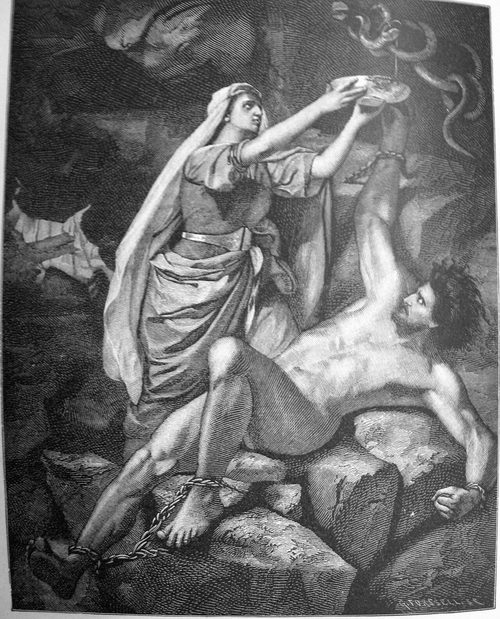
The gods send Loki to get the gold. He borrows the net of the sea-goddess Rán, goes to Andvari's fall, casts the net in front of the pike, and the pike swims into it Reginsmál, prose 1. Loki asks the fish what it is "that runs in the flood" and cannot save itself, and demands "the water's flame", which is to say gold, as the price of its head Reginsmál 1. The dwarf names himself: Andvari son of Óin, condemned by "an evil Norn in olden days" to live in water Reginsmál 2. Loki also asks him a riddle-like question about the punishment of liars, and Andvari answers that those who deceive must wade the river Vaðgelmir Reginsmál 3-4.
Andvari hands over all his gold, but holds back one ring. Loki takes that too. The dwarf goes into his hole in the rock and speaks a curse Reginsmál, prose 2:
"Now shall the gold that Gust once hadBring their death to brothers twain,And evil be for heroes eight;Joy of my wealth shall no man win."Reginsmál 5
The last whisker
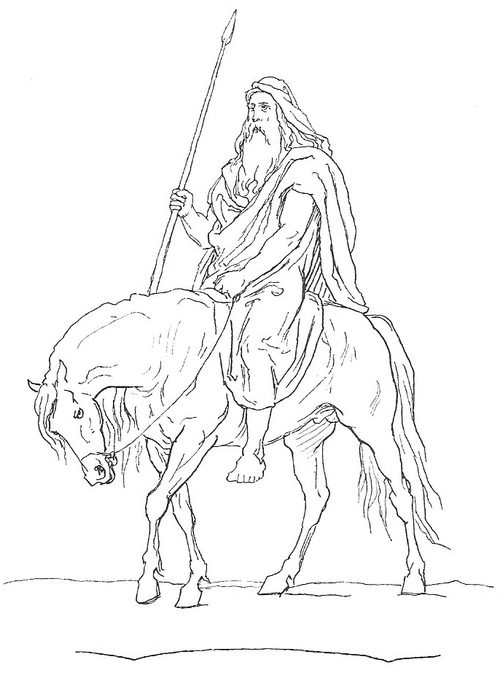
The gods give Hreiðmarr the gold. They fill the skin and stand it on its feet, then heap gold around it until it is covered. Hreiðmarr looks it over and finds one whisker still showing, and demands that it be covered. Odin brings out the ring, Andvaranaut, and lays it over the hair Reginsmál, prose 3.
The debt is paid, and Loki now passes the curse on to the new owners:
"The gold is given, and great the priceThou hast my head to save;But fortune thy sons shall find not there,The bane of ye both it is."Reginsmál 6
Hreiðmarr answers that if he had foreseen this he would have killed them all Reginsmál 7. Loki adds a second prophecy, that kinsmen will fight over a woman and heroes not yet born will be doomed to hatred Reginsmál 8. Hreiðmarr is not afraid: he will rule the red gold as long as he lives, and the gods can go home Reginsmál 9.
The curse begins
He does not live long. His sons Fáfnir and Reginn ask him for a share of the gold paid for their brother. He refuses, and Fáfnir runs him through with a sword while he sleeps Reginsmál, prose 4. Dying, Hreiðmarr calls on his daughters Lyngheiðr and Lofnheiðr. Lyngheiðr answers that a sister seldom avenges her father on her brother, and he tells her to bear a daughter, then, and to marry her to a hero so that a grandson may take revenge Reginsmál 10-11.
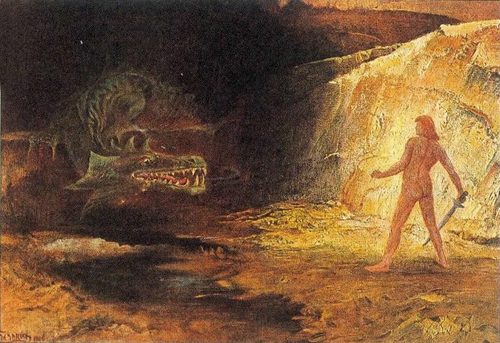
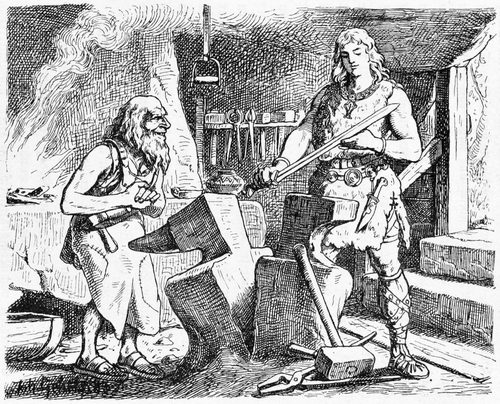
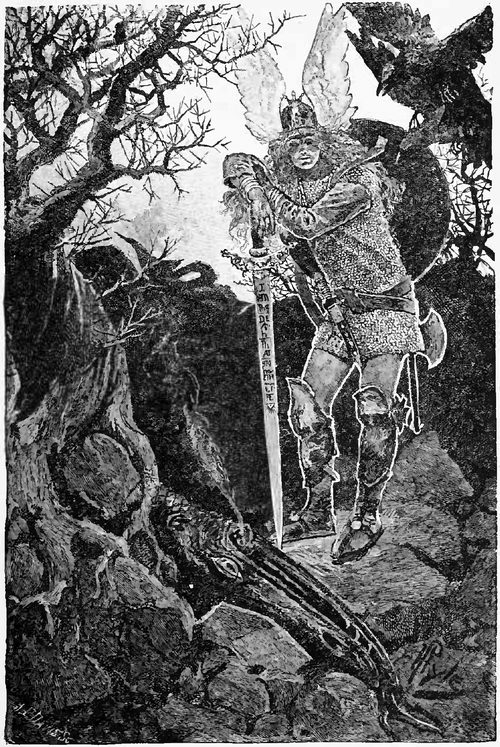
Fáfnir takes all the gold. When Reginn asks for his inheritance, Fáfnir refuses. Reginn asks his sister what to do; she advises him to ask kindly, because it is not fitting to take Fáfnir's treasure by the sword Reginsmál, prose 5 Reginsmál 12. Snorri gives the rest of this part. Fáfnir threatens to do to Reginn what he did to their father. He puts on Hreiðmarr's Helm of Terror, takes the sword Hrotti, goes up to Gnita Heath, makes himself a lair, turns into a serpent and lies down on the gold. Reginn flees to King Hjálprekr and becomes his smith Skáldskaparmál 40.
There he becomes foster-father to Sigurðr, and the story continues in Sigurðr slays Fáfnir.
Where the story comes from
There are two medieval tellings. Reginsmál in the Codex Regius mixes verse with long passages of prose, and the prose carries most of the plot. Skáldskaparmál 39–40 (Snorri, c. 1220s) tells it to explain why gold can be called "Otter's Wergild", "Forced Payment of the Æsir" or "Metal of Strife" Skáldskaparmál 39.
The two versions differ in several details:
- How Andvari is caught. Reginsmál: Loki uses Rán's net at Andvari's fall Reginsmál, prose 1. Snorri: Odin sends Loki to the land of the black elves, and Loki catches the dwarf in his hands Skáldskaparmál 39.
- Who keeps the ring. In Reginsmál, Loki takes the ring and Odin simply produces it at the end Reginsmál, prose 2 Reginsmál, prose 3. In Snorri, Odin sees the ring, finds it beautiful and keeps it back from the payment, and gives it up only when the whisker forces him to Skáldskaparmál 39.
- Who seizes the gods. Reginsmál: "we", the brothers Reginsmál, prose 1. Snorri: father and sons together bind them, and the ransom is sworn with oaths Skáldskaparmál 39.
- Who kills Hreiðmarr. Reginsmál: Fáfnir alone Reginsmál, prose 4. Snorri: "they slew their father", both brothers Skáldskaparmál 40.
- The curse. In Snorri, Loki says the curse is fine with him so long as he is the one to tell the new owners, and he announces it only after Odin has his spear and Loki his shoes again and they are safe Skáldskaparmál 39. Reginsmál has Loki speak it directly to Hreiðmarr Reginsmál 6.
The ring's later history bears the curse out. In Snorri's summary, Sigurðr gives "the same gold ring which Loki had taken from Andvari" to Brynhildr, and it is this ring, "Andvari's Yield", that Guðrún uses to shame her, leading to Sigurðr's murder Skáldskaparmál 41. Andvari's "brothers twain" are usually taken to be Fáfnir and Reginn, but "heroes eight" has been counted in different ways. "Gust", the gold's earlier owner, appears nowhere else.
Reading it today
The story is often read as the moral centre of the Völsung cycle: wealth won by violence and extortion carries its own punishment, and the gods themselves start the chain of disaster and walk away unharmed. Readers have also noticed that Otr, Andvari and Fáfnir are all shape-changers: an otter, a pike and a serpent, each living in the shape that suits how he gets or guards his wealth. Richard Wagner built Das Rheingold (1869) on this story, with Alberich's curse on the ring standing in for Andvari's.
Key passages
Loki threw a stone at him and killed him; the gods thought they had had great good luck, and stripped the skin off the otter.
Now shall the gold that Gust once had Bring their death to brothers twain, And evil be for heroes eight
Hreithmar came forward and saw a single whisker, and bade them cover it. Then Othin brought out the ring Andvaranaut and covered the hair.
the dwarf declared that that ring should be the ruin of every one who should come into possession of it
Fafnir thrust his sword through the body of his father, Hreithmar, while he was sleeping.