world
Niðavellir
A place named once in Völuspá, where a golden hall stands for 'Sindri's race'; modern lists often make it the dwarves' world, which the sources do not quite say.
Niðavellir appears in a single line of Völuspá: "Northward a hall in Nithavellir / Of gold there rose for Sindri's race" Völuspá 37. Nothing else in the Eddas uses the name. In the same stanza a second hall stands in Ókólnir, the beer-hall of the giant Brimir; the next stanza moves to the hall of horror on Náströnd Völuspá 38.
Is it the dwarves' home?
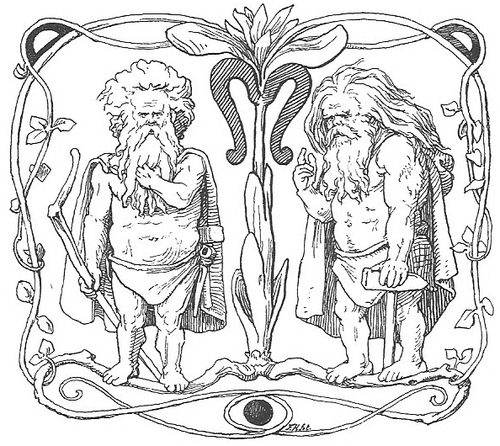
Modern lists of the nine worlds often name Niðavellir as the world of the Dwarves. The link rests on "Sindri's race". In Brodeur's translation of Snorri, Sindri is the dwarf smith who forges Draupnir and Mjöllnir Skáldskaparmál 35, and Völuspá names Brimir among the dwarves' ancestors Völuspá 9. So a reader can make Niðavellir a dwarf hall. But Völuspá itself never says who Sindri's kin are, and Snorri does not connect the place with dwarves at all.
Snorri's version
Snorri retells the stanza among his account of where souls dwell after Ragnarök. There is good drink in the hall Brimir in Ókólnir, and "a good hall which stands in Nida Fells, made of red gold; its name is Sindri. In these halls shall dwell good men and pure in heart" Gylfaginning 52. For Snorri, Sindri is the hall, not its builder, and the place is Niðafjöll ("Nida Fells"), not Niðavellir. He places it beside Gimlé as a home of the righteous dead.
The two accounts cannot both be followed exactly. Völuspá gives a hall for Sindri's kin in Niðavellir; Snorri gives a hall called Sindri on Niðafjöll, for good men. Niðafjöll is also where the dragon Níðhöggr comes flying from at the poem's close Völuspá 66, which makes a home of the blessed an odd neighbour. Scholars have read the Völuspá stanza in several ways, and the identification of Niðavellir with the dwarves' realm, like that of Svartálfaheimr, should be treated as a modern convenience.
In the sources
Quoted from the hosted translations; each line is checked against the text when the site is built. Select a reference to read it in context.
Northward a hall in Nithavellir Of gold there rose for Sindri's race
That too is a good hall which stands in Nida Fells, made of red gold; its name is Sindri.
Then Loki wagered his head with the dwarf called Brokkr that Brokkr's brother Sindri could not make three other precious things
Where the sources disagree or fall silent
- Whether Völuspá's 'Sindri's race' means dwarves is an inference; the poem does not say so.
- Völuspá 37 may describe a hall of the dead (it stands between other halls of the afterlife), a hall of the past, or simply a dwarf dwelling; readings differ.
- Whether Völuspá's Niðavellir and Snorri's Niðafjöll ('Nida Fells') are the same place, and how both relate to the Niðafjöll from which Níðhöggr flies (Völuspá 66), is unclear.
In modern culture
Not from the medieval sources.
Marvel's Avengers: Infinity War (2018) presents Nidavellir as a dwarven forge built round a dying star, where Thor's axe Stormbreaker is made. Several modern 'nine worlds' lists use Nidavellir in place of Svartalfheim as the dwarves' home.