dwarf
Alvíss
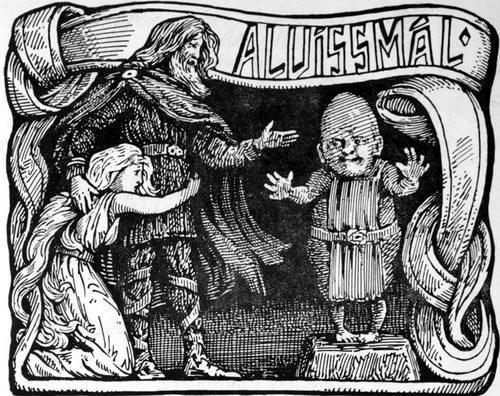
The dwarf who comes to claim Thor's daughter as his bride. Thor keeps him answering questions about the names of things in every world until the sun rises and catches him.
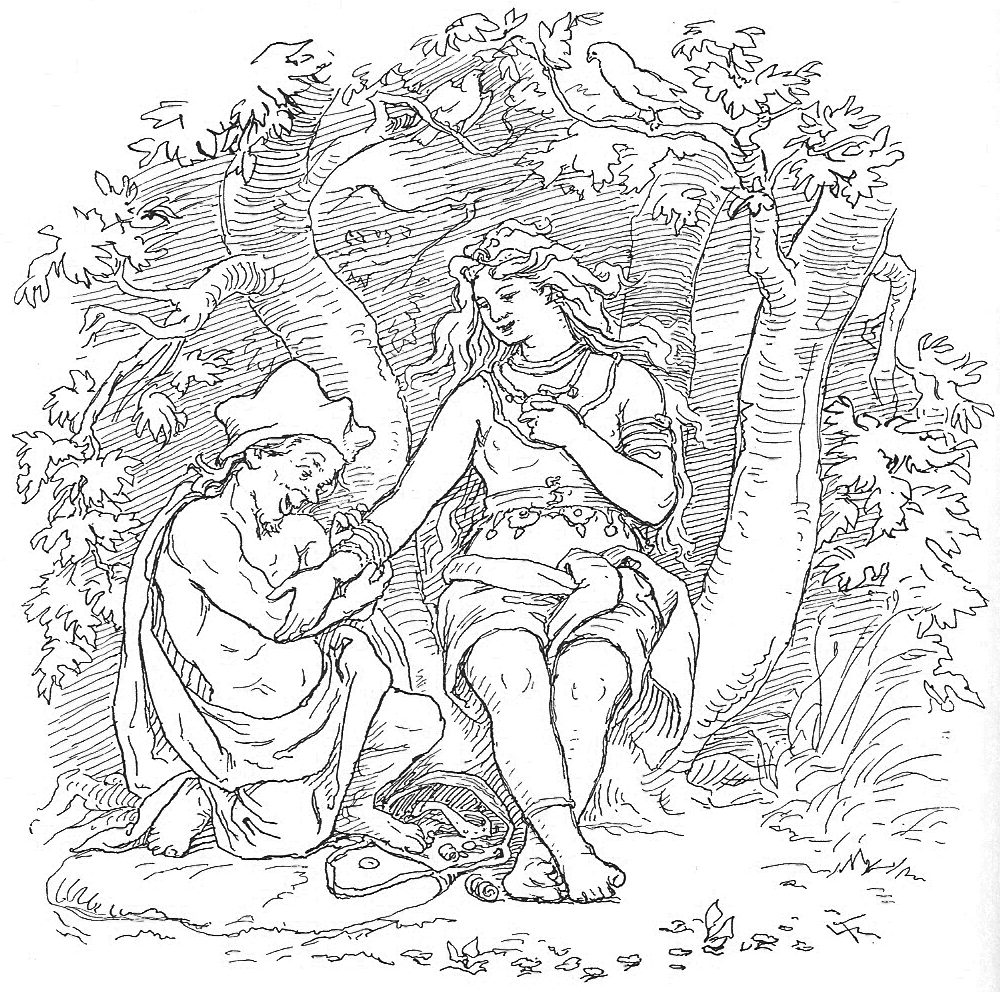
Alvíss ("all-wise") is the dwarf of Alvíssmál and is known only from that poem. He arrives to take home a bride promised to him while Thor was away, and is pale "round the nose", as if he had slept among the dead Alvíssmál 1-2. Thor says he looks like a giant and was "not born for the bride". As her father, Thor has the final say Alvíssmál 4.
Instead of refusing outright, Thor agrees to the marriage if Alvíss can answer every question he asks Alvíssmál 8. The rest of the poem is a list. Thor asks what the earth, sky, moon, sun, clouds, wind, calm, sea, fire, forest, night, seed and ale are called "in each and every world". Each time, Alvíss gives the name used by men, gods, Vanir, giants, elves, dwarves or the dead Alvíssmál 9-34. Ale, for example, is "'Ale' among men, 'Beer' the gods among", "Bright Draught" with giants, and "The Feast-Draught" with "Suttung's sons" Alvíssmál 34.
Thor praises the dwarf's learning and then springs the trap: the questions have lasted all night.
In a single breast I never have seenMore wealth of wisdom old;But with treacherous wiles must I now betray thee:The day has caught thee, dwarf!Alvíssmál 35
The poem is usually read as a learned catalogue of poetic synonyms (heiti) set in a thin story. It is the clearest case of Thor beating an opponent by talk instead of the hammer.
In the sources
Quoted from the hosted translations; each line is checked against the text when the site is built. Select a reference to read it in context.
Alvis am I, and under the earth My home 'neath the rocks I have
Break it shall I, for over the bride Her father has foremost right
'Earth' to men, 'Field' to the gods it is, 'The Ways' is it called by the Wanes
But with treacherous wiles must I now betray thee: The day has caught thee, dwarf!
Where the sources disagree or fall silent
- The bride is never named in the poem. She is usually taken to be Thor's daughter Þrúðr, whom Snorri names (Skáldskaparmál 4), but that is an inference.
- The poem says only that 'the day has caught' Alvíss. That he turns to stone, as many retellings say, is not in the text, though later sagas tell of dwarves and trolls turned to stone by sunlight.